


Have you ever stopped to look at a tree and felt something shift inside you? Or stood near the ocean and sensed its rhythm pulling at something deeper than thought? That’s not coincidence. Nature has always spoken in a language older than words — through symbols.
From ancient cave paintings to modern tattoos, nature symbols have been humanity’s way of making sense of life, death, growth, and transformation. They show up in every culture, every spiritual tradition, and every art form across history. And once you understand what they mean, you start seeing them everywhere.
This article explores 82+ nature symbols, their hidden meanings, cultural roots, and spiritual significance. Whether you’re searching for emoji combos, copy-paste text symbols, or deep symbolic insight, this is your complete guide.
What Are Nature Symbols?
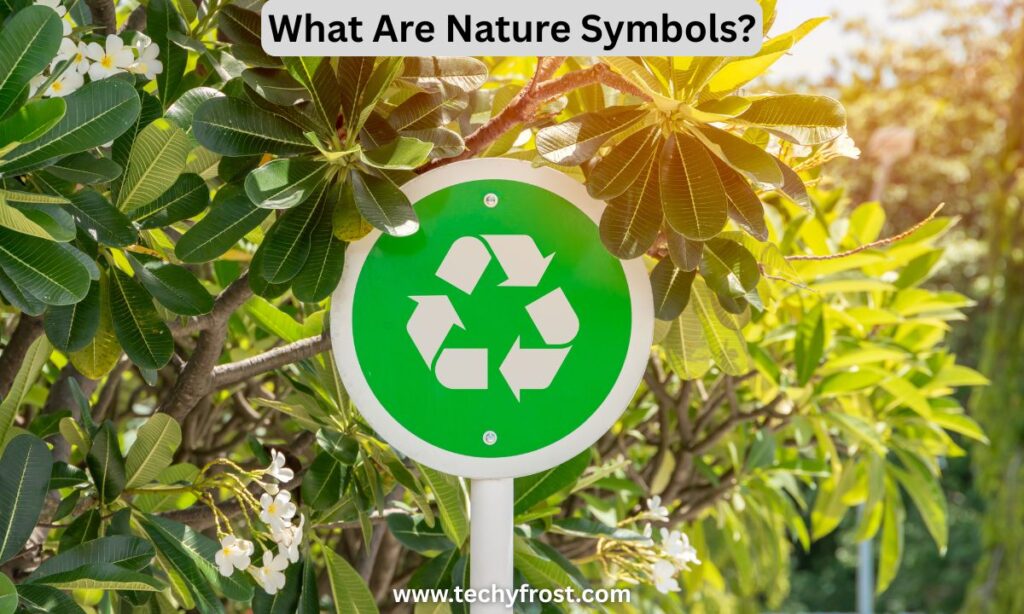
Nature symbols are images, signs, or representations drawn from the natural world — trees, water, mountains, animals, the sun, the moon — that carry meaning beyond their physical form. They serve as visual shorthand for complex ideas: life, death, renewal, strength, wisdom, love, and transformation.
At their core, nature symbols bridge the visible and invisible worlds. When a spiral appears carved into a stone, it’s not just decoration. It represents the cycle of seasons, the movement of the cosmos, and the journey of the soul. When someone chooses a mountain tattoo, they’re often expressing something about resilience and personal challenge.
Nature symbolism is cross-cultural and cross-time. A lotus flower in Hinduism carries the same essential meaning — purity emerging from struggle — as the butterfly in Native American traditions: transformation through difficulty.
Nature Symbols And Their Hidden Meanings
Nature Symbols Meaning
Every element in nature has been assigned meaning by cultures across the world. These meanings rarely conflict — they overlap, deepen, and enrich each other. Here’s a quick-reference breakdown of the most common nature symbols and what they represent:
| Symbol | Core Meaning | Associated With |
| Tree | Life, growth, wisdom | All cultures globally |
| Water | Purification, emotion, flow | Rivers, rain, oceans |
| Sun | Power, life-force, rebirth | Ancient Egypt, Aztecs, Celts |
| Moon | Intuition, mystery, cycles | Femininity, astrology |
| Mountain | Strength, challenge, transcendence | Spiritual journeys |
| Fire | Transformation, passion, energy | Norse, Hindu, Celtic |
| Snake | Renewal, knowledge, healing | Greek, Hindu, Native American |
| Butterfly | Transformation, soul, rebirth | Universal |
| Lotus | Purity, enlightenment | Buddhism, Hinduism |
| Oak Tree | Endurance, courage, sovereignty | Celtic traditions |
| River | Time, journey, continuity | Greek, Egyptian, Hindu |
| Wind | Spirit, change, freedom | Many indigenous cultures |
| Rain | Cleansing, renewal, fertility | Agricultural societies |
| Stone/Rock | Permanence, protection, stability | Shamanic traditions |
| Feather | Truth, freedom, communication | Native American, Egyptian |
Nature Symbols Emoji
Emojis are modern nature symbols — visual shorthand that instantly communicates meaning. Here are the most widely used nature emojis and what they express:
🌿 – Fresh growth, vitality, natural living
🌊 – Emotion, flow, overwhelm, or calm
🌸 – Fleeting beauty, spring, new beginnings
🌳 – Rootedness, strength, life
🌙 – Mystery, night, the subconscious
☀️ – Energy, joy, warmth, hope
🦋 – Change, transformation, freedom
🌺 – Beauty, passion, femininity
🍃 – Relaxation, nature connection, peace
⛰️ – Ambition, challenge, achievement
🌈 – Hope, promise, diversity
🌾 – Harvest, abundance, hard work
🐚 – Cycles, ocean, the unconscious
🍂 – Release, change, letting go
❄️ – Stillness, clarity, preservation
Beautiful Nature Symbols
The most visually beautiful nature symbols tend to also carry the deepest meaning. The lotus flower, the spiral, the tree of life, the crescent moon, and the snowflake fall into this category. Their beauty isn’t accidental — it reflects the mathematical and geometric perfection found in nature itself, sometimes called sacred geometry.
A snowflake’s perfect symmetry, the Fibonacci spiral in a nautilus shell, the branching of a river delta that mirrors a tree’s branches — these patterns recur throughout the natural world and have inspired symbols across civilizations.
Nature Symbol Text
For digital use, here are copy-paste nature text symbols:
☘ ♧ ✿ ❀ ❁ ✾ ☽ ☾ ☀ ☁ ⛅ 🌤 ❄ ⛄ 🌊 🌿 🍀 🌱 🌲 🌳 🌴 🎋 🎍 🌾 🍃 🍂 🍁 🌸 🌺 🌻 🌼 🌷 🌹 🌵 🎄 ⛰ 🗻 🏔 🌋 ♾ ✦ ✧ ⭐ 🌟 ★ ☆ ✶ ✷ ✸ ✹ ✺
Nature Emoji For Instagram
Great nature emoji combinations for captions and bios on Instagram:
- 🌿✨ — Aesthetic nature content
- 🌊🐚 — Beach or ocean vibes
- 🌸🦋 — Spring transformation
- 🌙⭐ — Night, dreams, spirituality
- 🌳🍃 — Forest, hiking, grounding
- ☀️🌻 — Summer, joy, positivity
- 🏔❄️ — Mountain, adventure, clarity
- 🌺🌿 — Tropical, wellness, growth
- 🍂🌾 — Autumn harvest, gratitude
- 🌈🌦 — Hope after the storm
Nature Symbols And Meanings
Beyond individual symbols, nature symbolism often works in systems. The four classical elements — earth, water, fire, and air — form a framework used by ancient Greeks, Celts, Hindus, and many other cultures. Each element connects to personality traits, seasons, directions, and psychological states.
- Earth → Stability, body, material world, the North
- Water → Emotion, intuition, purification, the West
- Fire → Will, passion, transformation, the South
- Air → Mind, communication, freedom, the East
- Ether/Spirit → The fifth element in many traditions — the animating force
Nature Emoji Combos
Try these expressive combos for social posts, journaling, or messaging:
🌿🌊☀️ — Balance of earth, water, and sun
🌙🐺⭐ — Wild instinct, night wisdom
🦋🌸🍃 — Growth and transformation
🌋🔥💨 — Raw power, passion, change
🐢🌿🌊 — Slow down, reconnect with nature
🌲🦅🌄 — Strength, vision, new horizons
🌺🌙✨ — Feminine beauty, mystery, magic
🐝🌼☀️ — Community, sweetness, joy
Nature Symbol Drawing
Some of the most iconic drawn nature symbols include:
- The Spiral — Found in ancient rock art from Ireland to New Mexico; represents growth, time, and the cosmos
- The Tree of Life — Roots below, branches above; symbolizes the connection between earth and sky
- The Eye of Ra — Egyptian sun symbol representing divine protection
- The Triquetra — Celtic three-point knot associated with natural cycles
- The Ouroboros — A serpent eating its own tail; eternity and natural cycles
- The Lotus Mandala — Sacred geometry drawn from the lotus bloom
- The Wheel of the Year — Eight-spoked wheel marking seasonal transitions
Symbols Of Nature
Some symbols have become universally recognized as representing “nature” itself:
- The leaf (particularly green or maple)
- The tree silhouette
- The sun and moon together
- The water drop
- The mountain outline
- The butterfly
- The snowflake
Each of these carries instant visual recognition across cultures, making them powerful in logo design, tattoos, art, and spiritual practice.
An Original Symbol For Nature

An original nature symbol might combine elements: a tree whose roots become waves, a sun whose rays become plant tendrils, or a mountain peak within a water drop. Many modern artists and spiritual practitioners create personal nature symbols by combining elements that resonate with their individual journey. There’s no single “correct” symbol for nature — the most powerful personal symbol is one that holds genuine meaning for you.
Nature Symbolism Examples
- A storm in a story symbolizes inner conflict or emotional upheaval
- A sunrise represents a fresh start, new hope, or awakening
- A willow tree evokes grief, flexibility, or emotional depth
- A wolf represents freedom, instinct, loyalty, or wildness
- A river reaching the sea symbolizes the completion of a journey or death
- A seed represents potential, patience, and new beginnings
- A rainbow after rain signals promise, hope, and transformation
Symbols For Nature
Universally used symbols for nature in logos, icons, and design:
🌱 The seedling — beginnings, eco-consciousness
🍃 The leaf — life, growth, sustainability
🌍 The earth — environmental awareness
♻️ The recycling symbol — natural cycles
🌿 Herbs/botanicals — healing, wildness
💧 The water drop — purity, conservation
Symbols That Represent Nature
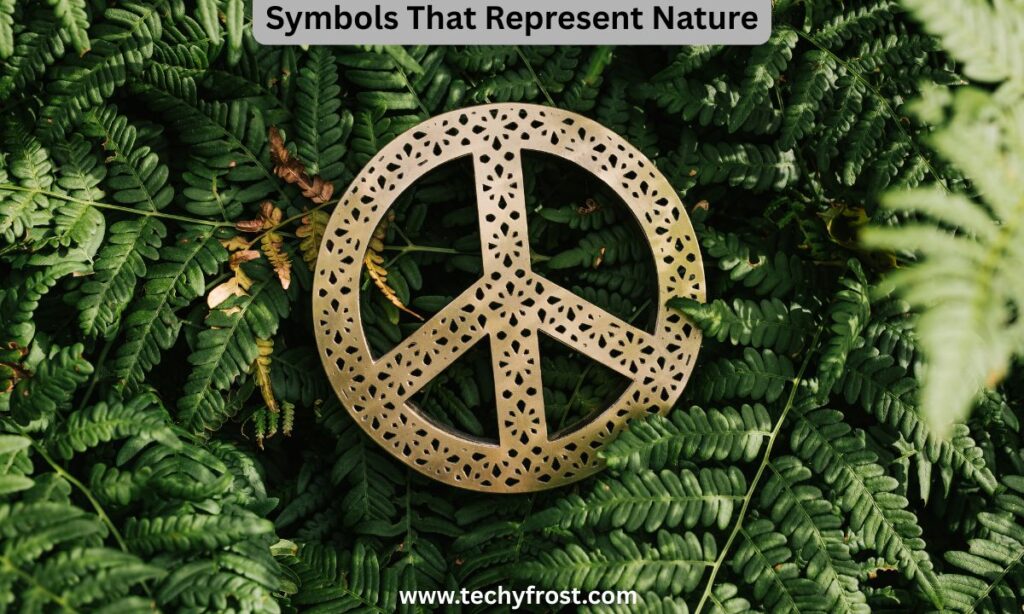
In spiritual and philosophical traditions, entire cosmologies are built on nature symbols. The Chinese yin-yang represents the duality of all natural forces. The Native American medicine wheel maps nature’s four directions to human experience. The Hindu chakra system aligns the body with the natural elements.
Things That Represent Nature
Beyond formal symbols, everyday things carry nature symbolism:
- Driftwood → resilience shaped by unseen forces
- A river stone → patience, smoothed by time
- Fallen leaves → letting go, natural endings
- A spider’s web → interconnection, creativity, fragility
- Morning dew → freshness, ephemerality, renewal
- The northern lights → awe, mystery, the divine in nature
Symbols In Nature
Nature itself produces symbols: the spiral of a shell, the branching of lightning, the ring patterns in a tree trunk, the hexagonal structure of a honeycomb. These naturally occurring patterns have inspired human symbolism for millennia because they feel like the universe speaking in its own language.
Spiritual And Ancient Nature Symbolism
What Represents Nature?
Nature is most commonly represented by the five classical elements — earth, water, fire, air, and spirit — along with plant life (particularly trees and flowers), animals, celestial bodies (sun, moon, stars), and geological features (mountains, rivers, stones).
Symbols Of Connection In Nature
- The Tree of Life — roots, trunk, and branches unify earth, humanity, and the cosmos
- The Web of Life — a spider’s web represents the invisible threads connecting all living things
- The Spiral — connects individual growth to cosmic patterns
- Water — the element that connects all land masses; a universal symbol of unity
Symbols Of Transformation In Nature
- The butterfly — metamorphosis from caterpillar to winged creature
- The phoenix — rebirth through fire (mythological but deeply embedded in natural symbolism)
- The snake shedding its skin — renewal, leaving the past behind
- The lotus — beauty emerging from muddy water
- The caterpillar’s cocoon — the importance of stillness before growth
12 Elements Of Nature Symbols
Many traditions recognize more than the classical four elements. A broader 12-element framework includes:
- Earth — grounding, stability
- Water — emotion, flow
- Fire — passion, transformation
- Air — thought, communication
- Ether/Spirit — life force
- Wood — growth, creativity (Chinese system)
- Metal — clarity, precision (Chinese system)
- Ice — stillness, preservation
- Lightning — sudden change, illumination
- Void — infinite potential
- Time — cycles, impermanence
- Life/Seed — beginnings, potential
Copy Paste Nature Symbols
🌿 🌱 🌲 🌳 🌴 🌵 🎋 🎍 🌾 🍀 🍁 🍂 🍃 🌸 🌺 🌻 🌼 🌷 🌹 🥀 🪷 🪻 🌊 💧 🌊 ❄️ ☃️ ⛄ 🌋 ⛰️ 🏔️ 🗻 🪨 🌙 ☀️ ⭐ 🌟 🌈 ☁️ ⛅ 🌤️ 🌦️ ⛈️ 🌀 🌬️ 🦋 🐝 🦅 🐢 🐺 🦊 🌍
Cute Nature Symbols
🌸🍀🌈🦋🌙🌻🐝🌿🌊⭐🌺🍃🌼
Cute nature symbols work well in journaling, stickers, planners, and social media. The combination of soft colors and natural shapes (petals, leaves, moons) creates an aesthetic that feels both grounding and delightful.
Ancient Nature Symbols
Some of the oldest known nature symbols include:
| Symbol | Origin | Age (approx.) | Meaning |
| The Spiral | Newgrange, Ireland | 5,200 years | Cosmic cycles, sun |
| The Ankh | Ancient Egypt | 4,500 years | Life, eternity |
| The Tree of Life | Mesopotamia | 4,000+ years | Cosmic order |
| The Ouroboros | Ancient Egypt/Greece | 3,500 years | Eternity, cycles |
| The Lotus | Ancient Egypt/India | 3,000+ years | Creation, purity |
| The Celtic Knot | Iron Age Britain | 2,500 years | Interconnection |
| The Yin-Yang | Ancient China | 3,000 years | Duality, balance |
Mother Nature Symbols
Mother Nature is most commonly represented by:
- Gaia — Greek Earth goddess; the literal embodiment of nature
- The Green Woman/Man — a face surrounded by leaves; life force of the natural world
- The Earth symbol — a circle with a cross; the planet itself
- The bear — nurturing, protective maternal energy in many traditions
- The cow — motherhood, fertility, and nourishment (Hindu)
- The moon — associated with feminine cycles and nurturing energy
Spiritual Nature Symbols
Key spiritual nature symbols and their traditions:
- The Lotus (Buddhism/Hinduism) — enlightenment and purity
- The Oak (Celtic/Norse) — sacred tree of the gods; wisdom, strength
- The Eagle (Native American) — divine messenger, spiritual vision
- The Sacred Mountain (Hindu/Buddhist) — Mount Meru as the axis of the universe
- The Serpent (multiple traditions) — Kundalini energy, healing (Asclepius), renewal
- The River (Hindu) — sacred rivers like the Ganges are goddesses themselves
- The Sun (Egyptian) — Ra, the supreme divine force
Nature Symbols Of Love
- The red rose — universal symbol of romantic love
- The dove — peace and love, especially in Christian symbolism
- The swan — eternal love and loyalty (swans mate for life)
- Cherry blossoms — the Japanese concept of love as beautiful and transient
- The hummingbird — joy, love, and the sweetness of life
- Intertwined trees — love that grows together and strengthens over time
- The ocean and shore — enduring love that always returns
All Elements Of Nature Symbols
The five classical elements and their associated symbols:
| Element | Symbol | Associated Animals | Season | Direction |
| Earth | Pentacle/square | Bull, bear, stag | Winter | North |
| Water | Cup/chalice | Fish, dolphin, frog | Autumn | West |
| Fire | Wand/flame | Lion, salamander, phoenix | Summer | South |
| Air | Sword/feather | Eagle, hawk, butterfly | Spring | East |
| Spirit | Circle/spiral | All sacred animals | Eternal | Center |
Japanese Nature Symbols
Japanese culture integrates nature symbolism deeply into art, religion, and daily life:
- Sakura (Cherry Blossom) — mono no aware, the bittersweet beauty of impermanence; life’s fleeting nature
- Crane (Tsuru) — longevity, good fortune, and fidelity; 1,000 origami cranes bring a wish
- Bamboo — resilience, flexibility, and rapid growth; bends but doesn’t break
- Koi Carp — perseverance, ambition, and transformation
- Mount Fuji — national symbol of Japan; strength, perfection, divine beauty
- Pine Tree — longevity, endurance, and vitality through harsh winters
- Chrysanthemum — the imperial symbol; longevity, rejuvenation, nobility
- The Moon (Tsuki) — melancholy, beauty, autumn, poetry, and Buddhist contemplation
- Maple (Momiji) — seasonal change, autumn reflection, the passage of time
Celtic Nature Symbols
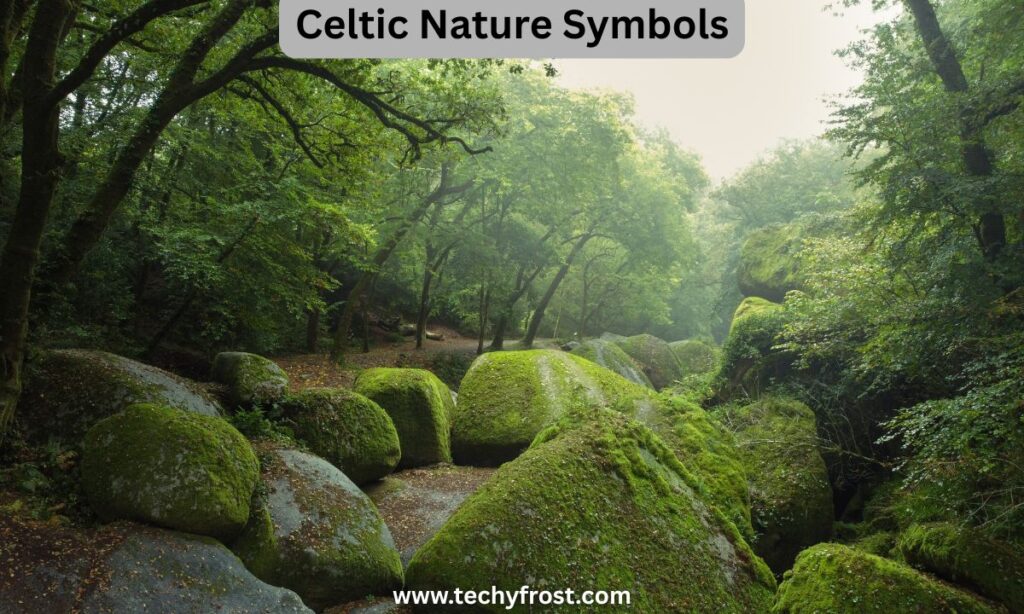
Celtic culture produced some of the world’s most iconic nature symbolism:
- The Oak Tree — king of trees; sacred to the druids; strength, wisdom, sovereignty
- The Triskele — three spirals representing land, sea, and sky; past, present, future
- The Green Man — face of leaves; the spirit of vegetation, rebirth, and the wild
- The Claddagh — hands, heart, crown; love, friendship, loyalty; often paired with natural motifs
- The Ailm — the fir tree symbol; resilience, endurance, and healing
- The Shamrock — trinity, luck, the land of Ireland itself
- The Spiral — at Newgrange, one of the world’s oldest sacred sites; solar cycles, rebirth
Aesthetic Nature Symbols
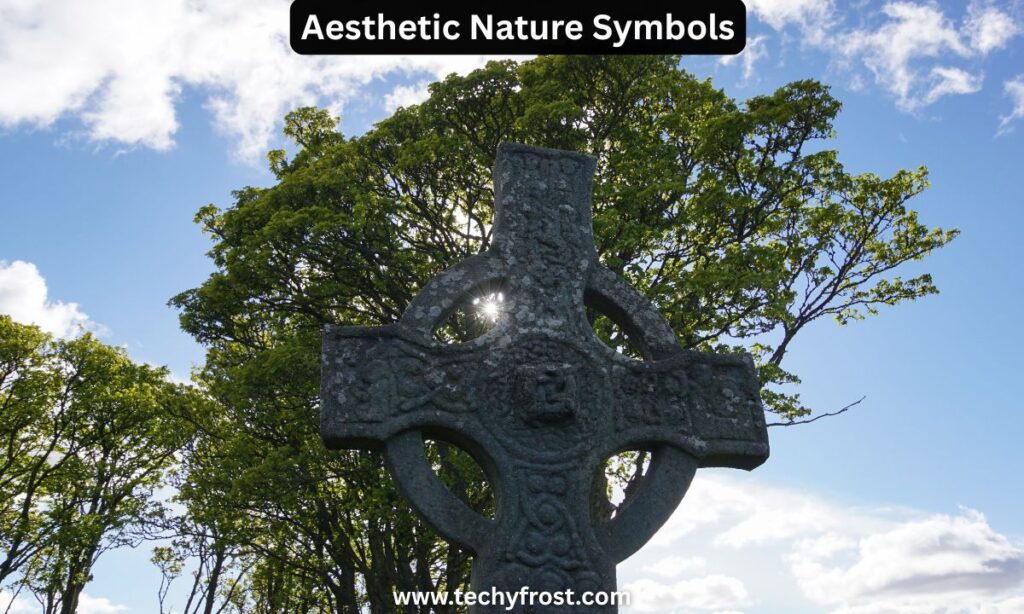
For modern design, journaling, and aesthetic content, these nature symbols are most popular:
🌙 crescent moon — mystery, femininity, witchy aesthetic
🌿 botanical leaf — natural wellness, slow living
🌸 cherry blossom — Japanese aesthetic, kawaii culture
⭐ star cluster — cosmic, dreamy, celestial aesthetic
🌊 wave — surf culture, fluidity, Zen
🪨 stone — minimalism, grounding, wabi-sabi
🌾 wheat — cottagecore, harvest, simplicity
🐚 shell — beach aesthetic, ocean connection, sacred geometry
Natural Symbols That Reflect Wisdom And Life
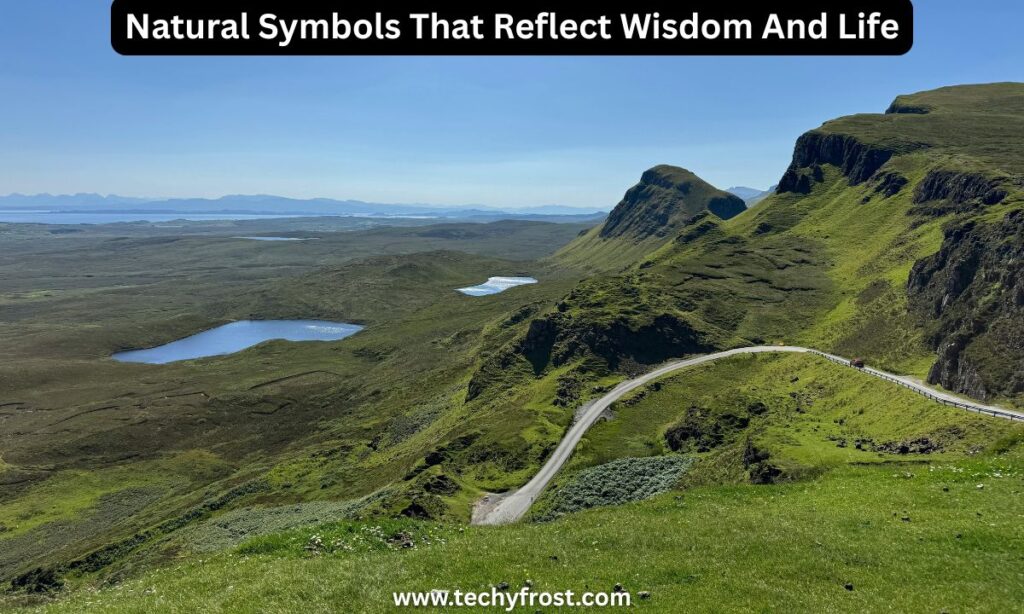
What Does Nature Symbolize?
Nature symbolizes the full spectrum of human experience. It represents the cycle of birth, growth, death, and rebirth. It reflects wisdom (the ancient tree), emotion (the flowing river), transformation (the changing seasons), power (the storm), peace (the still lake), and endurance (the mountain). Nature is, ultimately, the original teacher — and its symbols are the lessons it has handed down through time.
Symbols Of Wisdom In Nature
- The owl — in Greek mythology, the owl represented Athena, goddess of wisdom
- The ancient tree — a tree that has weathered centuries embodies accumulated wisdom
- The serpent — in many traditions, the serpent represents knowledge (including the Biblical tree of knowledge)
- The raven — associated with Odin in Norse mythology; a symbol of prophetic wisdom
- The tortoise — patience, longevity, and grounded wisdom
- The mountain peak — clarity of perspective; seeing the whole picture
What Symbolizes Nature?
In logo design and iconography, nature is most often symbolized by the leaf, the tree, the globe, the water drop, the mountain, and the sun. In poetry and literature, nature is symbolized by whatever the writer chooses — and the best writers pick symbols that carry multiple layers of meaning simultaneously.
Natural Symbols
Natural symbols are those drawn directly from the environment without cultural mediation:
- A cracking storm = power, chaos, or cleansing
- A calm river = peace, time, or inevitability
- A withered flower = mortality, loss, or the end of something beautiful
- A sunrise = hope, new beginnings, or awakening
- A full moon = completion, heightened emotion, or mystery
- A seed breaking through soil = effort rewarded, growth, resilience
Symbolism Of Nature
The symbolism of nature operates on three levels: universal, cultural, and personal. At the universal level, the sun means life and energy everywhere. At the cultural level, a white crane means luck in Japan but might mean mourning in other contexts. At the personal level, a particular tree or place in nature might hold unique meaning based on your lived experience.
This layering is what makes nature symbolism so rich and enduring — it can be read and felt at multiple depths simultaneously.
Deep Symbolic Meaning
Spiritual Level
On a spiritual level, nature symbols function as gateways. A meditator gazing at a candle flame isn’t just seeing fire — they’re contemplating the nature of consciousness, transformation, and divine energy. Sacred geometry found in nature (the Fibonacci sequence, the golden ratio) is seen in many traditions as evidence of divine intelligence woven into the fabric of the natural world.
Shamanic traditions worldwide use natural symbols — feathers, stones, animal spirits, directional winds — as tools for accessing deeper states of consciousness and communicating with the spirit world.
Psychological Level
From a psychological perspective, Carl Jung identified nature symbols as powerful archetypes arising from the collective unconscious. The Great Mother (earth), the Hero’s Journey (the mountain or quest), the Shadow (the dark forest), and Transformation (the butterfly or serpent) appear in dreams, myths, and stories across all human cultures.
When you feel drawn to a particular nature symbol — the ocean, the wolf, the ancient tree — psychologists suggest it may reflect something your inner self is processing or calling forth.
Cultural Level
At the cultural level, nature symbols serve as markers of identity, value, and worldview. National flags often use nature symbols: the maple leaf for Canada, the rising sun for Japan, the cedar for Lebanon. Cultural festivals are rooted in nature symbolism — harvest festivals, solstice celebrations, and spring renewal ceremonies exist on every inhabited continent.
Types / Variations of Nature Symbols
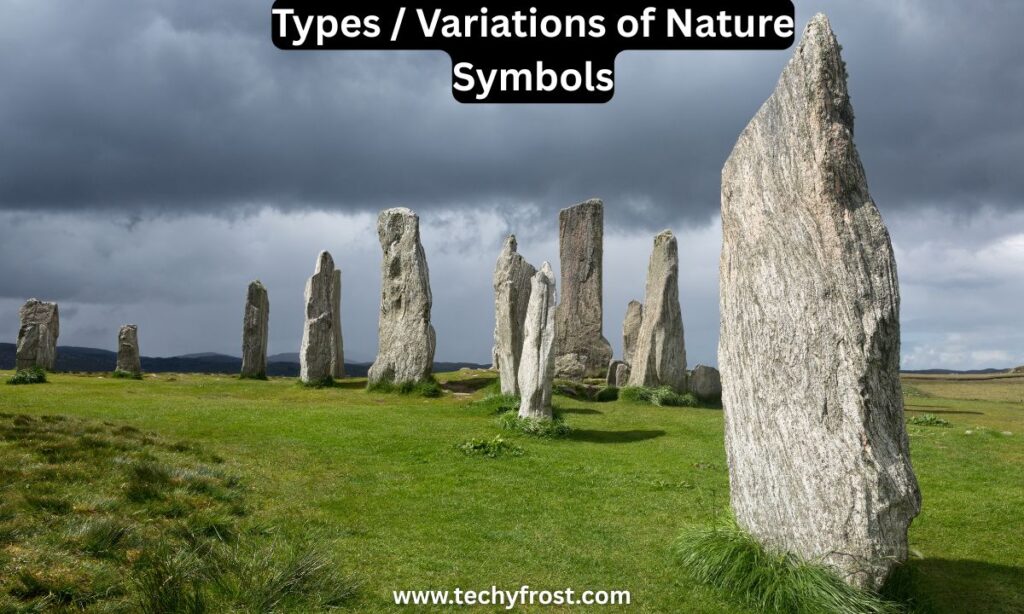
Tree
The tree is arguably the most universal of all nature symbols. Its roots in the earth, trunk in the present, and branches reaching toward the sky make it a natural image for the connection between worlds. Specific trees carry additional meaning: the oak = strength, the willow = grief and flexibility, the pine = immortality, the birch = new beginnings, the apple = temptation and wisdom.
Water
Water symbolism shifts dramatically based on its form. The ocean = the unconscious, mystery, vastness, or overwhelm. A river = the flow of time and life’s journey. A still lake = reflection, calm, clarity. Rain = renewal, cleansing, or sadness. Ice = stillness, preservation, or emotional coldness. A waterfall = letting go, abundance, raw natural power.
Sun
The sun is the most common symbol of life, energy, and divine power across human history. In Ancient Egypt, Ra (the sun god) was the supreme deity. In Celtic tradition, the sun marked the sacred calendar through solstices and equinoxes. In Aztec culture, the sun required nourishment through ritual. In Hinduism, Surya is the visible face of the divine. The sun universally represents consciousness, vitality, clarity, and the force that makes life possible.
Moon
Where the sun represents the conscious mind and outward power, the moon represents intuition, emotion, the subconscious, and inner rhythms. The moon’s phases create a natural symbol of cycles: new moon = beginnings, full moon = completion, waning moon = release, dark moon = rest and reflection. In many traditions, the moon is feminine, associated with goddesses, tides, fertility, and mystery.
Mountain
Mountains symbolize the meeting point between earth and heaven. Climbing a mountain = overcoming a great challenge. The mountain peak = achievement, transcendence, or enlightenment. In Hindu cosmology, Mount Meru is the axis of the universe. In Greek mythology, Olympus is the home of the gods. In Japanese culture, Mount Fuji is a national and spiritual symbol of near-perfection. Mountains remind us that some things require long, difficult journeys.
Animals
Animal symbolism is extraordinarily rich. Each creature carries meanings derived from its observed behavior, habitat, and mythological associations:
| Animal | Core Symbolism |
| Eagle | Vision, freedom, divine connection |
| Wolf | Loyalty, instinct, community |
| Bear | Strength, protection, hibernation/renewal |
| Butterfly | Transformation, soul, joy |
| Deer | Grace, gentleness, intuition |
| Owl | Wisdom, death, hidden knowledge |
| Serpent | Renewal, healing, duality |
| Salmon | Determination, wisdom, return |
| Lion | Courage, sovereignty, solar energy |
| Turtle | Longevity, patience, the earth itself |
Nature Symbols Across Cultures
Ancient Egypt
Ancient Egyptians built one of history’s most elaborate nature-symbol systems. The sun (Ra), the river Nile (source of life and fertility), the lotus (creation and purity), the scarab beetle (rebirth and transformation), the ibis (wisdom, connected to Thoth), and the crocodile (power, danger, and divine force) all played central roles in Egyptian spiritual and daily life. Nature wasn’t separate from the sacred — it was the sacred.
Chinese Culture
Chinese cosmology integrates nature symbolism through the five elements (wood, fire, earth, metal, water), feng shui, and the yin-yang. The dragon represents nature’s greatest power — benevolent, connected to water and sky. The phoenix represents the south, summer, and transformative renewal. The tiger represents the west, autumn, and natural protection. Nature is understood as a system of interdependent energies that must remain in balance — harmony with nature is the highest human goal.
Native American Traditions
Native American traditions treat nature as alive, conscious, and sacred. Every natural element carries spiritual significance. The eagle carries prayers to the Creator. The bear represents the direction west and the power of healing. The four directions (north, south, east, west) each hold an element, color, animal, and life lesson. Nature symbols aren’t ornamental — they’re relational. Humans exist within a web of relationships with the natural world, and symbols honor those relationships.
Hindu Culture
Hinduism is arguably the world’s most symbol-rich spiritual tradition, and nature is central to it. Rivers (especially the Ganges) are goddesses. Mountains (especially the Himalayas) are the abode of gods. Specific trees (the banyan, the peepal, the tulsi plant) are considered sacred and are worshipped. The lotus appears in the hands of nearly every deity. Nature in Hinduism isn’t just symbolic — it is divinity made manifest.
Celtic Traditions
The Celts organized their entire spiritual year around nature’s cycles. The eight festivals of the Wheel of the Year (Samhain, Yule, Imbolc, Ostara, Beltane, Litha, Lughnasadh, Mabon) marked solar and seasonal turning points. Trees were particularly sacred — the Ogham alphabet assigned a tree to each letter, and druids performed rituals in sacred groves. The landscape itself was alive with divine presence. Hills, springs, rivers, and particular rocks were places where the divine and natural world intersected.
Nature Symbols in Art, Movies & Pop Culture
Nature symbols appear constantly in storytelling and visual art. In film and literature, a storm often signals inner conflict, a sunrise signals hope, and a dark forest represents the unknown or unconscious mind. Think of the forest in The Wizard of Oz, the ocean in The Life of Pi, or the trees in Tolkien’s Middle-earth — each carries layers of nature symbolism.
In visual art, the Romantic painters (Turner, Caspar David Friedrich) used nature as a mirror of human emotion. A lone figure before a mountain = the sublime; the confrontation between human smallness and natural grandeur. Impressionists used light — the sun on water, the shimmer of seasons — as their primary symbolic language.
In tattoo culture, nature symbols dominate. The mountain, the wave, the moon phases, the tree of life, and the lotus are among the most requested designs globally. People choose these symbols to mark transformations, losses, achievements, and identities on their skin.
In fashion and design, botanical prints, animal motifs, and elemental imagery appear season after season — because nature symbols carry a timeless visual energy that resonates without explanation.
Spiritual & Dream Meaning of Nature Symbols
When nature symbols appear in dreams, they often carry heightened meaning. Dreaming of a storm typically signals emotional turbulence or an approaching challenge. A serene forest in a dream may reflect inner peace or a desire to reconnect with something true. An ocean rising can signal overwhelm; a calm sea reflects equanimity.
In many spiritual traditions, animals that appear in dreams are considered spirit guides. A wolf appearing repeatedly might be urging you to trust your instincts. An eagle in a dream might signal a call to see your situation from a higher perspective. A butterfly could signal that a major transformation is underway.
Plants in dreams are often about growth: a healthy, flourishing tree in a dream typically represents vitality and rootedness, while a dying tree might signal depletion or an ending that creates space for new growth.
Positive vs Negative Meaning
Most nature symbols carry both light and shadow meanings — their interpretation depends on context:
| Symbol | Positive Meaning | Shadow Meaning |
| Sun | Life, energy, clarity | Scorching drought, ego, excessive force |
| Water | Flow, healing, renewal | Overwhelm, emotional flooding, loss |
| Fire | Passion, transformation | Destruction, rage, consuming desire |
| Mountain | Strength, achievement | Isolation, impossible obstacles |
| Storm | Cleansing, needed change | Chaos, loss, unavoidable disruption |
| Snake | Renewal, healing wisdom | Deception, poison, hidden danger |
| Forest | Mystery, growth, sanctuary | The unknown, getting lost, the shadow |
| Moon | Intuition, beauty, cycles | Moodiness, illusion, hidden motives |
The most meaningful engagement with nature symbolism involves sitting with both dimensions — what gives life and what takes it away are often the same force.
Why Humans Are Attracted to Nature Symbols
The human attraction to nature symbols runs deep — deeper than culture, deeper than religion, deeper than art history. It may be biological. We evolved as part of the natural world. The sight of water, the sound of wind in trees, the smell of rain on earth — these things activate something primal in the nervous system.
Psychologists call it biophilia: the innate human affiliation with other living organisms and natural systems. Nature symbols may resonate so powerfully because they act as reminders of what we fundamentally are — part of a living, breathing, cycling world.
There’s also the matter of meaning. In an increasingly abstracted digital world, nature symbols remain stubbornly, powerfully concrete. A tree is a tree. The sun rises. The tide comes in. These are undeniable, cyclical truths that offer grounding when everything else feels uncertain.
Finally, nature symbols work because they hold multiple meanings simultaneously. The moon can be feminine and mysterious, but it can also be a navigation tool, a clock, a comfort in the dark. The best symbols don’t flatten meaning — they deepen it. And no system of symbols has been doing this longer, across more cultures, than the natural world itself.
Frequently Asked Questions
What are the most common nature symbols?
The tree, sun, moon, water, mountain, and butterfly are among the most universally recognized nature symbols across cultures.
What does a butterfly symbolize in nature?
Transformation, the soul, rebirth, and freedom — it’s one of the most universal symbols of profound personal change.
What does the lotus flower represent?
Purity, spiritual awakening, and the ability to rise above difficulty — it grows from mud into beauty.
What is the nature symbol for transformation?
The butterfly, the snake shedding its skin, and the phoenix are the three most common symbols of transformation in nature.
What are Celtic nature symbols?
The oak tree, the triskele, the Green Man, the shamrock, and the spiral are key Celtic nature symbols tied to seasonal and spiritual life.
What do Japanese nature symbols mean?
Cherry blossoms represent impermanence; the crane symbolizes longevity; bamboo means resilience; Mount Fuji represents perfection and endurance.
What is the universal symbol of nature?
There is no single universal symbol, but the tree, the leaf, and the sun come closest to being globally recognized representations of nature.
What does water symbolize spiritually?
Purification, emotional depth, the flow of life, and the unconscious mind — water is one of the most symbolically rich elements.
Conclusion
Nature symbols have outlasted every civilization that created them. They appear on cave walls 30,000 years old and on Instagram posts from this morning. They are tattooed on skin, painted on walls, woven into flags, and carved into sacred sites on every continent. They endure because they speak a truth that doesn’t become outdated — the truth of cycles, growth, transformation, connection, and the beauty of being alive in a world that is always changing.
Whether you’re drawn to the quiet wisdom of the ancient oak, the raw power of a storm rolling in off the sea, or the delicate promise of a first spring blossom, you are participating in a tradition as old as human consciousness itself. Nature has always been speaking. These symbols are how we’ve learned to listen.

