

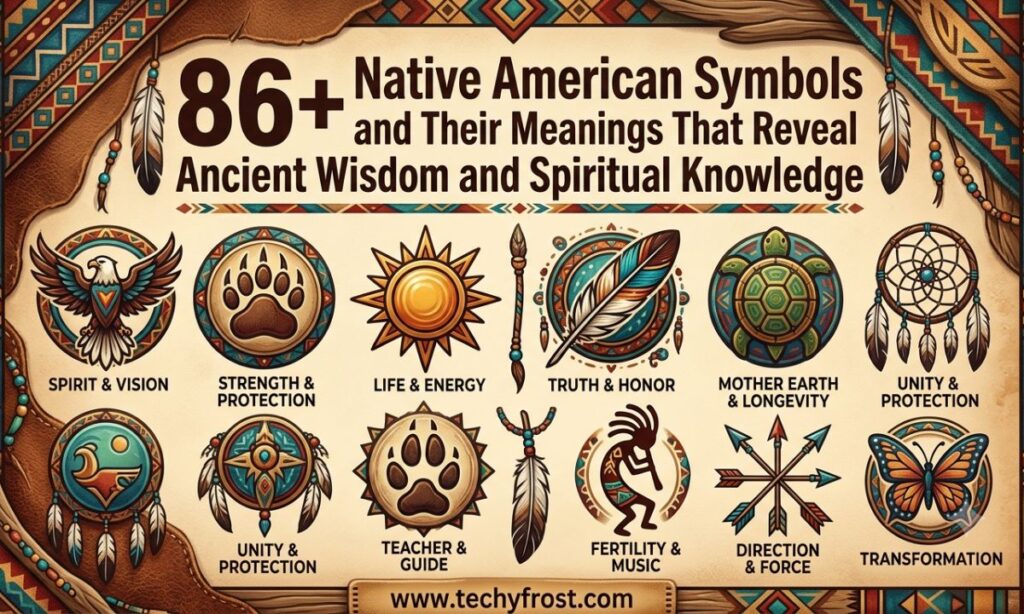
Few things carry as much depth and beauty as Native American symbols. Whether you’ve spotted them on pottery, tattoos, blankets, or ceremonial art, these images are not merely decorative — they are a visual language developed over thousands of years. Each symbol holds a story, a teaching, and often a direct connection to the natural and spiritual world.
This guide covers 86+ Native American symbols and their meanings, exploring the origins, cultural importance, spiritual power, and modern relevance of these ancient icons. Whether you’re a student, a spiritual seeker, an artist, or simply curious, you’ll find genuine value in every section below.
What Are Native American Symbols and Meanings?
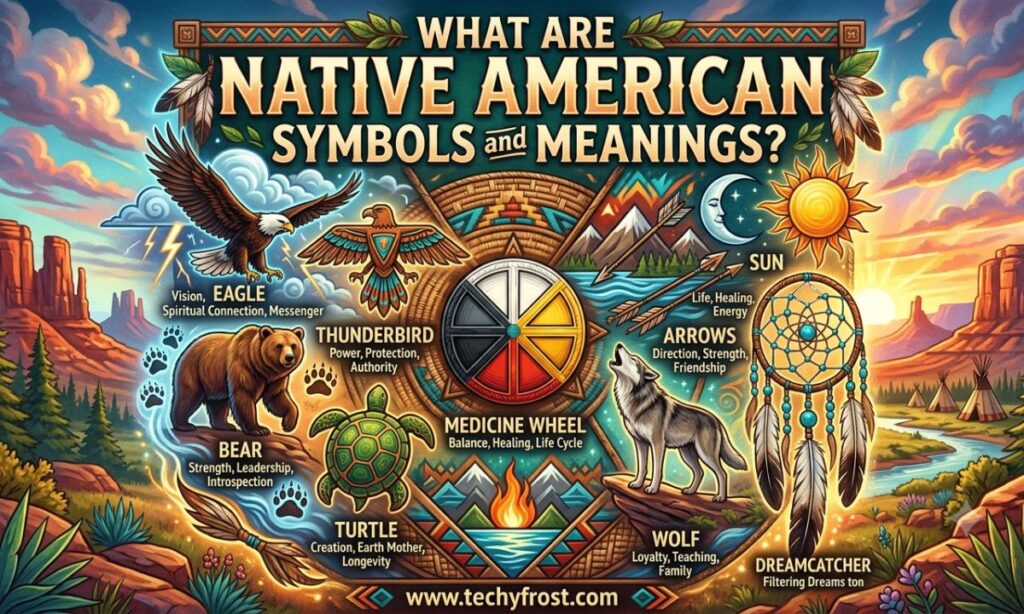
Native American symbols are visual representations of ideas, beliefs, natural forces, spiritual concepts, and tribal identity. They function as a form of non-written language — communicating complex meanings through shapes, animals, geometric patterns, and celestial imagery.
These symbols appear across hundreds of distinct tribal cultures, each with its own visual vocabulary. While some symbols share meanings across tribes, others are unique to specific nations such as the Cherokee, Navajo, Lakota, Hopi, or Apache.
Key characteristics of Native American symbols:
- Rooted in nature, animals, and the cosmos
- Connected to ceremony, healing, and spiritual practice
- Passed down through oral tradition and visual art
- Often hold different meanings depending on context or tribe
Origins and Cultural Importance of Native American Symbolism
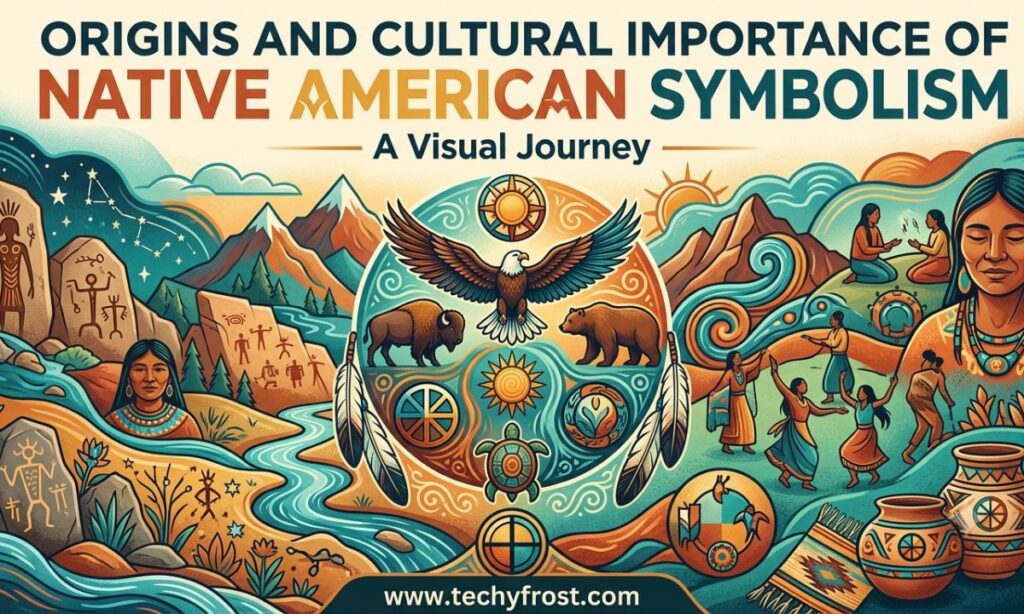
The use of symbols in Native American cultures predates written history. Petroglyphs — carvings on rock — found across North America date back more than 10,000 years. These early symbols tracked seasons, recorded migrations, honored spiritual beings, and communicated warnings or blessings.
Over generations, symbols became embedded into everyday life: woven into blankets, painted on pottery, beaded into garments, and carved into totem poles. Each item told a layered story about identity, belief, and relationship with the natural world.
Why Native American symbolism matters:
- It preserves cultural memory and ancestral wisdom
- It connects generations across time
- It transmits spiritual teaching without formal text
- It serves as a living record of indigenous worldviews
Understanding these symbols requires respect. They are not simply art — they are sacred texts written in image and form.
Beautiful Native American Symbols and Their Meanings
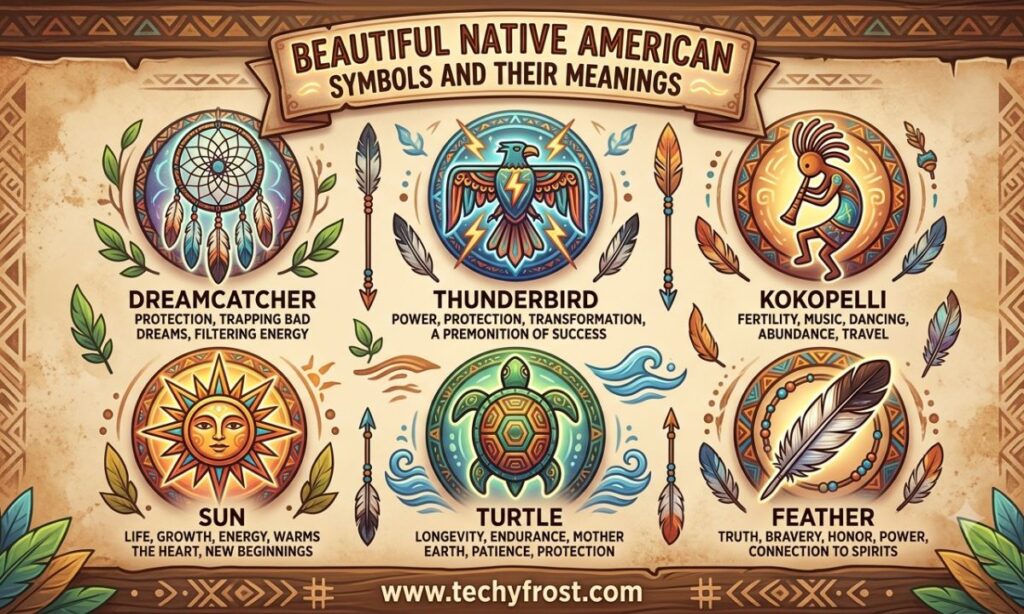
Native American Symbols
Here is a foundational reference table of commonly recognized symbols and their traditional meanings:
| Symbol | Common Meaning | Associated Tribe/Region |
|---|---|---|
| Dreamcatcher | Protection from evil, filtering of dreams | Ojibwe / Chippewa |
| Medicine Wheel | Balance, the four directions, life cycle | Plains tribes |
| Thunderbird | Power, storm, renewal | Pacific Northwest, Plains |
| Eagle | Courage, wisdom, spiritual messenger | Widespread |
| Bear Paw | Strength, tracking, healing | Multiple nations |
| Arrow | Direction, protection, movement | Widespread |
| Sun | Life, energy, creation | Southwest tribes |
| Feather | Spiritual communication, honor | Widespread |
| Wolf | Loyalty, guidance, family | Northern tribes |
| Kokopelli | Fertility, harvest, music | Hopi, Anasazi |
| Turtle | Earth, longevity, wisdom | Haudenosaunee (Iroquois) |
| Serpent | Water, transformation, healing | Multiple cultures |
| Corn / Maize | Life, nourishment, blessing | Southwest tribes |
| Hummingbird | Love, joy, resilience | Cherokee, Southwest |
| Dragonfly | Transformation, illusion, speed | Multiple nations |
| Butterfly | Change, rebirth, the soul | Hopi, Navajo |
| Spiral | Growth, water, cosmic energy | Anasazi, Hohokam |
| Hand | Presence, healing, identity | Widespread |
| Cross / Four Directions | Balance, the universe, wholeness | Plains, Southwest |
| Lizard | Conservation, agility, dreaming | Desert Southwest |
Native American Symbolism
Symbolism in Native American cultures is never arbitrary. Every shape, color, and direction carries significance:
- Colors: Red represents life and war in many Plains traditions; white symbolizes peace; black often signals death or the west; yellow or gold relates to the east and new beginnings.
- Directions: North, South, East, and West each carry spiritual attributes — wisdom, growth, renewal, and introspection respectively.
- Numbers: The number four is sacred in many traditions, representing the four directions, four seasons, and the four stages of life.
Native American Spirituality Symbols
Spirituality was not separate from daily life in indigenous cultures — it was woven into everything. The most important spirituality symbols include:
- The Sacred Hoop (Medicine Wheel): Represents the interconnectedness of all life forms and the eternal cycle of existence.
- The Pipe (Calumet): Represents prayer, peace, and the bridge between humans and the Great Spirit. Smoking the pipe was a sacred act of communication with the divine.
- The Thunderbird: A powerful supernatural being believed to control rain, thunder, and storms. It also symbolizes transformation and divine authority.
- The Kachina: Among Hopi and Pueblo peoples, Kachina spirits are intermediaries between humans and the spirit world, depicted in carved dolls and ceremonial masks.
- The Sweat Lodge: While a structure rather than a drawn symbol, its circular form is symbolic of rebirth, purification, and the womb of Mother Earth.
Native American Spiritual Symbols
Spiritual symbols serve different purposes in different contexts:
- Healing: The snake, bear claw, and medicine wheel are used in healing ceremonies.
- Protection: The evil eye (in some Southwestern cultures), the arrowhead, and the thunderbird shield are used as protective talismans.
- Connection to the spirit world: The feather, eagle, and rainbow bridge symbolize pathways to spiritual realms.
- Fertility and abundance: Kokopelli, corn, and the rain symbol call for growth, harvest, and blessing.
Native American Symbols and Meanings in Tattoos
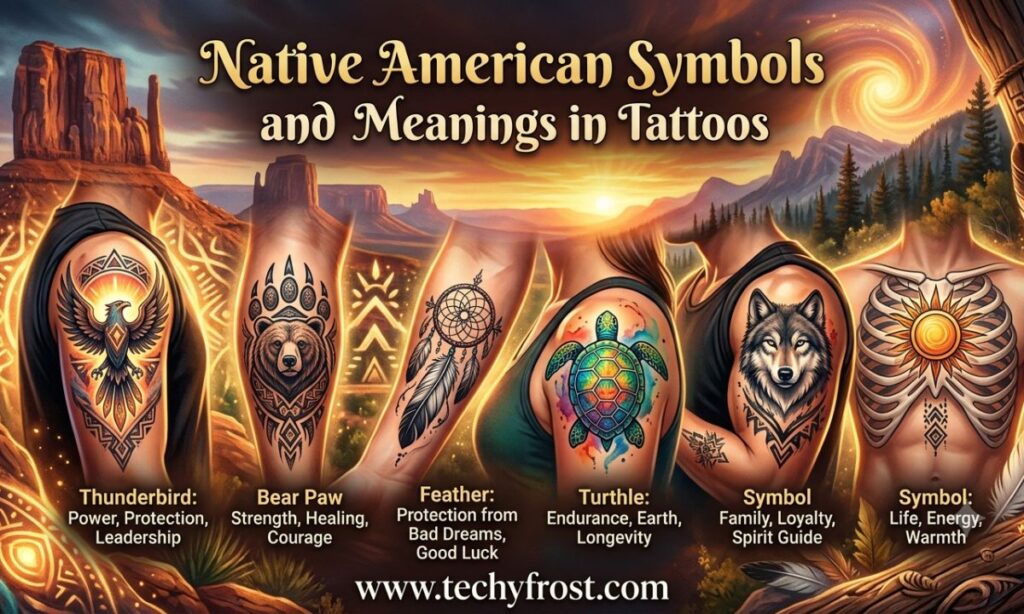
Tattoos have become a popular way to honor or express a connection to Native American heritage. The most commonly chosen symbols include:
- Dreamcatcher tattoos: Often placed on the shoulder or back to “catch” bad energy and allow only positive dreams.
- Feather tattoos: Represent freedom, spiritual journey, and honor — especially eagle feathers.
- Arrow tattoos: A single arrow means protection; two crossed arrows mean friendship; a broken arrow signals peace.
- Wolf tattoos: Represent family loyalty, instinct, and spiritual guidance.
- Bear claw tattoos: Symbolize strength and a connection to healing power.
⚠️ Cultural note: Many symbols hold deep sacred meaning to specific tribes. Wearing them without understanding or connection may be considered cultural appropriation. It’s worth researching the origin and significance before getting such a tattoo.
Native American Symbols for Protection from Evil
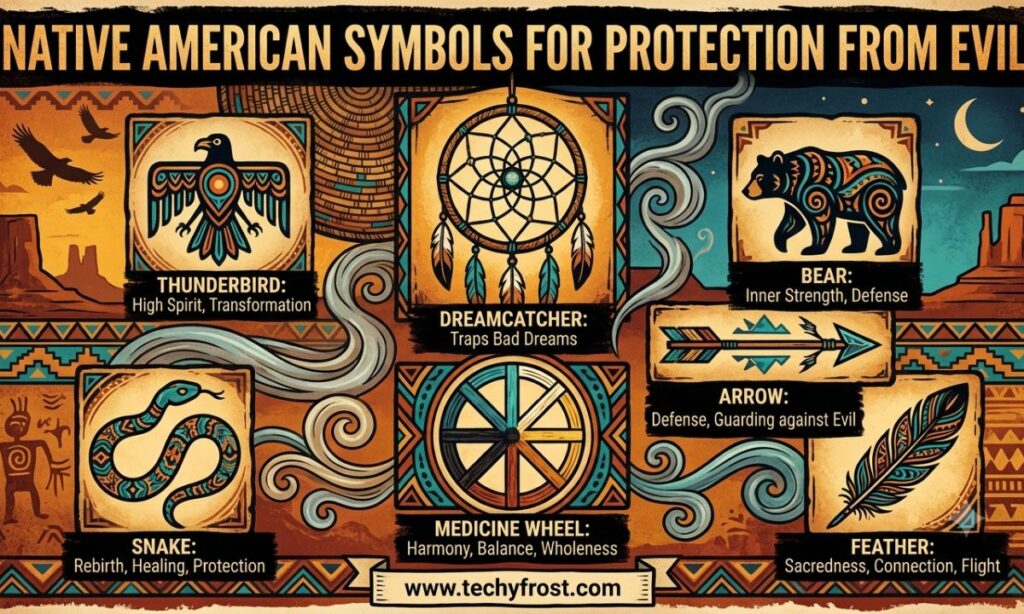
Protective symbols have been central to indigenous cultures for millennia:
- Dreamcatcher: Filters out nightmares; allows only good dreams to pass through its web.
- Arrowhead: Worn as an amulet to deflect negative energy and protect the wearer from harm.
- Bear: The bear spirit is called upon in many traditions as a guardian against danger.
- Evil Eye (Ojo de Dios / God’s Eye): Woven from two sticks and yarn, used in Southwest cultures to watch over and protect infants.
- Thunderbird Shield: Used in Plains cultures to invoke the power of the Thunderbird as a protector in battle and daily life.
- Snake (Horned Serpent): In some traditions, the horned serpent guards water sources and wards off evil spirits.
Native American Symbol for Wisdom
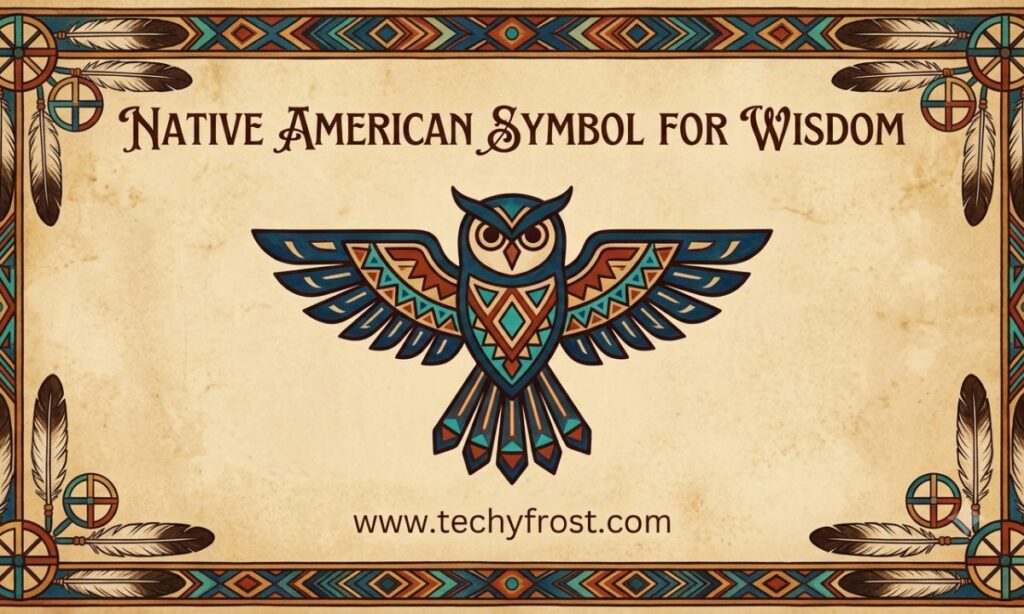
Several symbols represent wisdom across different tribal traditions:
- The Owl: Contrary to its Western interpretation as death or darkness, many Native cultures revere the owl as a keeper of wisdom and a guide through the unknown.
- The Tortoise or Turtle: Carries the world on its back in Haudenosaunee cosmology; represents patience, endurance, and ancient knowledge.
- The Elder Shaman Symbol: Often depicted as a human figure with rays, representing one who holds spiritual and ancestral knowledge.
- The Raven: In Pacific Northwest traditions, Raven is a trickster but also a bringer of light and knowledge — a complex symbol of cunning wisdom.
Native American Patterns and Meanings
Geometric patterns are as meaningful as figurative symbols:
| Pattern | Meaning |
|---|---|
| Zigzag / Lightning Bolt | Power, speed, rain, Thunderbird |
| Diamond Shape | Watchful eyes, sky, protection |
| Spiral | Journey of life, water, cosmos |
| Stepped Pyramid / Staircase | Clouds, rain, ascension |
| Triangle | Mountains, stability, earth |
| Cross/Plus Sign | Four sacred directions |
| Concentric Circles | Growth, ripple effect, sun |
| Checker Pattern | Day and night, balance |
Symbolism in Native American Art and Crafts
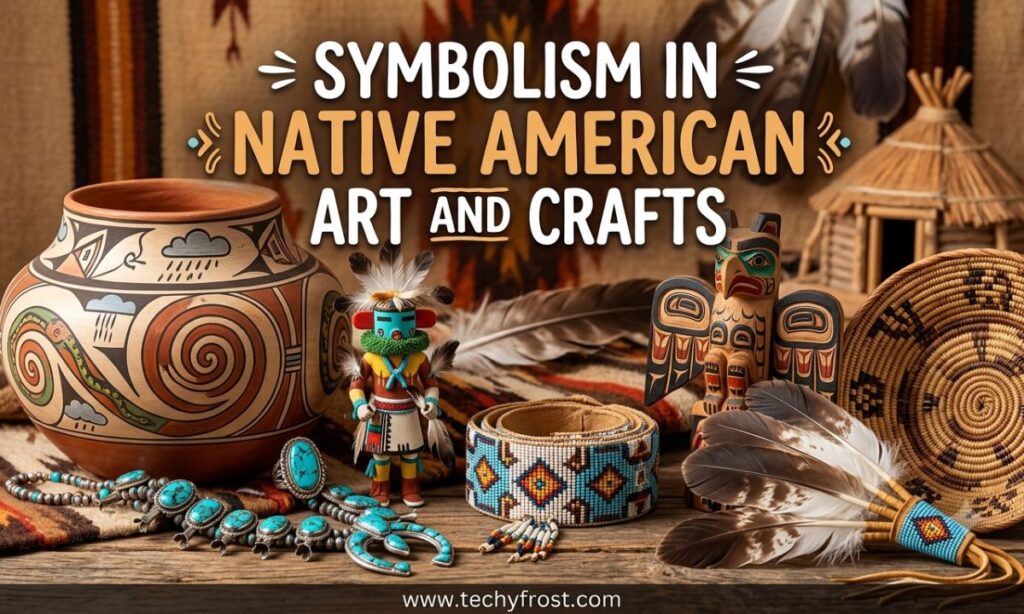
Art was never purely aesthetic in indigenous cultures — it was functional, spiritual, and communicative.
- Pottery: Pueblo and Navajo pottery uses spirals, birds, and rain patterns to represent prayers for water and life.
- Beadwork: Geometric beadwork on garments tells the story of a person’s clan, achievements, and spiritual identity.
- Totem Poles: Used by Pacific Northwest tribes to record clan ancestry, important events, and spiritual lineage.
- Sand Paintings: Navajo sand paintings are sacred healing art, created during ceremonies and ritually destroyed afterward.
- Blankets: Navajo weavings carry complex pattern languages; specific designs were reserved for ceremonial use.
Native American Art and Educational Meanings
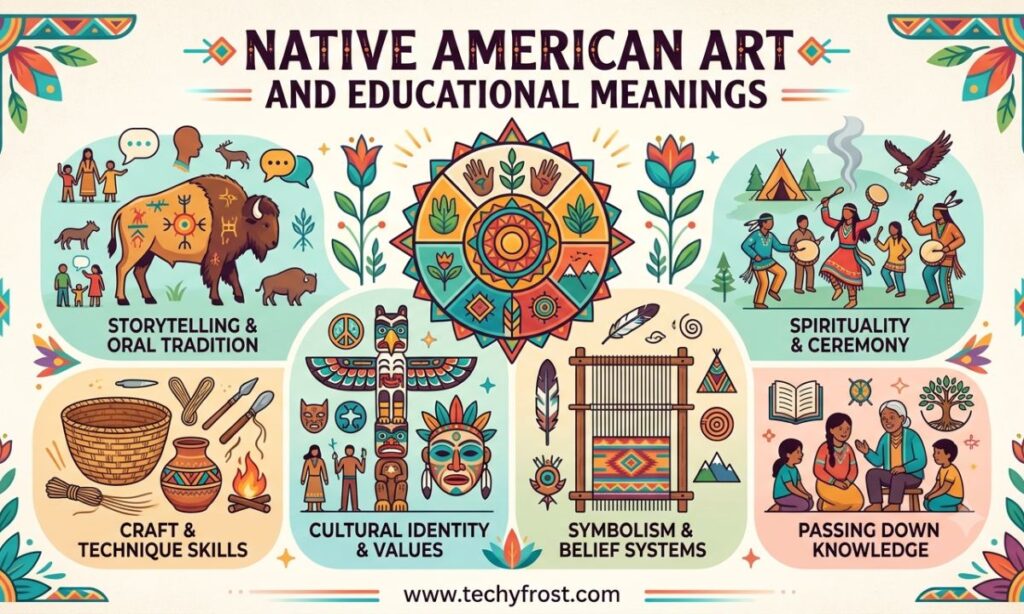
Native American Symbols Pictures
Visual learning is one of the most effective ways to understand indigenous symbolism. Traditional symbols appear in:
- Museum collections (Smithsonian’s National Museum of the American Indian)
- Archaeological sites and petroglyphs
- Educational illustrated guides and books
- Tribal websites and cultural centers
When searching for images, prioritize authentic, tribally-approved sources over commercial or simplified versions.
Native American Symbols and Meanings Chart
A quick-reference chart for educators, students, and researchers:
| Symbol | Element | Core Meaning | Used For |
|---|---|---|---|
| Eagle | Sky | Courage, divine connection | Ceremonies, war honors |
| Bear | Earth | Healing, strength | Medicine rituals |
| Wolf | Pack | Loyalty, guidance | Clan identity |
| Thunderbird | Sky | Power, storms | Protection, war |
| Turtle | Water/Earth | Longevity, wisdom | Creation stories |
| Feather | Sky | Honor, communication | Spiritual practice |
| Dreamcatcher | Spirit | Protection, dream filtering | Sleep, healing |
| Medicine Wheel | All Four | Balance, wholeness | Ceremony, health |
| Arrow | Earth | Direction, protection | Battle, travel |
| Sun | Sky | Life, energy | Daily ceremony |
Native American Symbols and Meanings for Kids
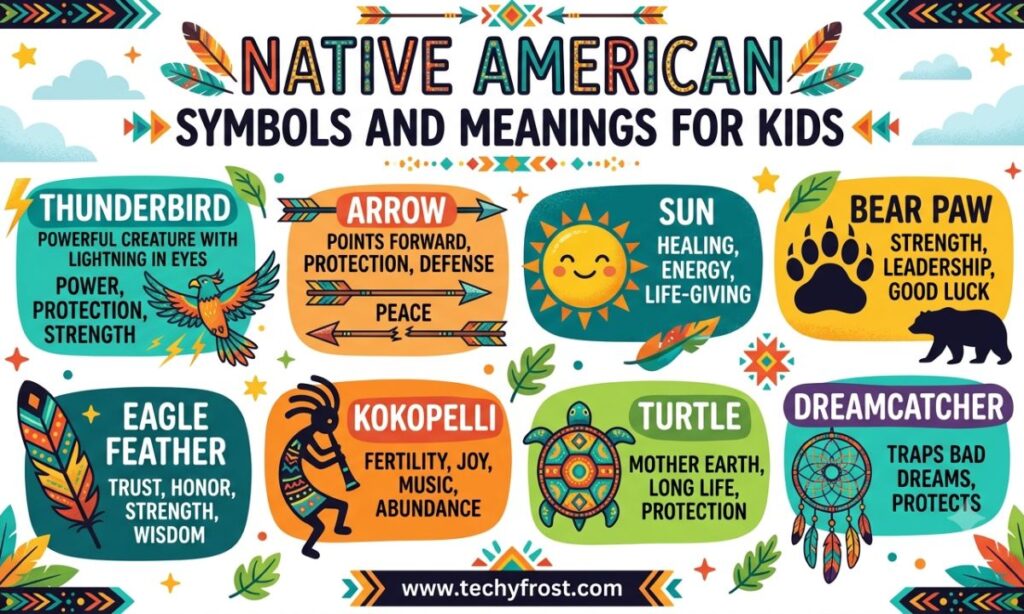
Teaching children about Native American symbols builds cultural appreciation from an early age. Here are some child-friendly interpretations:
- The Eagle: A bird that flies closest to the sky, carrying our prayers upward.
- The Turtle: One of Earth’s oldest animals, reminding us to slow down and be patient.
- The Dreamcatcher: A special web that catches bad dreams so only good ones reach you while you sleep.
- The Sun: The giver of warmth and life — celebrated every single day.
- The Bear: Strong and protective, like a parent watching over their family.
Activities for kids: coloring pages, simple bead patterns, and symbol matching games are engaging tools used in educational settings.
Printable Native American Symbols and Meanings
Printable guides are valuable for classrooms, art programs, and home education. A good printable resource should include:
- Clear illustrations of each symbol
- Short, accurate descriptions
- Tribal attribution where applicable
- A glossary of key terms
Look for resources from tribal cultural departments, museum education offices, and reputable indigenous education foundations.
Native American Symbols and Meanings PDF
For downloadable PDF guides, these are reliable starting points:
- The Smithsonian’s Native Knowledge 360° project (americanindian.si.edu)
- Native Languages of the Americas (native-languages.org)
- Tribal cultural department websites for specific nations
Always ensure the source has been developed in collaboration with indigenous communities.
Cherokee and Navajo Native Symbols
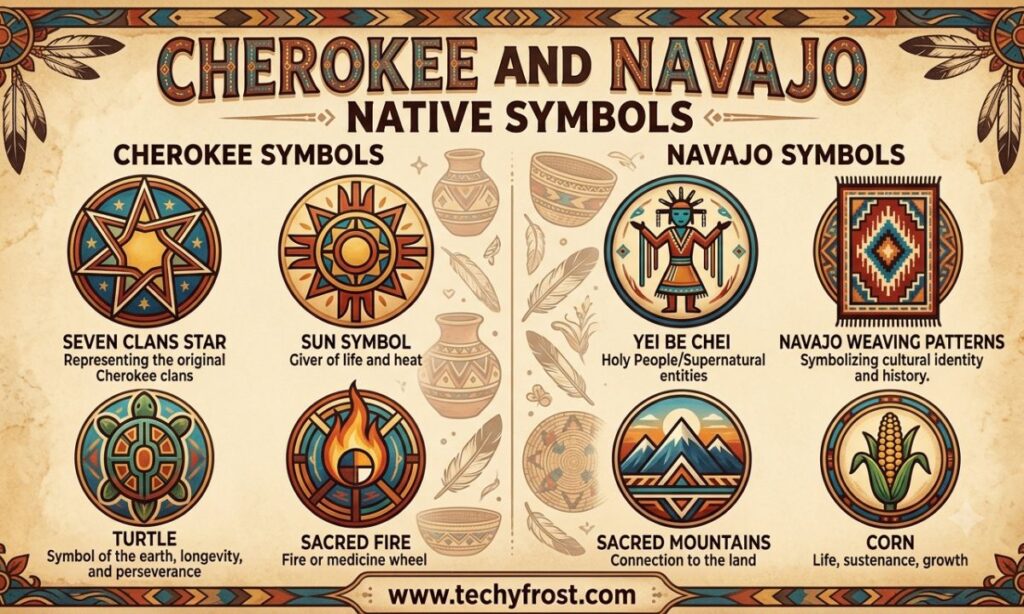
Cherokee Native American Symbols and Meanings
The Cherokee Nation has a rich symbolic tradition tied to the natural world and community life:
- The Cherokee Rose: Symbol of the Trail of Tears; each petal and gold center honors lives lost.
- The Seven-Pointed Star: Represents the seven clans of the Cherokee people.
- The Eternal Flame: The sacred fire kept burning in Cherokee towns symbolizes the presence of the Creator.
- The Buck: Represents grace, agility, and male life force.
- The Hummingbird: In Cherokee oral tradition, the hummingbird retrieves tobacco plants to heal the people — a symbol of courage, love, and resilience.
Navajo Native American Symbols and Meanings Chart
| Navajo Symbol | Meaning |
|---|---|
| The Holy People (Yei) | Divine spirits depicted in sand paintings and weaving |
| Spider Woman’s Cross | Weaving, creation, knowledge of the loom |
| Corn Pollen | Blessing, fertility, the essence of life |
| Rainbow | Protection, divine bridge between worlds |
| The Four Sacred Mountains | Boundaries of Dinétah (the Navajo homeland) |
| Lightning | Speed, power, purification |
| Water Creature (Tééhoołtsódii) | Guardian of water bodies |
| Storm Pattern (Rug) | Weather, power of sky, spiritual energy |
Native American Charms and Meanings
Charms and amulets have been used for centuries in indigenous cultures:
- Turquoise: One of the most sacred stones in Navajo and Pueblo traditions; brings health, protection, and luck.
- Fetish animals (Zuni): Small carved stone animals — bear, eagle, coyote — carry the spirit of that animal and are used in healing and prayer.
- Medicine bags (Bundles): Personal pouches containing sacred herbs, stones, and objects meaningful to the individual’s spirit helpers.
- Horseshoe amulets: In some Plains traditions, horse-related charms represented speed, freedom, and protection in battle.
What Are Some Native American Symbols?
Some of the most widely recognized include the dreamcatcher, medicine wheel, thunderbird, eagle feather, bear claw, arrowhead, kokopelli, sun symbol, and the hand symbol. Each belongs to specific cultural traditions and carries layered meanings tied to spirituality, nature, protection, and identity.
Spiritual Native Symbols and Meanings
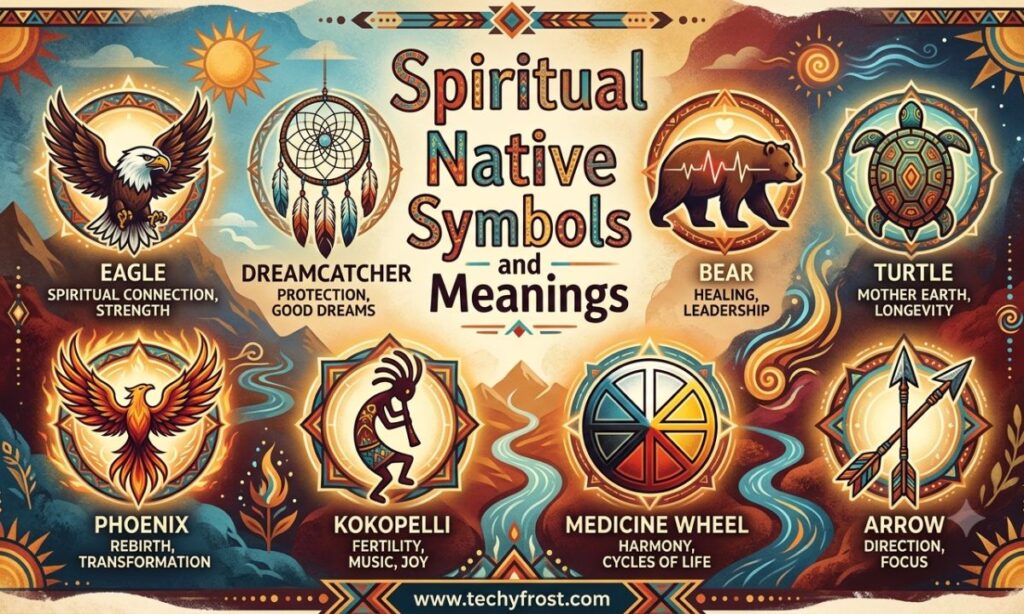
Spiritual Native American Symbols and Meanings
At their deepest level, Native American symbols are spiritual tools. They are not passive images — they are active agents in ceremony, healing, and communication with the divine.
- The Pipe Ceremony symbol: Represents the sacred act of prayer shared between all beings.
- The Vision Quest symbol (Lone Figure/Circle): Represents the individual’s journey into solitude to receive spiritual guidance.
- The Sweat Lodge Circle: Symbol of purification, rebirth, and community healing.
- Serpent-wrapped Staff: In some traditions, echoes the concept of healing (similar to the caduceus) — the serpent as transformer and healer.
Nature-Based Native Symbols
The natural world is the primary source of all Native American symbolism:
- Rain symbols (zigzag and vertical lines): Prayers for water, life, and agricultural abundance.
- Mountain symbols (triangles and stepped forms): Representing permanence, ancestors, and the sacred high places where spirits dwell.
- Wind symbols (swirling curves): The breath of life, change, and invisible power.
- Fire symbols (upward-pointing triangles, flames): Purification, transformation, and the central sacred element in ceremony.
- Water symbols (wavy lines, spirals): The origin of life, the unconscious, and emotional depth.
Deep Symbolic Meaning
Spiritual Level
At the spiritual level, Native American symbols serve as a bridge between the physical and spirit worlds. They are invoked during healing ceremonies, vision quests, and rites of passage to activate the power of unseen forces. The symbol is not merely a representation — it is the thing it represents, holding actual spiritual power in indigenous worldviews.
Psychological Level
Carl Jung observed that many Native American symbols function as archetypes — universal images that emerge from the collective human unconscious. The eagle as transcendence, the serpent as transformation, the circle as wholeness — these resonate across cultures because they speak to fundamental human experiences of life, death, and meaning.
Cultural Level
On a cultural level, symbols preserve and transmit identity across generations. In a history marked by forced assimilation policies that tried to erase indigenous languages and practices, symbols became vital acts of cultural survival and resistance. Today, the continued use of traditional symbols is an affirmation of sovereignty, pride, and living tradition.
Types and Variations of Native American Symbols and Meanings
The Dreamcatcher
Originally from the Ojibwe (Chippewa) people, the dreamcatcher is a hand-woven hoop containing a web, decorated with feathers and beads. It is hung above sleeping areas to capture bad dreams in its web, while allowing good dreams to filter through the center hole and slide down the feathers to the sleeper. The willow hoop represents the circle of life.
The Medicine Wheel
Found across Plains and Woodland tribes, the medicine wheel is a circle divided into four quadrants, each representing a cardinal direction, a season, a stage of life, and often a color. It is a map of the cosmos and a tool for achieving balance in body, mind, emotion, and spirit.
The Eagle
The eagle — particularly the golden and bald eagle — is the most sacred bird in many North American tribes. It flies highest of all creatures, making it the natural messenger between humans and the Creator. Eagle feathers are among the most honored gifts a person can receive, traditionally earned through acts of courage, wisdom, or service.
The Thunderbird
A creature of immense supernatural power, the Thunderbird is depicted with enormous wings, often holding lightning bolts in its talons. It is particularly central in Pacific Northwest and Plains iconography, appearing on totem poles, carvings, and war shields. The beating of its wings produces thunder; its eyes flash lightning.
The Bear
In most indigenous traditions, the bear represents healing, introspection, and raw power. Bear medicine is among the strongest healing forces in the spirit world. The bear’s ability to hibernate and re-emerge symbolizes death and rebirth. Many shamans and medicine people identify with bear as their primary spirit helper.
The Arrow
Arrows carry multiple meanings depending on presentation. A single upward arrow means protection. An arrow pointing left wards off evil. An arrow pointing right signals readiness. Two arrows in opposite directions mean conflict or war; crossed arrows signify friendship. A bundle of arrows together represents strength in unity.
The Wolf
The wolf is a complex, deeply respected symbol of loyalty, community, and spiritual guidance. In many traditions, the wolf is the pathfinder — one who goes ahead and returns to show others the way. Wolf clans exist in numerous tribes, and the animal is called upon as a teacher of communication, cooperation, and instinct.
The Sun
Virtually every Native American culture reveres the sun. As the source of warmth, crops, and life itself, the sun is celebrated daily and in seasonal ceremonies. The Hopi, Navajo, and many Plains tribes conduct elaborate sun dances and ceremonies tied to the solar calendar. The sun symbol (concentric circles with radiating lines) appears on pottery, kiva walls, and sand paintings.
The Feather
Feathers represent the connection between the earthly and spiritual planes. Eagle feathers are most sacred, awarded for acts of bravery and wisdom. Turkey feathers are used in prayer sticks; hawk feathers for swiftness; owl feathers in some healing traditions. The act of giving a feather is one of the highest honors in many indigenous cultures.
Native American Symbols Across Cultures
While certain symbols appear across many tribes, it’s important to recognize regional and cultural differences:
| Region | Dominant Symbols | Themes |
|---|---|---|
| Pacific Northwest | Totem animals, Raven, Orca, Salmon | Clan identity, ancestry, nature cycles |
| Southwest | Sun, Rain, Corn, Kachina | Agriculture, water, spiritual intermediaries |
| Plains | Medicine Wheel, Eagle, Buffalo, Tipi | Movement, honor, survival |
| Woodlands | Dreamcatcher, Turtle, Three Sisters | Dreams, earth, food sovereignty |
| Southeast | Heron, Fire, Spiral | Water, ceremony, eternal flame |
| Arctic | Polar Bear, Whale, Aurora | Survival, the spirit world, the hunt |
Native American Symbols in Art, Movies and Pop Culture
Native American symbols have entered mainstream culture through many channels — some respectful, others problematic. The dreamcatcher, in particular, has been heavily commercialized, appearing on everything from jewelry to car air fresheners, often stripped of its original context.
In cinema, films like Dances with Wolves, Smoke Signals, and Killers of the Flower Moon have brought indigenous imagery and culture to wider audiences. Indigenous artists and filmmakers are increasingly reclaiming their narratives and symbols in contemporary media, asserting the right to tell their own stories.
Tattoo culture, fashion design, and the wellness industry have all drawn heavily from Native American symbolism — making education and cultural sensitivity more important than ever.
Spiritual and Dream Meaning of Native American Symbols
When Native American symbols appear in dreams, many spiritual traditions consider this significant:
- Dreaming of an eagle: A message of strength and a call to rise above challenges; spiritual clarity is coming.
- Dreaming of a wolf: Trust your instincts; a guide or protector is near.
- Dreaming of a feather: A departed loved one or spirit guide is sending a message of peace.
- Dreaming of a bear: A period of healing or introspection lies ahead; it may also signal the need for rest.
- Dreaming of a dreamcatcher: Your spirit is actively working to protect you during sleep.
- Dreaming of the medicine wheel: You are being called to seek balance in your life.
Positive vs Negative Meaning
Most Native American symbols carry primarily positive associations, but context matters:
| Symbol | Positive Meaning | Cautionary Meaning |
|---|---|---|
| Owl | Wisdom, foresight | In some tribes, an omen of death |
| Snake | Transformation, healing | Deception, danger (context-dependent) |
| Raven | Light, knowledge, creativity | Trickery, mischief |
| Black | Rest, the west, transition | Death, the unknown |
| Coyote | Adaptability, humor | Chaos, irresponsibility |
Understanding polarity within symbols deepens our appreciation of indigenous worldviews, which embrace complexity and duality rather than simple good/evil binaries.
Why Humans Are Attracted to Native American Symbols
There are several deep reasons people across cultures feel drawn to these symbols:
- They are rooted in nature. In an increasingly disconnected modern world, symbols grounded in earth, sky, animals, and seasons feel healing and authentic.
- They carry genuine depth. Unlike modern graphic design, these symbols have thousands of years of meaning behind them — you can feel the weight of that history.
- They speak to universal human experiences. Birth, death, love, war, healing, transformation — these are themes every human being navigates.
- They are visually striking. The geometric precision of Navajo patterns, the bold lines of Pacific Northwest art, and the delicacy of beadwork are aesthetically powerful on their own terms.
- They offer a sense of connection. People seeking spiritual grounding often find resonance in these ancient systems of meaning-making.
- They represent resilience. Symbols of a people who survived centuries of attempted erasure carry a particular kind of power — they are proof that culture endures.
Frequently Asked Questions
What is the most common Native American symbol?
The dreamcatcher is arguably the most widely recognized Native American symbol worldwide, originally from the Ojibwe Nation.
What does the feather symbolize in Native American culture?
A feather symbolizes spiritual communication, honor, and a connection between the physical and spirit worlds; eagle feathers especially are among the most sacred objects in many traditions.
What does the medicine wheel represent?
The medicine wheel represents balance and wholeness — the four directions, four seasons, four stages of life, and the interconnection of all living things.
Are Native American symbols sacred?
Yes, many are considered sacred and are only used in specific ceremonial contexts within their originating cultures. Public or commercial use of certain symbols may be considered disrespectful.
What symbol represents strength in Native American culture?
The bear is the most widely recognized symbol of strength, alongside the eagle and the bear claw.
What does a single arrow mean?
A single arrow generally represents protection, direction, or readiness; a broken arrow symbolizes peace.
What does the thunderbird symbolize?
The Thunderbird symbolizes power, divine authority, storms, and protection — one of the most potent supernatural beings in many North American indigenous traditions.
What is the Native American symbol for healing?
The bear, the snake (in some traditions), the medicine wheel, and the hand symbol are all associated with healing in various Native American cultures.
Do different tribes use the same symbols?
Some symbols like the eagle or sun appear across many cultures, but their specific meanings and ceremonial uses may differ significantly from tribe to tribe.
What is the Native American symbol for wisdom?
The owl, the turtle, and the elder shaman figure are common representations of wisdom, though specific meanings vary by nation and tradition.
Conclusion
Native American symbols are far more than beautiful images — they are a living language that has carried wisdom, identity, healing, and spiritual knowledge across millennia. From the dreamcatcher filtering bad dreams to the eagle carrying prayers skyward, each symbol is a doorway into a worldview that sees humanity as part of a sacred, interconnected whole.
As we engage with these symbols — whether in art, tattoos, education, or spiritual practice — the most respectful approach is also the most enriching one: take the time to understand where each symbol comes from, what it means to the people who created it, and how it continues to live in indigenous communities today. When approached with that kind of respect and curiosity, Native American symbols have the power to reveal something genuinely profound about the world and our place in it.

