

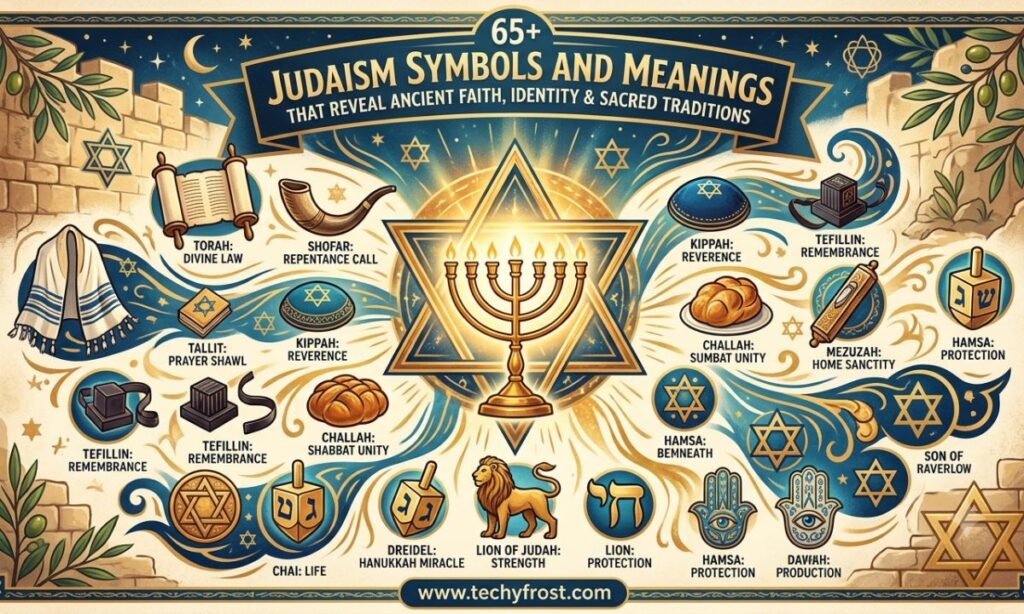
Judaism is one of the oldest continuous faith traditions in the world, and over thousands of years it has produced a rich visual language of symbols that communicate belief, memory, and belonging. From the Star of David glittering on a synagogue dome to a tiny mezuzah fixed to a doorpost, Jewish symbols do far more than decorate — they teach, protect, and connect generations.
This guide explores 65+ Judaism symbols and meanings, covering their origins, spiritual depth, and cultural significance. Whether you’re researching Jewish heritage or simply curious what these ancient icons represent, this article offers a complete, accurate look at the symbols that define Jewish identity.
What Are Judaism Symbols?
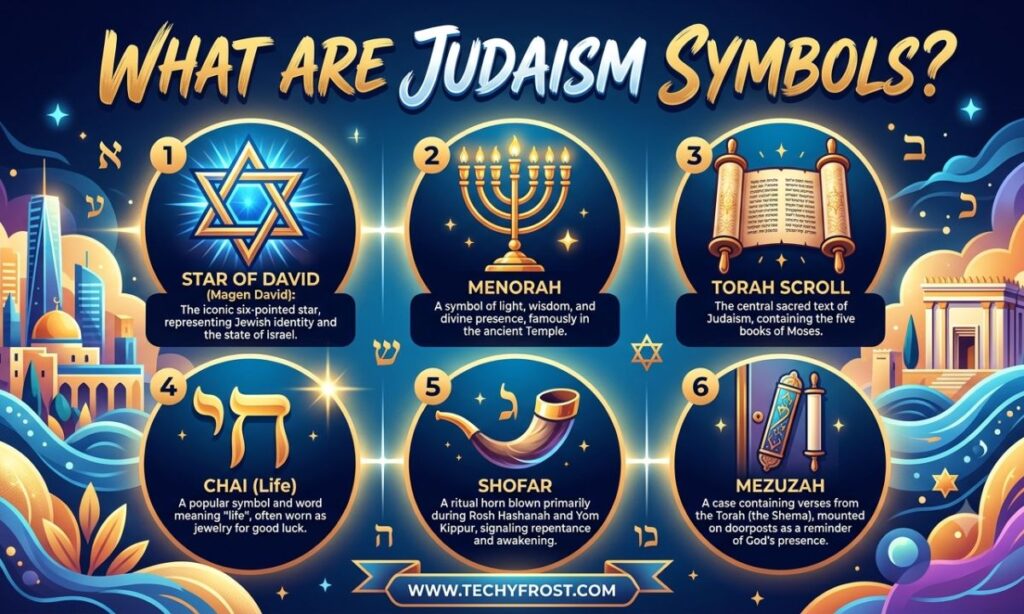
Judaism symbols are visual, numerical, or object-based representations that express core beliefs, historical memories, and spiritual values within Jewish tradition. They function as a shorthand language — a single image like the Star of David or a number like 18 can carry centuries of meaning in one glance.
These symbols generally fall into several categories:
- Ritual objects used in worship, such as the menorah, mezuzah, and Torah scroll
- Geometric and visual emblems, like the Star of David and hamsa
- Hebrew letters and words, such as Chai and Shin
- Numerical symbolism, including the number 18 and the concept of seven
- Natural and agricultural imagery, like the olive branch, pomegranate, and lulav
Unlike purely decorative art, Jewish symbols are typically rooted in scripture, rabbinic commentary, or lived historical experience. Many trace back to the Torah itself, while others developed over centuries of diaspora life, absorbing influences from the Middle East, Europe, and North Africa along the way.
The Historical Origins of Judaism Symbols
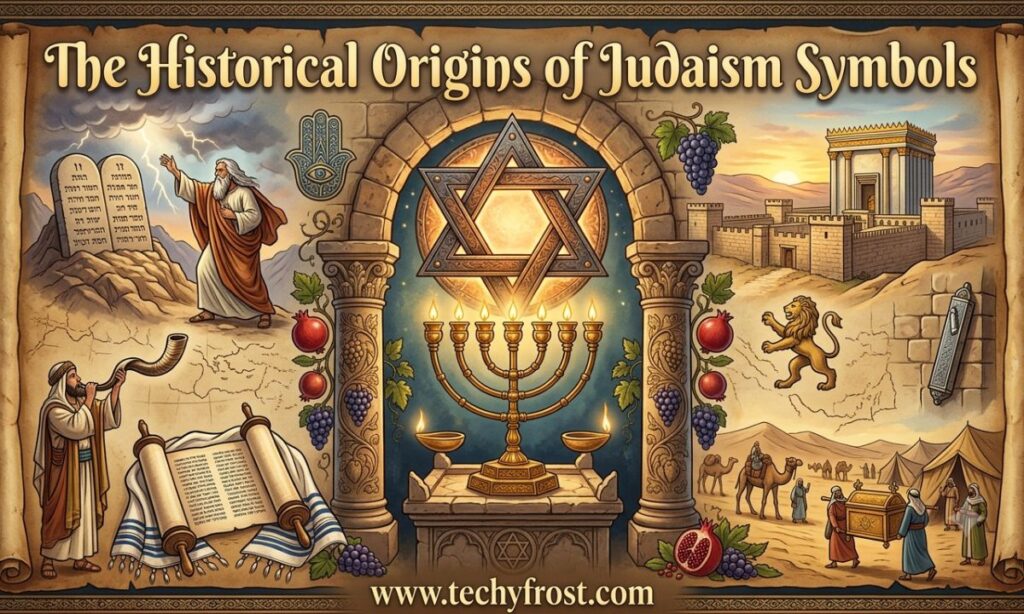
The story of Jewish symbolism stretches back more than 3,000 years, beginning with the instructions God gave Moses for the Tabernacle in the Sinai desert. The earliest and most historically significant symbol, the menorah, originates directly from the Book of Exodus, where God commands the construction of a seven-branched golden candelabrum for use in the portable sanctuary.
Many people assume the Star of David is the oldest Jewish symbol, but the seven-branched menorah is actually the oldest enduring physical image connected to the Jewish people. The hexagram only became a widespread, universally recognized emblem of Jewish identity much later.
| Era | Key Development |
|---|---|
| Biblical Period (c. 1200 BCE) | Menorah commanded for the Tabernacle; priestly garments and tablets introduced |
| Second Temple Period | Menorah becomes central Temple object; coins minted with Jewish imagery |
| Post-70 CE (Roman destruction) | The menorah’s image appears on the Arch of Titus in Rome, becoming a symbol of memory and resilience after the Temple’s fall |
| Medieval Period (12th–14th century) | Hexagram appears in Kabbalistic texts; Prague’s Jewish community adopts the star on a flag |
| 17th–19th century | Star of David becomes a widely recognized symbol of Jewish identity across Europe |
| 20th century | Chai and hamsa gain mainstream popularity; Israel adopts the menorah as its national emblem |
Unlike the menorah, the Lion of Judah, the shofar, and the lulav, the hexagram was not originally a uniquely Jewish symbol — it was a simple geometric shape used across many cultures long before it became linked to Judaism. Jewish symbolism has never been static; it has always absorbed new meanings while staying anchored to scripture and communal memory.
Deep Symbolic Meaning of Judaism Symbols
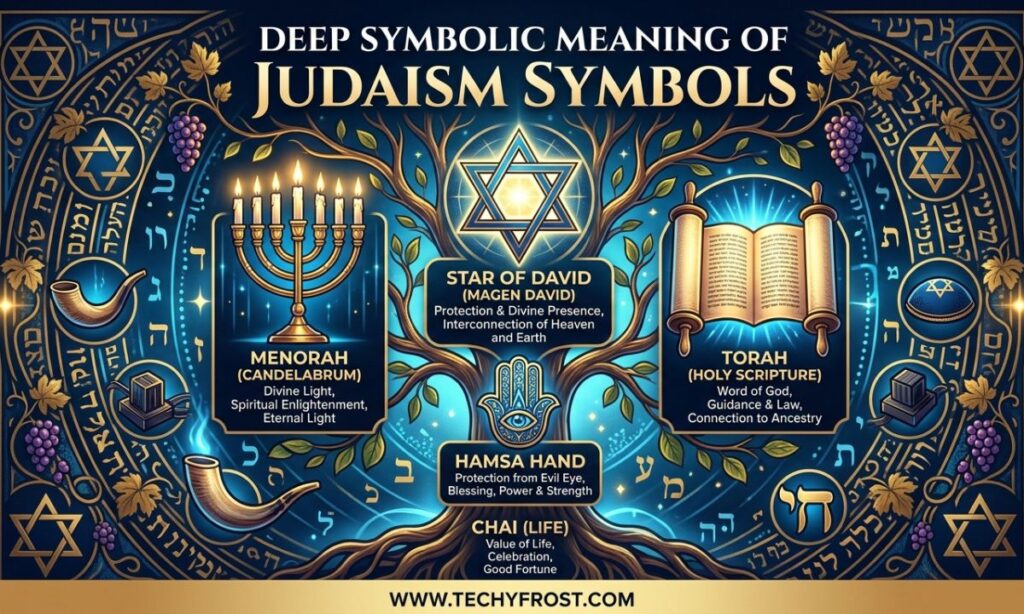
Jewish symbols operate on multiple levels at once. A single object can carry a spiritual message, trigger a psychological response, and serve a cultural function simultaneously.
Spiritual Meaning
On a spiritual level, Jewish symbols often represent the relationship between God and the Jewish people — what tradition calls the covenant. The menorah’s light symbolizes divine wisdom and presence in the world. The Star of David’s two interlocking triangles are frequently interpreted as humanity reaching upward toward God while divine grace reaches downward toward humanity. Mezuzahs sanctify physical space, turning an ordinary home into a place that remembers God’s commandments at every entrance and exit. Many symbols also point toward redemption and continuity — the idea that Jewish history, though marked by exile and hardship, moves toward restoration and hope.
Psychological Meaning
Symbols give people something tangible to hold onto during uncertainty. Wearing a Star of David necklace or hanging a hamsa near a doorway offers a sense of protection, belonging, and continuity with ancestors. Psychologically, these objects function as anchors of identity, especially for people navigating life in the diaspora. For many, displaying a Jewish symbol is also a quiet act of resilience — a way of saying “I am still here” after centuries of persecution and attempted erasure.
Cultural Meaning
Culturally, Jewish symbols serve as instant identifiers across a global, dispersed community. A traveler visiting a synagogue in Buenos Aires, Budapest, or Tel Aviv will likely recognize the same menorah or Star of David motif, even where language, food, and customs differ. This shared visual vocabulary binds Ashkenazi, Sephardi, and Mizrahi Jewish communities together despite centuries of geographic separation.
Most Important Types of Judaism Symbols
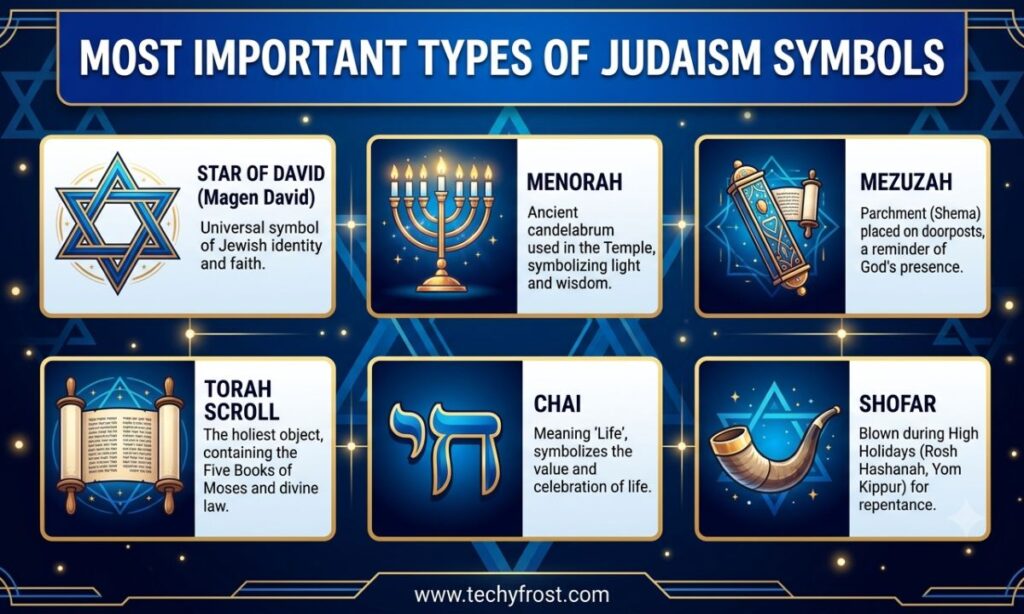
Star of David
Visual Description
The Star of David, known in Hebrew as Magen David (“Shield of David”), is a hexagram formed by two overlapping equilateral triangles — one pointing upward, one downward — creating a six-pointed star with a hexagon at its center.
Meaning
The upward-pointing triangle is often said to represent humanity’s connection to God, while the downward-pointing triangle symbolizes God’s divine grace reaching down to earth. Together, the two triangles signify the bond between God and the Jewish people. Other interpretations include the six points representing the six days of creation with the center symbolizing Shabbat, and the twelve sides corresponding to the twelve tribes of Israel.
Despite its ancient feel, the Star of David’s association as a distinctive symbol for the Jewish people only dates back to 17th-century Prague. Before that, it was tied more to mystical and magical practice than mainstream Jewish identity.
Where It Appears
- The flag of the State of Israel
- Synagogue architecture, windows, and gates
- Jewish jewelry, pendants, and rings
- Tombstones and memorial art
- Holocaust memorials, recalling the forced yellow badges Jews were made to wear under Nazi rule
Menorah
Visual Description
The menorah is a seven-branched candelabrum, traditionally crafted from gold, with a central stem and three branches curving outward on each side.
Meaning
The Torah describes how God gave Moses detailed instructions for building this holy seven-branched candelabra for the Tabernacle. The menorah represents divine light, wisdom, and spiritual presence in the world — far more than an ancient ritual object, it represents a visual theology that has accompanied the Jewish people from biblical times to today.
The number seven holds deep significance in Jewish thought, often connected to completeness, the days of creation, and Shabbat. The menorah’s fate after the Roman destruction of the Second Temple in 70 CE is famously depicted on the Arch of Titus in Rome, carried by soldiers as a spoil of conquest — yet it became a symbol of continuity and hope for restoration even in defeat.
Where It Appears
- The official emblem of the State of Israel
- Synagogues, as a central decorative and ritual feature
- Hanukkah celebrations, via the nine-branched Hanukkiah (a related but distinct object)
- Ancient coins, mosaics, and catacomb art
- Jewish institutional logos worldwide
Chai Symbol
Visual Description
The Chai symbol is formed from two Hebrew letters — Chet (ח) and Yud (י) — stylized together to form the word “chai,” meaning “alive” or “living.”
Meaning
Chai figures prominently in modern Jewish culture, with the gematria value of chai — 18 — frequently used as a symbol carrying the same meaning of life. Chet has a numerical value of 8 and Yud a value of 10, together forming 18 according to gematria, the mystical practice of assigning numbers to letters. Many Jews give monetary gifts in multiples of 18 to symbolically offer “life” or good fortune, and the phrase “Am Yisrael Chai” (“The people of Israel live”) has become a rallying expression of Jewish endurance, famously sung by survivors shortly after liberation from Bergen-Belsen in 1945.
Where It Appears
- Necklaces, pendants, rings, and bracelets
- Mezuzahs and Torah covers
- Wedding and bar/bat mitzvah gifts (in multiples of 18)
- Popular culture references in music and film
Mezuzah
Visual Description
A mezuzah is a small decorative case, often made of metal, wood, or glass, affixed at an angle to the doorpost of a Jewish home. Inside it holds a tiny parchment scroll handwritten with specific Torah verses.
Meaning
The mezuzah fulfills a direct biblical commandment from Deuteronomy 6:9, instructing Jews to write God’s words “on the doorposts of your house.” It serves as both a religious obligation and a constant spiritual reminder, sanctifying the threshold between the outside world and the home. Many mezuzah cases display the Hebrew letter Shin (ש), referencing God’s name Shaddai (Almighty), adding a layer of protective symbolism as people pass beneath it daily.
Where It Appears
- Doorposts of Jewish homes, offices, and institutions
- Typically placed on every interior doorway except bathrooms
- Sold as decorative Judaica art alongside its religious function
- Often inscribed or decorated with the Chai symbol or Star of David
Hamsa
Visual Description
The hamsa is an open-palm hand symbol, often featuring an eye in the center of the palm, used as a protective amulet.
Meaning
In Jewish tradition, the Hamsa is known as the Hand of Miriam, named for the sister of Moses and Aaron, remembered as a strong and caring woman who supported the Israelites during their desert journey.
The open hand has been used as a protective symbol for thousands of years, with archaeologists finding hand-shaped amulets across Mesopotamia, North Africa, and the Mediterranean, believed to guard against harm and bring blessings during uncertain times. The symbol was later adopted across Jewish, Islamic, and Christian traditions alike.
Many hamsa designs feature the Hebrew letter Shin prominently, the same letter that appears on mezuzahs, linking the two protective objects through shared symbolism of divine guardianship.
There is some debate about its religious standing — while some Jews refrain from using the hamsa, considering it foreign to Jewish religion, many Sephardic rabbis taught that it was a legitimate Jewish custom, particularly the practice of using a hand-shaped amulet engraved with the letter Hei to ward off the evil eye.
Where It Appears
- Jewelry, including necklaces and bracelets
- Wall hangings near front doors, often alongside a mezuzah
- Nursery decorations for protecting children
- Bar and bat mitzvah and wedding gifts
- Widely used across Sephardic and Mizrahi Jewish households
Other Important Jewish Religious Symbols
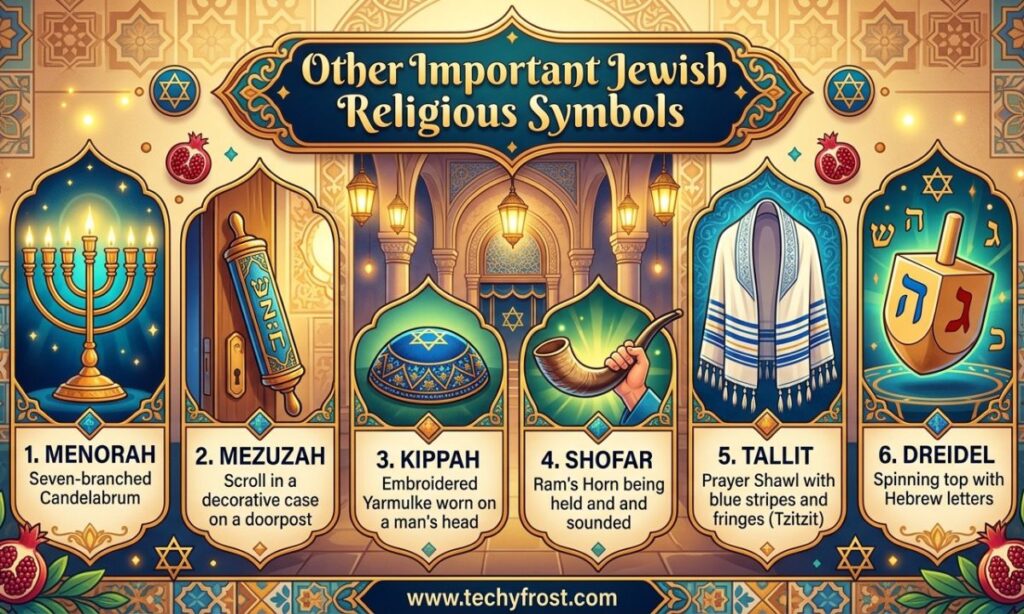
Beyond the five core symbols above, Judaism includes a wide range of additional symbols, each carrying its own story and significance:
- Torah Scroll – The handwritten scroll containing the Five Books of Moses, considered the holiest object in Judaism
- Luchot (The Two Tablets) – Representing the Ten Commandments given at Mount Sinai
- Shofar – A ram’s horn blown during Rosh Hashanah and Yom Kippur, symbolizing repentance and divine awakening
- Lulav and Etrog – Palm branch and citron fruit used during Sukkot, representing the harvest and unity of the Jewish people
- Star of David on Tombstones – Marking Jewish graves and memorial sites
- Priestly Blessing Hands – A hand gesture associated with the Kohanim (priestly class), recognizable as the inspiration for the Vulcan salute in Star Trek
- Tree of Life (Etz Chaim) – Representing the Torah itself and spiritual growth
- Pomegranate – Said to contain 613 seeds, echoing the 613 commandments in Jewish law
- Lion of Judah – Representing strength, royalty, and the tribe of Judah
- Dove and Olive Branch – Symbols of peace, tied to the story of Noah
- Tallit (Prayer Shawl) – Worn during prayer, with knotted fringes (tzitzit) symbolizing the commandments
- Tefillin – Small leather boxes containing scripture, worn during weekday morning prayers
- Kippah (Yarmulke) – A head covering symbolizing humility before God
- Seven Species – Wheat, barley, grapes, figs, pomegranates, olives, and dates, representing the land of Israel’s bounty
- Eternal Flame (Ner Tamid) – A continuously burning light in synagogues, symbolizing God’s eternal presence
- Ark of the Covenant imagery – Representing the holiest vessel in ancient Israelite worship
- Aleph-Bet letters – Hebrew letters themselves carry mystical weight, said in Jewish tradition to form the building blocks of creation
Judaism Symbols Across Cultures
Jewish symbolism has never developed in a single, isolated bubble. As Jewish communities spread across continents, local cultures shaped how these symbols were used, displayed, and understood.
Ancient Hebrew Culture
In the biblical and Second Temple periods, symbolism centered almost entirely on Temple worship — the menorah, the priestly garments, the tablets of the law, and Temple vessels. These were not decorative choices but functional religious objects tied directly to commanded ritual practice.
Medieval Europe
During the medieval period, the hexagram became associated chiefly with magic and the insignia of individual families or communities rather than as a unifying national symbol. It wasn’t until communities like Prague began using it on flags and seals that the star started gaining wider recognition as a marker of Jewish identity. This period also saw the rise of Kabbalistic mysticism, which deepened symbolic interpretations of numbers, letters, and geometric shapes.
Middle Eastern Jewish Traditions
Sephardic and Mizrahi Jewish communities, living for centuries throughout North Africa and the Middle East, embraced symbols like the hamsa far more visibly than their Ashkenazi counterparts. Among Sephardic Jews, the Hamsa was widely used for centuries, especially in North Africa and the Middle East, often paired with the evil eye symbol for double protective meaning.
Modern Western Culture
In the 19th and 20th centuries, particularly following Jewish emancipation in Europe, Jews began looking for a symbol to represent themselves comparable to the cross used by Christian neighbors, eventually settling on the six-pointed star largely because of its heraldic associations. This period cemented the Star of David’s modern role as the primary visual marker of Jewish identity in the West.
Mystical Kabbalah Traditions
Kabbalah added profound symbolic layers to existing objects. In kabbalistic tradition, the menorah’s seven branches are understood as corresponding to the seven lower sefirot — divine emanations including lovingkindness, strength, beauty, endurance, humility, foundation, and sovereignty — through which divine energy flows into the world. Similarly, the hexagram took on mystical meaning tied to cosmic directions and divine balance.
Judaism Symbols in Sacred Texts and Worship
Many Jewish symbols are not later additions but are commanded directly within sacred scripture, making them inseparable from worship itself.
- Torah-commanded symbols include the mezuzah (Deuteronomy 6:9), tefillin (Deuteronomy 6:8), and tzitzit fringes on garments (Numbers 15:38)
- The menorah appears with exact construction instructions in Exodus 25:31-40, specifying its material, branches, and decorative almond-blossom motifs
- The shofar is referenced throughout the Torah and Prophets as a call to attention, repentance, and divine revelation
- Liturgical references to “Shield of David” appear in the Siddur, the traditional prayer book, used poetically to invoke divine protection — independent of any visual hexagram symbol
In synagogue worship today, several symbols converge visually: an open Torah ark often flanked by tablets, a menorah or Ner Tamid burning nearby, and Stars of David frequently worked into stained glass or metalwork. This layering of symbols within a single worship space reinforces a unified visual theology every time a congregation gathers.
Judaism Symbols in Art, Movies and Pop Culture
Jewish symbols have moved well beyond religious settings into mainstream art, film, and music, often carrying their original meaning into new contexts.
- Fiddler on the Roof (1971) popularized the Chai symbol and the toast “L’chaim” (“To life”) for global audiences far beyond Jewish communities
- Star Trek’s Vulcan salute, created by actor Leonard Nimoy, was directly inspired by the Priestly Blessing hand gesture used by Kohanim
- Celebrity jewelry has brought Jewish symbols into fashion — figures from Elvis Presley to baseball star Rod Carew have worn Chai necklaces, while Canadian rapper Drake wore one on the cover of Vibe magazine in 2010
- Architecture and monuments worldwide use the Star of David and menorah as instantly recognizable shorthand for Jewish heritage sites, museums, and memorials
- Modern Judaica art continues to reinterpret traditional symbols like the hamsa and tree of life through contemporary materials and design styles, especially in Israeli jewelry design
This crossover into pop culture has helped many Jewish symbols become globally recognized, even among people unfamiliar with their religious origins.
Spiritual and Dream Meaning of Judaism Symbols
For many people, Jewish symbols appearing in dreams carry symbolic weight, often interpreted through a lens of identity, protection, or spiritual messaging. While dream interpretation is subjective and not part of normative Jewish religious practice, these are common reflective associations people draw.
Dreaming of the Star of David
Dreaming of the Star of David is often interpreted as a sign of seeking protection, balance, or a deeper connection to one’s heritage and identity. It may reflect a desire for harmony between the spiritual and physical aspects of life.
Dreaming of a Menorah
A menorah appearing in a dream is frequently associated with illumination, guidance, or a need for clarity during a confusing period. It can symbolize hope and the search for wisdom in uncertain circumstances.
Dreaming of Hebrew Letters
Dreams featuring Hebrew letters may point toward a search for deeper meaning, communication, or unresolved spiritual questions. Given the mystical weight Hebrew letters carry in Kabbalah, such dreams are sometimes interpreted as invitations toward study or self-reflection.
Dreaming of a Mezuzah
Dreaming of a mezuzah often relates to themes of home, safety, and boundaries. It may suggest a need to protect one’s personal space or a desire to feel more rooted and secure in one’s surroundings.
Positive and Negative Meanings of Judaism Symbols
Like most powerful symbols, Jewish icons carry both uplifting and painful associations depending on historical context.
Positive Meanings
- Continuity and survival of the Jewish people across millennia
- Divine protection and covenant between God and Israel
- Hope, light, and wisdom, especially through the menorah
- Cultural pride and identity, particularly through modern jewelry and art
- Connection to ancestry and tradition across generations
Negative Associations
- During the Holocaust, Nazis forced Jews to wear yellow patches shaped as the Star of David, turning a symbol of identity into a tool of persecution and humiliation
- Some symbols, like the hamsa, carry internal religious debate, with certain rabbinic authorities questioning whether folk amulets align with core Jewish theology
- Antisemitic groups have at times distorted or misused Jewish symbols to spread hatred, requiring ongoing education to reclaim their true meaning
Understanding both sides of this history is essential to appreciating why these symbols remain emotionally charged and culturally significant today.
Why Humans Are Attracted to Judaism Symbols
Symbols satisfy a deep human need for meaning, belonging, and continuity. People are drawn to Jewish symbols for several overlapping reasons:
- Visual simplicity carrying deep meaning — A six-pointed star or a single Hebrew letter can communicate centuries of belief in one glance
- Connection to ancestry — Many people wear or display these symbols to honor family heritage and Jewish lineage
- Universal themes — Concepts like light, protection, and life resonate even with people outside the Jewish faith
- Aesthetic appeal — The geometric elegance of the Star of David or the flowing lines of a hamsa hand make these symbols popular in jewelry and design
- Spiritual resilience — Symbols tied to survival and continuity, like Chai, offer comfort during difficult times
This universal pull explains why Jewish symbols appear not only in religious contexts but across fashion, home décor, and even tattoo art worldwide.
Judaism Symbols and Their Role in Modern Identity
In contemporary life, Jewish symbols function as powerful, portable markers of identity, especially for Jews living far from concentrated Jewish communities. A Star of David necklace can quietly signal belonging in a crowd. A mezuzah on a doorpost identifies a Jewish household before anyone steps inside.
For younger generations, particularly in the diaspora, these symbols often serve as accessible entry points into a broader Jewish identity, even for those who may not practice religious rituals regularly. Wearing a Chai pendant or hanging a hamsa can be a meaningful act of cultural connection independent of strict religious observance.
These symbols have also taken on political and national dimensions. The Star of David’s placement on Israel’s flag means it now carries both religious and national identity simultaneously, a dual role that adds complexity to how the symbol is read in different contexts worldwide.
Judaism Symbols in Contemporary Jewish Communities
Today, Jewish symbols remain deeply woven into everyday communal life:
- Synagogues continue to feature menorahs, Torah arks, and Star of David motifs in architecture and stained glass
- Jewish day schools and camps often incorporate symbols like the open Torah scroll into institutional logos
- Life-cycle events — births, bar/bat mitzvahs, weddings, and funerals — regularly involve symbolic objects like the tallit, chai jewelry, and tombstone engravings
- Holiday celebrations bring specific symbols to the forefront, such as the Hanukkiah during Hanukkah or the lulav and etrog during Sukkot
- Interfaith and cultural dialogue increasingly uses these symbols as starting points for education about Jewish history and combating antisemitism
Across Orthodox, Conservative, Reform, and secular Jewish communities alike, these symbols continue to adapt to modern life while staying tethered to ancient meaning — proof that Jewish symbolism is a living, evolving tradition rather than a frozen museum piece.
Frequently Asked Questions
What is the most important symbol in Judaism?
The menorah and the Star of David are widely considered the two most important Jewish symbols, though historically the menorah is older and was the primary emblem before the Star of David rose to prominence in recent centuries.
Is the Star of David older than the menorah?
No. The menorah, commanded in the Book of Exodus, predates the Star of David’s association with Jewish identity by well over a thousand years.
What does the number 18 mean in Judaism?
The number 18 corresponds to the Hebrew word “chai,” meaning life, through the mystical practice of gematria, making it a popular number for gifts and blessings.
Is the hamsa a Jewish symbol?
The hamsa is used by Jewish, particularly Sephardic and Mizrahi, communities, though some rabbinic authorities debate whether it is strictly a Jewish religious symbol or a broader Middle Eastern cultural one.
Why do Jews put a mezuzah on their door?
A mezuzah fulfills the biblical commandment in Deuteronomy 6:9 to inscribe God’s words on the doorposts of the home, serving as both religious obligation and spiritual reminder.
What do the colors blue and white mean in Jewish symbolism?
Blue and white are associated with the tallit (prayer shawl) and later became the colors of the Israeli flag, symbolizing purity, divinity, and national identity.
Can non-Jewish people wear Jewish symbols?
There is no religious prohibition against non-Jews wearing symbols like the Star of David or hamsa, though it’s respectful to understand their meaning and significance before doing so.
Conclusion
Jewish symbols offer a window into one of history’s most enduring faith traditions, blending biblical commandment, mystical interpretation, and lived historical experience into a visual language that still speaks clearly today. From the ancient menorah’s light to the modern Star of David’s prominence on Israel’s flag, these symbols tell a continuous story of identity, resilience, and sacred connection.
Whether encountered in a synagogue, a piece of jewelry, or a doorpost mezuzah, each symbol carries layered meaning shaped by thousands of years of history. Understanding these symbols — their origins, their spiritual weight, and their place in modern life — offers genuine insight into Jewish faith and the enduring strength of Jewish identity across the centuries.

