

Holy Thursday is one of the most spiritually charged days in the entire Christian calendar. It sits at the crossroads of sacrifice and love, memory and mystery. Yet for many believers, the rich world of Holy Thursday symbols remains only partially understood. From the chalice on the altar to the towel around Christ’s waist, every object, gesture, and color on this sacred night carries a meaning that goes far deeper than ritual.
This article unpacks 95+ symbols connected to Holy Thursday — also known as Maundy Thursday — and explores what they mean theologically, culturally, and spiritually. Whether you’re preparing for a Holy Week liturgy, researching Catholic traditions, or simply curious about the deeper story behind the Last Supper, you’ll find everything you need here.
What Are Holy Thursday Symbols?

Holy Thursday symbols are the sacred objects, actions, and visual signs used to commemorate the events of the night before Jesus Christ’s crucifixion. These symbols span the institution of the Eucharist, the washing of feet, the betrayal by Judas, the stripping of the altar, and the beginning of Christ’s Passion.
They are not decorative. Each one is a theological statement — a visible word that speaks what human language sometimes cannot. The Church has used these symbols for over two thousand years to pass on the mystery of faith from one generation to the next.
Holy Thursday Meaning and Symbolism
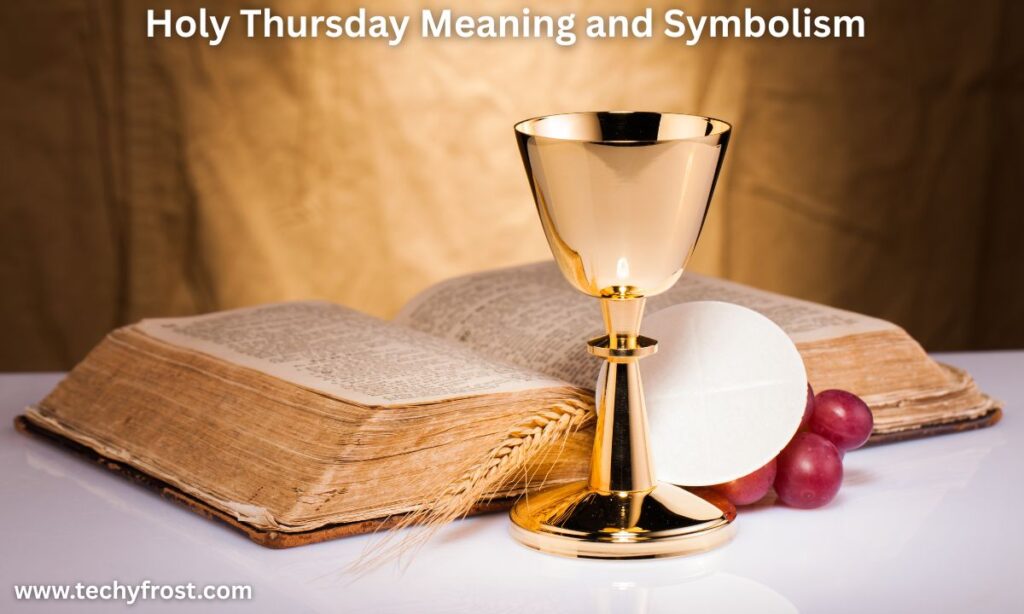
Holy Thursday Meaning
Holy Thursday — formally called The Thursday of the Lord’s Supper — falls three days before Easter and marks the beginning of the Paschal Triduum, the holiest three-day period in Christianity. On this night, Jesus gathered with His twelve apostles in the Upper Room in Jerusalem to celebrate the Jewish Passover meal.
Three defining events took place:
- The Institution of the Eucharist — Jesus took bread and wine and declared them His Body and Blood, establishing what Christians celebrate as Holy Communion to this day.
- The Washing of Feet — He rose from the table and, wrapping a towel around His waist, washed the feet of His disciples — a shocking act of servant leadership.
- The New Commandment — He gave His disciples a mandate: “Love one another as I have loved you” (John 13:34).
The word “Maundy” is derived from the Latin mandatum, meaning commandment — a direct reference to this new command of love.
Thursday Symbolism in Christian Tradition
Thursday itself holds symbolic weight. In the ancient Christian liturgical calendar, Thursday was associated with the institution of the priesthood and the Eucharist. It was the day the old Passover gave way to a new and eternal covenant sealed not in animal blood but in the self-offering of Christ.
Happy Holy Thursday: Understanding the Day’s Dual Nature

Many people ask: should Holy Thursday be celebrated joyfully or solemnly? The answer is both. The Presbyterian Church describes Maundy Thursday as having “a celebratively somber and solemnly celebrative” character. We rejoice in the gift of the Eucharist and the example of humble service. We also grieve, knowing that this meal preceded betrayal, suffering, and death. Both responses are honest, and both are sacred.
Holy Week Symbols and Meanings: A Complete Overview
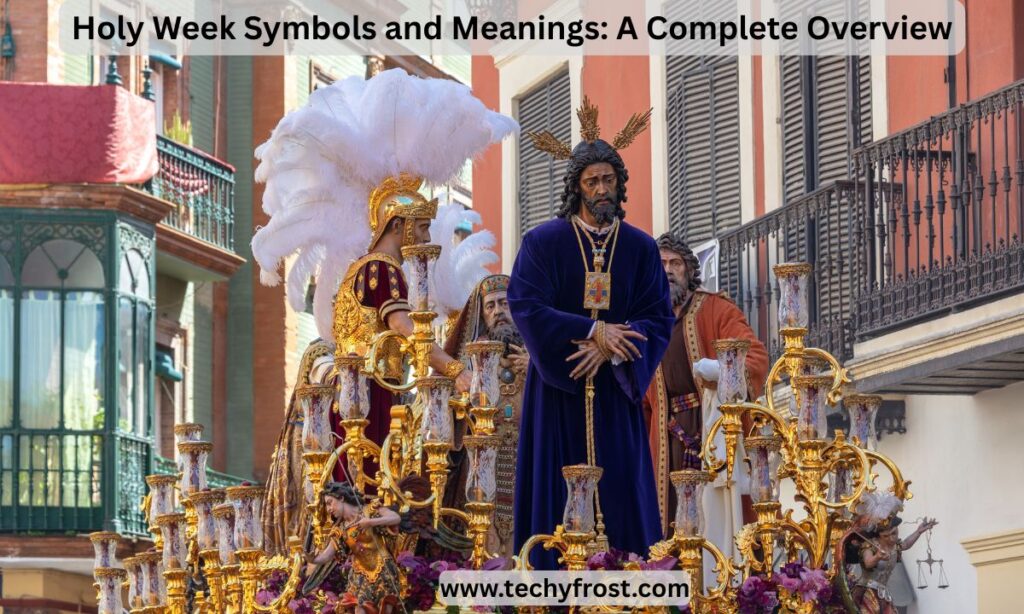
Holy Week is filled with interlocking symbols that tell the full story of Christ’s Passion and Resurrection. Here is how the key Holy Week symbols connect:
| Symbol | Holy Week Day | Core Meaning |
| Palm branches | Palm Sunday | Triumph of Christ entering Jerusalem |
| Bread and wine | Holy Thursday | Body and Blood of Christ; New Covenant |
| Basin and towel | Holy Thursday | Servant leadership; humility |
| Chalice | Holy Thursday | Christ’s Blood poured out for humanity |
| Stripped altar | Holy Thursday / Good Friday | Christ abandoned; Church in mourning |
| Cross | Good Friday | Redemption through sacrifice |
| Easter candle | Holy Saturday / Easter | Resurrection; Light of Christ |
| Empty tomb | Easter Sunday | Victory over death |
Good Friday Symbol Connection to Holy Thursday
Good Friday cannot be understood apart from Holy Thursday. The symbols of the Last Supper — bread, wine, the chalice — point directly to the Cross. The bread broken at the Last Supper foreshadows the body broken on Calvary. The wine poured out anticipates the blood shed on Good Friday. Every Holy Thursday symbol contains within it a shadow of Good Friday.
The stripped altar, which takes place at the close of the Holy Thursday Mass, is perhaps the most dramatic bridge between the two days. When the altar is left bare and dark, the church community enters symbolically into Christ’s abandonment and arrest in the Garden of Gethsemane.
Holy Thursday Symbols Catholic: The Full Liturgical Picture
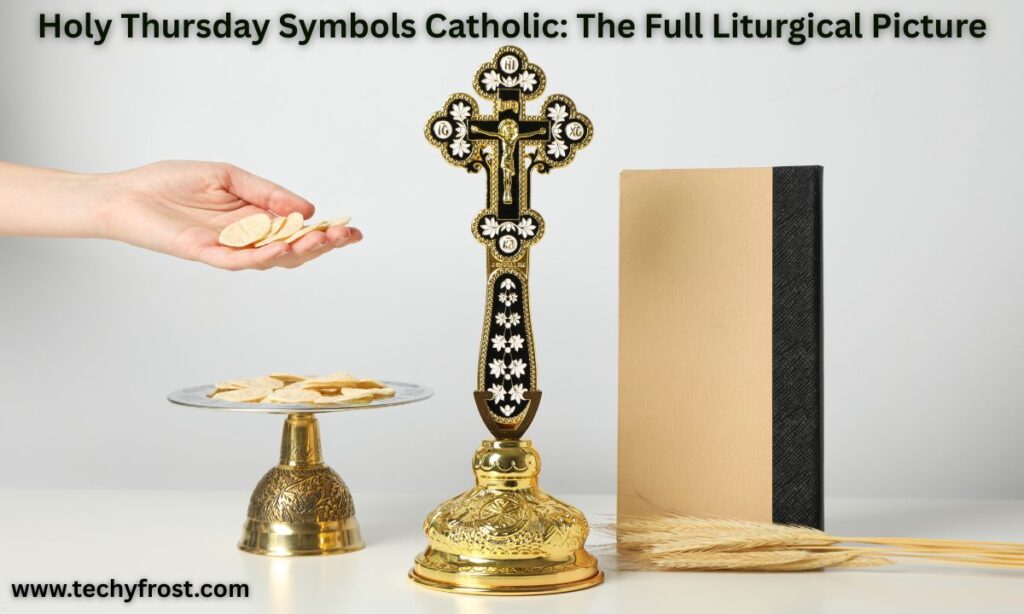
Catholic Holy Thursday Symbols Explained
In the Roman Catholic tradition, Holy Thursday is observed with a solemn evening Mass called the Mass of the Lord’s Supper. The liturgy is packed with symbolic actions, each carrying deep theological meaning.
The liturgical color for Holy Thursday is white — the color of feasts, joy, and the presence of Christ. This distinguishes it from the red and black associated with the days of Passion that follow.
Key Catholic Holy Thursday symbols include:
- The Chalice — represents the cup Jesus held when He declared “This is the chalice of my Blood.”
- The Host (Consecrated Bread) — the central symbol of the Eucharist, Christ’s Real Presence.
- The Tabernacle (left open and empty) — after Mass, the tabernacle is emptied, reminding the faithful that Christ has entered His Passion.
- The Altar of Repose — adorned with flowers, it becomes the temporary home of the Blessed Sacrament through the night.
- The Chrism Oils — blessed in the morning Chrism Mass, symbolizing priesthood, healing, and initiation.
- White Vestments — worn by priests, signifying the joy of the Eucharist.
- The Towel and Basin — used in the foot-washing ceremony.
- Psalm 22 — intoned during the stripping of the altar: “My God, My God, why have you abandoned me?”
Maundy Thursday Symbols Explained
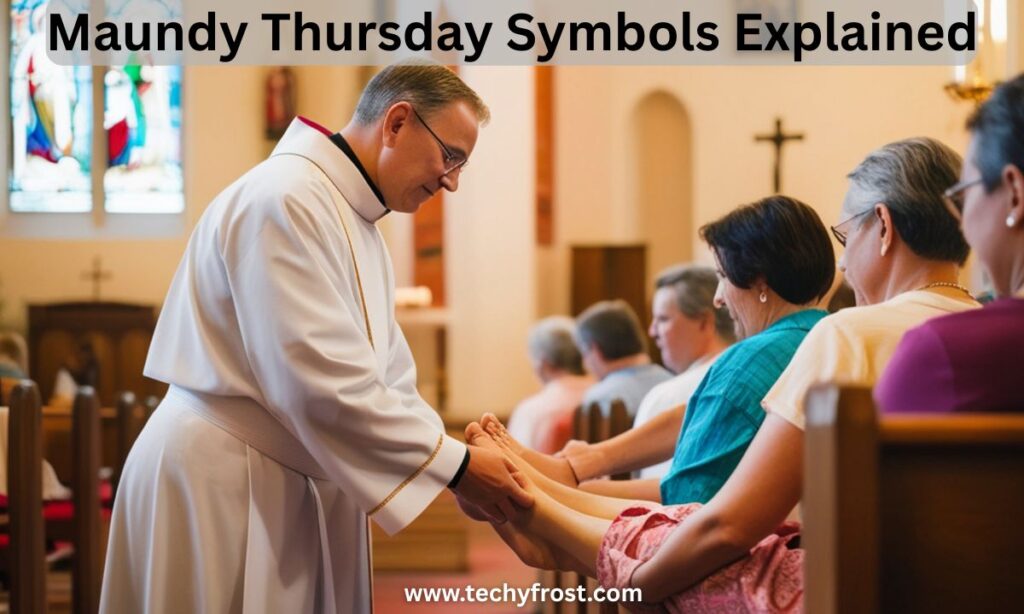
Symbols of Maundy Thursday Across Christian Denominations
Maundy Thursday symbols are observed not only by Catholics but across a wide range of Christian traditions:
| Denomination | Key Maundy Thursday Symbols and Practices |
| Roman Catholic | Eucharist, foot washing, chrism oils, stripped altar, altar of repose |
| Anglican / Episcopal | Holy Communion, foot washing, stripping of the altar |
| Lutheran | Lord’s Supper, stripping of altar, bare lectern and pulpit |
| Methodist | Holy Communion, foot washing, Tenebrae service |
| Eastern Orthodox | Foot washing ceremony, blessing of holy oils |
| Presbyterian | Lord’s Supper, foot washing, stripping of the sanctuary |
| Baptist / Evangelical | Communion service, remembrance of the Last Supper |
Last Supper and Eucharist Symbols
Last Supper Holy Thursday Symbols
The Last Supper is the defining event behind every Holy Thursday symbol. Understanding it requires knowing its Jewish context: Jesus celebrated the Passover Seder with His disciples. The Passover meal itself was already rich in symbolism — unleavened bread, lamb, bitter herbs, four cups of wine — all commemorating Israel’s liberation from Egypt.
Jesus transformed this ancient ritual. He took the unleavened bread, broke it, and said: “This is my body, which will be given up for you.” He took the cup of wine and declared: “This is the chalice of my Blood — the Blood of the new and eternal covenant.”
In doing so, He became the new Passover Lamb — not freeing one nation from physical slavery, but freeing all humanity from sin and death. The symbols of bread and wine became infinitely richer.
Holy Eucharist Holy Thursday Symbols
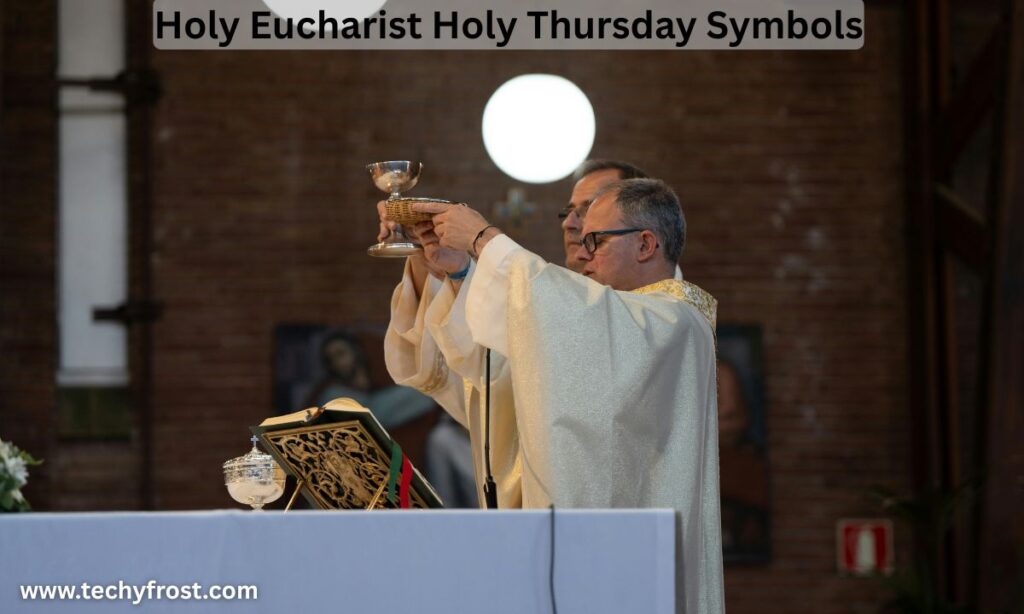
The Eucharist — from the Greek word eucharistia, meaning “thanksgiving” — is the central sacrament that flows directly from Holy Thursday. Its symbols include:
- Wheat — from which bread is made; symbol of the Incarnation (the Word becoming flesh)
- Grapes / Vine — from which wine is made; Jesus called Himself “the true vine” (John 15:1)
- Five loaves and two fish — recalling the miraculous feeding, a foreshadowing of the Eucharist
- The breaking of bread — a gesture of communion and shared life
- The chalice — containing the wine that becomes the Blood of Christ
- The host (circular wafer) — its round shape symbolizes eternity and wholeness
- The altar — representing both the table of the Last Supper and the sacrifice of the Cross
- The corporal (white linen cloth) — recalling the burial shroud of Christ
- Candles on the altar — signifying the Light of Christ present in the Eucharist
Washing of Feet Symbols

Jesus Washing Feet Holy Thursday Symbols
The foot-washing scene is found only in the Gospel of John (13:1–17) and is one of the most dramatic acts in all of Scripture. Jesus — Lord and Teacher — knelt before His disciples and performed the work of the lowest household servant.
The symbols embedded in this action are layered:
- Water — purification, baptism, cleansing from sin
- The basin — humility; a vessel that receives rather than pours itself out
- The towel — service; Jesus wrapped it around Himself as a servant’s garment
- Kneeling — the posture of submission and love
- Feet — in ancient culture, the most unclean part of the body; washing them was the ultimate act of humility
- Peter’s refusal, then acceptance — symbolizing humanity’s reluctance to receive grace, and the necessity of accepting it
The foot-washing is also read as a symbol of baptism — a cleansing that prepares the disciples for the Eucharist. Jesus told Peter: “Unless I wash you, you have no share with me” (John 13:8).
Creative and Visual Symbols of Holy Thursday
Holy Thursday Clipart and Action Symbols
In contemporary Christian art, education, and liturgical design, Holy Thursday is represented through a range of visual symbols:
Physical / Object Symbols:
- Chalice and host
- Bread loaf and grapes
- Basin and pitcher
- Towel
- Oil lamp / candle
- Twelve flames (representing the apostles)
- Keys (symbol of priesthood)
- Olive branch (symbol of peace and anointing)
- Hyssop branch (used in altar preparation)
- Purple stole (worn during altar stripping)
Action / Gesture Symbols:
- Kneeling
- Pouring water
- Breaking bread
- Lifting the chalice
- The prostration at the start of Good Friday
- Processing with the Blessed Sacrament
- Keeping vigil through the night
Color Symbols:
- White — feast and joy (Holy Thursday Mass)
- Gold — the glory of the Eucharist
- Purple — mourning (after the altar is stripped)
- Black — Passion and death (Good Friday)
Holy Thursday Images Free Download and Maundy Thursday Images 2026
Many Catholic and Christian parishes seek imagery for bulletins, social media, and devotional cards for Holy Thursday 2026 (which falls on April 2, 2026 in the Western calendar). Common visual themes include:
- Leonardo da Vinci’s The Last Supper (public domain)
- Depictions of the foot-washing scene
- Chalice and host compositions
- Stripped altar photography from liturgical settings
- Candle vigil scenes at altars of repose
Deep Symbolic Meaning: Types and Variations of Holy Thursday Symbols
The Bread and Wine
This is the foundational symbol of Holy Thursday and indeed of all Christianity. Bread and wine appear throughout Scripture — from Melchizedek’s offering to Abraham (Genesis 14:18) to the feeding of the five thousand — before reaching their fullest meaning at the Last Supper. Catholics believe the bread and wine become the actual Body and Blood of Christ (transubstantiation). Protestant traditions generally understand them as powerful symbolic memorials of Christ’s sacrifice.
The Basin and Towel
The basin and towel together form the symbol of servant leadership. They appear in church logos, retreat center crests, and ministry badges worldwide. Together they represent the radical claim that greatness in the Kingdom of God is measured by how willingly one serves, not by rank or recognition.
The Chalice
The chalice — also called the cup or goblet — is among the oldest Christian symbols in existence. It appears in catacomb art, ancient mosaics, and medieval illuminated manuscripts. The chalice symbolizes:
- The Blood of Christ
- The New Covenant
- Suffering accepted in love (“Father, if you are willing, take this cup from me” — Luke 22:42)
- The cup of salvation shared among believers
The Twelve Disciples
The number twelve is itself symbolic — mirroring the twelve tribes of Israel. At the Last Supper, the Twelve gathered around Jesus represent the new Israel, the Church. Their diversity (fishermen, a tax collector, a zealot) symbolizes the universal reach of the Gospel. Judas among them symbolizes the reality of betrayal within community, and the enduring mercy of Christ who washed his feet too.
The Stripped Altar
Few liturgical moments are as visually striking as the stripping of the altar. All cloths, candles, flowers, and vessels are removed. What remains is bare stone or wood — cold, exposed, silent. This powerful image represents:
- Christ stripped of His garments before crucifixion
- The Church entering into mourning
- The darkness of the world without the Eucharist
- The absence of Christ’s sacramental presence until the Easter Vigil
Holy Thursday Symbols Across Cultures
Holy Thursday is observed globally, and different cultures bring their own symbolic expressions to the celebration:
- United Kingdom — The King distributes Maundy Money (special coins) instead of washing feet, a tradition stretching back to medieval times.
- Philippines — Elaborate processions and Visita Iglesia (visiting seven churches) on Holy Thursday night.
- Latin America — Communities re-enact the Last Supper with dramatic foot-washing ceremonies involving local leaders.
- Ethiopia (Ethiopian Orthodox) — The Hossana celebrations include unique foot-washing rites and communal prayer vigils.
- Poland — Holy Thursday marks the blessing of special foods and intense preparation of the church for the Easter Triduum.
Holy Thursday Symbols in Art, Movies, and Pop Culture
Leonardo da Vinci’s The Last Supper (1495–1498) is the most recognized artwork in the world depicting Holy Thursday themes. It has been referenced, parodied, and reinterpreted thousands of times — from Salvador Dalí’s surrealist version to countless film stills.
In cinema, Holy Thursday symbolism appears in films such as The Passion of the Christ (2004), where the Last Supper sequence uses rich lighting and shadow to underscore the Eucharistic symbols. In literature, James Joyce’s Portrait of the Artist as a Young Man uses Holy Thursday imagery to explore guilt, transformation, and spiritual crisis.
Spiritual and Dream Meaning of Holy Thursday Symbols
In Christian spirituality and dream interpretation traditions, Holy Thursday symbols carry the following meanings:
| Symbol | Spiritual / Dream Meaning |
| Chalice | Calling to a deeper sacrifice or surrender |
| Bread being broken | A season of giving — of self, time, or resources |
| Washing of feet | Invitation to humility; letting go of pride |
| Stripped altar | A period of spiritual emptiness before renewal |
| Twelve disciples | Community; belonging; the importance of your circle |
| Candle vigil | Perseverance through a dark season; watchfulness |
Positive vs. Negative Meaning of Holy Thursday Symbols
Most Holy Thursday symbols carry both a positive (redemptive) and a sobering (sacrificial) dimension:
| Symbol | Positive Meaning | Sobering Meaning |
| Bread and wine | Nourishment; eternal life; communion | Body broken; blood poured out |
| Basin and towel | Love in action; servant leadership | Judas’s feet were washed too — betrayal follows |
| The chalice | Salvation; the new covenant | The cup of suffering Christ asked to pass |
| The stripped altar | Preparation; honesty before God | Abandonment; grief; the silence of God |
| The twelve disciples | Unity; the new Israel | One would betray; one would deny |
Why Humans Are Attracted to Holy Thursday Symbols
There is something about ritual symbols that reaches past the intellect and touches the soul directly. Holy Thursday symbols endure because they speak to universal human experiences:
- The meal — every culture gathers around food to mark meaning; the Last Supper elevates the ordinary act of eating into something eternal.
- Service — the foot-washing speaks to the part of us that longs to be valued and chosen for who we are, not what we can offer.
- Betrayal and forgiveness — Judas is in every room; so is Jesus’ willingness to wash his feet anyway. That paradox holds a mirror to human experience.
- Endings and beginnings — Holy Thursday is an evening of “last things” — yet it births the Eucharist, which the Church celebrates until the end of time.
Symbols work because they hold more meaning than words alone can carry. Holy Thursday symbols have been doing that for over two thousand years.
Conclusion
Holy Thursday is not simply a date on the calendar. It is a night charged with meaning that has shaped two thousand years of Christian worship, art, ethics, and community life. Every symbol — from the chalice to the towel, from the bare altar to the flickering candle at the altar of repose — is a doorway into the mystery of divine love expressed in ultimate sacrifice.
Whether you are exploring these symbols for the first time or deepening a lifelong faith, the invitation is the same as it was in the Upper Room: to receive, to serve, and to love one another as He loved us.
Approaching Holy Thursday with a symbol-aware heart transforms the liturgy from a ceremony you attend into a mystery you enter.

