

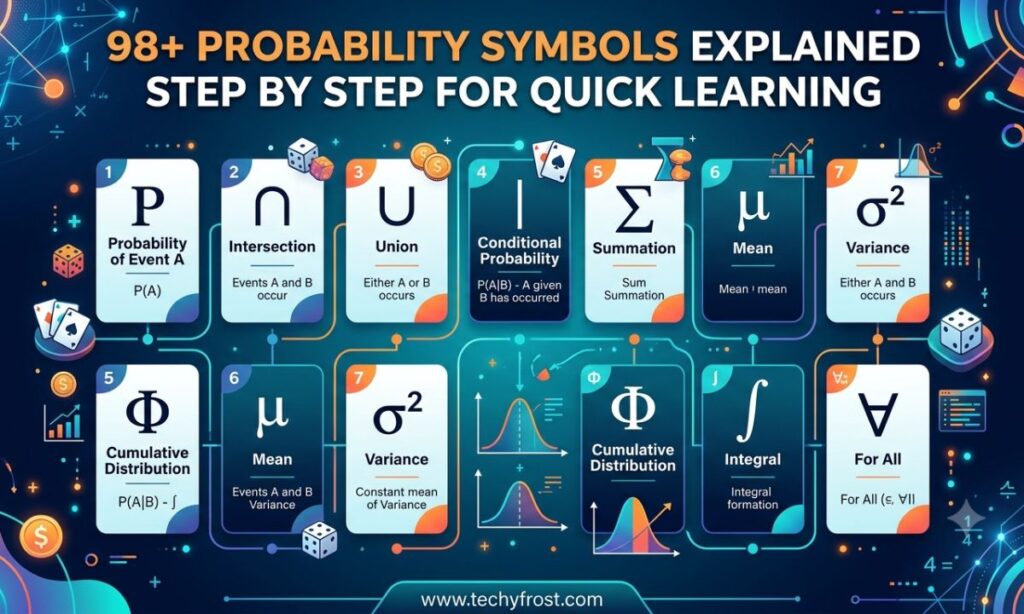
If you have ever stared at a statistics textbook and wondered what P(A|B) or ∩ actually means, you are not alone. Probability symbols look intimidating at first, but they are simply a shorthand language for describing chance.
This guide walks you through every major probability symbol, from the basic P(A) to advanced notation used in Bayes’ theorem — a complete, easy-to-follow reference for students, teachers, and data professionals alike.
By the end, you will be able to read, write, and explain probability notation with confidence.
What Are Probability Symbols?
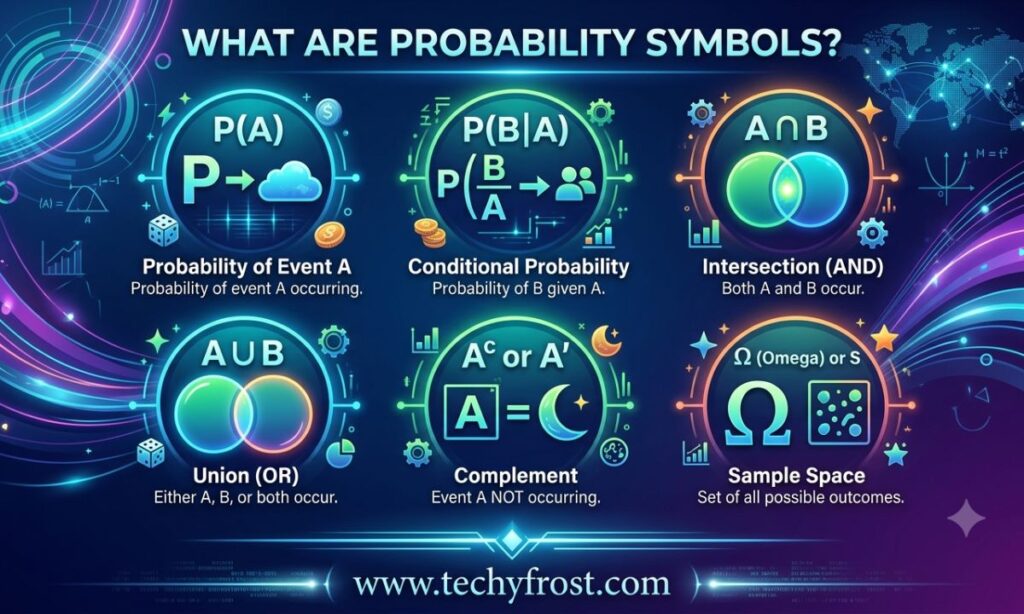
Probability symbols are mathematical signs used to represent the likelihood of an event happening. Instead of writing “the probability that event A occurs,” mathematicians use compact notation such as P(A) to say the same thing faster.
These symbols come from a mix of Latin letters, Greek letters, and set theory notation:
- Some describe a single event (like P(A))
- Some describe relationships between events (like ∩, ∪, or the vertical bar)
- Some describe statistical measures tied to probability, such as mean and standard deviation
Introduction to Probability Notation
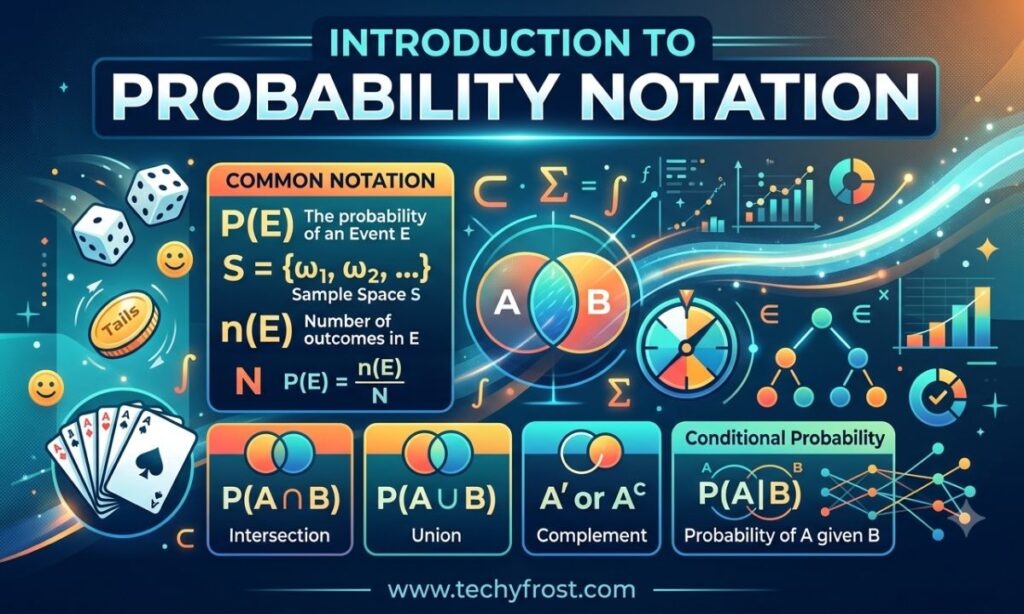
Probability notation exists for one simple reason: efficiency. Writing out full sentences every time you describe an event would make math problems painfully long. Notation compresses ideas into symbols that anyone trained in mathematics can instantly recognize, regardless of language or country.
Most probability notation falls into three broad categories:
- Event notation – symbols that describe what is happening (P(A), P(A’), P(A|B))
- Set notation – symbols borrowed from set theory to describe combinations of events (∩, ∪, ⊂)
- Statistical notation – symbols that describe the broader distribution of outcomes (μ, σ, ∑, Σ)
Learning probability notation is similar to learning a new alphabet. With repetition, your brain starts reading P(A ∩ B) the same way it reads a sentence — instantly and without translation.
Understanding Probability Symbols And Their Meanings
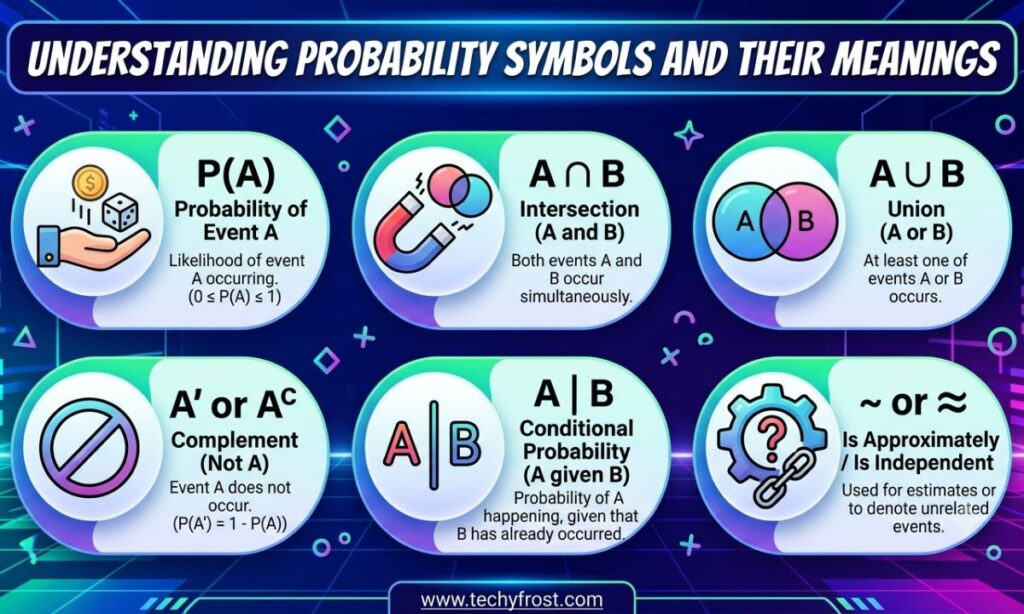
The core idea behind every probability symbol is the same: it represents a number between 0 and 1, where 0 means an event is impossible and 1 means it is certain. Everything else builds on top of that single concept.
Probability Symbols With Examples
Here is a quick snapshot of the most common symbols with practical, real-world examples attached.
| Symbol | Meaning | Example |
|---|---|---|
| P(A) | Probability of event A | P(rolling a 4) = 1/6 |
| P(A’) | Probability of A not happening | P(not rolling a 4) = 5/6 |
| P(A ∩ B) | Probability of A and B both happening | P(rain and wind) |
| P(A ∪ B) | Probability of A or B happening | P(rain or wind) |
| P(A|B) | Probability of A given B has happened | P(late|traffic) |
| ∑ | Sum of all probabilities | ∑P(x) = 1 |
These examples are intentionally simple because the goal is recognition, not memorization. Once the pattern clicks, harder problems become easier to decode.
Probability Symbols And Meanings
Some symbols carry more than one interpretation depending on context. The vertical bar “|” almost always means “given,” but its surrounding letters change the entire meaning of the statement. A useful habit is to read each symbol out loud in plain English: P(A ∩ B) becomes “the probability of A and B,” while P(A ∪ B) becomes “the probability of A or B.” This habit alone removes most of the confusion beginners face.
Probability Symbols in Venn Diagrams
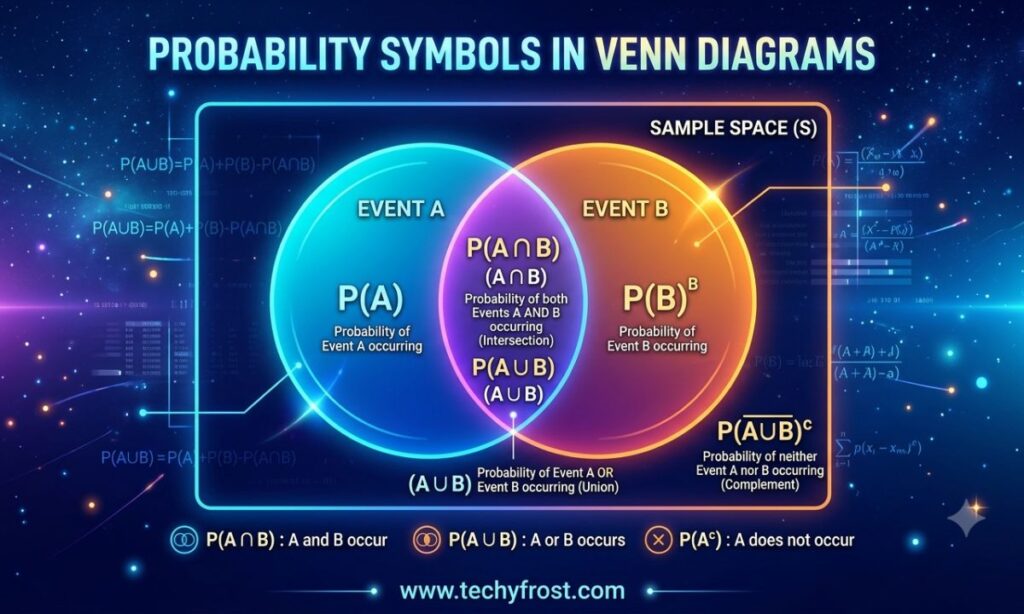
Venn diagrams are one of the best tools for visualizing probability symbols because they turn abstract notation into a picture.
- Intersection (∩): the overlapping region where both circles meet
- Union (∪): the entire shaded area covered by either circle
- Complement (A’): everything outside circle A
- Mutually exclusive events: circles that do not touch at all
Union “unites” everything, while intersection only keeps the shared middle section — much like a literal road intersection where two streets cross.
Conditional Probability Symbols Explained
Conditional probability describes how the probability of one event changes once you know another event has already occurred. It is expressed as P(A|B), meaning the probability of A happening, assuming B has occurred.
The formula behind this symbol is:
P(A|B) = P(A ∩ B) / P(B)
This single formula powers an enormous amount of real-world statistics, from medical testing to spam filters to weather forecasting. A simple way to approach conditional probability problems is to first write down what you know in symbols, then decide whether you need the basic definition, the multiplication rule, or Bayes’ theorem.
Probability Symbols PDF Guide
Many learners prefer a printable reference to keep beside their notes. A good probability symbols PDF should include a full symbol-to-meaning chart, example calculations, key formulas (addition rule, multiplication rule, Bayes’ theorem), and a blank practice section for self-testing. If your textbook does not provide one, build your own using the tables in this article — condensing everything onto a single page makes exam revision faster.
Common Mistakes in Reading Probability Symbols
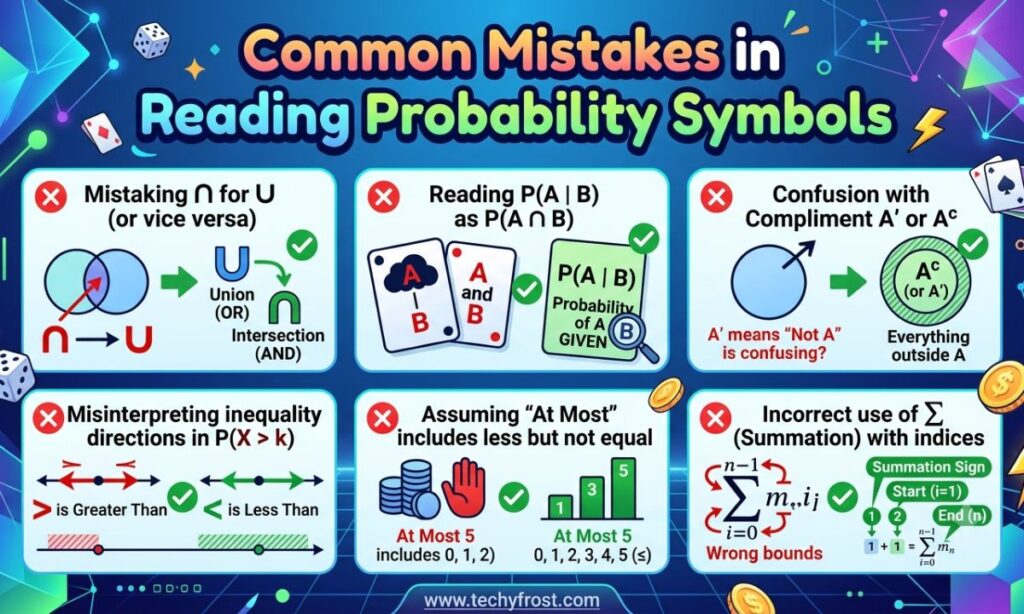
Even strong students mix up probability notation under exam pressure. The most frequent errors include:
- Confusing union (∪) with intersection (∩) because the shapes look similar
- Reading P(A|B) as “probability of A and B” instead of “given B”
- Forgetting that P(A’) means “not A,” not “A squared” or “A prime number”
- Mixing up population symbols (μ, σ) with sample symbols (x̄, s)
- Assuming P(A ∪ B) always equals P(A) + P(B), forgetting to subtract the overlap
Avoiding these mistakes mostly comes down to reading each symbol deliberately rather than skimming.
Complete Guide To Probability Signs And Symbols
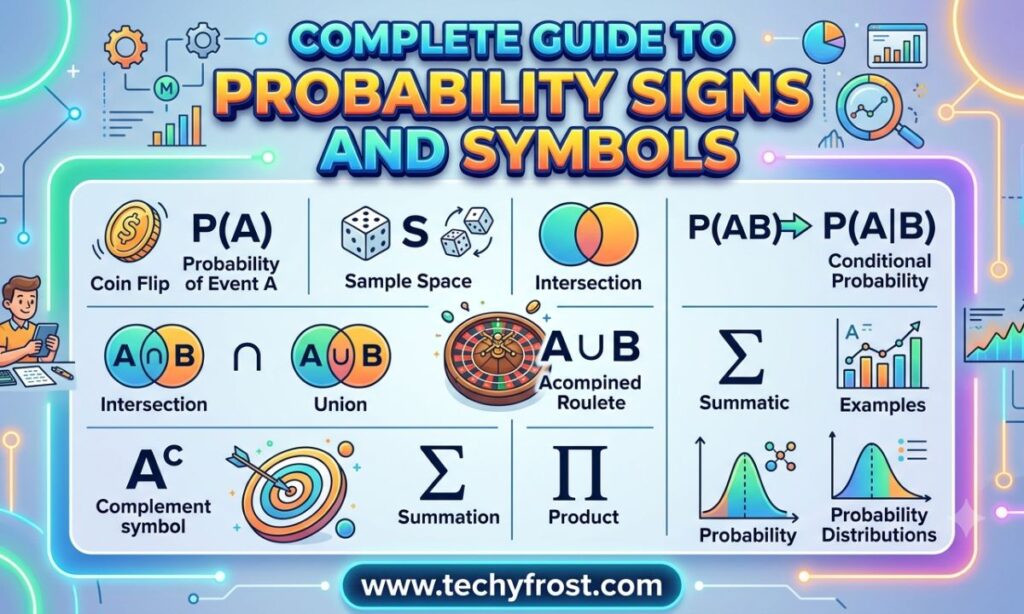
This section expands on the foundational symbols and brings in additional notation used across statistics courses, standardized tests, and data science workflows.
Probability Symbols Meaning
At a glance, here is an expanded reference table covering the most-searched probability symbols and their meanings.
| Symbol | Name | Meaning |
|---|---|---|
| P(A) | Probability function | Likelihood of event A |
| P(A ∩ B) | Intersection | A and B both occur |
| P(A ∪ B) | Union | A or B occurs |
| P(A|B) | Conditional probability | A occurs given B |
| P(A’) or P(Aᶜ) | Complement | A does not occur |
| f(x) | Probability density function | Probability for continuous variables |
| F(x) | Cumulative distribution function | P(X ≤ x) |
| E(X) | Expected value | Long-run average outcome |
| Var(X) | Variance | Spread of outcomes |
| σ | Standard deviation | Average distance from the mean |
| μ | Population mean | Central value of population |
| ∑ | Summation | Adding all values together |
| n! | Factorial | Number of arrangements |
| nCr | Combination | Selections without order |
| nPr | Permutation | Selections with order |
Symbol For Probability (P)
The capital letter “P” is the single most important symbol in this topic. It always means “probability of,” making it the easiest symbol to remember since the letter itself is a clue. Whatever follows inside the parentheses tells you exactly what scenario is being measured.
Probability Signs and Notation Rules
A few core rules govern how these signs behave:
- Every probability value lies between 0 and 1, inclusive
- The probabilities of all outcomes in a sample space must sum to 1
- P(A) + P(A’) = 1 always holds true
- P(A ∩ B) can never be larger than P(A) or P(B)
- P(A ∪ B) can never be smaller than P(A) or P(B)
These rules act as a built-in error check for your calculations.
All Probability Symbols List
For quick scanning, here is a consolidated list grouped by category:
- Event: P(A), P(B), P(C), P(A’)/P(Aᶜ), ∅
- Set theory: ∩, ∪, ⊂, ∈
- Conditional/joint: P(A|B), P(A ∩ B), P(A,B)
- Statistical: μ, σ, σ², x̄, s, ∑, n
- Distribution: f(x), F(x), E(X), Var(X)
Sign of Probability Explained
The “sign of probability” usually refers to the capital P notation itself, sometimes paired with a subscript for a specific distribution, such as P(X = x) for discrete variables. It tells the reader, at a glance, that a chance-based calculation is taking place.
Probability Sign Meanings in Statistics
In statistics, probability signs extend into distribution-based language:
- P(X = x) — the probability that random variable X takes a specific value x
- P(X ≤ x) — cumulative probability, common in standardized test score interpretation
- P(a ≤ X ≤ b) — the probability that a value falls within a range
These extended signs matter once you move from coin-flip examples into real datasets and research.
Deep Symbolic Meaning in Probability Concepts

Beyond pure mathematics, probability symbols carry meaning on multiple levels.
Mathematical Level
On the surface, every symbol is a precise mathematical instruction. P(A ∩ B) is not just a concept — it is a calculable number derived from set theory. The rules never bend, and the same symbol always means the same operation no matter who writes it.
Psychological Level
At their core, probability symbols represent humanity’s attempt to make sense of an uncertain world. Every coin flip, dice roll, or weather forecast taps into a basic need to predict outcomes and reduce anxiety about the unknown. The symbols become a kind of shorthand for control over uncertainty — turning vague worry into a measurable number.
Educational/Conceptual Level
From a teaching standpoint, probability symbols bridge everyday reasoning and formal mathematics. A student who already intuitively understands “there’s a good chance it rains today” is one step away from writing P(rain) = 0.7. The symbol formalizes an instinct the student already has.
Types / Variations of Probability Symbols
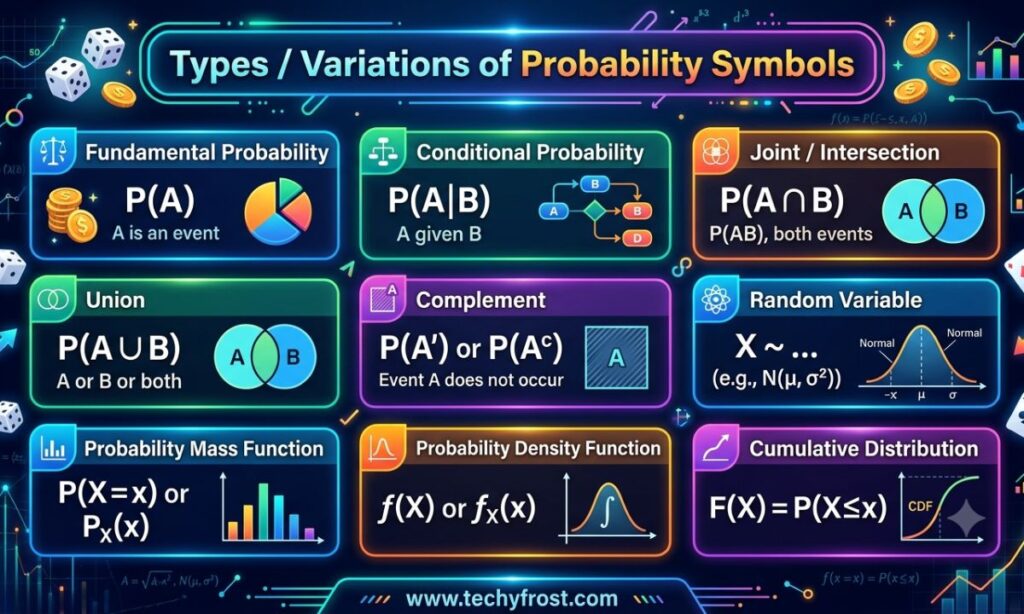
This section breaks down the most important variations one at a time.
P(A) – Basic Probability
This is the foundation of all probability notation: out of all possible outcomes, what fraction belongs to event A? Rolling a standard six-sided die, P(rolling an even number) = 3/6 = 0.5.
P(A ∩ B) – Intersection of Events
This symbol represents the probability that both event A and event B happen at the same time. The ∩ symbol looks like a small bridge connecting two things together, much like the events it connects.
Example: The probability that it rains today AND you forget your umbrella.
P(A ∪ B) – Union of Events
This symbol covers situations where either event can satisfy the condition. The ∪ shape resembles a cup, catching outcomes from either side.
Example: The probability that it rains today OR you catch a cold this week.
P(A ∪ B) = P(A) + P(B) − P(A ∩ B)
The subtraction prevents double-counting the overlap between the two events.
P(A|B) – Conditional Probability
Conditional probability is the probability that one event happens given that another has already happened. This is one of the most practically useful symbols here, because real life rarely deals with isolated, independent events.
Example: P(late for work | heavy traffic) is almost always higher than P(late for work) alone.
∑ (Summation Symbol) in Probability
The summation symbol adds together a series of values, most commonly probabilities across all possible outcomes:
∑P(x) = 1
Every possible outcome’s probability, added together, must equal exactly 1. If your calculations sum to anything else, something went wrong.
μ and σ in Statistical Probability
These two Greek letters describe the shape and center of a probability distribution. μ (mu) is the population mean — the long-run average value you would expect. σ (sigma) is the standard deviation — how spread out the values are from that average. Together they describe the shape of common distributions like the normal (bell curve), which appears constantly in test scores, heights, and measurement errors.
Probability Rules and Formulas Using Symbols
Symbols only become useful once you know the rules connecting them.
Addition Rule
Used for finding the probability that at least one of two events occurs.
P(A ∪ B) = P(A) + P(B) − P(A ∩ B)
If the events are mutually exclusive, this simplifies to P(A ∪ B) = P(A) + P(B).
Multiplication Rule
Used for finding the probability that two events both occur.
P(A ∩ B) = P(A) × P(B|A)
If the events are independent, this simplifies to P(A ∩ B) = P(A) × P(B).
Complement Rule
Used for finding the probability that an event does NOT happen.
P(A’) = 1 − P(A)
This is especially useful when calculating “at least one” outcome directly is complicated, but calculating “none at all” is simple.
Bayes’ Theorem Symbols
Bayes’ theorem lets you reverse a conditional probability, combining prior knowledge with new evidence to update beliefs.
P(A|B) = [P(B|A) × P(A)] / P(B)
| Symbol | Meaning |
|---|---|
| P(A) | Prior probability |
| P(B|A) | Likelihood |
| P(B) | Marginal probability |
| P(A|B) | Posterior probability |
Bayes’ theorem is widely used in medical diagnosis, spam filtering, and machine learning models that update beliefs as new evidence arrives.
Probability Symbols Across Educational Systems
Probability notation evolved gradually as different civilizations contributed pieces of the puzzle.
Ancient Greece Foundations
Greek mathematicians laid the early groundwork for logical reasoning and proof-based thinking. Many modern symbols trace back to Greek and Latin letters chosen by mathematicians who needed a shared mathematical language that could cross borders. While the Greeks did not formalize probability theory itself, their work on geometry and logic created the structured thinking probability would later depend on.
Indian Civilization Contributions
Ancient Indian mathematicians made significant advances in combinatorics — counting arrangements and combinations — which forms the backbone of modern calculations like permutations (nPr) and combinations (nCr), appearing in texts centuries before formal probability theory existed in Europe.
Islamic Golden Age Mathematics
Scholars of the Islamic Golden Age preserved, translated, and expanded upon Greek and Indian mathematical works, refining algebraic notation along the way. This period bridged ancient counting methods with the structured algebraic symbols European mathematicians later built probability theory on.
European Renaissance Development
Formal probability theory largely emerged during the European Renaissance, driven by problems involving games of chance and gambling disputes. Mathematicians working through these problems standardized notation, eventually settling on the P(), ∩, and ∪ symbols still used today.
Modern Global Statistics
The vertical bar notation became standard through 20th-century statistics texts, cementing the symbol system used worldwide today. Modern education systems and research journals now use a remarkably consistent set of probability symbols, making mathematics one of the few truly universal academic languages.
Probability Symbols in Real Life Applications
Probability notation is not confined to textbooks. It quietly powers decisions across nearly every industry:
- Weather forecasting: P(rain tomorrow) = 0.6 means a 60% chance of rain
- Insurance: Companies calculate P(claim filed) to set premium prices
- Medicine: Doctors use conditional probability to interpret test results accurately
- Sports analytics: Teams calculate win probabilities from in-game statistics
- Manufacturing: Quality control teams use probability to predict defect rates
- Finance: Investors use probability distributions to model risk and return
Each field relies on the same symbols covered in this guide, just applied to different real-world data.
Probability Symbols in Data Science and AI
Modern data science and AI depend heavily on probability notation. Machine learning models, especially Bayesian methods, use P(A|B) constantly to update predictions as new data arrives.
- Naive Bayes classifiers use conditional probability to filter spam emails
- Neural networks often output probability distributions across possible classifications
- Recommendation systems estimate the probability a user will like a product
- A/B testing uses probability to judge whether a result is statistically meaningful
The symbols from a high school statistics class are the exact same ones used in professional AI research, just applied at a larger scale.
Probability Symbols in Art, Movies and Pop Culture
Probability and chance have long fascinated storytellers and artists. Concepts of fate, odds, and randomness appear throughout literature, film, and games — from gambling scenes in classic movies to puzzle games built entirely around probability mechanics. These portrayals rarely use formal notation on screen, but the underlying fascination with chance is the same human curiosity that drove mathematicians to invent these symbols in the first place.
Common Confusions in Probability Notation
Several notation mix-ups appear again and again across classrooms and online forums:
| Confusion | Clarification |
|---|---|
| P(A∩B) vs P(A,B) | Both mean the same joint probability; notation varies by textbook |
| μ vs x̄ | μ is for population, x̄ is for sample |
| σ vs s | σ is for population, s is for sample |
| P(A|B) vs P(B|A) | These are NOT the same value unless A and B are independent |
| ∪ vs + | Union does not always mean simple addition; overlap must be subtracted |
Recognizing these patterns ahead of time prevents the most common point-loss mistakes on exams.
Why Humans Are Attracted to Mathematical Symbols
There is something satisfying about compressing a complex idea into a single, elegant symbol. Mathematical notation appeals to the brain’s love of patterns and efficiency — once learned, a symbol like ∩ communicates instantly, without the delay of full sentences.
Probability symbols tap into something more personal: our relationship with uncertainty. Humans are wired to seek patterns and predictability, and probability notation gives that instinct a precise, testable language. It transforms vague feelings like “this probably won’t happen” into something measurable, like P(event) = 0.05.
Frequently Asked Questions About Probability Symbols
What does P(A) mean in probability?
P(A) means the probability that event A occurs, expressed as a number between 0 and 1.
What is the difference between ∩ and ∪?
∩ (intersection) means both events happen together, while ∪ (union) means either event happens.
What does the vertical bar “|” mean in probability?
The vertical bar means “given,” used to show conditional probability, such as P(A|B).
What is P(A’) or P(Aᶜ)?
It represents the complement of A, meaning the probability that event A does not occur.
How many probability symbols are there in total?
There is no fixed universal number, but most courses cover between 30 and 50 core symbols across event, set, and statistical notation.
What is the symbol for standard deviation?
The lowercase Greek letter σ (sigma) represents standard deviation in a population.
Is P(A|B) the same as P(B|A)?
No, these represent different conditional relationships and are only equal under special independence conditions.
What does ∑ mean in probability?
∑ means summation, or adding together a series of values, often all probabilities in a sample space.
Final Thoughts on Probability Symbols
Probability symbols can look overwhelming at first, but they follow consistent, learnable rules. Once you understand that P always means “probability of,” that ∩ joins two events together, and that the vertical bar signals a conditional relationship, the notation system becomes far less intimidating.
The best way to master these symbols is through repetition and real examples. Work through practice problems, sketch Venn diagrams by hand, and revisit the tables in this guide whenever you get stuck. With consistent practice, what once felt like a foreign language will start to read as naturally as plain English.

