

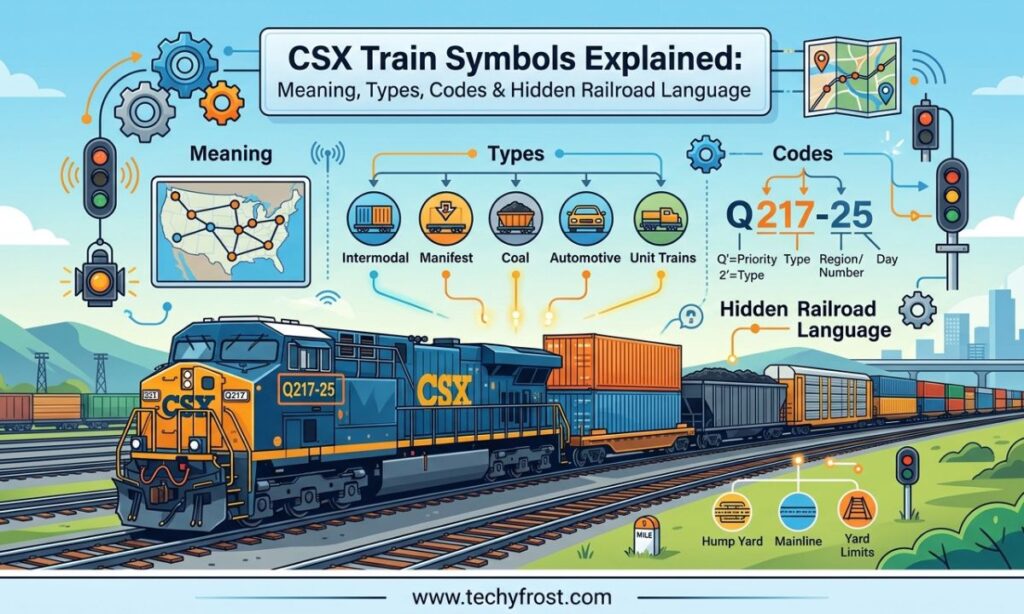
If you’ve ever stood beside a railroad track and watched a freight train roll by, you may have noticed a short alphanumeric code stenciled on paperwork, heard crackling over a scanner, or spotted it on a tracking app. That combination of a letter and three digits — something like Q416, M647, or I026 — is a CSX train symbol. It’s not random. It’s a language.
CSX Transportation, one of the largest Class I freight railroads in North America, operates across more than 20,000 route miles in the eastern United States. Keeping that network moving requires precision communication. Train symbols are the backbone of that communication. They tell dispatchers, crews, and yard workers exactly what a train is, where it’s going, what it’s carrying, and how much priority it holds.
This article breaks down everything you need to know about CSX train symbols — from the technical to the deeply human.
What Are CSX Train Symbols?
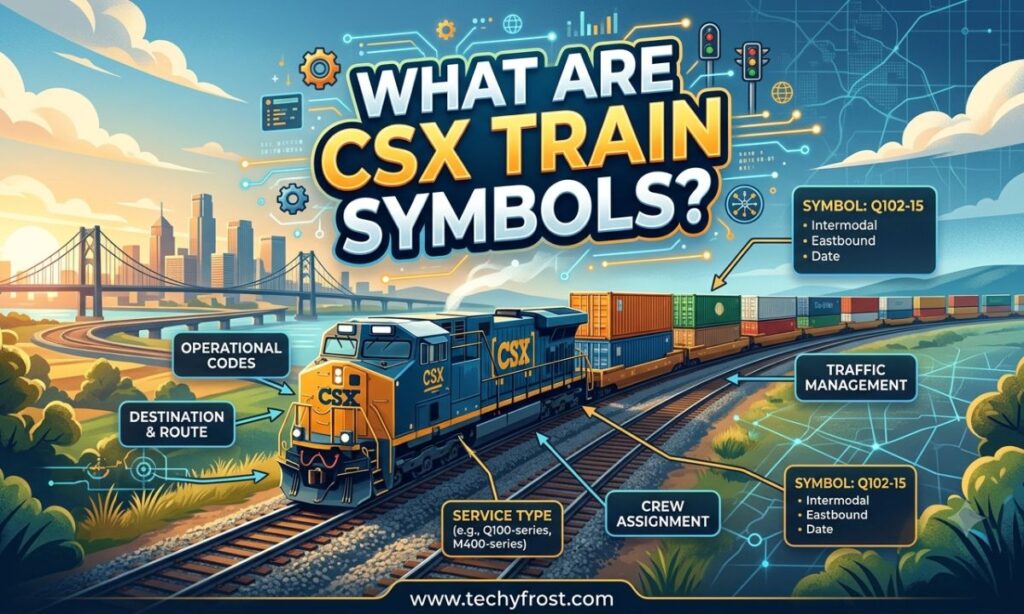
CSX train symbols are alphanumeric codes that identify individual trains operating within the CSX network. Every active train on the railroad carries a unique symbol used in dispatch systems, crew paperwork, radio communications, yard operations, and public tracking platforms.
A symbol does more than name a train. It encodes critical operational data — the type of service, the direction of travel, and sometimes even the day the train originated. A single code like Q416-23 tells an experienced railroader that this is a regularly scheduled manifest or intermodal train (Q), running a specific corridor route (416), and it originated on the 23rd of the month.
They are the operational DNA of every freight movement on the CSX system.
Historical Background
Railroads have used train symbols for well over a century. As the rail network expanded across the United States in the late 1800s and early 1900s, telegraph operators needed short, precise codes to communicate train movements efficiently. Radio dispatching later made clarity even more critical — long descriptive names were impractical when time and bandwidth were limited.
CSX itself was formed in 1986 through the merger of the Seaboard System Railroad and the Chessie System. Both legacy railroads already had their own train symbol frameworks in place. Early CSX trains used an “R” prefix for regularly scheduled services, and around 1990 that prefix shifted to the now-familiar “Q,” widely believed to stand for quality or simply inherited as a convention. What began as a logistical necessity gradually evolved into a rich, structured operational language that railfans and industry professionals study to this day.
How CSX Train Symbol Codes Work
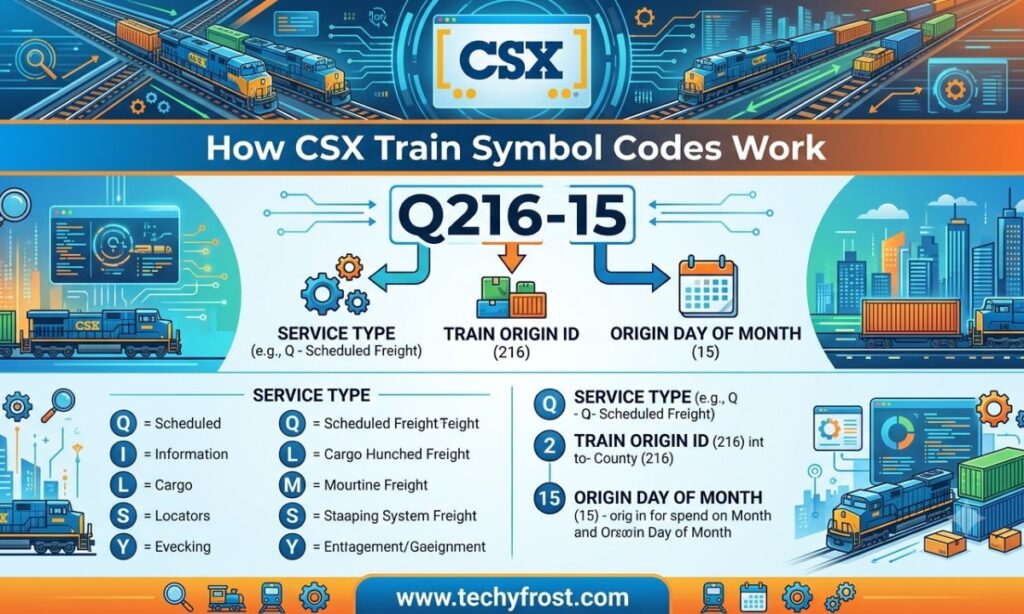
Every CSX train symbol follows a logical formula. Once you understand the structure, even a stranger’s scanner transmission starts to make sense.
Basic format: [Letter Prefix] + [Three-Digit Number] + [-Day of Month (optional)]
- The letter prefix identifies the train type or service category.
- The three-digit number typically encodes the route corridor and direction.
- The day suffix (e.g., -23) indicates the date the train originated, used to distinguish multiple instances of the same symbol running simultaneously.
| Element | Example | Meaning |
|---|---|---|
| Letter prefix | Q | Train type (intermodal/manifest) |
| First digit | 4 | Route corridor or region |
| Last two digits | 16 | Specific train sequence |
| Day suffix | -23 | Originated on the 23rd |
Direction is baked into the numbers: On most CSX symbol series, odd numbers indicate southbound or westbound trains, and even numbers indicate northbound or eastbound trains. This mirrors conventions used across much of the North American railroad industry.
When special conditions arise, symbols change in predictable ways:
- Curfewed trains (line closed for maintenance windows) shift to the 800 series — M647 becomes M847.
- Rerouted trains move to the 900 series — I026 becomes I926.
- Extra trains swap their prefix to X — M373 becomes X373.
- Locals running off-schedule become utility jobs with a U prefix — L388 becomes U388.
Deep Symbolic Meaning of CSX Train Symbols
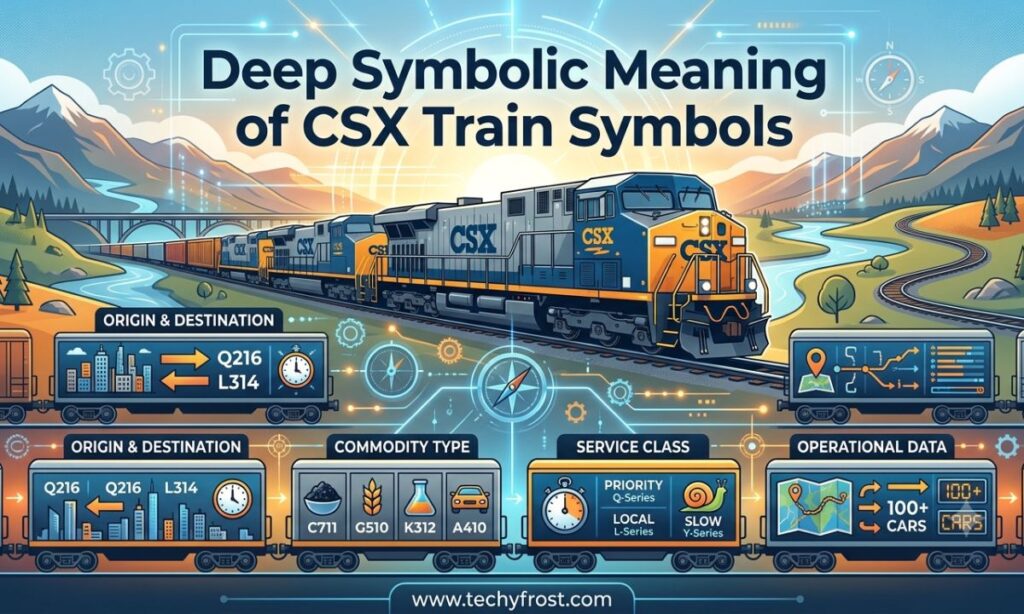
Train symbols are technical tools, but they carry meaning that reaches beyond the operational realm.
On a Spiritual Level
Trains have long represented life’s journey in spiritual traditions and personal mythology. The track is destiny — fixed, purposeful, forward-moving. A CSX train symbol, then, becomes a name for that journey. In meditation practices rooted in mindfulness and visualization, trains represent alignment: forward motion along a path laid with intention. A coded symbol attached to that motion becomes almost like a mantra — a precise name for a larger purpose. Many people report dreaming of trains during periods of transition, and the appearance of a specific numbered train in a dream can represent structured goals or a drive toward clarity.
On a Psychological Level
Humans are pattern-seeking creatures. Complex systems produce anxiety — but patterns within those systems create relief. CSX train symbols turn an overwhelming 20,000-mile railroad network into a readable, navigable language. When a railfan memorizes what Q090 or I135 means and then correctly identifies a passing train, the brain releases a small reward. Recognition feels like mastery. The coded world becomes understandable, and that understanding satisfies a deep psychological need for order.
There’s also the draw of exclusivity. Knowing the language of train symbols means belonging to a community of people who see more than steel and noise when a freight train rolls by.
On a Cultural Level
Railroads built modern America. They connected coastlines, moved armies, carried immigrants, and shaped the geography of cities and towns. CSX train symbols are living artifacts of that history. When you hear a dispatcher call out a symbol over the radio, you’re listening to a living language built across generations. The symbols connect today’s operations to the telegraph operators of the 1880s and the radio dispatchers of the 1950s — an unbroken chain of coded communication.
Types and Variations of CSX Train Symbols
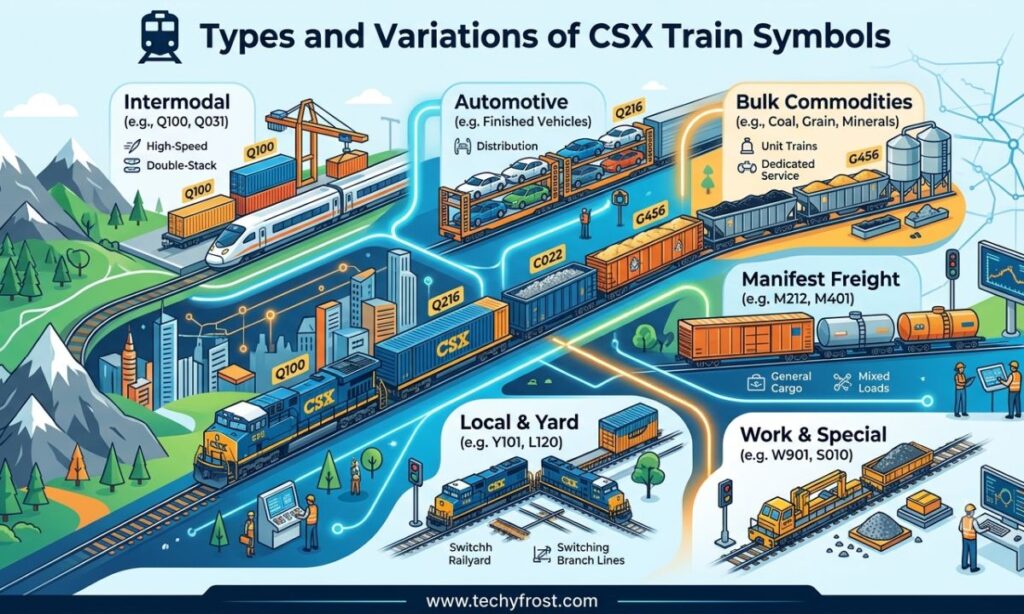
CSX uses a letter-based prefix system to categorize every train in its network. Here is a breakdown of the major symbol types.
Q Trains
Q trains are the workhorses of the CSX mainline. They cover regularly scheduled intermodal and manifest freight trains — the trains most railfans are likely to encounter on primary corridors. Within the Q series, the number range matters:
- 100s: Intermodal service
- 200s: Auto parts trains
- 300s: Northern East-West corridor general freight
- 400s: Eastern North-South corridor general freight
- 500s: Western North-South corridor general freight
- 600s: Cross-corridor general freight
A Q train carrying the number Q416 is a regularly scheduled train running an Eastern North-South corridor freight service.
M Trains
M trains are manifest freight trains — mixed freight carrying a variety of car types and commodities. These are the classic mixed-consist trains carrying everything from industrial materials to consumer goods. M trains are scheduled services operating on specific corridors and run frequently throughout the CSX network.
I Trains
I trains are intermodal trains focused on container and trailer movements. They are often high-priority runs connecting major distribution hubs. Rerouted I trains shift to the 900 series (e.g., I026 becomes I926), signaling to crews and dispatchers that the normal route has been altered.
E Trains
E trains handle empty equipment movements — particularly common in the coal and grain sectors where loaded and empty trains run as separate services. For example, a loaded coal train may operate under a T or N symbol, while the returning empties carry an E symbol.
L and Y Trains
L trains serve as alternate-schedule versions of regular trains. An L symbol on a train indicates it’s operating on a different day, route, or blocking than the standard schedule — for instance, a train that originates from a different station one day per week. When a Q train runs on a Sunday or alternate schedule, it may appear as an L train.
Y trains are strictly yard jobs — switching operations based out of a specific terminal. A Y followed by three digits identifies the yard and the shift. Y trains don’t travel long distances; they organize cars within a yard, serve local industries on industrial spurs, and keep the network flowing at ground level.
Understanding CSX Train Prefixes and Numbers
Beyond Q, M, I, E, L, and Y, the CSX symbol system includes a wide range of letter prefixes covering every operational need:
| Prefix | Service Type |
|---|---|
| G | Unit grain trains (loaded and empty) |
| N, T, V, W | Coal trains |
| Z | Foreign railroad trains operating on CSX |
| P | Passenger, circus, or CSX business car trains |
| X | Extra (unscheduled) trains |
| U | Utility jobs (locals running off-schedule) |
| S | Second sections of regularly scheduled trains |
| A, B, C, D, F, H, J, M, O | Local freights assigned by division |
Division-based locals use letter codes tied to the geographic division they serve. For example, in Virginia, H trains handle specific regional routes like Richmond to Newport News. The flexibility of this system allows CSX to expand and adapt without overhauling the entire symbol structure.
CSX Train Symbols Across Cultures
While CSX train symbols are uniquely American, the idea of coded train identification is universal.
United States
American freight railroads embed origin and destination logic into their symbol numbers. CSX, Union Pacific, BNSF, and Norfolk Southern all use letter-prefix alphanumeric systems, each with its own internal logic. Railfan culture in the U.S. treats symbol knowledge as a badge of honor — recognizing a symbol on a scanner or from trackside is a point of pride in the community.
United Kingdom
Under Network Rail, British trains use headcodes such as 4M25. These codes encode train class, destination region, and sequence number. The tradition traces back to British Rail and remains embedded in UK rail culture, where enthusiasts track headcodes with the same passion American railfans bring to CSX symbols.
Japan
Japan Freight Railway Company (JR Freight) uses a structured numbering system that emphasizes timetable precision above all. Japanese rail culture prizes punctuality as a near-spiritual value, and the train identification systems reflect that — every number carries scheduling weight.
India
Indian Railways, one of the world’s largest rail networks, assigns five-digit train numbers where each component identifies the train type, zone, and sequence. The system is vast and highly formalized, serving both freight and one of the world’s busiest passenger networks.
Canada
CN (Canadian National) and CP (Canadian Pacific) both operate alphanumeric symbol systems with strong similarities to their U.S. counterparts. Cross-border intermodal trains often carry symbols from both railroads as they transition between networks, with interchange points requiring careful symbol coordination.
CSX Train Symbols in Modern Railroad Operations
In day-to-day operations, CSX train symbols appear across every layer of the railroad:
- Dispatch communications: Symbols are called out over radio as the primary identification for any train on the network.
- Crew paperwork: Engineers and conductors receive consist sheets listing the train symbol, car count, tonnage, and hazmat details.
- Tracking platforms: Apps like Railstream, HeritageUnits.com, and various scanner-based platforms allow railfans to track trains by symbol in near real-time.
- Yard operations: Yardmasters use symbols to plan switching, prioritize movements, and manage traffic flow through busy terminals.
The suffix date system — adding the day of the month to a symbol (e.g., Q416-23) — was introduced to eliminate confusion when multiple instances of the same scheduled train are operating simultaneously. It’s a simple but elegant solution to a real operational challenge.
CSX Train Symbols in Art, Movies, and Pop Culture
Movies
Trains have served as powerful cinematic symbols for decades. Films like Emperor of the North (1973), Unstoppable (2010), and The Taking of Pelham 123 lean into the drama of rail operations. While Hollywood rarely gets the technical details of train symbols right, the atmosphere of dispatcher communications and coded language adds authenticity to rail-themed productions.
Literature
Railroad fiction and memoir have a long tradition in American literature. Writers from Jack Kerouac to John Steinbeck used trains as metaphors for freedom and movement. Technical railroad literature, from operating timetables to rule books, has itself become collectible, with vintage CSX and predecessor railroad documents sought by enthusiasts who appreciate the operational language embedded in every page.
Railfan Culture
Railfan culture treats CSX train symbols as the primary lens through which the railroad is understood. Online wikis like RailroadfanWiki maintain crowdsourced databases of active and historical symbols. Forums on Railroad.net, Trains.com, and RadioReference.com host ongoing discussions about symbol changes, new services, and symbol sightings. Catching a rare or newly introduced symbol on a scanner is celebrated in these communities.
Tattoos and Fashion
Minimalist railroad tattoos have entered mainstream culture. Some enthusiasts choose specific CSX train symbols as tattoos — connecting their personal identity to a route, a hometown yard, or a train they have a particular attachment to. Railroad-themed streetwear has followed, with locomotive numbers, track silhouettes, and coded symbols appearing on caps, jackets, and prints. What began as an operational code has become a design element with genuine cultural resonance.
Spiritual and Dream Meaning of CSX Train Symbols
Dreams involving trains are among the most commonly reported in psychological literature on dream symbolism. Trains in dreams often represent life direction, momentum, and the feeling of being on — or off — a predetermined path.
When specific train symbols appear in dreams or meditative visualizations:
- A fast Q intermodal train may signal ambition, urgency, or a life moving at speed.
- A slow manifest train can reflect gradual, steady progress toward a goal.
- A yard job switching cars often symbolizes a period of reorganization — rearranging the priorities of one’s life before moving forward.
- An empty E train may represent a transition phase — the return journey before the next load.
In broader spiritual symbolism, the track represents destiny or dharma — the path that has been laid. The train symbol becomes the name of the specific purpose you are currently carrying.
Positive vs Negative Meaning
Positive
- Order from complexity: CSX train symbols turn a massive, potentially chaotic network into a manageable, readable system.
- Community and belonging: Knowing the symbols grants entry into a passionate and knowledgeable community.
- Efficiency and trust: The system keeps commerce flowing, representing the best of human coordination and institutional reliability.
- Historical continuity: Symbols connect the present-day railroad to its century-plus history.
Negative
- Opacity: For the uninitiated, train symbols feel deliberately impenetrable. The learning curve can be steep and discouraging.
- Constant change: CSX periodically revises symbol assignments due to operational shifts, service changes, and mergers, making it difficult to maintain accurate information.
- Information asymmetry: Full symbol documentation is proprietary. Railfans rely on community-sourced intelligence, which can be incomplete or outdated.
- Misuse potential: Detailed knowledge of train symbols, combined with scanner monitoring, can raise security concerns when applied outside the enthusiast context.
Why Humans Are Attracted to CSX Train Symbols
The attraction runs deeper than curiosity about trains. CSX train symbols tap into several fundamental human drives:
- Pattern recognition: Our brains are wired to find patterns. A system as logical and consistent as train symbols is deeply satisfying to decode.
- Mastery: Learning an obscure but internally consistent language provides a sense of intellectual achievement.
- Nostalgia: Railroads are woven into American family and community history. A symbol connected to a local yard or route can carry personal memory.
- Community: Shared knowledge creates belonging. The railfan community is built on shared expertise in exactly this kind of specialized information.
- Real-world stakes: Unlike many hobbyist interests, train symbols describe actual heavy freight moving actual goods across actual geography. The knowledge feels meaningful because it is meaningful.
Why Railfans Track and Decode CSX Train Symbols
Railfanning — the hobby of observing, photographing, and documenting train activity — depends on train symbols as its organizing language. Here’s why:
- Prediction: Knowing a train’s symbol helps experienced railfans predict when and where it will appear, enabling better photography opportunities.
- Documentation: Tracking databases like HeritageUnits.com rely on community members to log symbol sightings, building a living record of CSX operations.
- Scanner culture: Many railfans monitor railroad radio frequencies with handheld scanners. Recognizing symbols in dispatcher communications transforms background noise into a readable story.
- Historical preservation: Retired symbols are preserved in wikis and forums, maintaining a record of trains that no longer run. The RailroadfanWiki convention of using strikethrough text rather than deletion preserves railroad history for future researchers.
- The thrill of the rare: When a new symbol appears or a rarely-seen train symbol passes a trackside observer, it becomes a trophy moment in the community — shared on forums, photographed, logged, and celebrated.
Frequently Asked Questions
What is a CSX train symbol?
A CSX train symbol is an alphanumeric code — typically a letter followed by three digits — that identifies a specific train operating within the CSX railroad network, encoding its service type, route, and operational priority.
What does the Q stand for in CSX Q trains?
The Q prefix is believed to have originated around 1990 when CSX shifted from an “R” prefix for regularly scheduled trains. It now identifies regularly scheduled intermodal and manifest freight trains across the CSX mainline.
How do I read a CSX train symbol like Q416-23?
The letter (Q) indicates train type, the three digits (416) identify the route corridor and direction, and the dash suffix (23) indicates the train originated on the 23rd of the month.
What does an M train mean on CSX?
An M train is a manifest freight train — a mixed-consist service carrying multiple car types and commodities across a scheduled CSX corridor.
Are CSX train symbols available to the public?
While official CSX documentation is proprietary, railfan communities maintain extensive crowdsourced databases of active and historical symbols through platforms like RailroadfanWiki and HeritageUnits.com.
What does it mean when a CSX train symbol changes to the 800 or 900 series?
An 800-series symbol indicates the train is curfewed due to a line closure; a 900-series symbol means the train has been rerouted from its normal path.
Do other railroads use similar train symbols?
Yes. Every major North American Class I railroad — including Union Pacific, BNSF, Norfolk Southern, CN, and CP — uses its own alphanumeric train symbol system, each with unique internal logic but sharing the same fundamental concept.
Can CSX train symbols change over time?
Yes. CSX periodically revises symbol assignments due to operational changes, new service launches, or network restructuring. Railfan communities track these changes actively.
Conclusion
CSX train symbols are far more than a shorthand for dispatchers. They are the living language of one of America’s great industrial networks — a language that encodes history, direction, priority, and purpose into just four or five characters. From the high-priority Q intermodal streaking down a mainline to the quiet Y yard job shuffling cars on a cold morning, every symbol tells a story.
Whether you’re a curious observer, a seasoned railfan, or simply someone who has wondered what that code means on the scanner — you now have the key. The rails are no longer anonymous. They speak, if you know how to listen.

