

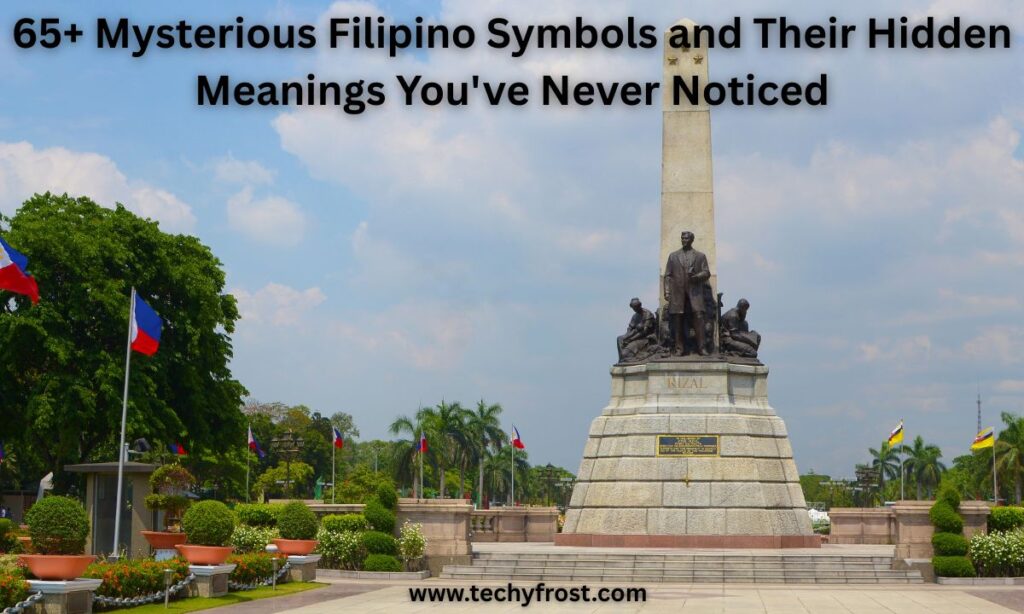
Have you ever looked at a Filipino tattoo, a carved wooden figure, or even the country’s national flag and wondered — what does this actually mean? Filipino symbols are not just decorative. They are layered with centuries of history, spiritual belief, tribal identity, and cultural pride. From the ancient script of Baybayin to the mythical Sarimanok bird of the Maranao people, every mark, color, and shape carries a story most people have never heard.
The Philippines is one of Southeast Asia’s most culturally rich nations, shaped by indigenous Austronesian traditions, centuries of Spanish colonization, Islamic influence in Mindanao, and contact with Chinese traders. Each of these forces left its mark — literally — on the symbols Filipinos use today. Whether you’re exploring Filipino heritage, considering a culturally meaningful tattoo, or simply want to understand the deeper language of this archipelago, this guide covers everything you need to know about Filipino symbols and their hidden meanings.
What Are Filipino Symbols?

Filipino symbols are visual, written, or artistic representations that carry specific cultural, spiritual, or national meaning within Philippine society. They exist across a wide range of forms: script characters, mythical creatures, national emblems, tribal tattoos, woven textile patterns, carved figures, and even architectural motifs.
These symbols serve multiple purposes:
- Identity markers — showing which tribe, region, or social class a person belongs to
- Spiritual protection — warding off evil spirits or invoking divine blessing
- Historical records — encoding stories of battles, achievements, and lineage
- Cultural pride — celebrating Filipino heritage in modern art, fashion, and activism
Filipino symbolism draws from two deep wells: the pre-colonial animist worldview (where mountains, rivers, animals, and ancestors all carried sacred meaning) and the hybrid culture that emerged after centuries of contact with Spanish, Islamic, and Chinese influence.
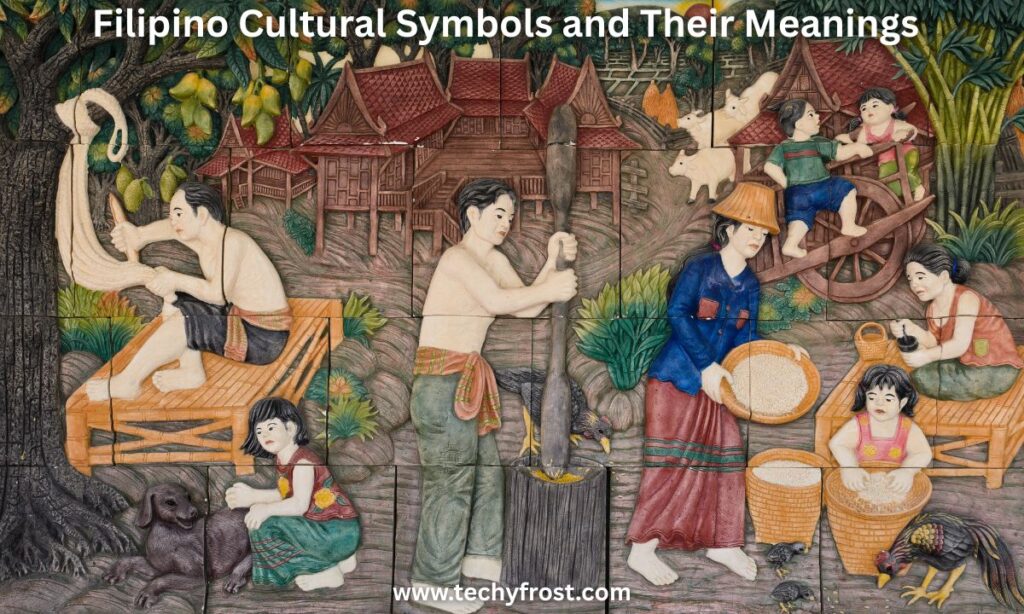
Filipino Cultural Symbols and Their Meanings
The Philippine Flag
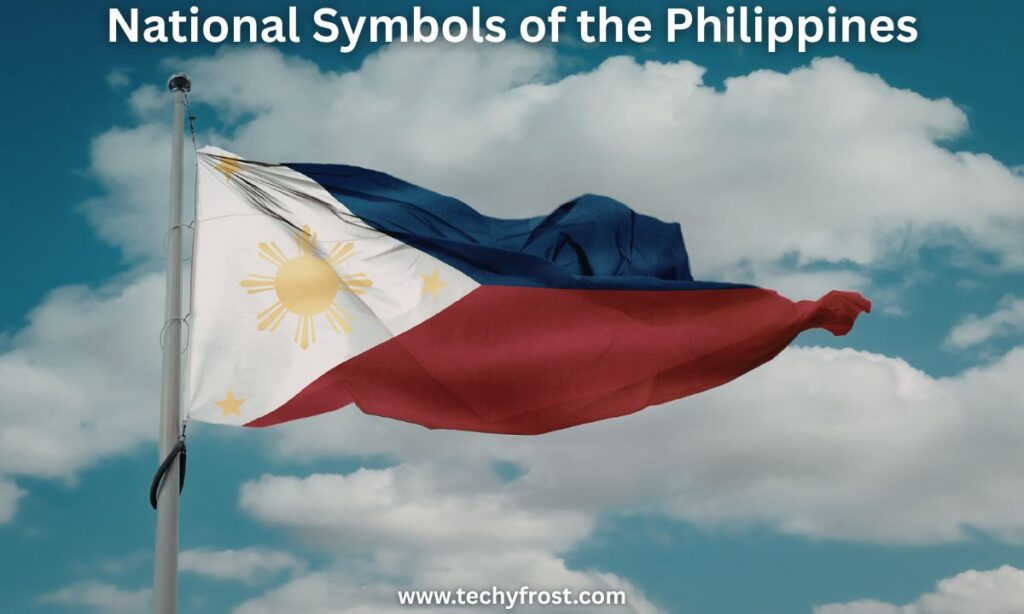
No symbol carries more weight in Filipino national identity than the flag. Adopted on June 12, 1898 — the date of Philippine independence — the flag’s design is a precise code of meaning.
| Element | Symbolism |
| Blue stripe | Peace, truth, and justice |
| Red stripe | Patriotism and valor |
| White triangle | Equality and the Katipunan fraternity |
| Golden sun (8 rays) | Freedom; each ray represents one of the 8 provinces that first revolted against Spain |
| Three golden stars | The three main island groups: Luzon, Visayas, and Mindanao |
One detail most people miss: when the flag is flown with the red stripe on top, it signals the country is in a state of war. It’s one of the few national flags in the world where the orientation itself carries a different meaning.
National Symbols of the Philippines
What Are the 10 National Symbols of the Philippines?
The Philippines officially recognizes several national symbols through legislation, executive order, and proclamation. Here is a comprehensive overview:
| National Symbol | What It Represents |
| Philippine Eagle | National bird — strength, power, freedom |
| Sampaguita | National flower — purity, simplicity, humility |
| Narra Tree | National tree — hardiness, resilience, beauty |
| Carabao (Water Buffalo) | National animal — hardwork, patience, strength |
| Philippine Pearl | National gem — uniqueness and natural wealth |
| Arnis | National martial art and sport |
| Bangus (Milkfish) | National fish |
| Mango | National fruit — richness, abundance |
| Anahaw | National leaf — resilience, hospitality |
| Barong Tagalog / Baro’t Saya | National costumes — elegance and craftsmanship |
Did you know? Some of these symbols — like the carabao, mango, and anahaw — are widely recognized as national symbols but have no formal law officially declaring them as such. The Philippine Eagle, Sampaguita, and Narra Tree are formally legislated as official national symbols.
Philippines National Bird: The Philippine Eagle
The Philippine Eagle (Pithecophaga jefferyi) is not just a national symbol — it is one of the largest, most powerful eagles on Earth and one of the rarest. Known locally as Haribon (literally “bird-king”), it embodies the Filipino aspiration for sovereignty and strength. Its sharp eyes, powerful talons, and regal crown of brown feathers made it the natural choice to represent the nation.
The eagle also symbolizes the biodiversity of the Philippine rainforest. Its endangered status serves as a reminder of environmental responsibility — a meaning that has grown more significant in modern Filipino consciousness.
National Tree of the Philippines: Narra
The Narra tree (Pterocarpus indicus) is admired for its dense hardwood and its delicate golden-yellow flowers. In Filipino symbolism, the Narra stands for durability, strength, and beauty — qualities that mirror the national character. Its wood has been used for centuries in furniture, religious icons, and traditional structures, making it both practically and culturally important.
Ancient and Traditional Filipino Symbols
Ancient Filipino Symbols: Before the Colonizers Arrived
Before Spanish ships arrived in 1521, the Philippine archipelago was home to dozens of indigenous groups with rich symbolic traditions rooted in animism. These pre-colonial Filipino symbols were embedded in everyday life, from the tools people carried to the patterns woven into their clothing.
Key characteristics of ancient Filipino symbols:
- They were animistic — nature was alive with spirit
- They often encoded social rank and warrior status
- Many were carved into wood, bone, and metal objects
- Symbols were carried on the body as tattoos (batok) believed to offer protection
Filipino Indigenous Symbols and Their Meanings
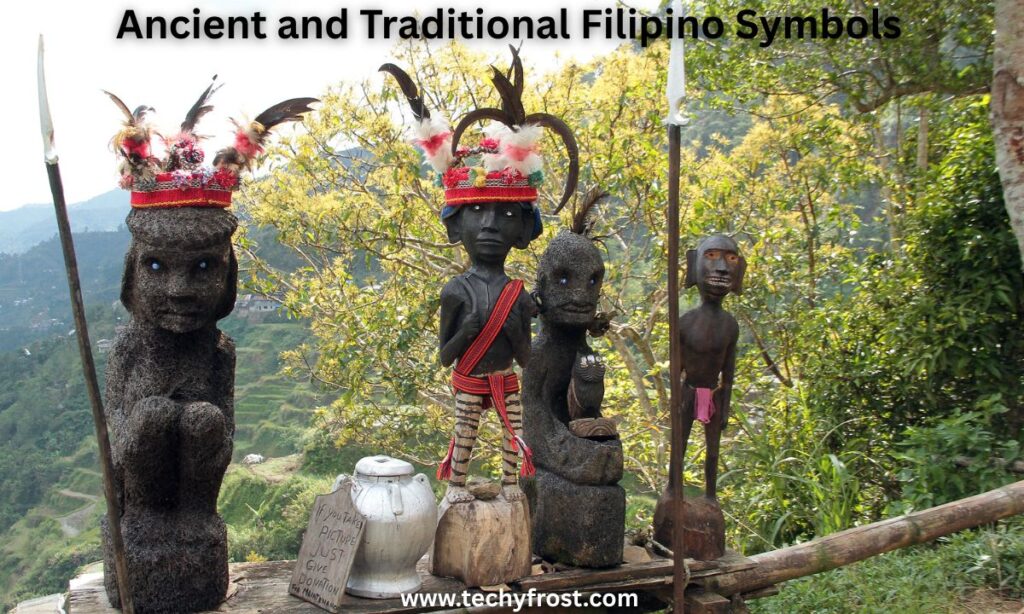
Bulul (Ifugao Rice Guardian) Among the Ifugao people of the Cordillera mountains, carved wooden figures called bulul were placed near granaries to protect the rice harvest. These figures — typically depicting seated human ancestors — were believed to be inhabited by ancestral spirits. They represent lineage, agricultural prosperity, and protection from harm. Archaeologists have traced these figures to pre-colonial origins tied to the rice terraces of northern Luzon, a UNESCO World Heritage Site.
Lingling-o (Jade Ear Ornament) Found in archaeological sites from Palawan to Cebu, the lingling-o is a distinctively shaped jade pendant resembling an incomplete circle or a fetal shape. Dating from the 10th to 15th centuries, these ornaments were traded across maritime Southeast Asia and were symbols of fertility, protection, and prosperity. Wearing one was believed to invite good fortune and safeguard the wearer from illness.
Bakong (Wave/Serpent Pattern) Seen in the tattoos and textiles of Visayan communities, the bakong is a wave-like or serpentine pattern representing water, movement, and life force. Water held immense spiritual significance for coastal Filipino peoples, and this curving mark was among the oldest protective symbols applied to the skin.
The Centipede Motif (Alupihan) Used extensively in Kalinga tribal tattoos, the centipede (alupihan) was a symbol of warrior courage and healing power. Its many legs represented speed, agility, and reach — qualities prized in a fighter. Wearing this mark on the skin was believed to transfer those qualities to the warrior.
The Rice Motif Rice is sacred in Philippine indigenous culture, and its symbol appears in tattoos, weaving, and ceremonial objects. It represents life, abundance, and gratitude to the divine, as rice farming formed the backbone of most pre-colonial Filipino communities.
Filipino Symbols and Meanings: A Complete Reference Table
| Symbol | Origin | Meaning |
| Sarimanok | Maranao (Mindanao) | Good fortune, prosperity, divine blessing |
| Baybayin | Pre-colonial Philippines | Cultural identity, literacy, heritage |
| Okir patterns | Mindanao, Maranao | Life force, continuity, harmony |
| Bulul figures | Ifugao (Cordillera) | Ancestral protection, rice abundance |
| Lingling-o | Austronesian | Fertility, protection, prosperity |
| Carabao | Nationwide | Hardwork, patience, rural spirit |
| Philippine Eagle | Nationwide | Strength, freedom, sovereignty |
| Sampaguita | Nationwide | Purity, simplicity, love |
| Narra Tree | Nationwide | Durability, resilience, beauty |
| Sun and Stars (Flag) | National | Freedom, unity, revolution |
| Centipede tattoo | Kalinga | Warrior courage, healing |
| Rice motif | Nationwide indigenous | Life, abundance, gratitude |
| Bakong wave | Visayas | Water spirit, movement, protection |
| Bahay Kubo (Nipa Hut) | Nationwide | Community, simplicity, bayanihan spirit |
| T’nalak textile | T’boli (Mindanao) | Heritage, womanhood, sacred craft |
| Babaylan symbol | Visayas | Spiritual wisdom, healing, leadership |
Filipino Symbols and Tattoos
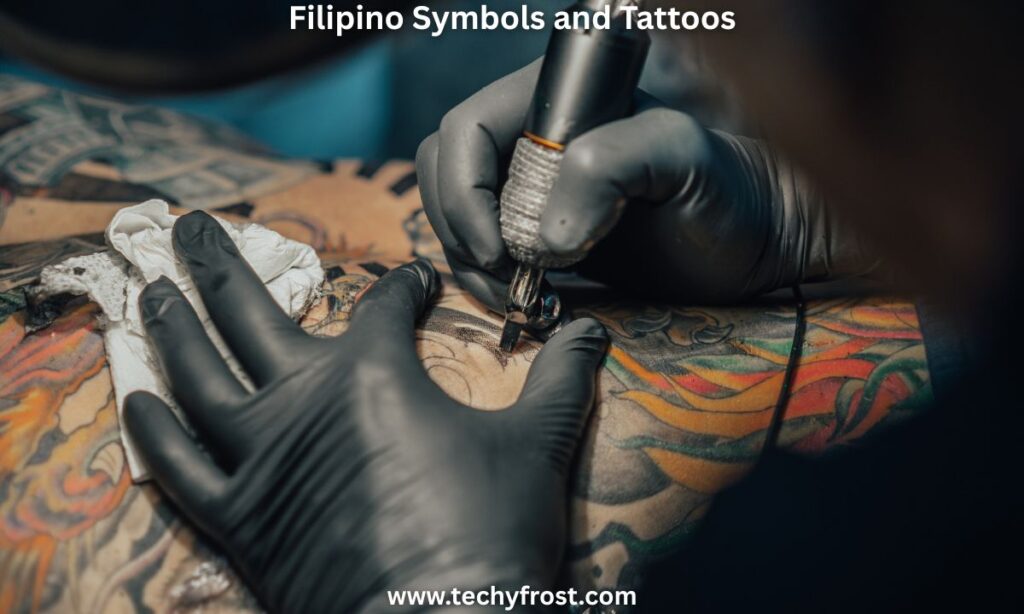
The Sacred Art of Batok
Filipino tattoo culture is one of the oldest in the world and one of the most symbolic. The practice, called batok in northern Luzon and pintados among the Visayans, was never purely aesthetic. Every mark meant something.
Spanish colonizers who encountered Visayan warriors in the 16th century called them “Pintados” — painted ones — because their bodies were covered with intricate tattoos from neck to ankle. What the colonizers dismissed as savagery was actually a living archive of each warrior’s life story, rank, and spiritual status.
How tattoos worked as symbols:
- Warriors earned tattoo designs after battles, each marking a specific achievement
- Healers and babaylan (shamans) wore protective symbols indicating their spiritual authority
- Women in the Cordillera wore tattoos on their hands and arms as marks of beauty, fertility, and protection during childbirth
- Tribal leaders wore designs that distinguished their lineage and rank
Kalinga Tattoo Symbols and Meanings
The Kalinga people of the Cordillera mountain region have the most documented surviving tattoo tradition in the Philippines, largely because of the legendary mambabatok (tattoo master) Apo Whang-Od, who has continued the practice into the 21st century.
Key Kalinga tattoo symbols include:
- Interlocking tribal bands — community bonds, unbreakable unity, protection
- Shield motifs with geometric patterns — warrior courage, defense against enemies
- Mountain lines — strength, connection to the land, ancestral homeland
- Snake/serpent forms — power, transformation, spiritual authority
- Sun patterns — life force, guidance, divine connection
Visayan Pintados Symbols
Among the ancient Visayans, tattoo motifs included wave patterns (bakong), sun symbols, and animal figures. The more tattooed a warrior was, the higher his status. These symbols were not merely decorative — they were believed to carry spiritual protection (anting-anting), shielding the wearer from harm in battle.
Filipino Symbol Letters: Baybayin Script
What Is Baybayin?
Baybayin is the pre-colonial script of the Philippines, used primarily across Luzon before Spanish missionaries replaced it with the Latin alphabet in the 17th century. The name comes from the Tagalog word baybay, meaning “to spell out syllable by syllable.”
Baybayin is an abugida — a syllabic writing system where each character represents a consonant-vowel combination. It originally had 17 basic characters and reads from left to right.
Why Baybayin Matters Today
Baybayin has become one of the most powerful symbols of Filipino cultural revival and indigenous identity. Its resurgence is part of a broader decolonization movement that seeks to reconnect modern Filipinos with their pre-colonial roots.
You’ll find Baybayin today on:
- Tattoos worn as personal declarations of Filipino identity
- Street art and murals in urban areas
- Philippine peso banknotes
- Fashion collections and clothing lines
- Educational materials advocating for recognition as a national writing system
In April 2018, the Philippine House Committee on Basic Education approved a bill seeking to declare Baybayin the country’s national writing system, though as of recent years it remains pending full legislative approval.
Baybayin as a Symbol of Identity
At its core, Baybayin is not just a writing system — it is a symbol of reclaimed identity. For many Filipinos in the diaspora, having their name written in Baybayin script is an act of cultural pride, a reconnection with an identity that was nearly erased by colonization.
Filipino Symbols of Identity, Culture, and Strength
Family Filipino Symbols and Meanings
Family (pamilya) is the cornerstone of Filipino society, and this is reflected in symbolic culture. Several symbols are specifically associated with family bonds:
- Bahay Kubo (Nipa Hut) — represents bayanihan, the tradition of community members literally helping to carry a neighbor’s home to a new location; a perfect symbol of collective family strength
- Bulul ancestors figures — embody the belief that deceased family members continue to watch over and protect the living
- T’nalak textile — among the T’boli people, this woven cloth was produced only by women, and its patterns were received in dreams; creating it was a sacred duty passed from mother to daughter, making it a deep symbol of family lineage and feminine strength
- Centipede tattoo on the back — in Kalinga tradition, this marking on a woman symbolized her role as a protector of the family home
Filipino Symbols for Strength
The following symbols consistently appear across Filipino tribal traditions as representations of strength, courage, and resilience:
- Philippine Eagle — national symbol of power and sovereignty
- Warrior tattoo bands (Kalinga) — courage earned through action
- Narra hardwood tree — unyielding strength of character
- Carabao — patient, powerful endurance
- Mountain motifs — rootedness, stability, immovability
- The sun on the flag — the unquenchable flame of freedom
- Okir spiral patterns — the endless cycle of life force and renewal
- Old Filipino symbols for strength (Sarimanok) — spiritual courage and divine backing
More Ancient and Cultural Filipino Symbols
Ilocano Ancient Filipino Symbols and Meanings
The Ilocano people of northern Luzon developed their own symbolic vocabulary tied to agricultural life, weaving traditions, and warrior culture. The abel Iloko — a hand-woven textile tradition — encoded social meaning in its patterns. Diamond shapes represented protection; zigzag lines indicated connection to water spirits; and geometric borders signified family lineage.
Ilocano warriors also used body tattoos similar to those of the Kalinga, with specific marks indicating tribal affiliation and battle honors.
Igorot Symbols and Meanings
The collective term “Igorot” refers to several indigenous highland tribes of the Cordillera (including the Bontoc, Ifugao, Benguet, and Kalinga). Their symbolic traditions include:
- G-string weaving patterns — social status and tribal identity
- Headhunting trophies and their decorative equivalents — warrior rank
- Ritual objects and wooden carvings — ancestral communication
- Tattoo placement on the body — specific locations meant specific life achievements
Common Filipino Symbols and Their Practices
The Cross and Sun Fusion After Spanish colonization, indigenous sun imagery merged with the Christian cross, creating hybrid symbols seen in church facades and folk art across the Philippines. The sun retained its old meaning of life and divine power while the cross overlaid it with Catholic significance — a visible record of two worldviews finding accommodation.
The Anting-Anting (Amulet) While not a single defined symbol, the anting-anting tradition involves objects — engraved metals, written prayers, carved stones — believed to grant their bearer supernatural protection. These are among the most intimately personal Filipino protection symbols, often inscribed with a combination of indigenous marks, Latin script, and sacred numbers.
The Carabao Beyond being the national animal, the water buffalo is a deeply symbolic creature in rural Philippine life. It represents the Filipino farmer’s patience, hard work, and organic connection to the land. Its image appears in folk sayings, murals, local government seals, and everyday idioms — making it one of the most pervasive symbols of Filipino cultural identity.
The Jeepney Though a modern creation born from post-WWII American military jeeps, the jeepney has become a genuine cultural symbol representing Filipino ingenuity, color, creativity, and community. Its flamboyant decoration — religious icons, mythical creatures, folk patterns — makes every jeepney a moving art piece encoding individual and cultural stories.
Types and Variations of Filipino Symbols
Sarimanok
The Sarimanok is arguably the single most iconic cultural symbol in the Philippines after the national flag. It is a legendary mythical bird rooted in Maranao culture in Mindanao, depicted as a strikingly colorful fowl with ornate wings and a flowing tail, holding a fish in its beak or talons.
The name combines sari (meaning “various” or “of different colors”) and manok (meaning “rooster” or “chicken”). It is a symbol of good fortune, prosperity, divine blessing, and royal power. Traditionally, it was placed atop the umbrellas of sultans and dignitaries, and whoever caught the Sarimanok was believed to receive great luck.
What makes the Sarimanok especially fascinating is its layered mythology. In indigenous Maranao belief, it is connected to Itotoro, a spirit totem bird that mediates between the human and spirit worlds through its unseen twin, Inikadowa. Later Islamic influence wove in a parallel legend: the Prophet Muhammad was said to have encountered a similarly magnificent celestial rooster during his ascension through the heavens.
This blending of animist and Islamic meaning makes the Sarimanok a perfect emblem of Mindanao’s hybrid spiritual culture.
Sun and Stars of the Philippine Flag
The sun on the Philippine flag has eight rays, each representing one of the eight provinces that first took up arms against Spanish colonial rule: Batangas, Bulacan, Cavite, Laguna, Manila, Nueva Ecija, Pampanga, and Tarlac. The three five-pointed stars represent Luzon, Visayas, and Mindanao — the three major island groups that form the nation.
The sun itself draws on older pre-colonial imagery, where the sun was a primary symbol of divine power, life, and freedom. Placing it on the flag was a conscious decision to link the revolution with something deeply rooted in Filipino spiritual heritage.
Anito Figures
Anito is the collective term for ancestral spirits and nature deities in pre-colonial Filipino animist belief. Carved wooden figures representing anito were placed in homes, on boats, and in community structures. The figures — known in different regions as taotao, diwata, or bulul — were not idols in the religious sense but rather dwelling places where ancestor spirits could be invited to reside and offer protection.
Anito figures symbolize the fundamental Filipino value of respect for lineage and the unseen world. The belief that the living and the dead exist in continuous relationship — that family extends beyond death — is embedded in these carvings. This worldview was not entirely displaced by Christianity; instead, it merged with Catholic veneration of saints in ways that are still visible in Filipino folk religion today.
Okir Patterns
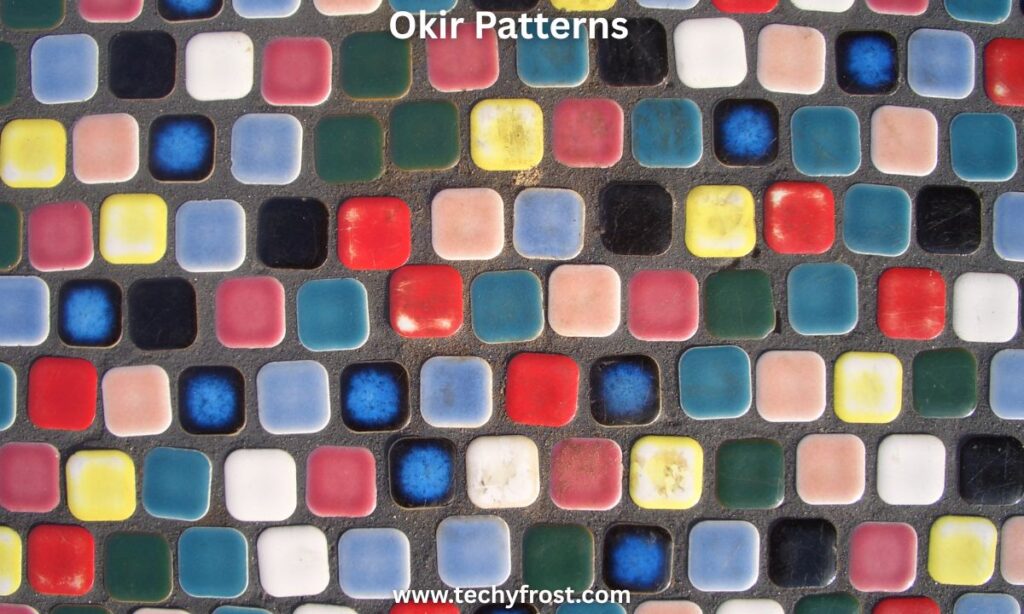
Okir (also spelled ukkil or okil) is a system of flowing, plant-inspired geometric ornamental patterns originating in the Muslim communities of Mindanao and the Sulu Archipelago. The curving, spiral, and vegetal motifs of Okir appear in:
- Wood and ivory carvings on the torogan (traditional Maranao royal house)
- Metalwork on kris swords and brass vessels
- Painted decorations on boats and ceremonial objects
- Textiles and embroidery
Okir’s visual vocabulary represents life force, continuity, and the harmonious flow of the cosmos. Each element of an Okir design contributes to a whole that is never static — the curving lines suggest constant movement, regeneration, and connection between all living things. It is, in a visual sense, the Filipino Muslim equivalent of the cosmic tree: a single design that encodes an entire worldview.
Baybayin Script
Already discussed above as a writing system, Baybayin functions as both a functional script and a powerful cultural symbol. As a symbol, it represents the period before colonization when Filipinos had their own literary culture, their own way of recording transactions, poetry, and correspondence.
Seeing Baybayin used on skin, in art, or in public spaces is an assertion: we existed fully before others arrived. Its revival in the 21st century is one of the clearest expressions of Filipino cultural renaissance.
Deep Symbolic Meaning of Filipino Symbols
Spiritual Level
At their deepest layer, Filipino symbols communicate a fundamentally spiritual worldview. Pre-colonial Filipinos did not separate the material from the spiritual. A carved figure was not merely an object — it was a residence for something alive. A tattoo was not merely decoration — it was armor against the unseen world. A woven pattern was not merely fabric — it was a prayer made visible.
This spiritual dimension means that many Filipino symbols operate as bridges: between the living and the dead, between the human and the divine, between the visible world and the world of spirits. The Sarimanok connects earth and heaven. The Bulul connects the living farmer to the ancestral guardian. The Baybayin character connects the modern Filipino to a pre-colonial ancestor who once wrote with the same shapes.
Psychological Level
On a psychological level, Filipino symbols serve as anchors of identity in a society that has experienced profound disruption from colonization, diaspora, and cultural erasure. Choosing to wear a Baybayin tattoo or display an Okir-patterned object is an act of psychological rootedness — a way of saying: I know where I come from and I choose to carry it forward.
For the estimated 10+ million Filipinos living abroad, these symbols take on additional weight. They become portable homeland — a piece of the archipelago that travels with the person.
Cultural Level
Culturally, Filipino symbols are mechanisms of social cohesion. They create shared meaning among people who might speak different dialects, follow different religions, or live on different islands. When a Tagalog-speaking person in Manila and a Maranao-speaking person in Cotabato both recognize the Sarimanok as a symbol of the Philippines, they participate in a shared national narrative that transcends regional difference.
This cultural function is especially powerful in a nation of over 7,000 islands and 175+ languages — symbols do the work that a single common language cannot always do.
Filipino Symbols Across Cultures
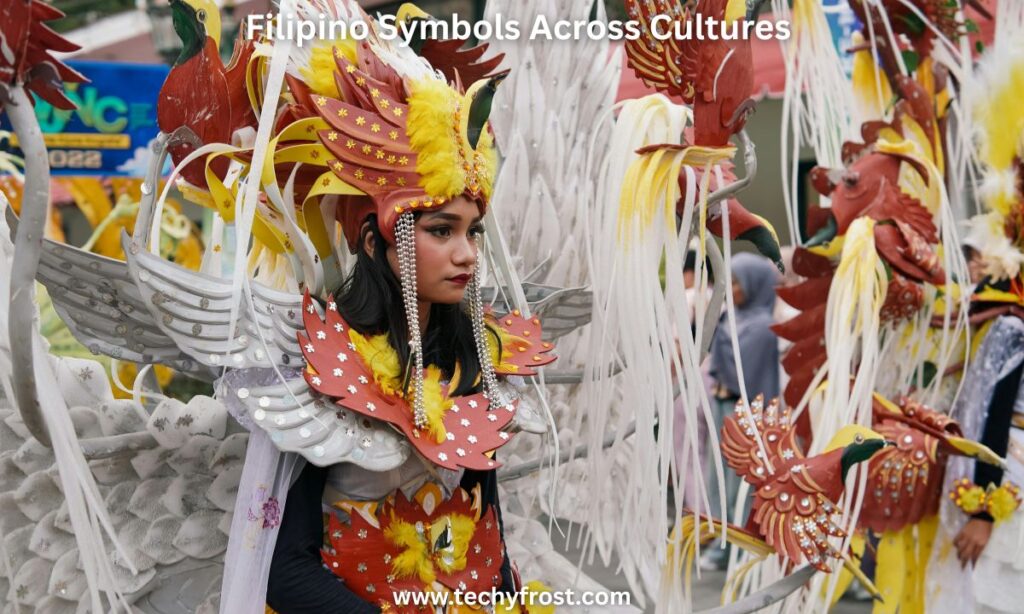
Filipino symbolism does not exist in isolation. It is the product of millennia of contact and exchange.
Austronesian roots: The earliest Filipino symbols — jade ornaments, animist figures, wave tattoos — share motifs with cultures across maritime Southeast Asia, from Taiwan to Borneo to Madagascar. They are part of a vast Austronesian visual language that spread with seafaring peoples across the Pacific and Indian Oceans.
Hindu-Buddhist influence (pre-Islamic): Before Islam reached Mindanao in the 14th century, Hindu and Buddhist iconography from the Srivijaya and Majapahit empires influenced art in the Visayas and Mindanao. The Laguna Copperplate Inscription (900 CE), the oldest known written document found in the Philippines, is in Sanskrit-influenced Old Malay — evidence of this deep cultural connection.
Islamic influence: From the 14th century onward, Islamic art traditions from Malay, Arab, and Persian sources shaped the ornamental vocabulary of Mindanao and Sulu. Okir patterns, the Sarimanok’s layered mythology, and Maranao architecture all reflect this synthesis of indigenous and Islamic aesthetic traditions.
Spanish-Christian influence: Four centuries of Spanish rule layered Catholic imagery — crosses, saints, the Virgin Mary — over indigenous symbols. The result is the uniquely Filipino folk-Catholic tradition where the Santo Niño, Marian blue, and ancient sun imagery coexist in folk art, tattoos, and religious iconography.
Filipino Symbols in Art, Movies, and Pop Culture
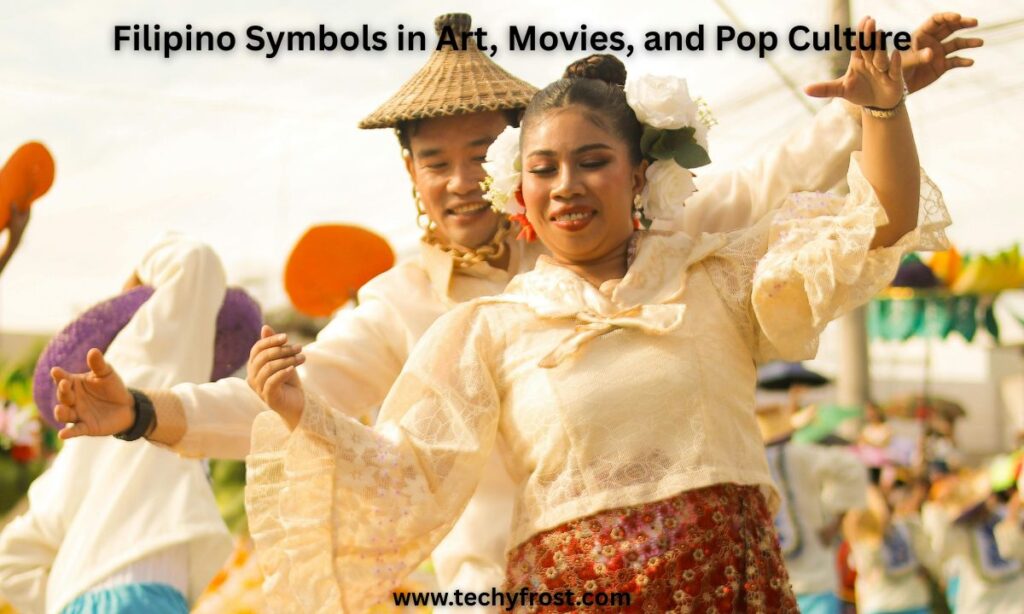
Filipino symbols have seen a significant resurgence in contemporary culture:
- Visual art: Artists like Abdulmari Asia Imao elevated the Sarimanok into a mainstream Philippine icon through large-scale paintings that brought Maranao culture to national galleries.
- Fashion: Filipino designers regularly incorporate Baybayin script, Okir patterns, and tribal weaving motifs into haute couture and streetwear.
- Film and television: Filipino fantasy and historical dramas (teleseryes and films) have increasingly used Anito figures, Babaylan characters, and mythological creatures as storytelling elements, driving renewed public interest in pre-colonial culture.
- Tattoo culture: The global popularity of Filipino tribal tattoos — sparked partly by international attention to Apo Whang-Od — has made Kalinga-style batok recognizable far beyond the Philippines.
- Digital art and activism: Baybayin and Okir designs frequently appear in social media graphics created by Filipino cultural advocates, particularly in the diaspora community.
Spiritual and Dream Meaning of Filipino Symbols
In Filipino folk belief, certain symbols carry meaning that extends into the realm of dreams and spiritual communication:
- Dreaming of the Sarimanok is considered a highly auspicious sign, often interpreted as an ancestral blessing or an omen of incoming prosperity
- The Bulul appearing in dreams is interpreted as a message from deceased ancestors — either a warning, a blessing, or guidance on an important decision
- The centipede tattoo symbol in dreams is associated with healing energy and the presence of protective spirits
- Baybayin characters appearing in dreams are seen by some practitioners of Filipino folk spirituality as messages from spirit guides
These dream interpretations are not universal but reflect the continuing vitality of pre-colonial belief systems within modern Filipino folk religion — often blended seamlessly with Catholic prayer practice.
Positive vs Negative Meaning of Filipino Symbols
Most Filipino symbols carry primarily positive connotations, but context matters.
| Symbol | Positive Meaning | Potentially Negative Context |
| Sarimanok | Good fortune, blessing | Used frivolously without cultural respect |
| Anting-anting amulet | Protection, divine favor | Associated with dangerous folk magic when misused |
| Red flag orientation | War readiness (purposeful) | Associated with conflict and danger |
| Bakunawa (serpent) | Transformation, power | Represents chaos and the swallowing of the moon (misfortune) |
| Centipede tattoo | Warrior strength | Among some traditions, an omen if seen unexpectedly |
| Black in Kalinga weaving | Ancestral connection | Sometimes associated with mourning |
Why Humans Are Attracted to Filipino Symbols

The appeal of Filipino symbols — both to Filipinos and to people around the world — comes down to a few universal human needs:
1. The need for belonging. Symbols mark membership in a group, a lineage, a story. Filipino symbols say: you belong to something ancient and meaningful.
2. The need for protection. Across all cultures, humans seek protection from harm. Filipino symbols — particularly tattoos and amulets — were specifically designed to meet this need, and that function still resonates emotionally.
3. The desire to connect with the past. In a rapidly changing world, ancient symbols offer continuity. A Baybayin tattoo connects a 21st-century Filipino to an ancestor who lived before colonization — a powerful emotional bridge.
4. The beauty of the imagery itself. Sarimanok birds with flowing multicolored feathers, intricate Okir spirals, bold geometric Kalinga bands — Filipino symbols are visually striking on their own terms, which drives their appeal in tattoo culture and contemporary design.
5. The experience of cultural revival. For millions of Filipinos, engaging with indigenous symbols is an act of decolonization — a reclaiming of identity that was suppressed or nearly erased. This gives the symbols a charge of meaning far beyond the visual.
Conclusion
Filipino symbols are far more than beautiful designs. They are a civilization’s memory — encoded in feathers, spirals, script, and ink. Whether you look at the eight-rayed sun on the national flag, the flowing wings of the Sarimanok, the curves of a Baybayin character, or the geometric bands of a Kalinga batok tattoo, you are reading a language that predates written history.
What makes Filipino symbolism especially remarkable is its layered quality. Pre-colonial animism, Islamic ornamental tradition, Spanish Catholic influence, and contemporary cultural revival have all contributed to a symbolic vocabulary that is simultaneously ancient and urgently modern. For millions of Filipinos — at home and across the globe — these symbols are not relics. They are living tools for building identity, honoring ancestors, claiming belonging, and imagining the future.
The next time you see a Filipino symbol — whether on skin, fabric, stone, or screen — know that you are glimpsing the deep, unbroken thread of a culture that has endured everything and still creates beauty.

