

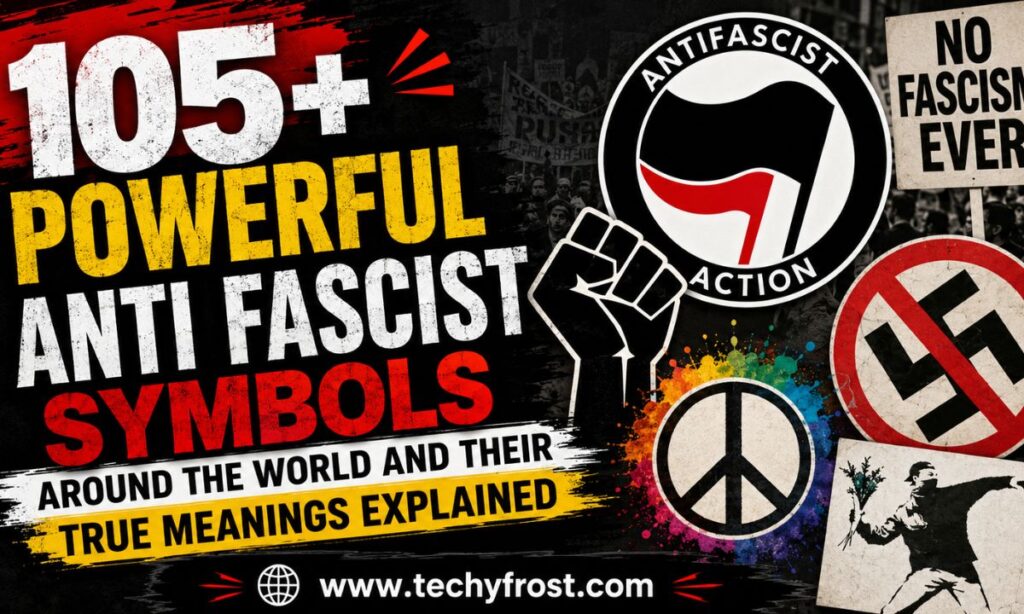
From protest marches in Berlin to murals in Buenos Aires, anti fascist symbols have carried the weight of resistance across generations. These visual icons are not just logos or graphics — they are coded messages of defiance, solidarity, and the enduring human refusal to submit to authoritarianism. Whether you are a history enthusiast, a political activist, or simply curious about the imagery you see at rallies and in art, this guide breaks down every major anti fascist symbol, its origin, cultural significance, and how it is used today.
What are Anti Fascist Symbols?
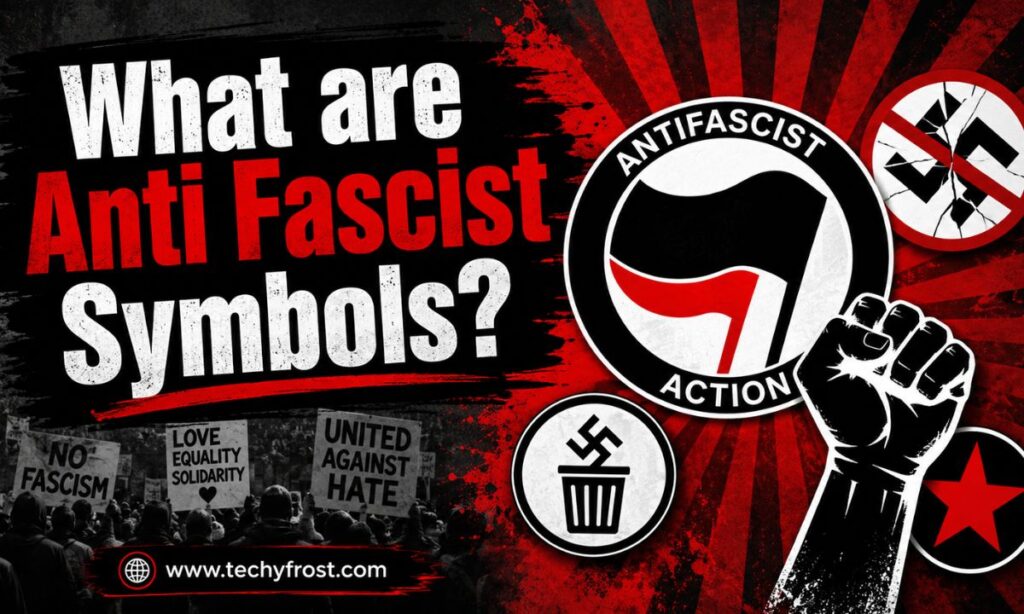
Anti fascist symbols are visual signs, emblems, and icons used by individuals and movements to express opposition to fascism — a political ideology characterized by ultranationalism, authoritarian power, suppression of opposition, and forcible control over society and economy.
These symbols serve several core functions:
- Identity markers — they signal belonging to a resistance community
- Political communication — they convey ideology without words
- Historical memory — they connect present-day movements to past struggles
- Psychological tools — they inspire courage and solidarity among activists
Common anti fascist symbols include the Three Arrows, the Antifa flag (red and black), the Raised Fist, the Circle A (anarchism), and the universal No Fascism sign (a fascist symbol crossed out in red).
Origin and History of Anti Fascist Movement Symbols
The roots of anti fascist symbolism stretch back to the 1920s and 1930s in Europe, when fascist movements led by Benito Mussolini in Italy and Adolf Hitler in Germany began seizing political power.
Key historical milestones:
| Year | Event | Symbol Born |
|---|---|---|
| 1923 | Iron Front formed in Germany | Three Arrows |
| 1932 | Social Democrats adopt anti-Nazi visual language | Three Arrows (widespread use) |
| 1930s | Anarchist militias in Spain | Black and Red Flag |
| 1960s–70s | New Left and labor movements globally | Raised Fist |
| 1980s | Antifa reborn in UK punk/skinhead scene | Modern Antifa Flag |
| 1988 | Antifa establishes in the United States | Dual-flag emblem |
The Iron Front, a German paramilitary organization formed to oppose Nazism and Stalinism simultaneously, created the Three Arrows as a response to the Nazi swastika. The symbol was deliberately simple — three arrows pointing downward — designed to be quickly painted over swastikas on walls and posters.
After World War II, anti fascist symbolism largely went dormant in mainstream Western politics. It was revived in the 1970s and 1980s through punk rock culture in the UK, where skinheads opposing racism adopted the anti fascist badge culture that still influences movements today.
Deep Symbolic Meaning
Spiritual Level
On a spiritual level, anti fascist symbols represent the archetypal struggle between freedom and tyranny — a theme found in nearly every world religion and mythology. The raised fist, for example, echoes ancient warrior iconography and the spiritual concept of righteous resistance. Many practitioners of liberation theology in Latin America adopted these symbols as expressions of divine justice. The downward arrow motif in the Three Arrows has also been interpreted as pushing down and defeating oppressive forces, aligning with spiritual narratives of light overcoming darkness.
Psychological Level
Psychologically, symbols like the clenched fist and the crossed-out swastika function as empowerment icons. Research in social psychology suggests that shared symbols reduce feelings of isolation, amplify group identity, and increase willingness to take collective action. For individuals facing oppression, displaying an anti fascist symbol can trigger a measurable shift in self-perception — from victim to active resistor. The simple act of wearing a pin or painting a wall creates what psychologists call symbolic self-completion, where the external symbol reinforces an internal identity commitment.
Cultural Level
Culturally, anti fascist symbols operate as living historical documents. When a protester in 2025 raises a fist or wears the black-and-red flag, they are consciously drawing a line connecting themselves to Spanish Civil War volunteers, German resistance fighters, and American civil rights activists. This cultural layering gives the symbols their emotional depth and makes them instantly recognizable across language barriers.
Types and Variations of Anti Fascist Symbols
Three Arrows
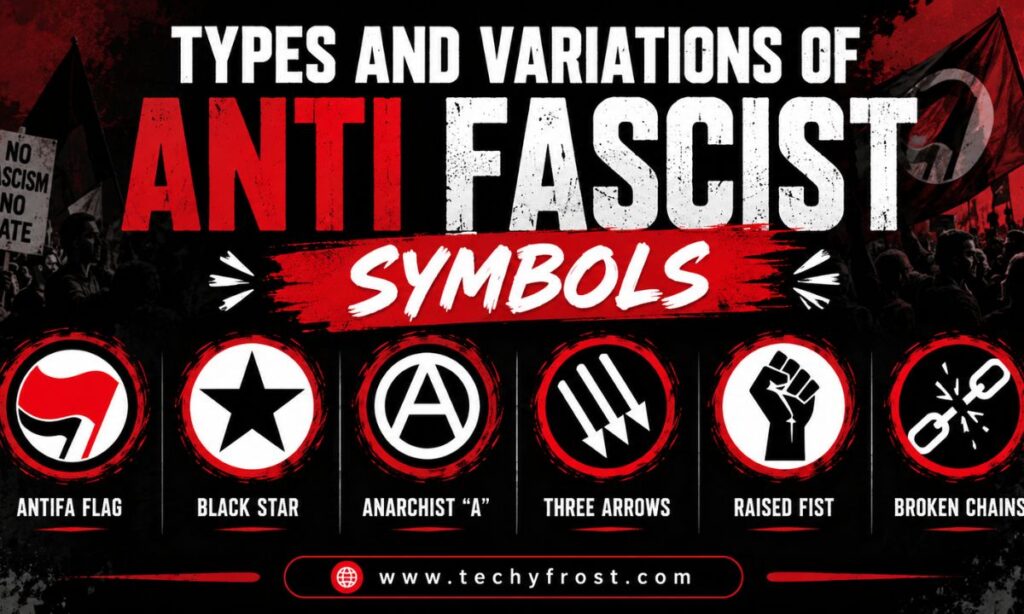
The Three Arrows (Drei Pfeile) is arguably the oldest specifically anti fascist symbol still in active use. Created for the Iron Front in 1932, the three arrows represent resistance against three enemies: Nazism, Stalinism, and reactionary conservatism. The arrows point diagonally downward, visually “striking down” opponents.
Today the Three Arrows symbol appears in:
- European Social Democratic party logos
- Anti-fascist merchandise and patches
- Protest graffiti across Germany, Poland, and the Netherlands
Antifa Flag
The Antifa flag consists of two flags — one black (representing anarchism) and one red (representing socialism/communism) — overlapping inside a circle. This dual-flag emblem was popularized by the German group Antifaschistische Aktion in 1932 and was revived by the modern Antifa movement in the 1980s.
The symbol explicitly signals that anti fascism is not a single-ideology movement but a coalition of left-wing traditions united against fascism.
Raised Fist
The Raised Fist (or Power Fist) is one of the most universally recognized symbols of resistance. Originally adopted by the labor movement in the early 20th century, it became a global icon during:
- The Black Power movement in the United States (1960s)
- Anti-apartheid protests in South Africa
- Feminist movements worldwide
- Antifa and anti fascist protests across Europe and North America
The fist is sometimes colored red (socialism), black (anarchism), or shown in brown/black (racial solidarity). Each variation shifts the symbolic emphasis while retaining the core message of collective defiance.
Circle A
The Circle A — the letter “A” enclosed in a circle — is the universal symbol of anarchism. Because anarchism has historically been one of the most active and militant forces of anti fascist resistance (particularly during the Spanish Civil War), the Circle A appears frequently in anti fascist contexts.
It represents the anarchist slogan “Anarchy is Order” — the idea that true social order emerges from voluntary cooperation, not authoritarian control.
No Fascism Sign
The No Fascism sign typically depicts a fascist symbol (most commonly a swastika or a fasces) inside a red circle with a diagonal line through it — identical in format to a “no entry” road sign. This symbol is widely used in:
- Public awareness campaigns
- Educational materials
- Protest signage
- Anti-hate organization branding
Its design language is internationally intuitive, making it one of the most accessible and widely understood anti fascist symbols.
Anti Fascist Symbols Across Cultures
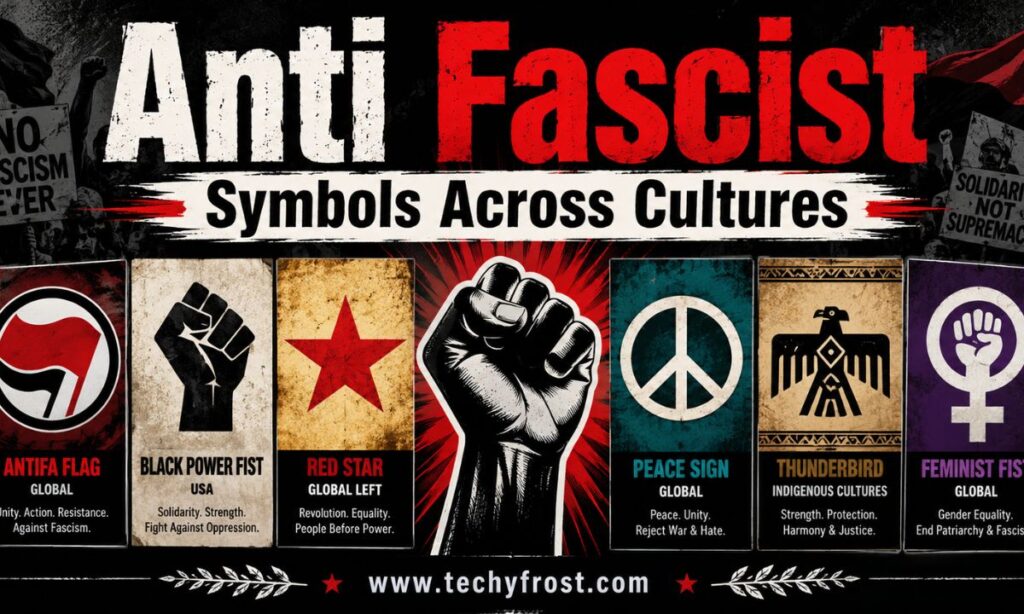
Europe
Europe is the birthplace of most formal anti fascist symbolism. In Germany, the Three Arrows and Antifa flag remain active in political culture. In Spain, the black-and-red flag carries deep historical resonance from the Civil War. In Italy, the birthplace of fascism, anti fascist symbols are embedded in national identity — the partisans’ red neckerchief (fazzoletto rosso) remains an honored emblem.
United States
In the United States, anti fascist symbolism blends European traditions with homegrown movements. The Raised Fist was adopted by the Black Panther Party, feminist groups, and labor unions. After 2016, the Antifa dual-flag emblem became widely visible at protests, though it remains controversial and misunderstood by large segments of the American public.
Latin America
Latin America developed its own powerful anti fascist visual vocabulary, shaped by opposition to military dictatorships in the 20th century. In Chile, Argentina, and Brazil, the raised fist merged with indigenous iconography and liberation theology imagery. The red bandana and the clenched fist became emblems of the desaparecidos (the disappeared) movements demanding justice for victims of authoritarian regimes.
Asia
In Japan, anti fascist symbols are used by left-wing groups in opposition to nationalist movements. In South Korea, resistance symbols echoing the democratic uprising of 1980 (the Gwangju Uprising) share visual DNA with global anti fascist iconography. Indian Dalit liberation movements have adopted the raised fist as a symbol of resistance against caste-based oppression, intertwining it with anti fascist meaning.
Middle East
In the Middle East, anti fascist and anti-authoritarian symbols appear in protest movements across the region. During the Arab Spring (2010–2012), the raised fist became an iconic image from Cairo’s Tahrir Square to Tunis. Kurdish resistance movements, particularly the YPJ and YPG in Syria and Iraq, have used anti fascist symbolism — including the dual-flag Antifa emblem — to signal their ideological alignment and gain international solidarity.
Meaning of Antifascism in Modern Politics
In the 21st century, antifascism has expanded beyond its original European context. Modern antifascism refers broadly to organized resistance against:
- Far-right extremism and white nationalism
- Authoritarian government overreach
- Systemic racism and ethnic nationalism
- Suppression of democratic institutions
Anti fascist symbols have been reclaimed by a diverse coalition including democratic socialists, anarchists, liberals, and nonpartisan civil libertarians. At the same time, the term “antifa” has been heavily politicized, particularly in the United States, where it is used both as a self-identifier and as a political attack label.
Differences Between Anti Fascist Symbols and Fascist Symbols
| Feature | Anti Fascist Symbols | Fascist Symbols |
|---|---|---|
| Core message | Resistance, solidarity, equality | Authority, purity, hierarchy |
| Common imagery | Fists, arrows, crossed-out symbols | Eagles, fasces, lightning bolts |
| Color palette | Red, black, occasionally rainbow | Black, red, white, gold |
| Historical origin | Labor, anarchist, socialist movements | Nationalist and militarist movements |
| Intent | Liberation and protection of rights | Domination and suppression |
Understanding these differences is important because some groups deliberately blur this distinction, misappropriating anti fascist imagery or falsely labeling fascist symbols as “anti fascist” to cause confusion.
How Anti Fascist Symbols Are Used in Protests
At protests and demonstrations, anti fascist symbols serve several tactical and communicative purposes:
- Group identification — patches, flags, and banners mark bloc affiliations
- Intimidation of far-right groups — visible symbols signal organized opposition
- Media messaging — visually striking symbols generate press coverage
- Solidarity signaling — they communicate alignment with global movements
- Historical invocation — connecting present actions to honored past struggles
The black bloc protest tactic, often associated with anti fascist protesters, uses black clothing and masks alongside anti fascist flags to create visual uniformity and protect individual identities.
Anti Fascist Symbols in Art, Movies and Pop Culture
Anti fascist imagery has a rich presence in global art and popular culture:
- Pablo Picasso’s Guernica — though not a symbol per se, it became the defining anti fascist artwork, depicting the bombing of a Basque town by Nazi and fascist forces
- Rage Against the Machine — the raised fist was central to the band’s visual identity and anti fascist messaging
- Marvel Comics — Captain America, created in 1941, was explicitly designed as an anti fascist superhero; the character’s original story is rooted in anti-Nazi resistance
- The Handmaid’s Tale — the red-robed resisters have adopted raised-fist iconography at real-world protests against authoritarianism
- Street art and graffiti — artists like Banksy have incorporated anti fascist symbolism into globally recognized works
Misinterpretations and Misuse of Anti Fascist Symbols
Anti fascist symbols are frequently misrepresented, both deliberately and through genuine misunderstanding:
- Conflation with violence — critics often equate anti fascist symbols with property destruction or assault, though the symbols predate modern protest tactics by decades
- Government designation — in 2020, the U.S. government sought (unsuccessfully) to designate “antifa” as a terrorist organization; no such organization formally exists
- Far-right cooption — some far-right groups have printed anti fascist symbols on merchandise ironically or to mock movements
- Media misidentification — news outlets have occasionally mislabeled anarchist or socialist symbols as “antifa symbols,” creating public confusion
Spiritual and Dream Meaning of Anti Fascist Symbols
In spiritual and dream interpretation frameworks, anti fascist symbols carry layered meaning:
- Dreaming of a raised fist often symbolizes a desire to assert personal power or resist an oppressive situation in waking life
- The Three Arrows in a dream context can represent decisiveness and the need to actively confront challenges rather than avoid them
- The black and red flag may appear in dreams during periods of internal conflict between structure (red/order) and freedom (black/individual will)
- In Jungian psychology, these symbols can represent the “shadow” energy of the collective unconscious rising to confront authoritarian archetypes
Positive vs Negative Meaning
Like all powerful symbols, anti fascist icons carry both positive and negative associations depending on perspective and context.
| Dimension | Positive Meaning | Negative Perception |
|---|---|---|
| Raised Fist | Solidarity, empowerment, resistance | Aggression, threat |
| Antifa Flag | Coalition-building, anti-oppression | Extremism (by critics) |
| Three Arrows | Strategic resistance, historical memory | Associated with radical politics |
| Circle A | Voluntary order, freedom | Chaos, lawlessness |
| No Fascism Sign | Clear rejection of hate | Dismissed as performative |
The meaning a viewer assigns to these symbols depends heavily on their political context, media exposure, and historical literacy. Education remains the most effective tool for ensuring accurate interpretation.
Why Humans Are Attracted to These Symbols
The psychological draw of anti fascist symbols is deeply rooted in human nature:
- Tribalism and identity — humans are biologically wired to form in-groups; symbols accelerate this bonding process
- Moral clarity — in a complex world, a simple visual that says “I oppose oppression” provides psychological comfort
- Historical continuity — connecting to a long resistance tradition gives individuals a sense of purpose larger than themselves
- Aesthetic appeal — many anti fascist symbols are visually striking, bold, and emotionally resonant — good design amplifies a message
- Empowerment — displaying resistance symbols shifts the psychological dynamic from passivity to agency
Humans have always used symbols to mark the boundaries between what they stand for and what they stand against. Anti fascist symbols, at their core, represent one of humanity’s oldest and most fundamental commitments: the refusal to be ruled by fear.
Frequently Asked Questions
What is the most recognized anti fascist symbol?
The raised fist is widely considered the most universally recognized anti fascist and resistance symbol, used across movements on every continent.
What does the Antifa symbol mean?
The Antifa symbol — two overlapping flags, one black and one red — represents a coalition of anarchist and socialist traditions united against fascism.
Are anti fascist symbols illegal?
In most democracies, displaying anti fascist symbols is protected as free speech. However, in some countries with specific laws against political insignia, certain symbols may face restrictions.
What are the Three Arrows?
The Three Arrows are a symbol created in 1932 by Germany’s Iron Front to represent resistance against fascism, Stalinism, and reactionary conservatism.
What does a raised fist symbolize?
The raised fist symbolizes solidarity, resistance, and collective power. It is used across labor, civil rights, feminist, and anti fascist movements worldwide.
Is the Circle A an anti fascist symbol?
The Circle A is primarily an anarchist symbol, but it appears frequently in anti fascist contexts because anarchism has historically been a major force in anti fascist resistance.
What does the black and red flag represent?
The black and red flag represents a union of anarchism (black) and socialism or communism (red), often used to signal broad left-wing anti fascist solidarity.
Were anti fascist symbols used in World War II?
Yes. European resistance movements, particularly in France, Italy, Poland, and Yugoslavia, used various anti fascist emblems, armbands, and insignia to identify themselves and signal opposition to Nazi occupation.
Conclusion
Anti fascist symbols are far more than protest accessories — they are compressed histories, carrying decades of struggle, sacrifice, and solidarity within their simple lines and colors. From the Three Arrows drawn on German walls in 1932 to raised fists at protests around the world today, these symbols tell a continuous story about the human capacity to resist oppression.
Understanding them — their origins, their variations across cultures, and their layered meanings — is not just an academic exercise. It is a form of historical literacy that helps distinguish between genuine resistance movements and the forces they oppose. Whether you encounter these symbols in the news, in art, in dreams, or on the streets, knowing what they represent places you in a better position to think critically, engage thoughtfully, and form your own informed perspective.
The fight against fascism, in all its forms, has always been a deeply human one. And the symbols that carry that fight forward are part of that humanity.

