

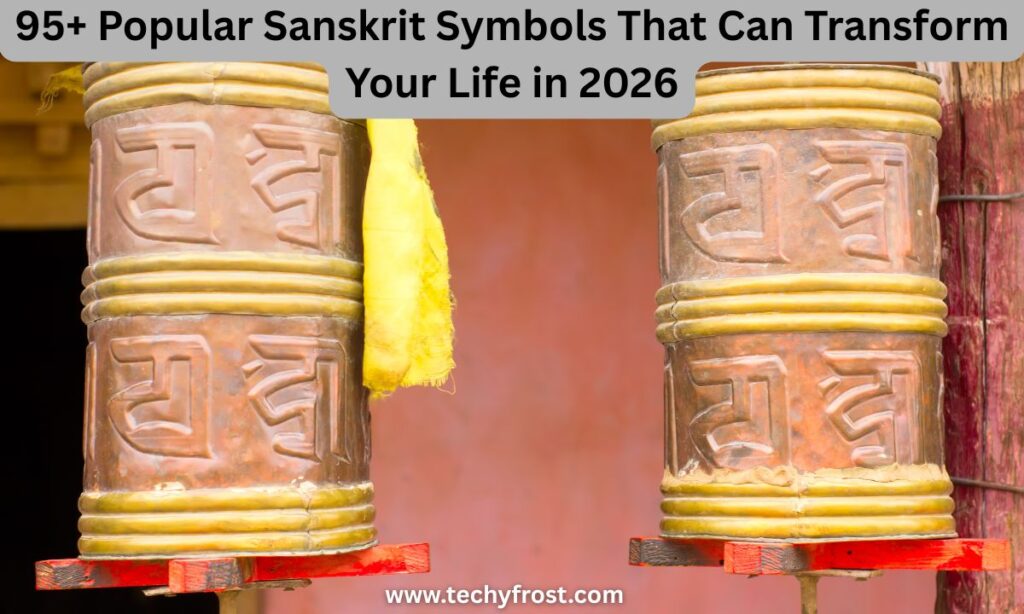
There’s something magnetic about Sanskrit symbols. Walk into any yoga studio, scroll through tattoo inspiration boards, or browse a meditation app — and you’ll find these ancient signs everywhere. But their presence in modern life is no accident. These symbols carry thousands of years of spiritual wisdom, and in 2026, more people than ever are turning to them for meaning, healing, and identity.
Whether you’re exploring Sanskrit symbols for tattoos, spiritual practice, or just pure curiosity, this guide covers everything — their origins, deep meanings, cultural significance, and why they continue to shape modern life. Let’s dive in.
What Are Sanskrit Symbols?
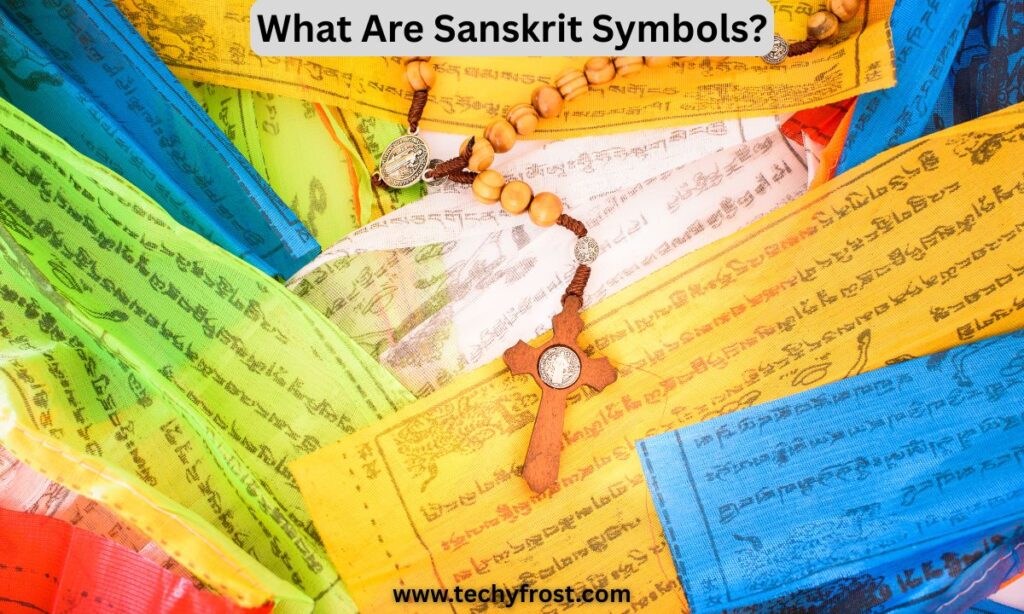
Sanskrit is one of the world’s oldest languages, originating in ancient India more than 3,500 years ago. It served as the sacred tongue of Hindu scriptures, Buddhist texts, and Jain philosophy. But Sanskrit was never just a spoken language — it was considered a divine language, where every sound and character held vibrational and spiritual energy.
Sanskrit symbols are sacred signs drawn from this ancient tradition. Unlike standard letters or words, these symbols function as visual mantras — geometric, phonetic, or iconic forms that represent universal truths. They appear in religious texts, temple carvings, meditation practices, and rituals across Hinduism, Buddhism, and Jainism.
Key characteristics of Sanskrit symbols:
- Each symbol corresponds to a specific sound or concept
- They are written primarily in the Devanagari script
- Many carry cosmological meanings linked to creation, consciousness, and divinity
- They are used as tools for meditation, healing, and spiritual awakening
Today, Sanskrit symbols bridge the ancient and the modern — showing up in yoga studios, digital art, jewelry, and on skin as tattoos that people wear close to their hearts.
Ancient Sanskrit Symbols And Their Spiritual Meanings
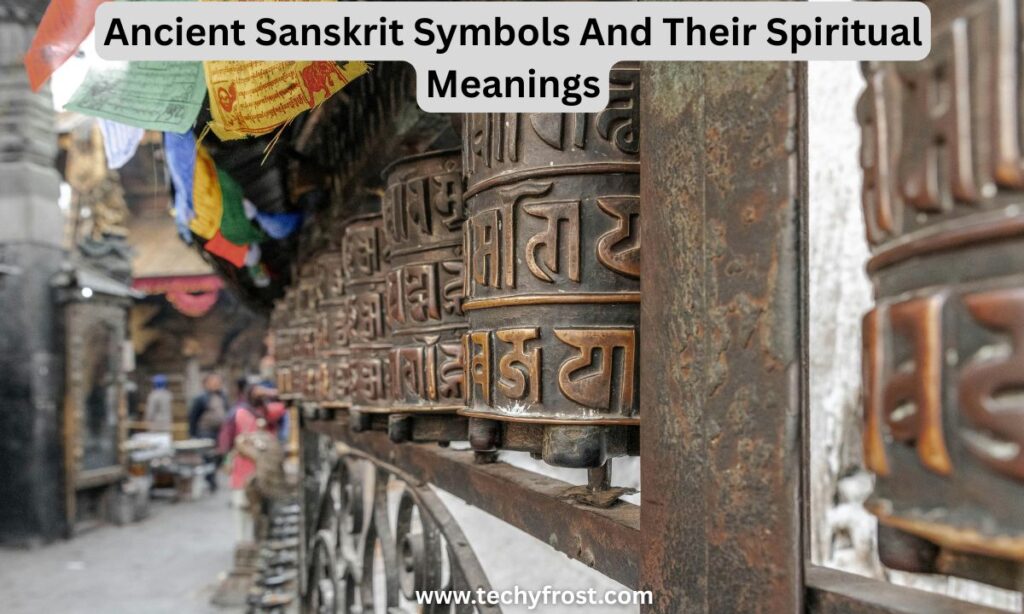
Sanskrit Symbols And Meanings
Understanding Sanskrit symbols starts with understanding their layered meanings. Each symbol operates on at least three levels: phonetic (the sound it represents), philosophical (the concept it embodies), and spiritual (the energy it channels). Here’s a quick-reference table of some of the most recognized Sanskrit symbols:
| Sanskrit Symbol | Name | Core Meaning |
| ॐ | Om (Aum) | Universal consciousness, creation |
| 卐 | Swastika | Well-being, good fortune, prosperity |
| ☸ | Dharma Chakra | Cycle of life, righteousness |
| 🪷 | Padma (Lotus) | Purity, enlightenment, rebirth |
| श | Shanti | Peace, inner calm |
| प्राण | Prana | Life force, vital breath |
| कर्म | Karma | Action, cause and effect |
| ध्यान | Dhyana | Meditation, contemplation |
| मोक्ष | Moksha | Liberation, spiritual freedom |
| ज्ञान | Jnana | Wisdom, divine knowledge |
These symbols aren’t decorative — they’re philosophical landmarks. Choosing one for a tattoo, altar, or daily practice means inviting its energy into your life.
Buddhist Sanskrit Symbols And Meanings
Buddhism adopted many Sanskrit symbols and gave them nuanced interpretations that focus on compassion, mindfulness, and liberation from suffering. Here are the most significant Buddhist Sanskrit symbols:
1. Om Mani Padme Hum (ॐ मणि पद्मे हूँ) This six-syllable mantra is one of the most chanted phrases in Buddhism. It translates roughly to “the jewel is in the lotus” and represents the path to enlightenment. Each syllable purifies a different aspect of the human condition — pride, jealousy, desire, ignorance, greed, and aggression.
2. Dharma Wheel (धर्म चक्र) The eight-spoked wheel symbolizes the Noble Eightfold Path taught by the Buddha — right view, intention, speech, action, livelihood, effort, mindfulness, and concentration.
3. Bodhi (बोधि) Derived from Sanskrit meaning “awakening” or “enlightenment,” this symbol is connected to the Bodhi tree under which Siddhartha Gautama reached enlightenment around the 6th century BCE.
4. Ahimsa (अहिंसा) This symbol represents non-violence and non-harm — a cornerstone principle shared by Buddhism, Hinduism, and Jainism. It’s often depicted as an open hand with a wheel at its center.
5. Vajra (वज्र) Known as the “thunderbolt” or “diamond,” the Vajra symbolizes indestructibility and clarity of mind. It’s a central symbol in Tibetan Buddhism and Tantric practice.
Ancient Sanskrit Symbols
The oldest Sanskrit symbols predate modern religion. They emerged from Vedic civilization and encoded cosmic truths that scholars, sages, and seekers have studied for millennia.
Aum (ॐ) — The primordial sound said to have been present at the moment of creation. Ancient Vedic texts describe it as the “seed of all existence.”
Shri (श्री) — A symbol of divine grace, abundance, and the sacred feminine. It precedes the names of deities and sacred texts as a mark of reverence.
Bindu (बिन्दु) — A dot representing the point of creation — the moment before the universe expanded. In meditation, it represents focused consciousness.
Nada (नाद) — The Sanskrit concept of primordial sound or cosmic vibration. It is the auditory equivalent of Bindu and represents the universe’s vibrational nature.
Trishula (त्रिशूल) — Shiva’s trident, representing the three aspects of existence: creation, preservation, and destruction. It’s one of the most ancient symbols in Hindu iconography.
Sanskrit Symbol For Life
In Sanskrit, the concept of “life” is expressed through multiple symbols, each capturing a different dimension of what it means to be alive.
Prana (प्राण) is the most direct Sanskrit symbol for life. It means “vital life force” — the energy that animates every living being. According to yogic philosophy, prana flows through invisible channels in the body called nadis and governs breath, movement, thought, and consciousness.
Ayus (आयुस्) means lifespan or longevity and is used in blessings and healing traditions.
Jiva (जीव) refers to the individual soul or living being. It represents the spark of consciousness within every creature.
People often choose the Prana or Jiva symbol as a reminder to live intentionally — to treat each breath as a gift and each day as sacred.
Sanskrit Symbols For Breathe
The Sanskrit symbol most associated with breath is Prana (प्राण) — but there’s a subtlety worth knowing. In recent years, a specific symbol has circulated widely online under the label “Sanskrit symbol for breathe.” While its exact ancient origin is debated among scholars, it’s become a widely recognized modern spiritual icon.
The deeper Sanskrit concept behind it is powerful regardless:
- Prana = the breath that sustains life
- Pranayama (प्राणायाम) = the yogic practice of breath control
- Svasa (श्वास) = the Sanskrit word literally meaning “breath”
In a fast-paced world where anxiety and stress are commonplace, the symbol for breathe serves as a grounding reminder. It says: stop, inhale, return to yourself. That’s why it appears so frequently in mindfulness spaces, meditation apps, and on wrists as a tiny but meaningful tattoo.
Popular Sanskrit Symbols In Tattoos And Modern Design

Sanskrit Symbols Tattoos
Tattoos are one of the most intimate ways people connect with Sanskrit symbols. Permanently placing a sacred symbol on your skin is a deeply personal act — a commitment to carry its meaning wherever you go.
Sanskrit tattoos gained massive popularity through the early 2000s and have never really faded. In 2026, they remain among the most searched tattoo styles globally. Part of their appeal is aesthetic — the curves and strokes of Devanagari script are visually beautiful. But the bigger draw is meaning.
Most popular Sanskrit tattoo placements:
- Wrist — for mantras or short symbols like Om, visible as a daily reminder
- Spine — for a series of chakra symbols, aligned with the body’s energy centers
- Chest — for deeply personal symbols like Prana or Aham Brahmasmi, close to the heart
- Forearm — for longer Sanskrit phrases or words like Karma or Shanti
- Upper back — for larger designs like Mandalas or Lotus combinations
Sanskrit Symbols And Meanings Tattoos
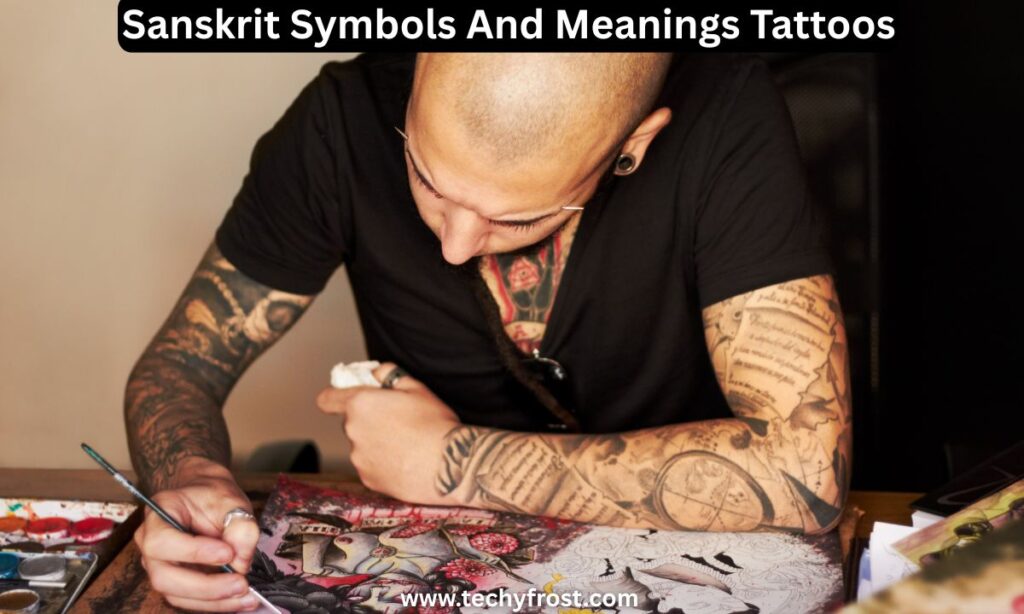
Before getting a Sanskrit tattoo, knowing the symbol’s meaning is essential. Here are some of the most popular choices and what they represent:
| Sanskrit Word/Symbol | Script | Tattoo Meaning |
| Om | ॐ | Universal consciousness, spiritual harmony |
| Shanti | शान्ति | Peace, tranquility |
| Karma | कर्म | Action and its consequences |
| Prana | प्राण | Life force, breath |
| Dharma | धर्म | Righteousness, life path |
| Moksha | मोक्ष | Liberation, spiritual freedom |
| Ahimsa | अहिंसा | Non-violence, compassion |
| Asha | आशा | Hope, wish |
| Satya | सत्य | Truth |
| Aham Brahmasmi | अहं ब्रह्मास्मि | “I am divine” — self-realization |
Celebrity-approved picks: Katy Perry and Russell Brand both famously chose Anuugacchati Pravaha — meaning “go with the flow” — as Sanskrit tattoos, bringing global attention to this beautiful tradition.
Spiritual Sanskrit Symbols
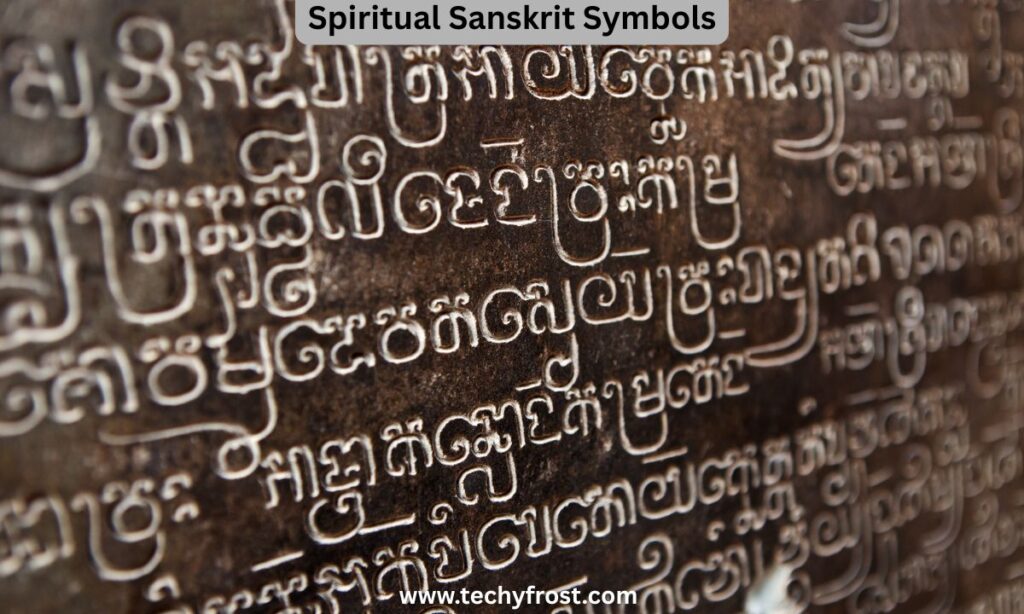
Beyond tattoos, Sanskrit symbols are powerful tools for spiritual practice. Many people incorporate them into:
- Meditation spaces — placing an Om symbol or mandala at the center of an altar
- Yoga practice — using chakra symbols to visualize energy flow during poses
- Prayer and ritual — chanting mantras connected to specific symbols
- Jewelry and malas — wearing symbols as pendants or incorporating them into prayer beads
- Home décor — hanging sacred symbols to invite specific energies into a space
The spiritual power of these symbols lies in focused intention. When you meditate on an Om symbol, you’re not just looking at a drawing — you’re engaging with thousands of years of collective spiritual energy.
Sanskrit Symbols Text
In the Devanagari script, Sanskrit symbols are written with remarkable precision. Each character corresponds to a specific phonetic sound, which is why Sanskrit has often been called the most scientifically structured language ever created.
Here are some commonly used Sanskrit symbols in text form:
- ॐ — Om
- श्री — Shri (auspiciousness)
- 🕉 — Unicode Om symbol
- स्वस्तिक — Swastika (rendered as text)
- नमस्ते — Namaste
For tattoos or digital design, it’s critical to verify that the Devanagari characters are correctly rendered. Errors in Sanskrit script can completely alter the meaning of a symbol — a common pitfall when working with non-native artists.
Symbols Of Sanskrit
Sanskrit’s symbolic system goes beyond single characters. It includes:
- Aksharas — individual letters, each representing a sound-energy unit
- Bija mantras — seed syllables like Lam, Vam, Ram, Yam, Ham, Om that correspond to the chakras
- Yantras — geometric diagrams used as meditation tools
- Mandalas — circular geometric designs representing the cosmos
- Mudras — hand gestures that redirect the body’s energy
Together, these form a complete symbolic language — one that encodes philosophy, cosmology, and spiritual practice in visual and auditory form.
Sanskrit Symbol For Balance
The Sanskrit symbol most associated with balance is the Shatkona (षट्कोण) — the six-pointed Star of David-like symbol formed by two interlocking triangles. In Hinduism, the upward triangle represents masculine energy (Shiva), and the downward triangle represents feminine energy (Shakti). Their union creates perfect balance.
Other Sanskrit symbols for balance include:
- Yin-Yang equivalent — Ardhanarisvara — the half-male, half-female form of Shiva, representing cosmic balance
- Dharma Chakra — its eight equal spokes symbolize balanced living
- Om — its three sounds (A-U-M) balance waking, dreaming, and deep sleep states
Breathe Sanskrit Symbol
The breathe symbol has become one of the most tattooed Sanskrit-inspired designs in recent years. It connects deeply to the practice of mindful breathing — something that resonates strongly in an anxious, digitally overwhelmed age.
The symbol is often combined with:
- Lotus — to represent growth through difficulty
- Om — to add spiritual depth
- Feather or wave — for a more personal, contemporary feel
For people dealing with anxiety, grief, or burnout, this symbol is a daily anchor. It’s a whisper inked into skin: you are alive, breathe, that is enough.
Deep Symbolic Meaning
Sanskrit symbols are not flat. Each one carries multiple layers of meaning that expand the more you study them.
Take the Om symbol (ॐ) as an example:
- Phonetically, it’s three sounds: A (creation), U (preservation), M (dissolution)
- Visually, the curved lower part represents waking consciousness, the upper curve represents deep sleep, the tail represents the dream state, and the crescent with dot above represents the state of pure transcendence (Turiya)
- Cosmologically, it represents Brahma (creator), Vishnu (preserver), and Shiva (destroyer) — the Hindu Trinity
- Universally, it’s accepted across Hinduism, Buddhism, and Jainism as a symbol of the absolute
This depth is what separates Sanskrit symbols from decorative art. They are living teachings encoded in form.
Types / Variations of Sanskrit Symbols
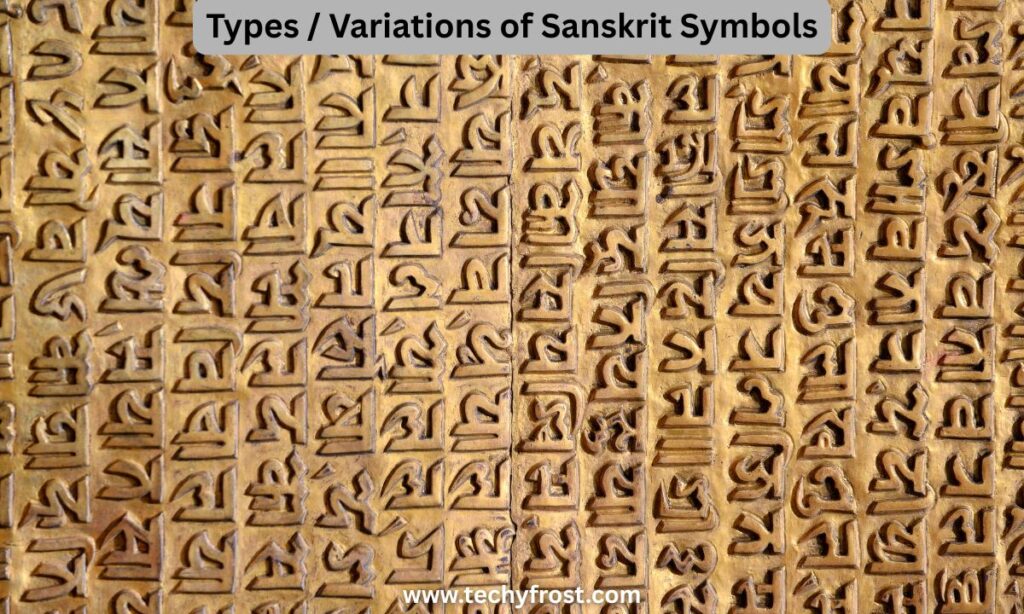
Om Symbol
Script: ॐ Also spelled: Aum Origin: Vedic tradition, mentioned in the Upanishads and Mandukya Upanishad
Om is considered the most sacred sound in the universe. It is said to be the first sound — the vibration that preceded creation. Chanting Om brings the mind to a state of stillness and aligns one’s consciousness with universal energy. It is used at the beginning and end of yoga sessions, meditation, and prayer. As a tattoo, the Om symbol is the single most chosen Sanskrit design worldwide.
Lotus Symbol
Sanskrit name: Padma (पद्म) Element: Water Associated deity: Lakshmi, Brahma, and the Buddha
The lotus grows from muddy water but blooms in perfect beauty above the surface. This makes it a universal symbol for spiritual growth, resilience, and the journey from darkness to light. In Buddhist tradition, the lotus represents the possibility of enlightenment for every being. In Hinduism, Lakshmi — goddess of prosperity — stands on a fully bloomed lotus. The lotus appears in every major Sanskrit spiritual tradition and continues to inspire modern art, tattoos, and home design.
Swastika Symbol
Sanskrit name: Svastika (स्वस्तिक) Literal meaning: “That which brings good fortune” (Su = good, Asti = it is, Ka = noun suffix) Origin: Over 7,000 years old — one of the oldest symbols in human history
The Swastika’s misappropriation by the Nazi regime in the 20th century caused enormous pain and confusion around this symbol. But its original Sanskrit meaning is entirely positive — good fortune, well-being, prosperity, and auspiciousness. In Hindu, Buddhist, and Jain traditions, the Swastika continues to be used in ceremonies, temple decorations, and celebrations. Understanding its true Sanskrit origin is essential for cultural respect.
Chakra Symbols
Sanskrit name: Chakra (चक्र) — meaning “wheel” or “circle” Number: 7 main chakras (with additional minor chakras)
The chakra system maps the body’s energy centers, from the base of the spine to the crown of the head. Each chakra has its own Sanskrit name, bija mantra (seed sound), geometric form, and color:
| Chakra | Sanskrit Name | Location | Bija Mantra | Meaning |
| Root | Muladhara | Base of spine | Lam | Stability, security |
| Sacral | Svadhisthana | Lower abdomen | Vam | Creativity, emotion |
| Solar Plexus | Manipura | Upper abdomen | Ram | Power, confidence |
| Heart | Anahata | Center of chest | Yam | Love, compassion |
| Throat | Vishuddha | Throat | Ham | Communication, truth |
| Third Eye | Ajna | Forehead | Om | Intuition, wisdom |
| Crown | Sahasrara | Top of head | Silence | Spiritual connection |
Mandala
Sanskrit name: Mandala (मण्डल) — meaning “circle” Type: Geometric spiritual diagram
A mandala is much more than a pretty circular design. It is a map of the cosmos — a visual representation of the universe’s structure, with the self at the center. In meditation, focusing on a mandala helps the mind enter deeper states of concentration. Tibetan Buddhist monks spend weeks creating intricate sand mandalas, only to sweep them away upon completion — a teaching about impermanence.
In modern life, mandalas appear in art therapy (they’re clinically used to reduce anxiety), tattoo design, home décor, and digital art. Creating or coloring a mandala is itself a meditative practice.
Sanskrit Symbols Across Cultures
Sanskrit symbols didn’t stay within the borders of ancient India. They traveled along trade routes, with Buddhist missionaries, and through cultural exchange to shape spiritual traditions across Asia and beyond.
- In Tibet, Sanskrit mantras and symbols became central to Vajrayana Buddhism, appearing on prayer flags, prayer wheels, and thangka paintings
- In Japan, Sanskrit-derived Siddham script is used in Shingon Buddhism for writing mantras and deity names
- In Southeast Asia (Thailand, Cambodia, Indonesia), Sanskrit symbols appear in royal temples, royal ceremonies, and protective tattoos called Sak Yant
- In the West, Sanskrit symbols entered mainstream culture through the yoga movement of the 20th century, and accelerated through social media and celebrity tattoo culture in the 2000s
This cross-cultural journey is a testament to the universality of Sanskrit’s wisdom. Its symbols speak a language that transcends borders.
Sanskrit Symbols in Art, Movies & Pop Culture
Sanskrit symbols have made significant appearances in global pop culture:
- Movies: Doctor Strange (2016) prominently features Sanskrit-inspired mystical symbols. Indiana Jones and The Matrix trilogy both draw on Eastern mystical symbolism with Sanskrit roots.
- Music: Artists like Björk, Madonna, and countless world-music musicians have incorporated Om and Sanskrit phrases into album art and lyrics.
- Fashion: Luxury brands and streetwear alike have featured Om symbols and lotus motifs on clothing and accessories.
- Gaming: Games like Civilization and various RPGs use Devanagari-inspired scripts for fictional ancient civilizations.
- Social Media: The Om symbol (🕉) is one of the most used spiritual emojis globally across Instagram, Pinterest, and TikTok wellness communities.
- Architecture: Modern yoga studios, spas, and wellness centers worldwide use Sanskrit symbols as part of their design identity.
Spiritual & Dream Meaning of Sanskrit Symbols
When Sanskrit symbols appear in dreams or deep meditation, many spiritual traditions interpret this as significant:
Seeing Om in a dream is traditionally interpreted as a message of alignment — your life is in harmony with your purpose, or you are being called toward deeper spiritual practice.
Dreaming of a lotus often signals personal growth, an upcoming transformation, or the emergence of something beautiful from a difficult period in your life.
A spinning chakra symbol in meditation is seen as activation of that energy center — a sign that healing or awakening is occurring in that area of life.
Encountering a mandala in a dream is associated with the quest for wholeness, integration of the self, and finding one’s center amid chaos.
These interpretations come from yogic and tantric traditions and vary by school of thought. What matters most is the personal resonance you feel with a symbol — your intuition is itself a valid guide.
Positive vs Negative Meaning
Most Sanskrit symbols are inherently positive. However, context, intent, and cultural awareness matter deeply.
| Symbol | Positive Meaning | Potential Concern |
| Swastika | Good fortune, auspiciousness (original) | Misappropriated by Nazism (unrelated to Sanskrit origin) |
| Om | Universal consciousness, peace | Overuse without understanding can feel disrespectful to practitioners |
| Lotus | Purity, growth | No negative connotations |
| Chakra symbols | Energy, healing | Misrepresentation in wellness culture |
| Sanskrit tattoos | Spiritual connection, meaning | Incorrect script can unintentionally alter meaning |
The lesson here is simple: research before you adopt. These symbols carry the weight of entire civilizations. Approaching them with respect and genuine curiosity keeps their power intact — and honors the traditions they come from.
Why Humans Are Attracted to This Symbol
The appeal of Sanskrit symbols runs deeper than aesthetics. Several layers explain why people across cultures and generations keep returning to them:
1. They answer the big questions. Sanskrit symbols encode ancient answers to the deepest human questions — Who am I? Why am I here? What is beyond this life? In an age of information overload, people hunger for wisdom that feels timeless.
2. They create a sense of connection. Using a symbol that billions of people across thousands of years have also used creates a felt sense of belonging to something larger than yourself.
3. They are visually beautiful. The curves of Devanagari script and the geometric precision of mandalas and chakra symbols are genuinely beautiful — they satisfy both aesthetic and spiritual hunger simultaneously.
4. They work as anchors. A tiny Om on your wrist, a lotus pendant around your neck — these objects create a physical anchor for intentions, values, and states of mind that might otherwise drift.
5. They carry vibrational energy. Across Hindu, Buddhist, and yogic traditions, Sanskrit symbols are believed to carry actual energetic frequencies that influence consciousness. Even from a secular perspective, the psychological effect of working with meaningful symbols is well-documented.
6. They transcend language. You don’t need to speak Sanskrit to feel the power of Om. The symbol communicates across linguistic barriers — a rare quality in human communication.
Frequently Asked Questions
Q: What is the most powerful Sanskrit symbol? A: Om (ॐ) is universally considered the most powerful, representing the primordial sound of the universe and all of existence.
Q: What does the Sanskrit symbol for peace look like? A: It’s written as शान्ति (Shanti) in Devanagari script, meaning peace, tranquility, and inner calm.
Q: Is it disrespectful to get a Sanskrit tattoo? A: Not inherently — but it’s important to understand the symbol’s meaning, use correct script, and approach it with genuine respect rather than treating it as a trend.
Q: What is the Sanskrit symbol for love? A: प्रेम (Prema) means divine, unconditional love. ❤️ It’s used in yoga and devotional practice to express love beyond romance.
Q: What does the Sanskrit breathe symbol mean? A: It represents the power of breath as a life force (Prana), reminding the wearer to pause, breathe consciously, and return to the present moment.
Q: Are Sanskrit symbols used in Buddhism? A: Yes — many Buddhist traditions, especially Tibetan and Japanese schools, use Sanskrit symbols and mantras extensively in their practices.
Q: What is the Sanskrit symbol for strength? A: शक्ति (Shakti), meaning divine power or strength, is one of the most recognized Sanskrit symbols for inner power.
Q: Can I use Sanskrit symbols in home decoration? A: Absolutely — placing symbols like Om, lotus, or mandala in your home is widely practiced and considered auspicious when done respectfully.
Conclusion
Sanskrit symbols are more than ancient relics. They are living tools — for meditation, self-expression, healing, and connection. Whether you’re drawn to the Om for its universal resonance, the lotus for its message of growth through adversity, or the breathe symbol for its quiet daily power, each of these symbols has something to offer modern life.
In 2026, as more people seek depth in a world of surface-level noise, Sanskrit symbols continue to rise. They remind us that humans have always searched for meaning — and that the most profound truths were often encoded thousands of years ago, waiting patiently in curves and lines of an ancient sacred script.
Choose your symbol with intention. Wear it, display it, meditate on it. Let it ask you better questions about who you are and who you are becoming.

