

If you’ve ever watched One Piece and felt something stir inside you when Luffy raises his fist or a pirate crew unfurls its flag — that’s not an accident. Eiichiro Oda didn’t just design cool-looking logos. He built an entire language of symbols, and every skull, scar, sun, and straw hat carries a weight that goes far beyond the page.
From the Straw Hat Jolly Roger that has become one of anime’s most recognized icons, to Ace’s heartbreaking “ASCE” tattoo — One Piece symbols are silent storytellers. They hold the weight of dreams, brotherhood, rebellion, and sacrifice. In this guide, we’ll break down every major symbol, what it means on the surface and what it means in your soul.
What Are One Piece Symbols?
One Piece symbols are visual marks — flags, tattoos, crests, emblems, and logos — used throughout Eiichiro Oda’s world to communicate identity, power, loyalty, and purpose. They function like a visual language in a universe where pirates, marines, revolutionaries, and world governments all mark their territory, their beliefs, and their bonds.
These symbols draw on real pirate history, ancient mythology, Eastern philosophy, and universal human psychology. When a character bears a mark — whether tattooed on their skin or flying from their ship — it tells you everything you need to know about who they are, what they stand for, and what they’re willing to die for.
Throughout the series, symbols serve three key functions:
- Identity markers — telling the world which crew or faction a person belongs to
- Emotional declarations — expressing personal bonds, dreams, or pain
- Power signals — warning enemies, claiming territory, and inspiring allies
One Piece Symbols Guide, Text And Logos
Before diving into individual flags and tattoos, it helps to understand the visual DNA of One Piece symbols. Oda’s design philosophy is intentional — nothing in this series is decorative without also being meaningful.
One Piece Symbols Copy And Paste
Fans frequently look for One Piece symbols in text form to use in usernames, bios, and social media profiles. While the Unicode character set doesn’t contain official One Piece icons, fan communities have adopted these close alternatives:
| Symbol | Represents | Unicode/Text Equivalent |
| ☠ | Skull (Jolly Roger base) | U+2620 |
| ⚓ | Anchor (adventure, sailing) | U+2693 |
| 🏴☠️ | Pirate flag (general) | Emoji combo |
| ✖ | Crossed bones / the “S” cross-out | U+2716 |
| ☀ | Sun (Sun Pirates symbol) | U+2600 |
| 🌀 | Swirl (chaos, Devil Fruit energy) | Emoji |
One Piece Symbol Text
In fan typography, “One Piece” symbols are often rendered as stylized ASCII art or using Japanese katakana characters. The Japanese word for the Jolly Roger is ドクロのマーク (Dokuro no Māku, meaning “Skull Mark”), and in deeper symbolic contexts, the term シンボル (Shinboru, or “Symbol”) is used — reflecting just how seriously the story treats these visual identifiers.
One Piece Symbols Font
The distinctive typography of One Piece uses a bold, slightly aggressive serif style that balances adventure with authority. Fans recreating the look often use fonts like Pirata One, Jolly Lodger, or MedievalSharp to capture the swashbuckling aesthetic. The official manga title uses custom lettering that mirrors the nautical era’s hand-painted ship signage.
One Piece Symbols Text
For keyboard art and Discord servers, fans often combine:
- ☠️ + 🎩 = Straw Hat vibe
- ✖ + 🔥 = Ace tribute
- ☀️ + 🐟 = Sun Pirates reference
- 💀 + 🥊 = Whitebeard Pirates
One Piece Logo Meaning
The official One Piece logo — first seen in 1999 — is one of the most cleverly designed franchise logos in anime history. Three letters carry hidden visual messages:
- The “O” features a skull wearing a straw hat and gripping a rope in its teeth, with bones extending along its perimeter. This is a direct nod to the classic Jolly Roger, but humanized with Luffy’s signature hat — symbolizing that this version of piracy is about hope, not terror.
- The “I” is replaced with the silhouette of a human figure — widely interpreted as Monkey D. Luffy himself, the protagonist at the center of the story.
- The “E” is stylized as a ship’s anchor, grounding the word — and the franchise — in maritime adventure.
A rope also winds through the entire logo, connecting all letters and tying to the anchor. Symbolically, it binds every character, every crew, and every dream into one connected journey.
The gradient blue color of the logo represents the sea — the vast, dangerous, liberating ocean that is the soul of One Piece.
One Piece Logo Symbols
Beyond the letters, the One Piece logo as a whole communicates several themes:
- Freedom — through the open sea imagery and pirate iconography
- Unity — through the rope that ties all elements together
- Adventure — through the anchor and nautical references
- Hope — through the straw hat on the skull, softening death into possibility
One Piece Anime Symbols
The anime adaptation maintains logo consistency while adding vibrant, saturated color — particularly the golden yellows and ocean blues that have become synonymous with the franchise. In the anime, symbols appear not just on flags but woven into set design, clothing, scar tissue, and architecture — reinforcing the world’s visual grammar.
Symbols From One Piece
The most recognized symbols across the full One Piece universe include:
- Straw Hat Jolly Roger — skull with a straw hat
- Whitebeard Emblem — skull with a white mustache and purple cross
- Blackbeard Triple Skulls — three skulls, representing darkness and greed
- Sun Pirates Mark — a bold sun symbol covering slave brands
- ASCE Tattoo — Ace’s personal tribute to his brothers
- 3D2Y — Luffy’s coded message and commitment to growth
- Revolutionary Army Claw — Dragon’s symbol of rebellion
- Marine Kanji (正義) — “Seigi” meaning “Justice,” worn on Marine jackets
Popular Pirate Flags And Crew Symbols In One Piece
One Piece Jolly Roger
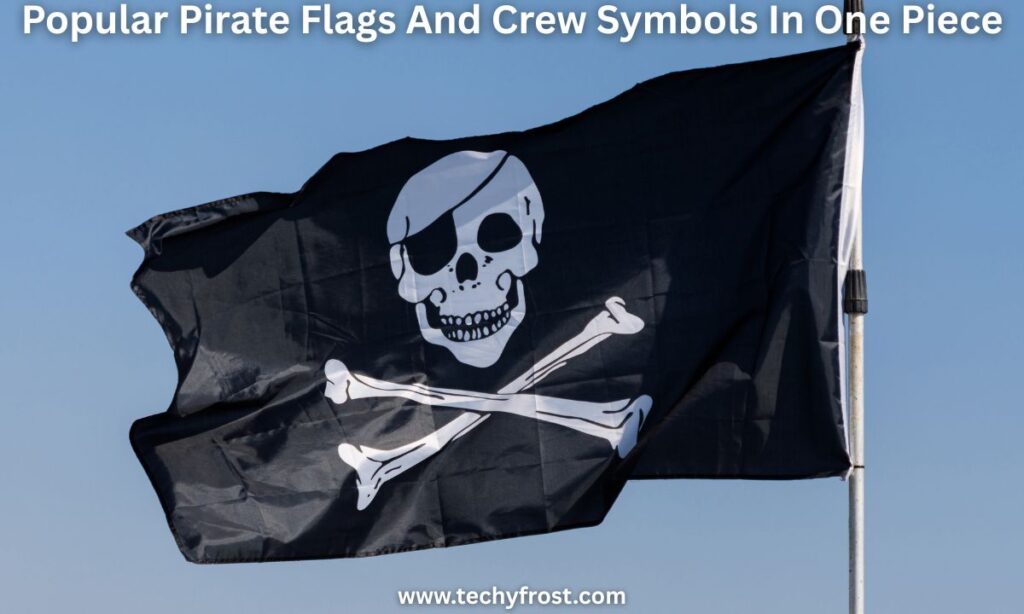
The Jolly Roger is the beating heart of pirate identity in One Piece. Every crew has one, and no two are alike. The term itself has murky historical origins — potentially from the French jolie rouge (“lovely red,” invoking blood), the English word “rogue,” or the folk name “Old Roger” for the Devil. In One Piece, Oda took this tradition and elevated it into an art form.
As stated in the One Piece Fandom Wiki, a Jolly Roger is “the primary emblem of a pirate crew” that exists “in countless variations across the world, distinguishing hundreds — if not thousands — of different crews.” For more idealistic pirates, the Jolly Roger expresses “wider principles of freedom, personal conviction, and even friendship.”
Losing one’s Jolly Roger in One Piece is treated as one of the gravest humiliations possible — it’s not just property, it’s the soul of the crew made visible.
One Piece Flag Symbol
Every pirate flag in One Piece is a visual fingerprint of its captain’s personality. Unlike real-world pirate flags that were designed to maximize fear, One Piece flags are designed to express character. Oda uses them as a shorthand for an entire crew’s philosophy.
All One Piece Symbols
Here is a reference table of major One Piece crew symbols:
| Crew | Flag Description | Core Symbolism |
| Straw Hat Pirates | Smiling skull with straw hat | Hope, freedom, joy |
| Whitebeard Pirates | Skull with mustache, purple cross | Family, power, loyalty |
| Blackbeard Pirates | Triple skulls, no smile | Darkness, betrayal, ambition |
| Big Mom Pirates | Skull with red lips, lollipop bones | Matriarchal control, hunger |
| Kaido / Beast Pirates | Kaido’s head silhouette | Dominance, “no mercy” |
| Heart Pirates | Skull with spotted hat, smiling | Calculated cunning |
| Kid Pirates | Skull with spiky hair, smiling | Recklessness, aggression |
| Sun Pirates | Sun symbol | Liberation, racial pride |
| Donquixote Pirates | Smiley face | Twisted joy, manipulation |
One Piece Symbols Names
Beyond Jolly Rogers, here are key named symbols in the series:
- Haki marks — visual manifestations of Armament and Conqueror’s Haki
- Devil Fruit crests — represented on Vivre Cards and in encyclopedias
- Poneglyph script — the ancient language carrying the Void Century’s truth
- Government Cipher Pol marks — secret agency insignia
- The “D” initial — not a visible symbol but a deeply symbolic letter, the “Will of D”
Ace One Piece Symbols
Portgas D. Ace carried two of the most emotionally loaded symbols in the entire series on his body:
- Whitebeard Pirates emblem (on his back) — A purple skull with a white mustache and a cross of bones behind it. Ace described this as his greatest pride. He chose to wear it as a tattoo rather than just a flag because he wanted to carry his family with him at all times.
- “ASCE” tattoo (on his left bicep) — Each letter is stacked vertically, with the “S” crossed out. According to One Piece Green: Secret Pieces (the official databook), the meaning is: A = Ace, S = Sabo (crossed out because he was believed dead), C = “Crybaby” (Luffy’s nickname), E = Edward Newgate (Whitebeard). It is one of the most heartbreaking symbols in anime — a man wearing his entire family on his arm, including the brother he lost.
Cool One Piece Symbols
Among fan favorites for aesthetic appeal and symbolic depth:
- Mihawk’s cross — stark, imposing, almost religious in its authority
- Law’s Heart Pirates flag — the speckled mushroom-hat skull with its knowing smirk
- Roger Pirates’ flag — the original, the legend, the template for every dream that followed
- Shanks’ flag — three slash marks across a standard Jolly Roger, a reference to his encounter with Blackbeard
Symbols In One Piece
What makes One Piece unique is that symbols aren’t just external markers — they’re internal. Characters don’t just fly flags; they become their symbols. Luffy’s straw hat isn’t just a hat. It’s the weight of Roger’s era, Shanks’ sacrifice, and an entire generation’s hope resting on one boy’s head.
One Piece Symbolism, Tattoos And Meanings
One Piece Symbols Tattoos
Tattoos in One Piece function as living symbols — permanent commitments worn on the body. They’re not fashion. They’re vows. The major tattoos in the series include:
- Whitebeard emblem — worn on the backs of crew’s most loyal members
- ASCE — Ace’s brotherhood tribute
- Sun Pirates mark — used to cover the Hoof of the Celestial Dragon brand burned onto slaves
- Arlong Pirates shark — a mark of oppression; the same symbol that Nami was forced to wear
- 3D2Y — Luffy’s arm tattoo representing the two years of training after Marineford
- Dressrosa colosseum tattoo — worn by slave gladiators
Tattoo One Piece Symbols
Fans worldwide have embraced One Piece tattoo culture, with ASCE, the Straw Hat Jolly Roger, and Whitebeard’s emblem ranking among the most requested anime tattoo designs globally. Many fans choose these not just for aesthetics but because the stories behind them — loyalty, brotherhood, sacrifice — resonate deeply with personal experience.
One Piece Symbols Tattoo
Getting a One Piece tattoo is, in many ways, mirroring what the characters do — making a public, permanent declaration of what you believe in. The Straw Hat Jolly Roger says: I believe in impossible dreams. The ASCE tattoo says: I carry my family with me always.
One Piece Symbols And Meanings
| Symbol | Character/Crew | Core Meaning |
| Straw Hat Jolly Roger | Straw Hat Pirates | Freedom, dream-chasing, joy |
| ASCE tattoo | Portgas D. Ace | Brotherhood, love, loss |
| Whitebeard emblem | Whitebeard Pirates | Family, strength, legacy |
| Sun mark | Sun Pirates | Liberation from oppression |
| 3D2Y | Monkey D. Luffy | Growth, resilience, promise |
| Marine Kanji (正義) | World Government | Justice (often corrupt) |
| Poneglyph script | Ancient world | Hidden truth, suppressed history |
| Dragon’s claw | Revolutionary Army | Defiance, freedom for all |
One Piece Symbol Meaning
At its deepest level, every One Piece symbol shares one root meaning: conviction. As Zoro says in the series, “The skull and crossbones isn’t flown lightly. It’s an unbreakable symbol. A symbol of conviction.”
Symbolism In One Piece
Oda’s use of symbolism extends far beyond flags and tattoos. Devil Fruits are themselves symbols — Luffy’s rubber body represents his adaptability and refusal to be permanently shaped by anyone else’s will. Zoro’s three swords embody his three-dimensional loyalty to his crew, his dream, and the memory of Kuina. Robin’s hands that bloom flowers in bleak places symbolize resilience born from isolation and trauma.
One Piece Symbolism
The series as a whole is a massive symbolic act about what it means to be free. The World Government’s authoritarianism, the Marines’ “justice,” the Celestial Dragons’ cruelty — all of these are contrasted against the Straw Hats’ simple, stubborn insistence on living by their own code. In that sense, every symbol in One Piece is arguing the same point: choose your own meaning, and wear it proudly.
Symbols One Piece
From the smallest detail — the “D” in a character’s name, the way a scar curves, the color of a Vivre Card — to the grand sweep of the Jolly Roger flying at the top of the mast, One Piece is a series that trusts its symbols to do the emotional heavy lifting.
Deep Symbolic Meaning of One Piece Symbols
Spiritual Level
On a spiritual level, One Piece symbols function like totems — objects that carry the essence of a person or community’s spirit. The Jolly Roger of a pirate crew is treated with the same reverence as a sacred relic. When Luffy painted the Straw Hat skull on Laboon the whale to mark their promise of return, it wasn’t a territorial claim. It was a prayer. It was faith made visible.
The Sun Pirates’ mark holds particular spiritual weight — Fisher Tiger literally covered the slave brands of fish-men with a sun symbol, transforming a mark of ownership and shame into one of solar pride and liberation. The act mirrors ancient practices where oppressed peoples reclaimed spiritual symbols from their oppressors.
The “Will of D” functions as an almost mystical inheritance — a symbol hidden in a name, passing through generations like a spiritual flame, connecting Roger, Luffy, Ace, Law, and others across centuries to a destiny that even the World Government fears.
Psychological Level
Psychologically, One Piece symbols speak to our deep need for belonging and identity. Research in social psychology shows that humans are tribal by nature — we mark ourselves and our groups with visual signals. One Piece dramatizes this instinct with extraordinary clarity.
The moment a new crew raises its Jolly Roger, it is declaring: We exist. We are real. We have chosen each other. This is why losing the flag is treated as catastrophic — it’s not a material loss, it’s an identity crisis.
Ace’s ASCE tattoo is a case study in psychological complexity. The crossed-out “S” (representing Sabo, believed dead) transforms the tattoo into a grief ritual worn on the body — a visible wound that refuses to be hidden. When Sabo returns alive, that crossed-out letter retroactively becomes one of the most emotionally devastating details in the series.
Cultural Level
One Piece draws from a vast cultural heritage of symbolic traditions — Japanese clan mon, European heraldry, Polynesian tribal tattoos, African sun worship, and the real-world history of maritime piracy all flow into Oda’s designs. The result is a visual language that feels simultaneously exotic and universally legible.
The Sun Pirates’ sun mark connects to ancient sun worship traditions across Egyptian, Greek, Celtic, and Polynesian cultures. The Whitebeard cross echoes medieval Christian iconography of death and redemption. The Revolutionary Army’s claw mark carries echoes of revolutionary symbols across history — from the French tricolor to Che Guevara’s beret.
Types and Variations of One Piece Symbols
1. The Straw Hat Jolly Roger
Design: A grinning skull wearing a distinctive wide-brimmed straw hat, with simple crossed bones.
Why it works: Unlike most Jolly Rogers designed to intimidate, this one smiles. It’s disarming, even joyful — but that smile carries the weight of Roger’s legacy and the promise of the next Pirate King. The simplicity of the design mirrors Luffy’s personality: no pretension, pure conviction.
Cultural parallel: The smile on the skull echoes the Mexican Día de los Muertos tradition — death reimagined not as terror but as celebration and continuity.
2. Ace’s “ASCE” Tattoo
Design: Four letters stacked vertically on the left bicep, with the “S” crossed out by a diagonal line.
Full decoded meaning (per official databook): A = Ace | S (crossed out) = Sabo, presumed dead | C = “Crybaby” (Luffy) | E = Edward Newgate (Whitebeard)
Emotional weight: This tiny tattoo contains an entire autobiography — his name, his grief, his family, his chosen father. It is arguably the single most information-dense symbol in the entire series.
3. Whitebeard Pirates’ Swastika-like Emblem
Design: A skull with a flowing white mustache, with a large cross of bones behind it — sometimes compared superficially to a swastika shape, though the design predates and has no connection to that symbol.
Meaning: The cross behind the skull represents Whitebeard’s immense power radiating in all directions. The mustache humanizes the skull, making it a portrait rather than a generic death symbol. Members who had this tattooed on their bodies — like Ace — were declaring that they had found a family, not just a crew.
4. Fish-Man Sun Pirates Mark
Design: A bold, simple sun with radiating points, designed to be placed over the “Hoof of the Celestial Dragon” — a brand burned onto slaves.
Meaning: Fisher Tiger designed this mark specifically to cover the slave brands on freed fish-men and merfolk, transforming a mark of shame into one of pride and liberation. It’s one of the most politically charged symbols in One Piece — an act of rebellion encoded in a single image.
The sun symbolism connects to Fisher Tiger’s nature as someone who literally brought light to the darkest corners of the One Piece world.
5. Dragon’s Claw (Revolutionary Army)
Design: A stylized dragon claw or talon, appearing on Revolutionary Army materials.
Meaning: Monkey D. Dragon’s symbol represents tearing through the existing order — claws ripping apart the structures of World Government authority. The dragon motif also connects to Dragon’s mysterious identity and his almost mythological reputation in the One Piece world.
One Piece Symbols Across Cultures
Ancient Cultures
Sun symbols like the Sun Pirates’ mark appear in virtually every ancient culture — Egyptian Ra worship, Greek Helios mythology, Aztec solar calendars. The cross-in-circle motif of One Piece’s sun symbol closely mirrors the Celtic sun cross, which was also a symbol of cosmic balance and the four directions. Fan theories have noted that this design appears subtly throughout One Piece’s background art, in temple murals and on the pants of certain characters.
Eastern Philosophy
Japanese mon (family crests) are a direct influence on One Piece’s Jolly Rogers — each one a distinct, heraldic design that communicates lineage and honor. The skull motif in Japanese culture (dokuro) carries connotations of both danger and impermanence, echoing Buddhist concepts of mono no aware — the bittersweet beauty of transient things. Luffy’s smiling skull is deeply Japanese in this sense: it accepts death while insisting on life.
Medieval Europe
The real-world Jolly Roger emerged from European maritime culture of the 17th and 18th centuries. The skull and crossbones was used on poison labels, gravestones, and eventually pirate flags — always as a memento mori, a reminder of mortality. One Piece honors this tradition while subverting it: in Oda’s world, the skull doesn’t warn of death, it declares freedom.
African & Oceanic Cultures
Fisher Tiger’s Sun Pirates reflect Polynesian and African traditions of tattooing as identity reclamation. In many Pacific Island cultures, tattoos were not decorative but genealogical — maps of who you were and where you came from. The Sun Pirates’ mark functions exactly this way, replacing the World Government’s brand of ownership with a mark of self-determined identity.
Modern Culture
One Piece symbols have crossed from anime into global street culture. The Straw Hat Jolly Roger appears on merchandise, fan tattoos, mural art, and protest signs worldwide. It has become a genuine symbol of outsider determination — the underdogs who refuse to be stopped. In this sense, it joins the ranks of modern icons like the peace sign, the raised fist, and the anarchist circle-A as a mark of collective hope.
One Piece Symbols in Art, Movies & Pop Culture

The One Piece logo and its associated symbols have achieved rare cross-cultural resonance. Since Netflix’s live-action adaptation brought the series to global mainstream audiences, the Straw Hat Jolly Roger has been featured in:
- Street murals across Brazil, Japan, the Philippines, and France
- Fashion collaborations with brands like Uniqlo, Adidas, and various streetwear labels
- Academic analysis in papers on media studies, cultural imperialism, and narrative symbolism
- Fan tattoo culture, ranking among the top 10 most requested anime tattoos globally
- Protest movements, where the flag’s anti-establishment message resonates with real-world activists
The ASCE tattoo design has inspired real memorial tattoos among fans who connect it to their own experiences of loss and brotherhood. In online communities, sharing One Piece symbol tattoos has become a form of communal identity-building that mirrors exactly what the symbols do within the story.
Spiritual and Dream Meaning of One Piece Symbols
When One Piece symbols appear in dreams or personal meditation, they tend to carry the following associations:
Jolly Roger (skull and crossbones): Often interpreted as confronting mortality with courage — a call to live fully rather than cautiously. In dream symbolism, a grinning skull suggests acceptance of impermanence and liberation from fear.
The Straw Hat: In Jungian analysis, the hat represents persona and social identity. Luffy’s hat, passed from Roger to Shanks to Luffy, represents inherited legacy and the responsibility that comes with others’ belief in you.
Sun symbol (Sun Pirates): Universally a symbol of consciousness, clarity, and overcoming darkness. In personal symbolism, encountering this mark suggests a breakthrough from oppression or self-imposed limitation.
The “D” initial: For those drawn to One Piece’s deeper lore, the Will of D represents the archetype of the rebel who carries an ancient truth — the person who seems ordinary but is destined to change the world.
Crossed-out symbols (like Ace’s S): In dream work, crossed-out marks represent grief, denial, or the acknowledgment of irreversible loss. They’re about carrying pain while still moving forward.
Positive vs Negative Meaning
Positive Meanings
One Piece symbols more often than not carry powerfully positive connotations:
- Freedom and self-determination — the Jolly Roger as liberation from conformity
- Brotherhood and chosen family — the ASCE tattoo, Whitebeard’s emblem
- Resilience and hope — the Straw Hat smile, the Sun over slave brands
- Conviction and integrity — Zoro’s famous line about symbols being unbreakable vows
- Legacy and continuity — the handing down of hats, flags, and marks across generations
- Identity reclamation — the Sun Pirates transforming marks of shame into marks of pride
Negative Meanings
Not all One Piece symbols are benevolent. Some carry deliberately dark meaning:
- Blackbeard’s triple skulls — greed, betrayal, destruction without philosophy
- World Government’s Hoof brand — human ownership, dehumanization
- Forced tattoos (Arlong Pirates) — coercion masked as belonging
- Marine “Justice” kanji — a reminder that authority can weaponize virtue language
- Crossed-out symbols — grief, loss, the mark of the presumed dead
The tension between these positive and negative uses is one of the series’ central themes: the same visual language can declare freedom or enforce slavery, depending on who holds the power to apply it.
Why Humans Are Drawn to One Piece Symbols
The global obsession with One Piece symbols reveals something fundamental about human psychology. We are symbol-making creatures. Long before we had language, we drew on cave walls. We marked our bodies, our weapons, our homes. We needed the world to know: this is who I am, this is what I believe, this is who I belong to.
One Piece taps directly into that ancient instinct. Oda’s genius is that he doesn’t just give us cool flags — he shows us what those flags cost. We watch characters earn their symbols through pain, loyalty, and sacrifice. By the time Luffy’s Jolly Roger is flying over the Grand Line, we feel the weight of every moment that led to it being raised.
We’re drawn to these symbols because they model something we deeply want in our own lives: the clarity of knowing exactly who you are and what you stand for, and the courage to show it to the world without apology.
The Straw Hat Jolly Roger says: I am chasing the impossible, and I’m grinning while I do it.
That’s not just an anime symbol. That’s a way of living.
Conclusion
One Piece symbols are among the most carefully crafted visual language in all of modern storytelling. Whether it’s the joyful skull on a straw hat, the grief-encoded letters on Ace’s arm, or the sun that Fisher Tiger pressed over the wounds of the oppressed — every mark in this series is a story compressed into an image.
These symbols endure because they speak to our deepest human needs: to belong, to declare ourselves, to carry our loved ones with us even when they’re gone, and to keep sailing toward the horizon no matter how rough the sea becomes.
Long after the final chapter is written, these symbols will continue to mean something — because what they mean is us.

