

Every time you light a candle before dinner, gather your family around a warm meal, or feel a quiet sense of peace in your own home — you are living inside Hestia’s world. She is the most overlooked goddess in the entire Greek pantheon, yet her influence is woven into the very fabric of how we live, eat, and belong. This article uncovers over 86 Hestia symbols, their hidden meanings, spiritual power, and why this forgotten goddess still shapes modern life in ways most people never notice.
What Are Hestia Symbols?
Hestia symbols are sacred objects, images, and concepts directly associated with the Greek goddess of the hearth, home, and domestic harmony. Unlike the dramatic symbols of Zeus or Ares, Hestia’s symbols are quiet and grounded — rooted in everyday life rather than battlefield glory. They speak of warmth, belonging, stability, and the sacred center of human civilization: the home fire.
The core symbols of Hestia include the eternal flame, the hearth, the kettle, the circle, the veil, the chaste tree branch, and the donkey. Together, these symbols paint a picture of a goddess who was not defined by war or romance, but by something far more lasting — the steady, nurturing power of home.
Historical Background
Hestia is among the very oldest of the Olympian deities. As the first-born child of the Titans Cronus and Rhea, she was swallowed by her father at birth and later freed when Zeus forced Cronus to release his children. Because she was swallowed first and released last, ancient Greeks considered her simultaneously the eldest and youngest of the Olympians — a paradox that speaks to her timeless, cyclical nature.
Her name itself carries meaning. In ancient Greek, “Hestia” (Ἑστία) translates roughly to “hearth” or “fireplace,” but it also extends to mean “home,” “family,” and even the welfare of the civic state. Every Greek household maintained a dedicated hearth fire in her honor. Every city’s prytaneion (town hall) housed a public flame sacred to her. When Greek colonists founded new settlements abroad, they carried fire from the mother city’s hearth to ignite the flame in their new home — a ritual act of both continuity and Hestia’s blessing.
She chose to remain a virgin goddess, rejecting the marriage proposals of both Apollo and Poseidon. Rather than cause conflict between two powerful gods, she placed her hand on Zeus’s head and swore eternal chastity. In return, Zeus granted her the highest honor: the first and last offering at every sacrifice, and a place of reverence at the center of every home and temple.
Hidden Power Of Hestia Symbols
Hestia Symbols And Meanings
| Symbol | Core Meaning |
| Sacred Flame | Continuity, protection, eternal presence |
| Hearth | Center of home, family unity, spiritual anchor |
| Kettle / Cooking Pot | Nourishment, domestic care, sustenance |
| Circle | Wholeness, eternity, unbroken peace |
| Veil | Purity, modesty, virginal devotion |
| Chaste Tree Branch | Chastity, spiritual purity, inner strength |
| Donkey | Humility, protection, domestic guardianship |
| Pig | Sacrifice, household ritual, abundance |
| Torch | Guidance, warmth, light against darkness |
| Olive Branch | Peace, hospitality, civic harmony |
Hestia Symbols And Animals

Hestia’s animal associations are modest, like the goddess herself. The pig was her primary sacred animal in classical Greek practice, used most commonly in household sacrifices. Pigs were considered clean, domestic animals and were associated with fertility and prosperity of the home.
The donkey carries its own mythology. Legend holds that at a rustic feast, the drunken god Priapus tried to assault the sleeping Hestia. A donkey’s loud braying woke her and the other guests, driving Priapus away in shame. From that moment, Hestia designated the donkey as her sacred guardian. During her feast days, donkeys were rested, garlanded with flowers, and honored.
The cow also appears in her sacred circle, used in larger state-level sacrifices offered in her name at public hearths.
Hestia Goddess
Hestia is the Greek goddess of the hearth, home, domesticity, family, the state, and architecture. She presided over the construction of houses, the baking of bread, and the preparation of family meals. She ruled over both the private hearth of individual families and the communal public hearths that served as the spiritual center of Greek city-states.
Unlike most Olympian deities, Hestia had no love affairs, no dramatic myths, and no battles. She did not ride chariots across the sky or transform mortals into animals. Her power was quieter — and arguably more deeply felt in daily life than any other god.
Hestia Sacred Animal
The donkey is the primary sacred animal of Hestia, particularly in Roman tradition (where she is known as Vesta). In classical Greek sources, the pig holds this role, used in household sacrifices and domestic rituals. Both animals represent humble, domestic strength — a fitting reflection of Hestia’s own nature.
Hestia Facts
- Parents: Cronus and Rhea (Titan generation)
- Siblings: Demeter, Hera, Hades, Poseidon, Zeus, and Chiron (half-brother)
- Domain: Hearth, home, family, domesticity, state
- Status: One of the original Twelve Olympians; later gave her seat to Dionysus
- Virgin Status: One of three eternal virgin goddesses alongside Athena and Artemis
- Roman Counterpart: Vesta, whose sacred flame was tended by the Vestal Virgins
- Epithets: Hestia Estiarchos (Mistress of the Hearth), Hestia Semnē Thea (The Revered Goddess)
- Sacred Plants: Chaste tree, olive tree, bay laurel
- Gems: Garnet, red jasper, carnelian
- Colors: Warm red, gold, orange, and white
Symbols Of Hestia
The complete symbolic catalog of Hestia reaches well beyond the hearth and flame. Here is an expanded reference:
Fire-based symbols: Sacred flame, eternal fire, torch, burning coal, hearth fire, candle flame, bonfire, embers
Domestic symbols: Cooking pot, kettle, cauldron, bread loaf, wooden spoon, olive oil lamp, clay vessel, wine offering bowl
Architectural symbols: Hearth stone, prytaneion (public hearth hall), home threshold, circular altar, foundation stone
Nature symbols: Chaste tree branch, olive branch, bay laurel wreath, grain sheaf, chamomile, lavender
Geometric symbols: Circle, spiral, unbroken ring, centered dot (representing the hearth at the center of the home)
Animal symbols: Donkey, pig, cow, dove (peace)
Clothing/personal symbols: Veil, modest linen robe, draped shawl, simple sandals
Hestia Friends
Hestia was known for her peaceful relationships. Among the gods, she maintained cordial bonds with:
- Demeter — her sister and fellow goddess of domestic abundance
- Hermes — the messenger god who protected thresholds and homes
- Apollo — despite his rejected marriage proposal, they maintained peaceful respect
- Zeus — who honored her request for eternal chastity and granted her the highest portion of sacrifices
- Heracles — demigod hero associated with protection of the home and hearth
She was described as the gentlest, most forgiving deity in the pantheon — a goddess who simply chose not to make enemies.
Hestia Offerings
Traditional offerings to Hestia included:
- Wine — poured first and last at every feast, into the hearth fire
- Olive oil — burned as a lamp offering, symbolizing light and sustenance
- Bread — baked at the family hearth and offered before meals
- Animal portions — the first cut of any sacrificed animal at household rituals
- Flowers — especially those tied to purity and peace
- Simple meals — the first portion of every family dinner was traditionally cast into the hearth flame
Modern practitioners honor Hestia with candles, home-baked bread, a cup of tea offered silently before drinking, or by consciously cleaning and tending their living space as an act of devotion.
What Are Hestia’s Powers?
Hestia’s powers were subtler than those of other Olympians but deeply significant:
- Control of sacred fire — she tended the eternal flame on Mount Olympus and could never be put out
- Domestic protection — her presence kept homes safe and families unified
- Purification — fire under her domain could cleanse spiritual impurity
- Hospitality magic — any guest welcomed at a Hestia-honoring hearth was considered under divine protection
- Civic harmony — her public hearth presence stabilized communities and city-states
- Peace-keeping — the only Olympian who never engaged in conflict, jealousy, or power struggles
Greek Goddess Hestia Symbols Explained
What Are Hestia Symbols?
Hestia symbols are the sacred objects and concepts associated with her divine domain. The primary symbols are the eternal flame and the hearth. Secondary symbols include the circle (representing her unbroken, eternal nature), the veil (representing her chaste purity), and the kettle (representing domestic nourishment and cooking).
Hestia Symbols And Powers
Each symbol directly reflects one of Hestia’s divine powers:
- Flame → purification and eternal presence
- Hearth → protection of the home and family unity
- Circle → completeness, eternity, wholeness
- Veil → chastity and spiritual dedication
- Kettle → nourishment and sustenance of life
What Is Hestia Symbol?
The single most recognized symbol of Hestia is the sacred flame — an eternal fire that was never allowed to extinguish. In both private homes and public halls across ancient Greece, this flame represented her constant, unwavering presence at the heart of civilization.
Hestia Symbols Greek Mythology
In Greek mythology, Hestia’s symbols consistently emphasize peace, stability, and the sacred nature of home. Unlike gods whose symbols involved weapons, lightning bolts, or wild animals, Hestia’s symbols were entirely domestic — reinforcing the idea that the home and family are not lesser concerns but the very foundation of society.
What Is The Symbol For Hestia?
The symbol most commonly used to represent Hestia is a flame above a hearth or simply a burning torch. In modern symbolic shorthand, a circle containing a flame or a glowing hearth image is widely recognized as her emblem.
Goddess Hestia Symbols
As a goddess, Hestia’s symbolic arsenal includes fire, the hearth, the veil, the kettle, the circle, the chaste tree, the donkey, the pig, garnet gemstones, and the colors of flame: red, gold, and amber.
Greek Mythology Hestia Symbols
Within the broader Greek mythological system, Hestia’s symbols stand in intentional contrast to the dramatic, violent, or romantic symbols of other gods. Her symbolism reminds readers that civilization’s greatest power lies not in conquest but in the warmth of home.
Greek Goddess Hestia Symbols
The Greek goddess Hestia’s symbols are among the most enduring in Western culture. Every fireplace, every candle lit at a dinner table, and every ritual of breaking bread together carries a trace of her symbolic legacy — whether or not those participating know her name.
Symbols For Hestia
Symbols specifically invoked to honor Hestia include the hearth fire, the lit candle, the circle, the loaf of bread, the wine cup, and the donkey garland.
Hestia Goddess Symbols
A complete symbol chart for Hestia the goddess:
| Category | Symbols |
| Primary | Sacred flame, hearth, circle |
| Secondary | Veil, kettle, chaste tree branch |
| Animal | Donkey, pig, cow |
| Plant | Chaste tree, lavender, olive branch |
| Stone | Garnet, red jasper |
| Color | Red, gold, amber, white |
| Number | 1 (she is the first) |
Greek God Hestia Symbol
Though Hestia is a goddess, not a god, the symbol most associated with her in Greek iconography is the undying hearth flame — a circle of warm light representing the eternal, ever-present center of human life.
Deep Symbolic Meaning of Hestia Symbols
Spiritual Meaning
Spiritually, Hestia’s symbols point toward the concept of the inner sanctuary — the quiet, sacred space within the self that no external chaos can touch. The eternal flame represents the soul’s undying light. The hearth represents the body as a temple. The circle represents the wholeness that comes from turning inward rather than always seeking outward.
In modern spiritual practice, lighting a candle and sitting in quiet stillness is essentially a Hestian act — an invocation of the same sacred energy she embodied in ancient Greece.
Psychological Meaning
From a Jungian psychological perspective, Hestia represents the introvert archetype — the inner-directed personality who finds meaning in home, ritual, quiet focus, and the care of one’s immediate circle. Psychologist Jean Shinoda Bolen wrote extensively about Hestia as one of the seven goddess archetypes in women, describing her as the force that values inner experience over external achievement.
The hearth symbol, psychologically, represents the self as center — the integrated, grounded identity that doesn’t fragment under pressure. People who resonate with Hestia’s energy tend to be nurturing, home-oriented, deeply loyal, and spiritually focused.
Cultural Meaning
Culturally, Hestia’s symbols represent the universal human need for belonging, warmth, and a place to call home. The concept of the sacred hearth appears in virtually every ancient civilization — from the Roman Vestal flame to the Hindu Agni (fire deity) to the Celtic fire festivals. Hestia’s symbolism is not exclusively Greek; it is the archetypal human relationship with fire as protection, community, and survival.
Types and Variations of Hestia Symbols
1. The Sacred Flame
The most powerful and recognizable of all Hestia symbols. In ancient Greece, a home whose hearth fire went out was considered cursed or abandoned. Public hearths in every city were maintained continuously, and the Vestal Virgins in Rome tended Vesta’s (Hestia’s Roman counterpart) eternal flame for over 1,000 years. The flame represents divine protection, spiritual continuity, and the undying warmth of love.
2. The Hearth
The hearth was literally the center of the Greek home — not just the heat source, but the altar. Prayers were offered here, meals were sanctified here, newborns were presented here, and guests were welcomed here. As a symbol, the hearth represents the heart of family life, the gathering place where bonds are formed and relationships are sustained.
3. The Circle
The circle is one of Hestia’s more abstract but deeply meaningful symbols. Representing eternity, completeness, and the unbroken nature of her devotion, the circle also reflects the circular layout of the Greek hearth room (tholos) and the cyclical nature of domestic life — meals prepared, shared, and begun again.
4. The Veil
Hestia was almost always depicted in modest dress, her head covered with a light veil or shawl. This veil symbolizes her eternal virginity — not as absence of love, but as total dedication to her sacred role. The veil also carries connotations of mystery, the sacred hidden behind the simple and everyday.
5. The Kettle or Pot
The cooking pot or kettle represents Hestia’s direct role in daily nourishment. Food prepared over a sacred fire was considered blessed. The kettle, as a symbol, speaks of care, preparation, and the labor of love that sustains families across generations.
Hestia Symbols Across Cultures
Ancient Greece
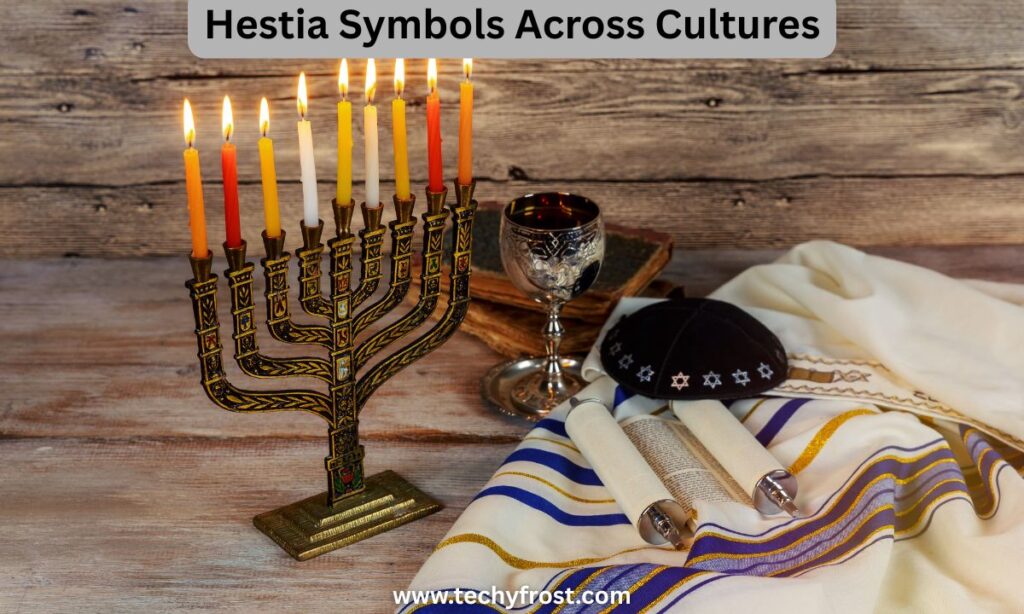
In ancient Greece, Hestia’s symbols were present in every home and every civic hall. Her eternal flame in the prytaneion was considered the spiritual heartbeat of the city. Colonists carried fire from the mother city’s public hearth to light the hearth of their new settlement — a deeply symbolic act of cultural continuity and divine blessing.
Ancient Rome
In Rome, Hestia became Vesta — and her cult grew even more formalized. The Vestal Virgins were six priestesses chosen to tend the sacred flame in the Temple of Vesta in the Roman Forum. This flame was considered essential to Rome’s safety and continuity. If it ever went out, it was treated as a grave religious crisis. The symbols of flame, circle (the round Temple of Vesta), and virginal veil carried directly into the Roman tradition.
Hindu Culture
The Hindu fire deity Agni occupies a strikingly similar symbolic space to Hestia. Agni is the god of the sacred household fire, invoked at the beginning of all rituals, weddings, and meals. The sacred flame (havan) at the center of Hindu ceremonies directly parallels Hestia’s hearth, reflecting a universal archetype of fire as the divine center of home life.
Celtic Traditions
Celtic traditions revered the hearth goddess Brigid — a figure with remarkable parallels to Hestia. Brigid’s eternal flame at Kildare, Ireland, was tended by 19 priestesses in rotation, echoing the Vestal Virgins of Rome. The Celtic concept of the “sacred fire of the hearth” and Hestia’s symbolism share the same deep human root: fire as divine presence in the home.
Modern Interpretations
Today, Hestia’s symbols appear in:
- Candle rituals in spiritual and mindfulness practices
- Hygge culture (Danish concept of cozy home warmth)
- Hearth-centered home design in architecture and interior design
- The Olympic flame — literally Hestia’s sacred fire carried to modern stadiums
- Wedding candle ceremonies across multiple cultures
Hestia Symbols in Art, Movies and Pop Culture
Movies
Hestia appears in Percy Jackson and the Olympians — both the book-based films and the Disney+ series — depicted as a small, kind figure tending the hearth at Olympus. Her role in the story emphasizes her quiet power and her role as a keeper of peace and warmth.
Art
In classical Greek art, Hestia is depicted as a fully draped, veiled woman seated near a hearth — always composed, never theatric. Her calmness amid the dramatic scenes of other deities made her stand out for her gravity and restraint. Modern artists have revisited her as a symbol of the sacred feminine principle — inner fire, home as sanctuary, and the dignity of domestic life.
Books
Beyond Percy Jackson, Hestia appears in Jean Shinoda Bolen’s Goddesses in Everywoman, where she is explored as a powerful psychological archetype of the introverted, inner-directed woman. She is also featured in Rick Riordan’s Percy Jackson’s Greek Gods as a uniquely compassionate and peaceful figure.
Tattoos
Hestia-inspired tattoos are growing in popularity within mythology and spiritual tattoo communities. Common designs include:
- A flame inside a circle
- A simple hearth with a fire
- The word “Hestia” in Greek script (Ἑστία)
- A veiled woman holding a torch
- A continuous circular line representing her unbroken devotion
Fashion
Hestia’s symbolism has influenced slow-fashion and cottagecore aesthetics — the warm, domestic, linen-and-candle visual world that dominates platforms like Pinterest and Instagram. The goddess’s energy lives in apron designs, hearthside imagery, bread-baking content, and the entire genre of “cozy home” content that has exploded in the digital age.
Spiritual and Dream Meaning of Hestia Symbols
Common Dream Interpretations
Dreaming of Hestia’s symbols often carries significant spiritual messages:
- Dreaming of a fireplace or hearth: A desire for warmth, belonging, or home; a need to tend to family relationships
- Dreaming of an unlit or extinguished flame: Feeling disconnected from your sense of home or inner peace; emotional coldness or spiritual neglect
- Dreaming of a bright eternal fire: Inner strength, spiritual awakening, or feeling divinely protected
- Dreaming of baking or cooking: Nurturing energy directed toward yourself or others; creative expression through care
- Dreaming of a circle of light: Wholeness, spiritual completion, or a message to return to your center
- Dreaming of a veiled woman near fire: Encounter with the Hestia archetype; a call toward simplicity, stillness, or sacred domesticity
Positive vs Negative Meaning
Positive Aspects
Hestia’s symbols are overwhelmingly positive in nature. They represent:
- Warmth and safety — the hearth as protection against cold and danger
- Unity — fire as the gathering point that binds families and communities
- Peace — Hestia never engaged in war, jealousy, or conflict
- Continuity — the eternal flame representing life’s ongoing rhythm
- Nourishment — food, warmth, and care as expressions of love
- Spiritual depth — the quiet inner life as the source of true power
- Hospitality — guests welcomed at her hearth were divinely protected
Negative Aspects
Even Hestia’s symbols carry cautionary dimensions when taken to extremes:
- Isolation — excessive focus on the domestic can lead to withdrawal from the wider world
- Self-neglect — always tending others’ flames while letting your own burn out
- Stagnation — the unmoving hearth as a metaphor for resistance to necessary change
- Over-idealization of home — home as a hiding place rather than a sanctuary
- Invisibility — Hestia’s quietness can be read as powerlessness rather than strength
Understanding these shadow aspects is part of working consciously with Hestia’s energy.
Why Humans Are Attracted to Hestia Symbols
Psychological Reasons
Human beings are neurologically wired to find fire soothing — a phenomenon called pyrorelaxation. Our earliest ancestors gathered around flames for warmth, protection, and community. Hestia’s symbols tap directly into this ancient, pre-verbal memory. When modern people light candles, build fires, or arrange their home intentionally, they are satisfying a deep cognitive hunger for safety and belonging.
Psychologist Abraham Maslow’s hierarchy of needs places safety and belonging as the second and third most fundamental human needs — precisely the domain Hestia governs. Her symbols persist because they address needs that never go away.
Emotional Connection
At an emotional level, Hestia’s symbols represent the longing for home — not just a physical place, but a felt sense of being welcome, seen, and safe. In an era of increasing disconnection, digital overload, and transient living, the symbolism of the hearth speaks with extraordinary directness to what many people feel they are missing.
The rising popularity of hygge culture, cottagecore aesthetics, bread-baking, home altars, and candle rituals are all modern expressions of the same archetypal pull toward Hestia’s world. We may have forgotten her name — but we have never stopped seeking the warmth she represents.
Conclusion
Hestia may be the quietest of the Olympians, but she may also be the most present. Her symbols — the flame, the hearth, the circle, the veil, the kettle — appear in every culture, every era, and every home. She is the goddess who chose peace over power, devotion over drama, and the sacred ordinary over heroic spectacle.
Whether you encounter her in the lit candle on your dinner table, the warmth of your kitchen in winter, the Olympic torch carried into a stadium, or the quiet feeling of sanctuary when you close your front door — Hestia’s symbols are working their quiet, enduring magic. She was never forgotten. She was always home.
Frequently Asked Questions
What is the main symbol of Hestia? The sacred eternal flame and the hearth are her two primary symbols, representing warmth, protection, and the unbroken center of home life.
What animal is sacred to Hestia? The donkey and the pig are both sacred to Hestia — the donkey in Roman tradition, the pig primarily in classical Greek household sacrifice.
What are Hestia’s powers? Hestia’s powers include control of sacred fire, protection of home and family, purification through flame, and the ability to grant hospitality and sanctuary to all who enter her hearth.
Is Hestia the same as Vesta? Yes. Vesta is Hestia’s Roman counterpart, sharing nearly identical symbols and domain, with her sacred flame tended by the famous Vestal Virgins.
Why did Hestia give up her Olympian throne? To preserve peace when Dionysus arrived, Hestia voluntarily stepped down from her Olympian throne — a characteristically selfless act that only deepened her symbolic association with harmony.
What does dreaming of Hestia’s symbols mean? Dreams involving fire, hearths, or warm domestic imagery often signal a need to reconnect with inner peace, family bonds, or a deeper sense of belonging.
What color is associated with Hestia? Red, gold, orange, and warm amber represent her flame-nature, while white symbolizes her purity and chaste devotion.

