
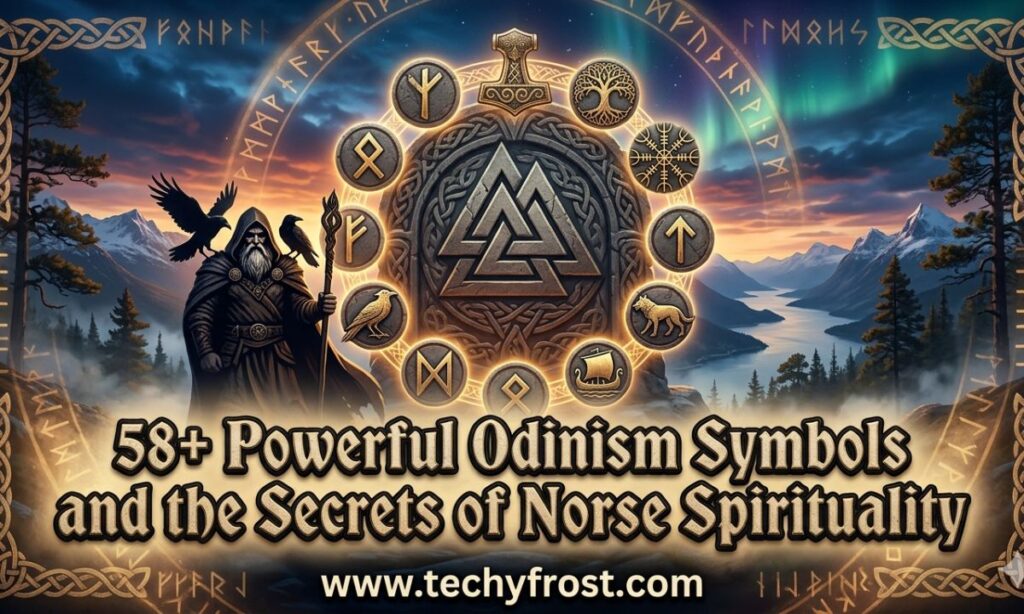
There is something about ancient symbols that refuses to stay buried. Carved into stone, etched onto weapons, tattooed onto skin — Odinism symbols have traveled through more than a thousand years of human history and arrived in our modern world still carrying their full weight. They don’t feel like relics. They feel alive.
Whether you’ve encountered the three interlocked triangles of the Valknut on a piece of jewelry, spotted Thor’s Hammer on a movie screen, or found yourself drawn to a runic inscription without fully understanding why, you’ve already felt the pull these symbols carry. In this guide, we’ll move past surface-level descriptions and explore the true depth of Odinism symbols — their origins, their layered meanings, their cultural journey, and why they continue to resonate so powerfully in the modern world.
What Are Odinism Symbols?
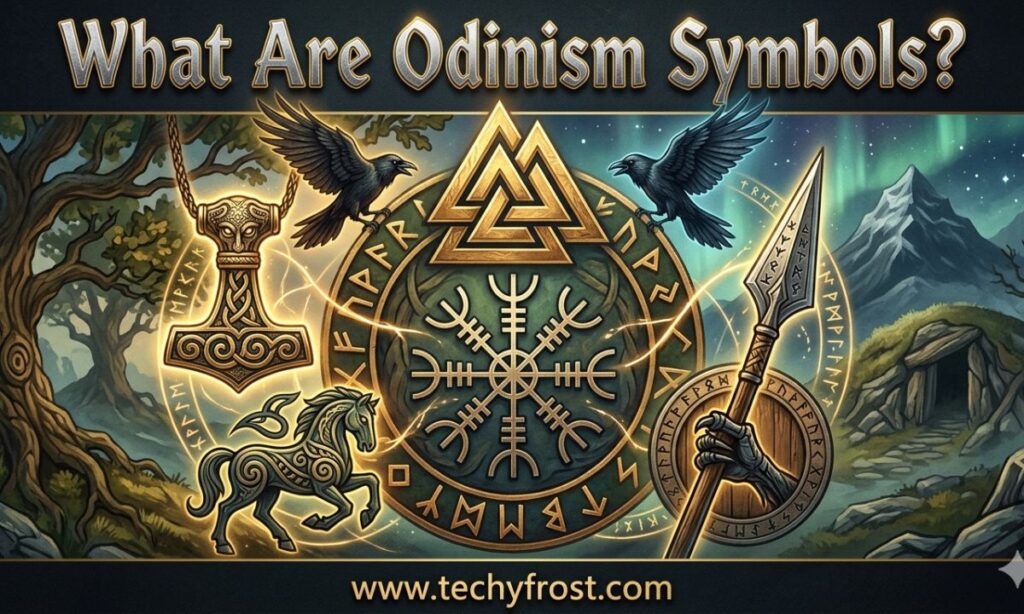
Odinism symbols are sacred signs rooted in the worship of Odin, the Allfather of Norse mythology, and the broader religious worldview of ancient Germanic and Scandinavian peoples. They are not merely decorative — each symbol functions as a compressed spiritual language, encoding beliefs about fate, death, wisdom, protection, and the relationship between humans and the divine.
These symbols emerged from a pre-Christian worldview where the line between the sacred and the everyday was thin. Warriors carried them into battle. Poets wove them into verse. Healers inscribed them on talismans. Farmers asked them for good harvests. Understanding Odinism symbols means understanding how an entire civilization made sense of the world.
Origin in Norse and Germanic Beliefs
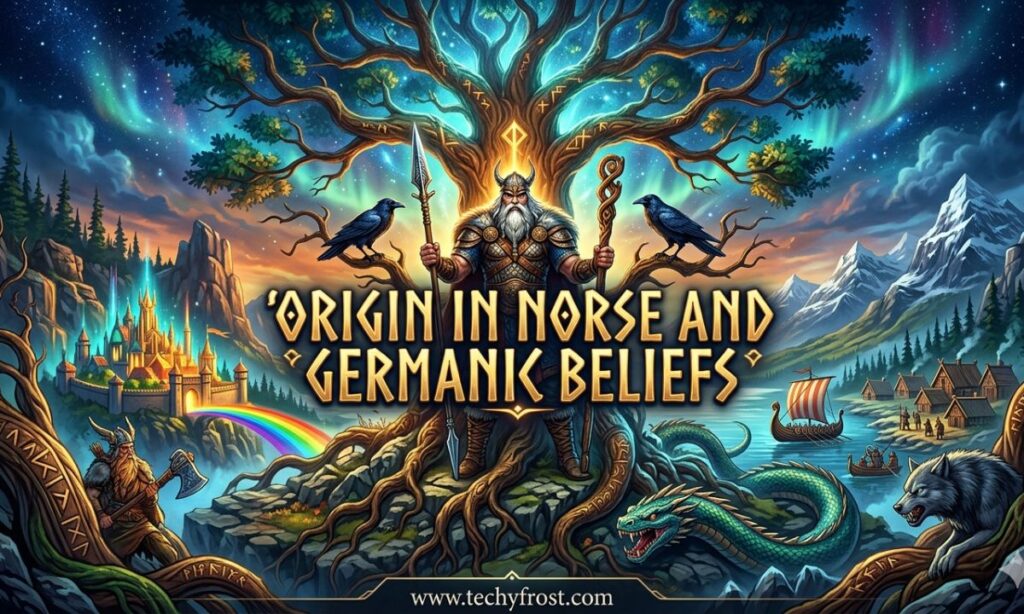
The roots of Odinism symbols stretch back to the Iron Age, with many scholars tracing the earliest runic inscriptions to around 150 CE. The Germanic tribes of northern and central Europe — including the Norse, the Saxons, the Goths, and the Franks — shared a spiritual framework in which gods, spirits, and natural forces were deeply interconnected.
Odin sat at the center of this cosmology. Known by over 200 names, he was the god of wisdom, war, magic, death, poetry, and prophecy. The symbols tied to him were not invented arbitrarily. Many emerged from specific myths: the Valknut appeared near burial sites associated with Odin’s role as conductor of the dead; the ravens Huginn and Muninn reflected his all-seeing nature; the runes themselves were said to have been revealed to Odin during a self-sacrifice on the world tree.
The Elder Futhark runic alphabet, consisting of 24 symbols, is believed to date back to at least 150 CE and was used across Germanic tribes for writing, divination, and magical inscriptions before gradually being replaced by the Younger Futhark (16 runes) during the late 8th century.
Role in Odinism and Heathen Traditions
Modern Odinism — also called Ásatrú or Heathenry — is a reconstructed spiritual path that looks to ancient Norse and Germanic practices for guidance. Within this tradition, the old symbols are not treated as historical curiosities. They are living tools used in ritual, meditation, and personal practice.
Practitioners may carve runes for divination, wear the Valknut as a statement of spiritual dedication, or display Yggdrasil imagery as a reminder of universal interconnection. The symbols serve as anchors between the believer and the mythological world that shaped them.
Deep Symbolic Meaning
What makes Odinism symbols remarkable is that they operate on multiple levels simultaneously. A single symbol can carry a spiritual teaching, a psychological truth, and a cultural identity all at once.
Spiritual Level
On a spiritual level, Odinism symbols are bridges. They connect the visible world of humans — Midgard — with the nine realms of Norse cosmology. The Yggdrasil, for instance, is not just a tree. It is the architecture of existence itself, with its roots reaching into the realm of the dead and its branches touching the realm of the gods. When someone meditates on this symbol, they are orienting themselves within that cosmic structure.
Odin’s own spiritual journey is embedded in many of these symbols. He hung on Yggdrasil for nine days, sacrificing himself to himself to gain the wisdom of the runes. This act of suffering for knowledge is reflected in the runes as symbols of hard-won truth rather than easy answers. The symbols remind practitioners that spiritual depth comes at a cost.
Psychological Level
From a Jungian perspective, Odinism symbols function as archetypes — universal images that arise from the collective unconscious. The Valknut’s interlocking triangles speak to the integration of life, death, and rebirth. The ravens Huginn (Thought) and Muninn (Memory) represent the dual forces of rational cognition and experiential knowing.
In times of uncertainty or personal struggle, these symbols provide a framework. They have long given people a sense of identity and control, allowing them to externalize internal states — courage, grief, determination — and hold them in a form they could touch and see.
Cultural Level
Culturally, Odinism symbols are markers of heritage and belonging. For Scandinavian and Germanic peoples, they represent a direct connection to ancestral identity. For practitioners worldwide, they signal membership in a spiritual community that values courage, wisdom, self-reliance, and an honest reckoning with fate. Symbols like Mjölnir have even become widely recognized badges of Heathen identity, functioning much the way a cross functions for Christians.
Types / Variations of Odinism Symbols
Below are seven of the most significant and widely recognized Odinism symbols, along with their meanings, origins, and uses.
1. Valknut (The Knot of the Slain)
The Valknut — from the Old Norse valr (slain warrior) and knut (knot) — consists of three interlocked triangles forming nine outer points. Those nine corners correspond to the nine worlds of Norse cosmology, making this one of the most cosmologically dense symbols in the tradition.
Found on Viking burial stones, ship carvings, and runestones, the Valknut was closely tied to Odin’s role as the god who welcomed fallen warriors into Valhalla. Its presence in burial contexts suggests it marked a transition between the living and the dead — a threshold Odin himself governed.
Today, the Valknut is used in Heathen practice as a symbol of dedication to Odin. Some practitioners treat it as a serious spiritual commitment, signifying that the bearer is, in some sense, already claimed by the Allfather.
| Attribute | Detail |
|---|---|
| Also Known As | Odin’s Knot, Hrungnir’s Heart |
| Symbolizes | Death, afterlife, fate, Odin’s power |
| Found In | Burial sites, runestones, Viking artifacts |
| Modern Use | Jewelry, tattoos, spiritual practice |
2. Yggdrasil (The World Tree)
Yggdrasil is the immense ash tree at the center of Norse cosmology, whose roots and branches connect all nine worlds — from Asgard (realm of the gods) at the top to Niflheim (realm of the dead) at the roots. Creatures inhabit every layer: the dragon Níðhöggr gnaws at the roots, an eagle perches at the crown, and a squirrel named Ratatoskr runs between them carrying messages.
As a symbol, Yggdrasil represents the cyclical nature of existence, the interconnection of all living things, and the belief that life is in a constant state of transformation. It is one of the most universally understood Odinism symbols precisely because the concept of a world tree — an axis connecting earth, sky, and underworld — appears in spiritual traditions across many cultures.
3. Huginn and Muninn (Odin’s Ravens)
Each morning, Odin’s two ravens flew out across the nine worlds, gathering knowledge of all that occurred among gods, giants, and humans. Each evening, they returned to whisper what they had seen into Odin’s ears. Huginn represents thought — the analytical mind that observes and reasons. Muninn represents memory — the experiential knowledge accumulated over time.
Together, these ravens make Odin the most informed being in Norse mythology. As symbols, they represent the value placed on intelligence and awareness. Viking warriors carried raven imagery into battle, believing the birds provided divine oversight and protection. The raven banner was one of the most feared emblems in medieval Scandinavia.
4. Gungnir (Odin’s Spear)
Gungnir — meaning “The Swaying One” — was crafted by the master dwarven smiths known as the Sons of Ivaldi. It was said to never miss its target and to always return to Odin’s hand. Odin threw Gungnir over the heads of enemy armies to claim them in battle, just as he had hurled it over the first battlefield to initiate the Aesir-Vanir war.
As a symbol, Gungnir represents divine authority, unwavering aim, and the cosmic contract — an oath sworn on Gungnir could not be broken. In modern Heathen practice, the spear symbolizes focus, purpose, and the directed will of the practitioner.
5. Runes (Elder Futhark)
The Elder Futhark consists of 24 symbols, each carrying its own name, phonetic value, and layered meaning. They are not merely letters. According to Norse myth, Odin discovered the runes through an act of voluntary sacrifice — hanging on Yggdrasil for nine days and nights, wounded by his own spear, neither fed nor given water, until the runes revealed themselves to him.
Each rune encodes a specific concept: Fehu (wealth and abundance), Tiwaz (justice and sacrifice), Berkana (growth and new beginnings), Algiz (protection), and so on. They were used for inscriptions, talismans, magical workings, and divination. Today, rune casting remains one of the most practiced forms of Norse-based divination, with practitioners drawing runes to gain insight into questions of fate, character, and circumstance.
6. Helm of Awe (Ægishjálmr)
The Ægishjálmr — literally “helmet of terror” — is a radial sigil composed of eight arms radiating from a central point, each arm itself carrying complex rune-like forms. The eight arms are often associated with the eight legs of Odin’s horse Sleipnir. Each arm incorporates elements of the Algiz rune (protection) and the Isa rune (self, focus, identity).
According to the Eddic poem Fáfnismál, the dragon Fáfnir wore the Helm of Awe between his eyes to strike fear into all opponents. After slaying Fáfnir, the hero Sigurd claimed it. Norse warriors later painted this symbol on their foreheads before battle — specifically between the eyebrows, at the location associated with the third eye — believing it would both protect them and paralyze their enemies with dread.
7. Mjölnir (Thor’s Hammer)
While technically Thor’s symbol, Mjölnir occupies a central place in Odinist and Heathen tradition because it represents the protective power of the Norse gods over humanity. Thor used his hammer to defend Midgard from giants and chaos. It was unbreakable, supernaturally accurate, and always returned to his hand after being thrown.
Viking-age Norse people wore Mjölnir pendants in enormous numbers — archaeologists have recovered hundreds of such amulets across Scandinavia and Britain. Remarkably, many Norse people continued wearing Mjölnir pendants even after converting to Christianity, indicating how deeply the symbol was tied to identity and protection beyond purely religious affiliation. Today, Mjölnir serves as the primary symbol of modern Heathenry, recognized internationally in the same way that other faith communities use cross or star symbols.
Odinism Symbols Across Cultures
Ancient Norse Culture
In the Viking Age (roughly 793–1066 CE), these symbols were fully integrated into daily life. They appeared on ship prows, runestones, jewelry, weapons, and burial goods. Symbolism was not separated from the practical — a sword inscribed with runes was believed to be a better sword, not merely a decorated one.
Germanic Tribes
Before the Norse Viking Age, the broader Germanic peoples of Europe used many of the same symbolic forms. The Elder Futhark runes were a pan-Germanic system, shared across regions from Scandinavia to the British Isles and deep into what is now Germany and Austria. This means Odinism symbols were never purely “Viking” — they belonged to a much wider cultural and spiritual tradition.
Influence in Medieval Europe
As Christianity spread across northern Europe between the 7th and 12th centuries, Odinism symbols were suppressed in official practice. However, they were not erased. They survived in folklore, folk magic, and hidden traditions. The Helm of Awe, for instance, appears in Icelandic manuscripts from the 16th and 17th centuries — centuries after Iceland’s official Christianization — demonstrating how persistently these symbols held on.
Revival in Modern Paganism
The late 19th and 20th centuries saw a scholarly and then spiritual revival of interest in Norse and Germanic symbolism. The modern Ásatrú movement formally emerged in Iceland in 1972, and similar Heathen organizations appeared across Europe and North America through the following decades. These movements reclaimed Odinism symbols as living spiritual tools, not museum artifacts.
Global Interpretation
In the 21st century, Odinism symbols have transcended their original cultural geography. They appear in spiritual communities across Asia, Latin America, Africa, and beyond — carried by people who feel a genuine resonance with Norse mythology’s themes of resilience, wisdom, and fate, regardless of ethnic background.
Odinism Symbols in Art, Movies & Pop Culture
The reach of Odinism symbols into mainstream culture has accelerated dramatically in the past two decades. The Marvel Cinematic Universe introduced millions of people to characters like Thor, Odin, and Loki, bringing Mjölnir, Yggdrasil, and Gungnir into global popular awareness. The television series Vikings and The Last Kingdom depicted runic inscriptions and Norse iconography with considerable attention to historical detail, sparking widespread interest in the authentic symbols.
Video games have also played a major role. God of War (2018) and its sequel Ragnarök presented Norse mythology with remarkable depth, introducing players to the Valknut, the World Tree, and the Elder Futhark runes as integral plot elements. The games prompted many players to seek out the real historical meanings behind the symbols they encountered.
In visual art and tattoo culture, Odinism symbols are among the most requested designs worldwide. The Vegvisir (Viking compass), Yggdrasil, Mjölnir, and runes appear on the skin of people who may not practice Heathenry at all but who feel a personal connection to the values these symbols represent.
Spiritual & Dream Meaning of Odinism Symbols
When Odinism symbols appear in dreams, many practitioners interpret them as meaningful communication from the subconscious or from divine sources within their belief system.
- Valknut in dreams often signals a confrontation with mortality, transition, or significant life change.
- Ravens appearing in dreams are frequently interpreted as messages — the dreamer is receiving information they need to pay attention to.
- Yggdrasil in a dream suggests a need to examine one’s place within a larger system, or a period of growth and expansion across multiple areas of life.
- Runes seen in dreams may point to specific aspects of the dreamer’s situation depending on which rune appears.
- Mjölnir in a dream often signals a need for protection or a call to take decisive protective action for oneself or others.
From a secular psychological standpoint, these dream interpretations align well with what each symbol represents in waking mythology — the unconscious mind draws on the same archetypal content that the myths themselves explore.
Positive vs Negative Meaning
Like all powerful symbols, Odinism symbols carry a dual nature. Their meaning is shaped largely by context and intent.
Positive Aspects
- Wisdom and knowledge — Odin’s endless pursuit of understanding, symbolized by the runes and his ravens, inspires a love of learning and truth-seeking.
- Protection — Mjölnir, the Helm of Awe, and many runes were used specifically as protective talismans, carrying the intention of safeguarding the bearer.
- Courage in the face of fate — the Norse worldview acknowledged that death and hardship were inevitable, but emphasized facing them with dignity and will.
- Connection to nature and cosmos — Yggdrasil and the broader Norse symbolic world express a deep reverence for the natural world and humanity’s place within it.
- Community and identity — these symbols create bonds between practitioners, connecting modern people to each other and to their ancestral heritage.
Negative Aspects
It is important to acknowledge that several Odinism symbols have been misappropriated by white nationalist and neo-Nazi groups, particularly since the late 19th century and into the 20th. Symbols such as the Valknut, certain runes (especially the Odal rune and the Tyr rune), and the Irminsul have been co-opted by extremist organizations in ways that are entirely disconnected from their original meanings.
The vast majority of modern Heathens, Ásatrú practitioners, and scholars of Norse mythology actively reject these appropriations. Organizations like the Troth and Ásatrú Alliance have formal anti-discrimination policies and work to reclaim these symbols from harmful misuse. When encountering Odinism symbols today, context matters enormously — the same Valknut worn by a Heathen practitioner as a spiritual emblem may appear in a very different context elsewhere.
Why Humans Are Attracted to Odinism Symbols
The enduring appeal of Odinism symbols is not accidental. Several factors converge to make them unusually compelling:
They carry real stories. Unlike purely abstract symbols, each Odinism symbol is tied to a rich narrative tradition. The Valknut is not just three triangles — it is Odin standing at the boundary between the living and the dead. That narrative weight gives the symbol gravity.
They honor difficult truths. Norse mythology does not promise easy salvation or comfortable afterlives for everyone. It insists on courage, sacrifice, and the acceptance of fate. In a culture saturated with shallow positivity, this unflinching honesty is refreshing and resonant.
They are aesthetically powerful. The visual designs of Norse symbols — the geometric precision of runes, the interlocking elegance of the Valknut, the radiating complexity of the Helm of Awe — are simply compelling to look at. Good design has always drawn human attention.
They offer identity and belonging. In an increasingly fragmented world, symbols that connect individuals to a larger community and a deeper history provide genuine psychological grounding.
They are universal in their themes. Wisdom, death, fate, protection, connection — these are not specifically Norse concerns. They are human concerns. Odinism symbols speak to the parts of human experience that have never changed, which is precisely why they have survived everything that history has thrown at them.
Frequently Asked Questions
What is the most powerful Odinism symbol?
Many practitioners consider the Valknut the most powerful Odinism symbol due to its direct connection to Odin and its association with fate, death, and the afterlife.
Are Odinism symbols safe to wear?
Yes, for spiritual practitioners and those who connect with Norse heritage, these symbols are meaningful and safe. Context and personal intention matter most.
What does the Valknut symbolize in Odinism?
The Valknut symbolizes Odin’s power over life and death, the nine worlds of Norse cosmology, and the transition of fallen warriors to Valhalla.
Is Mjölnir an Odinism symbol or a Norse symbol?
Mjölnir belongs to both — while it is specifically Thor’s weapon, it is widely used in Odinism and Heathen practice as a symbol of protection and spiritual identity.
What are runes used for in Odinism?
Runes are used for divination, magical inscriptions, meditation, and communication with divine forces. Each of the 24 Elder Futhark runes carries a specific meaning and energy.
What is the difference between Odinism and Ásatrú?
Both terms refer to modern revivals of ancient Norse and Germanic paganism. Odinism often emphasizes Odin specifically, while Ásatrú (meaning “loyalty to the Aesir”) encompasses the full Norse pantheon.
What does Yggdrasil represent in Norse spirituality?
Yggdrasil represents the interconnectedness of all existence — the cosmic axis connecting all nine realms, symbolizing life’s cyclical nature and the constant state of transformation.
Can anyone use Odinism symbols?
Spiritually, most Heathen traditions welcome sincere practitioners regardless of background. Culturally, some practitioners emphasize Norse or Germanic heritage, while others take an inclusive approach.
Where can Odinism symbols be found today?
They appear in jewelry, tattoos, art, video games, films, and spiritual practice worldwide, reflecting both their cultural staying power and their contemporary relevance.
Conclusion
Odinism symbols are more than historical artifacts or aesthetic designs. They are a living symbolic language, shaped by centuries of human experience with death, wisdom, nature, and the search for meaning. From the cosmic architecture of Yggdrasil to the battle-hardened protection of the Helm of Awe, from the all-seeing ravens of Odin to the thunderous authority of Mjölnir — each symbol is a compressed universe of meaning waiting to be explored.
What makes them remarkable is their durability. They survived Christianization. They survived suppression. They survived centuries of obscurity. And today, they are not merely surviving — they are thriving, finding new resonance with people around the world who recognize in them something true about the human condition: that life demands courage, wisdom is worth sacrifice, fate is real, and beauty can be found even in the difficult things.
If you are drawn to these symbols, that pull is worth paying attention to. Ancient peoples put a great deal of thought and experience into creating them. Their wisdom, encoded in stone and metal and ink across more than a millennium, is still speaking. The only question is whether you are listening.

