

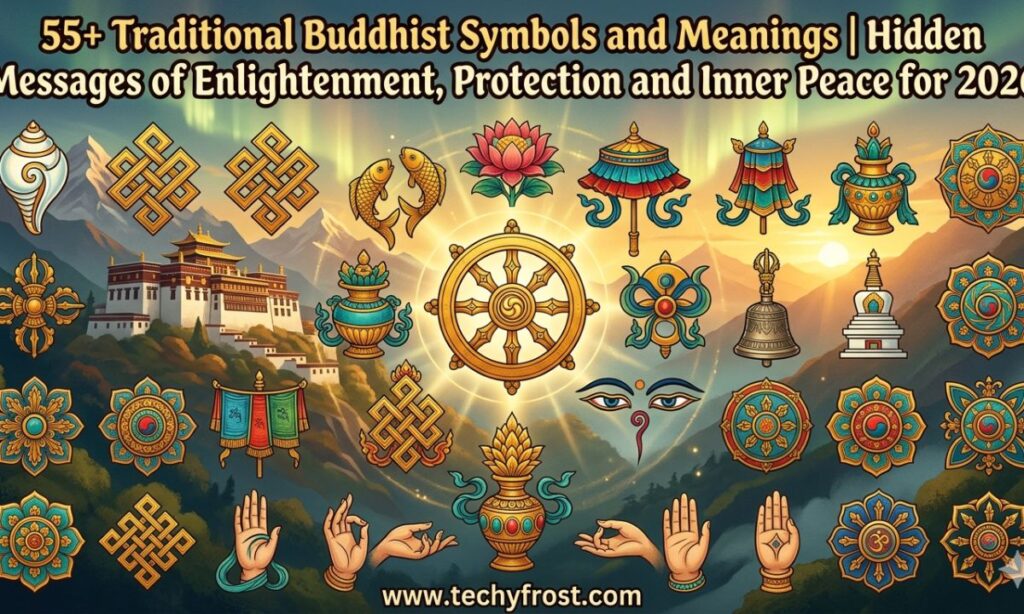
Walk into any Buddhist temple and you’ll notice something unusual — the walls speak. Carved wheels spin without moving. Lotus flowers bloom in stone. Knotted patterns loop without beginning or end. These are not decorations. They are a living language, thousands of years old, encoding some of the most profound ideas about suffering, awakening, compassion, and the nature of reality.
Buddhist symbols have guided monks, artists, and ordinary people for more than 2,500 years. Today, they appear on jewelry, tattoos, temple walls, meditation cushions, and even phone cases. Yet most people only scratch the surface of what these symbols truly mean.
This guide explores over 55 traditional Buddhist symbols and their meanings — from the universally recognized Dharma Wheel to the lesser-known Vajra — covering their spiritual significance, cultural variations, use in daily life, and why they still resonate powerfully in 2026.
What Are Buddhist Symbols and Meanings?
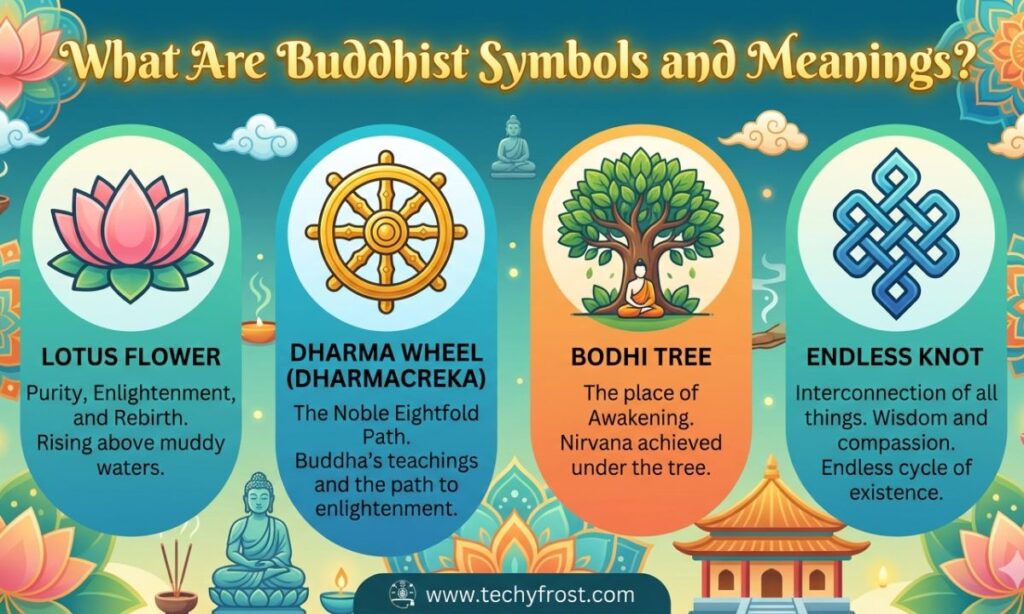
Buddhist symbols are visual representations of the Buddha’s teachings, known as the Dharma. Rather than worshipping an external god, Buddhism uses symbols as mental tools — anchors for the mind during meditation, reminders of ethical principles, and expressions of complex philosophical ideas in a form that anyone can see and feel.
These symbols first appeared in India around the 3rd century BCE, several centuries after the Buddha’s own lifetime. Early Buddhist art avoided showing the Buddha in human form, instead representing him through objects like an empty throne, a footprint, or the Bodhi tree. Over centuries, as Buddhism spread across Asia, each culture added its own visual vocabulary while preserving the core spiritual message.
According to research, the aesthetic perception of Buddhist symbols positively influences perceived happiness and life satisfaction — which goes some way to explaining why they continue to spread far beyond traditional Buddhist communities today.
Understanding Buddhist Symbols And Their Deep Meanings
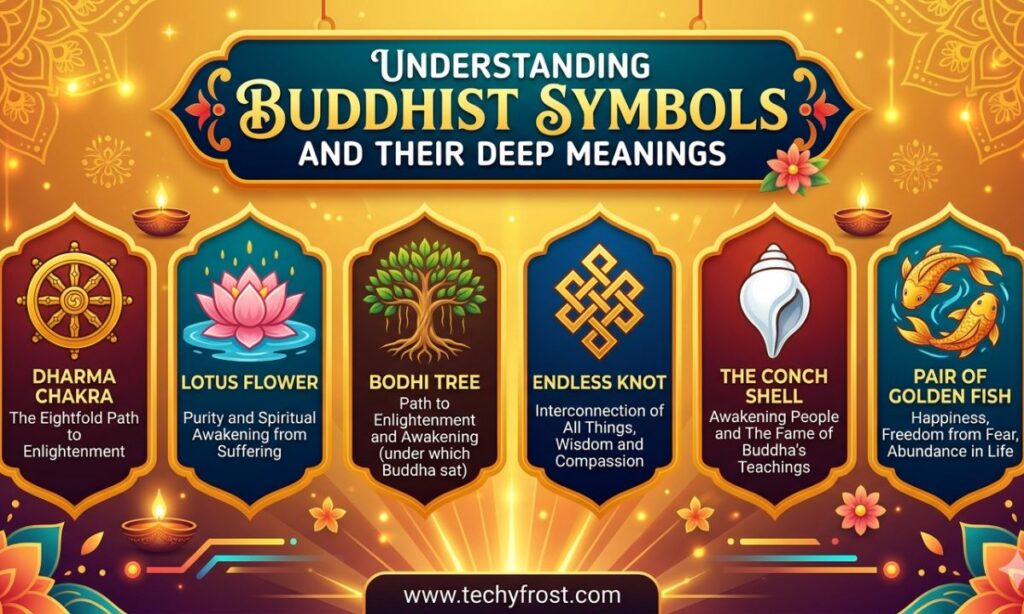
At their core, Buddhist symbols communicate one central message: liberation from suffering is possible. Every symbol points toward this goal, whether it depicts the path to get there, the teacher who showed the way, or the state of peace awaiting at the journey’s end.
Buddhist symbolism operates on multiple levels simultaneously. A single image — the lotus, for example — can speak to a child learning about resilience, a monk practicing advanced meditation, and a grieving person seeking comfort, all at once. This layered quality is precisely why these symbols have endured.
What Are The 8 Symbols Of Buddhism?
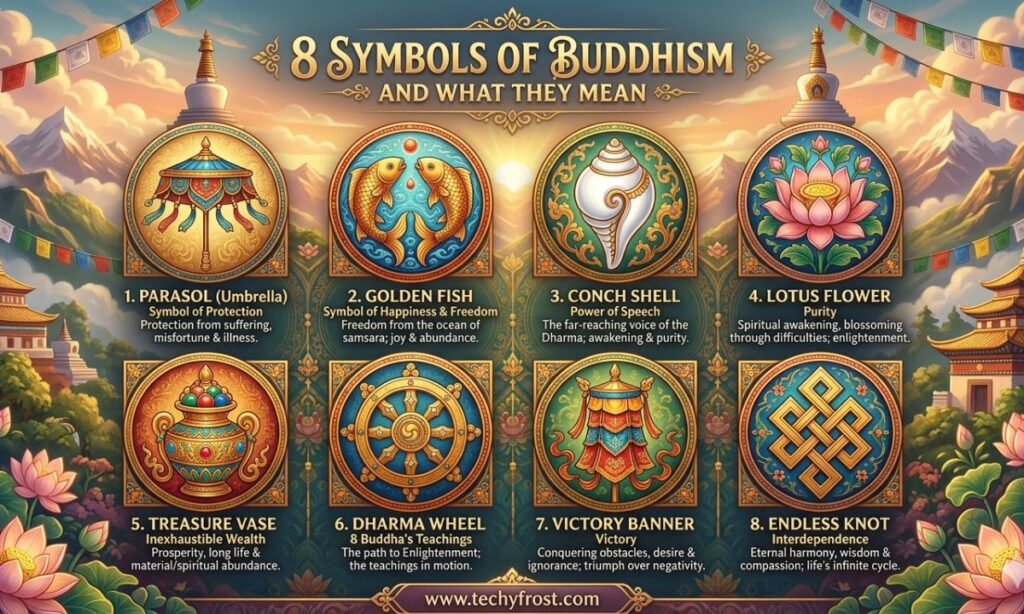
The eight primary symbols of Buddhism are collectively known as the Ashtamangala, from Sanskrit words meaning “eight auspicious signs.” These symbols were originally associated with Indian kingship before being incorporated into Buddhist tradition. They are found throughout Tibetan and East Asian Buddhist art, on thangka paintings, temple doors, ritual objects, and ceremonial offerings.
8 Symbols Of Buddhism And What They Mean
| Symbol | Sanskrit Name | Core Meaning |
|---|---|---|
| Dharma Wheel | Dharmachakra | The Buddha’s teachings; the Noble Eightfold Path |
| Lotus Flower | Padma | Purity, spiritual awakening, rising above suffering |
| Conch Shell | Shankha | The spreading of the Dharma; a call to awakening |
| Endless Knot | Shrivasta | Interconnectedness of all things; infinite wisdom |
| Parasol (Umbrella) | Chatra | Protection from suffering and harmful influences |
| Golden Fish Pair | Matsyayugma | Freedom, abundance, fearlessness in the ocean of samsara |
| Treasure Vase | Kalasha | Spiritual abundance; the inexhaustible wealth of the Dharma |
| Victory Banner | Dhvaja | Triumph over ignorance, delusion, and ego |
5 Symbols Of Buddhism
For those beginning to explore Buddhist symbolism, five symbols stand out as especially central across all traditions:
- The Dharma Wheel — the most recognized symbol of Buddhism worldwide
- The Lotus Flower — representing transformation from suffering to enlightenment
- The Endless Knot — symbolizing the interconnectedness of wisdom and compassion
- The Bodhi Tree — the site of the Buddha’s awakening
- The Parasol — offering protection on the spiritual path
Popular Buddhist Symbols And Their Uses In Daily Life
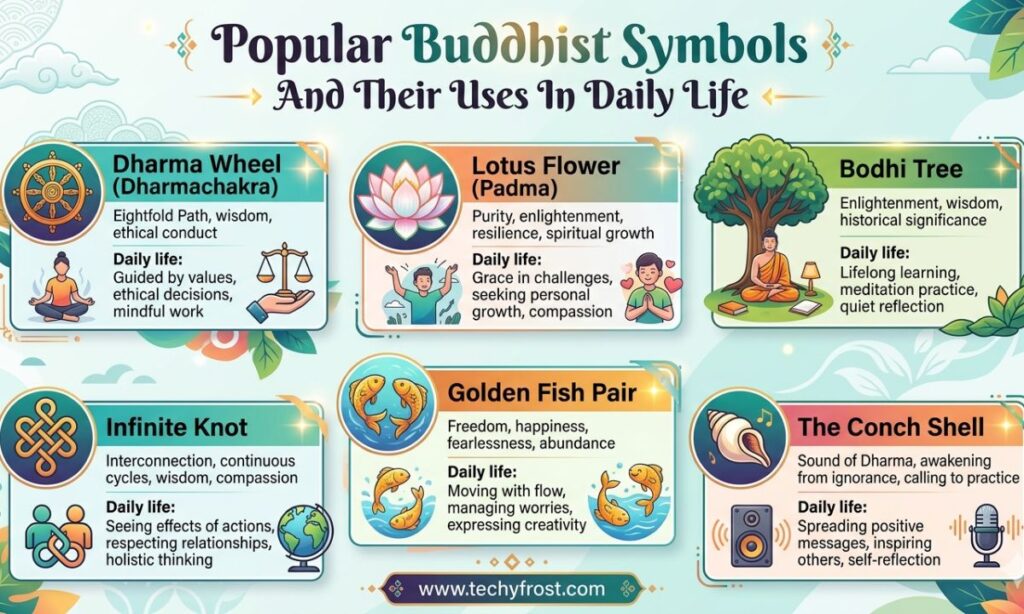
Buddhist symbols are woven into daily life in ways most people don’t realize. Here’s how the most popular symbols are understood and used across different contexts.
Buddhist Symbol Of Life
The Dharma Wheel (Dharmachakra) is widely regarded as the Buddhist symbol of life because it represents samsara — the cycle of birth, death, and rebirth. Its circular form captures the continuous movement of existence. Following the wheel’s teachings offers a path to break free from this cycle and reach liberation.
Buddhist Symbols And Meanings For Tattoos
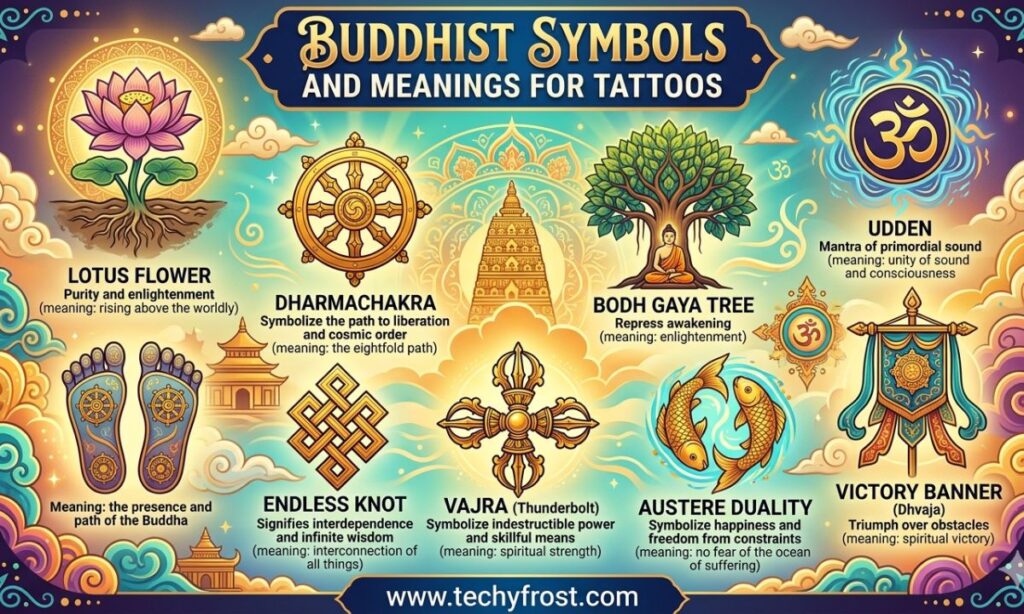
Tattoos featuring Buddhist imagery have become increasingly popular worldwide. People choose these designs not merely for their aesthetic appeal, but because the symbols carry personal meaning. The lotus represents overcoming personal hardship. The Dharma Wheel speaks to those committed to self-improvement. The Unalome — a spiral line ascending toward a point — resonates with those who understand that the path to peace is rarely straight. Before getting a Buddhist tattoo, it’s worth spending time understanding the symbol’s full meaning, especially given the cultural and spiritual weight these images carry.
Buddhist Symbols Images
Buddhist symbols appear across an enormous range of visual media: temple murals, thangka paintings, carved stupas, illuminated manuscripts, ceremonial fabrics, and modern digital art. Each image conveys meaning through its shape, color, and compositional context. For example, a fully open lotus in bright pink or white signals complete enlightenment, while a tightly closed bud suggests a spiritual journey just beginning.
Buddhist Protection Symbols
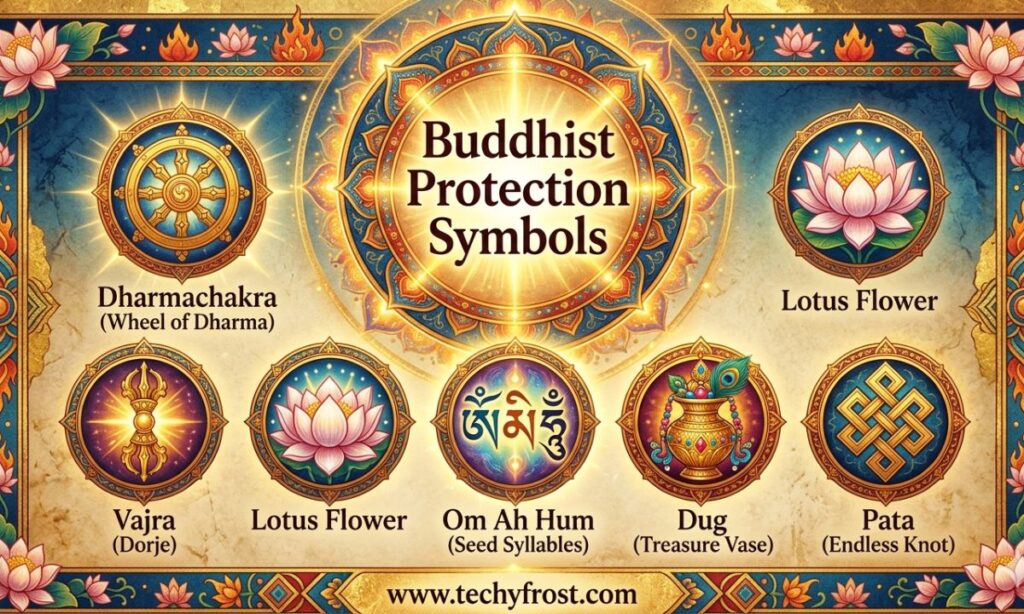
Several Buddhist symbols function specifically as protectors against negative energy, spiritual harm, and misfortune. The most prominent include:
- The Parasol — shelters practitioners from the “heat” of suffering and negative forces
- The Vajra (thunderbolt/diamond scepter) — destroys harmful influences while itself remaining indestructible
- The Endless Knot — creates a spiritual shield through the energy of interconnected wisdom
- Om Mani Padme Hum — the most widely recited mantra, inscribed on prayer wheels and stones for protective power
- The Bodhi Seed Mala — prayer beads made from seeds of the Bodhi tree, used as a protective talisman during meditation
Buddhist Symbol For Love
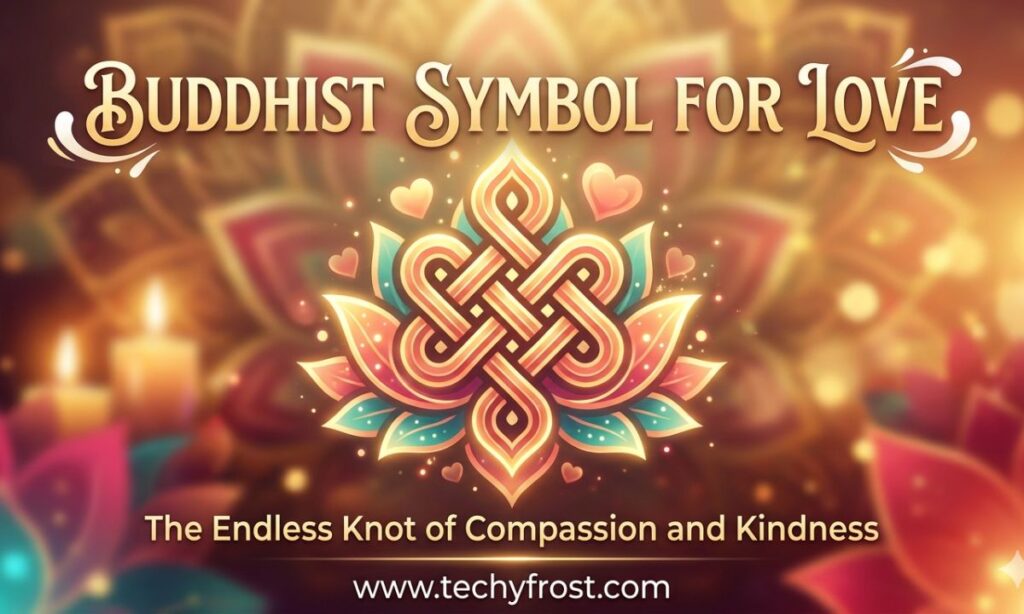
Buddhism expresses love through the concept of Metta (loving-kindness). While there isn’t a single fixed symbol for romantic love, several images represent compassion and universal love. Avalokiteshvara, the thousand-armed Bodhisattva of Compassion, is perhaps the most direct visual symbol of boundless love. The Endless Knot also symbolizes love in certain cultural contexts, particularly in China, where it represents an unbreakable bond between two people.
Zen Buddhist Symbols
Zen Buddhism, which developed in China and Japan, developed its own minimalist visual vocabulary. The most iconic Zen symbol is the Ensō — a circle drawn in one or two brushstrokes that simultaneously represents completion, emptiness, the infinite, and the imperfect nature of all things. Other Zen symbols include the brush itself, used in calligraphy as a meditative practice, and simple natural forms like a plum blossom or an autumn leaf, each reflecting the Zen teaching of impermanence.
Buddhist Symbols Meanings
Every Buddhist symbol carries at least three layers of meaning: its surface (what it looks like), its symbolic reference (what it stands for in Buddhist teachings), and its practice implication (how meditating on this symbol changes the mind). This layered structure is not accidental — it reflects the Buddhist understanding that reality itself operates on multiple levels simultaneously.
Meaning Of Buddha Symbols
Buddha symbols collectively represent the qualities of the enlightened mind: wisdom, compassion, equanimity, and freedom from suffering. They also mark key moments in the Buddha’s life — the Bodhi tree marks his awakening, the Dharma Wheel marks his first teaching, the footprint marks his presence on earth, and the stupa marks his parinirvana (final passing).
Buddhism Symbol And Meaning
Buddhism uses symbols differently from many other religions. Rather than demanding belief in the symbol itself, Buddhism invites practitioners to use symbols as “fingers pointing at the moon” — useful tools that guide attention toward deeper truths, not ends in themselves.
Buddhist Symbol Tattoos
Popular Buddhist tattoo designs include the lotus, the Dharma Wheel, the Unalome, the Om symbol, the Ensō circle, the Bodhi leaf, and the triple gem (Triratna). When done thoughtfully, these tattoos serve as daily reminders of one’s spiritual intentions and values.
Symbols Of Zen Buddhism
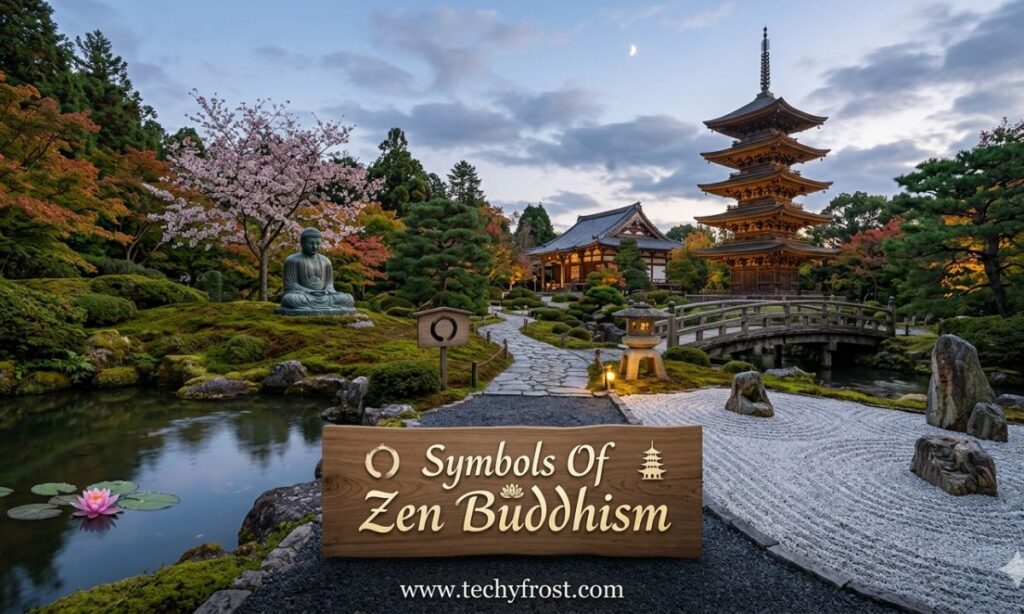
Beyond the Ensō, Zen Buddhist symbols include:
- The Empty Circle — representing the void from which all things arise
- The Brush and Ink — tools of Zen calligraphy, symbolizing mindful presence
- The Plum Blossom — blooming in winter, symbolizing resilience and hope
- The Pine Tree — evergreen, symbolizing steadiness and endurance
Inner Peace Buddhist Symbol
The Lotus Flower is most widely associated with inner peace. Its growth from muddy water to pristine blossom mirrors the human journey from confusion and suffering to clarity and stillness. The Ensō circle also powerfully represents inner peace — its complete, unbroken form suggesting a mind that is whole, calm, and free.
Buddhist Inner Peace Symbol
The seated meditating Buddha image is perhaps the most universally recognized symbol of inner peace. The posture — legs crossed, spine upright, hands resting in the lap or touching the earth — communicates stillness that is not passive, but deeply alive and aware.
Buddhism Symbols And Meanings
Buddhism employs a rich and varied symbolic vocabulary. Below is an expanded reference:
| Symbol | Meaning |
|---|---|
| Dharma Wheel | Buddha’s teachings; the Eightfold Path |
| Lotus | Purity, enlightenment, spiritual rebirth |
| Bodhi Tree | Awakening; the site of the Buddha’s enlightenment |
| Stupa | The Buddha’s enlightened mind; a sacred shrine |
| Ensō | Completeness, emptiness, Zen awakening |
| Unalome | The winding path to enlightenment |
| Vajra | Indestructibility; the power of enlightened compassion |
| Om Mani Padme Hum | Compassion; the jewel in the lotus of the heart |
| Three Jewels (Triratna) | The Buddha, the Dharma, and the Sangha |
| Mandala | The universe; the wholeness of reality |
| Prayer Wheel | The spreading of compassionate intention |
| Buddhist Flag | The six colors of the Buddha’s aura at enlightenment |
| Swastika (Manji) | Eternity, good fortune (pre-WWII Buddhist tradition) |
| Mudra (Hand Gesture) | Specific states of mind; spiritual intentions |
| Mala (Prayer Beads) | Meditative counting; the interconnection of all beings |
| Bell | The Buddha’s voice; wisdom and compassion |
| Conch Shell | The spread of the Dharma in all directions |
| Elephant | Wisdom, mental strength, steadiness of practice |
| Lion | Courage, the power of the Buddha’s teaching |
| Deer | Gentleness, peace; represents the site of the first teaching |
Buddhist Images And Meanings
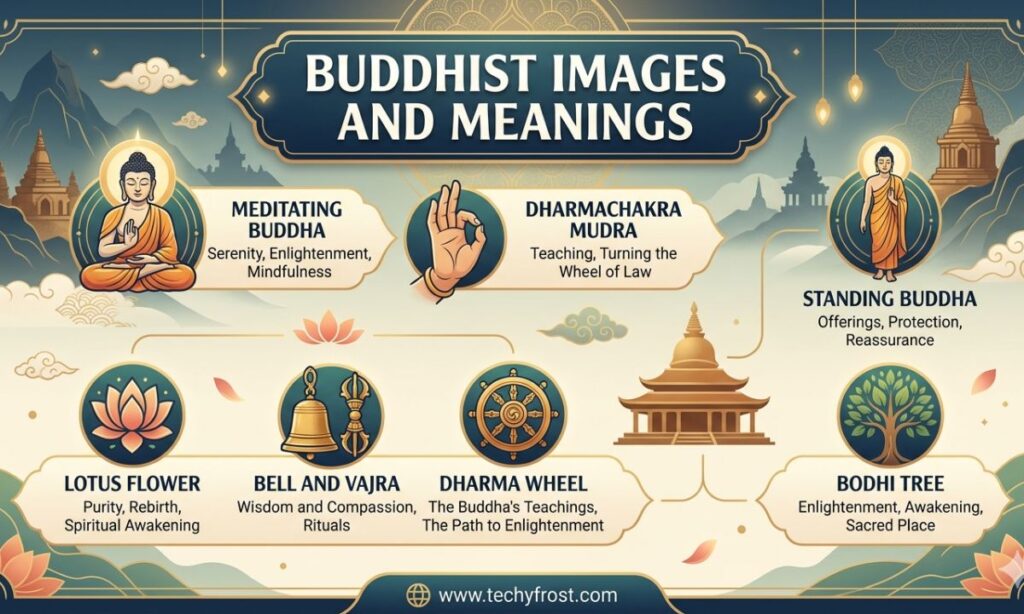
Buddhist images tell stories as well as conveying teachings. The sight of the Buddha touching the earth (Bhumisparsha mudra) recalls the moment he called the earth to witness his enlightenment. The Medicine Buddha, shown with a lapis-blue body, speaks to healing and the relief of suffering. The Laughing Buddha (Budai) — actually a beloved Chinese monk, not the historical Buddha — represents joy, abundance, and contentment.
Buddhist Symbol Meaning
A key principle to understand: in Buddhism, symbols are always pointers, never endpoints. The lotus is not worshipped for being a lotus — it is meditated upon because its story helps the mind understand transformation. This distinction is what keeps Buddhist symbolism from becoming mere superstition.
Buddhist Symbols And Their Meanings
Each Buddhist symbol is rich with interconnected meanings. The Dharma Wheel, for instance, simultaneously represents the Buddha, his teachings, the Eightfold Path, the cycle of existence, and the motion of spiritual practice. Understanding one symbol deeply often illuminates all the others.
Buddha Symbols Meaning
The symbols most directly associated with the historical Buddha himself include: the Bodhi Tree (his awakening), his footprint (his physical presence), the empty throne (his royal origins and transcendence of worldly power), and the Dharma Wheel (his role as teacher). Together, they construct a portrait of a fully realized human being.
Buddhist Protection Symbol
The Parasol or royal umbrella is the definitive Buddhist protection symbol. Held over royalty in pre-Buddhist India, it was adopted as a symbol of the Dharma’s shelter from the “three fires” of greed, hatred, and delusion. The Vajra also functions as a powerful protection symbol, its diamond-like indestructibility cutting through all negativity.
Buddhist Symbols For Peace
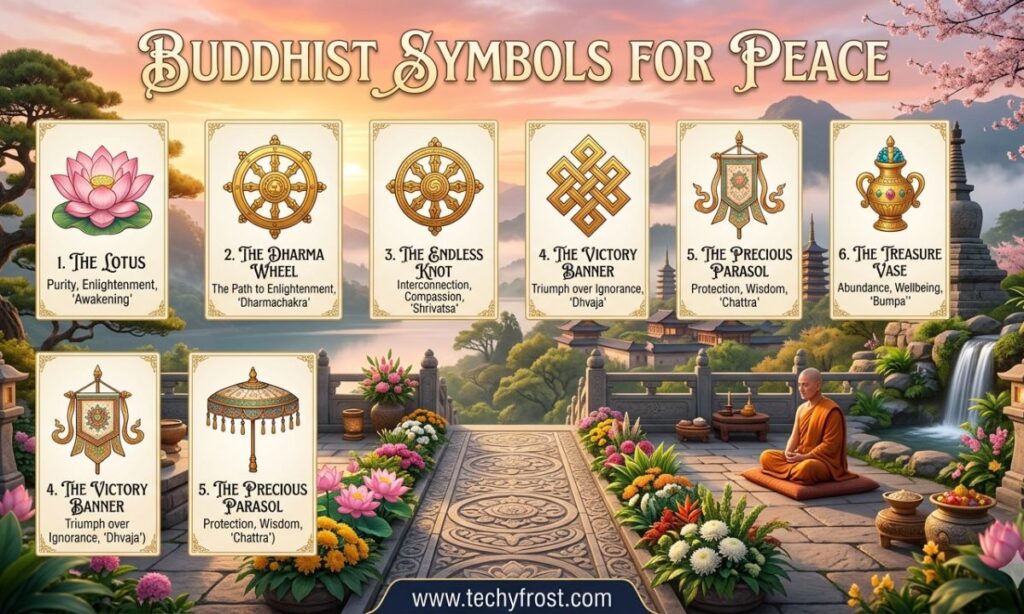
The most powerful Buddhist symbols for peace are the Lotus, the meditating Buddha image, and the Ensō. The Buddhist flag — with its blue, yellow, red, white, and orange stripes — also globally represents peace and inter-religious harmony.
Zen Symbols And Meanings
| Zen Symbol | Meaning |
|---|---|
| Ensō | Enlightenment, emptiness, wholeness |
| Brush and Ink | Mindful presence; the art of non-doing |
| Empty Bowl | Receptivity; beginner’s mind |
| Plum Blossom | Resilience; blooming in adversity |
| Koi Fish | Perseverance; flowing with life’s current |
Symbols And Meanings Of Buddhism
In total, Buddhist symbolism forms a complete map of the spiritual journey: from the suffering of samsara (represented by the Dharma Wheel’s endless turning) through the path of practice (the Eightfold Path, the lotus unfolding) to the goal of liberation (the fully bloomed lotus, the open Ensō, the awakened Buddha).
Buddhist Symbol For Protection
Beyond the Parasol and Vajra, Buddhist protection also comes through the mantra Om Mani Padme Hum, the Endless Knot (binding harmful forces), and the Bodhi Seed mala, which channels the protective energy of the Bodhi tree.
Buddhist Symbol Meanings
Every Buddhist symbol has at minimum a historical origin, a philosophical meaning, a meditative application, and a cultural variation. The richest symbols — the lotus, the Dharma Wheel, the Endless Knot — have all four in abundance.
Buddhist Symbol For Inner Peace
The closed-eye meditating Buddha is the most direct and universally understood Buddhist symbol for inner peace. Its stillness communicates that peace is not the absence of difficulty, but a quality of mind that remains stable in the midst of all circumstances.
Enlightenment Symbols And Meanings
Key Buddhist symbols directly representing enlightenment include:
- The Bodhi Tree — the place of the Buddha’s awakening
- The fully bloomed Lotus — complete spiritual unfoldment
- The Dharma Wheel — the turning of wisdom into action
- The open Ensō — the circle of completeness
- The Unalome — the spiral path arriving at stillness
Buddhist Signs And Meanings
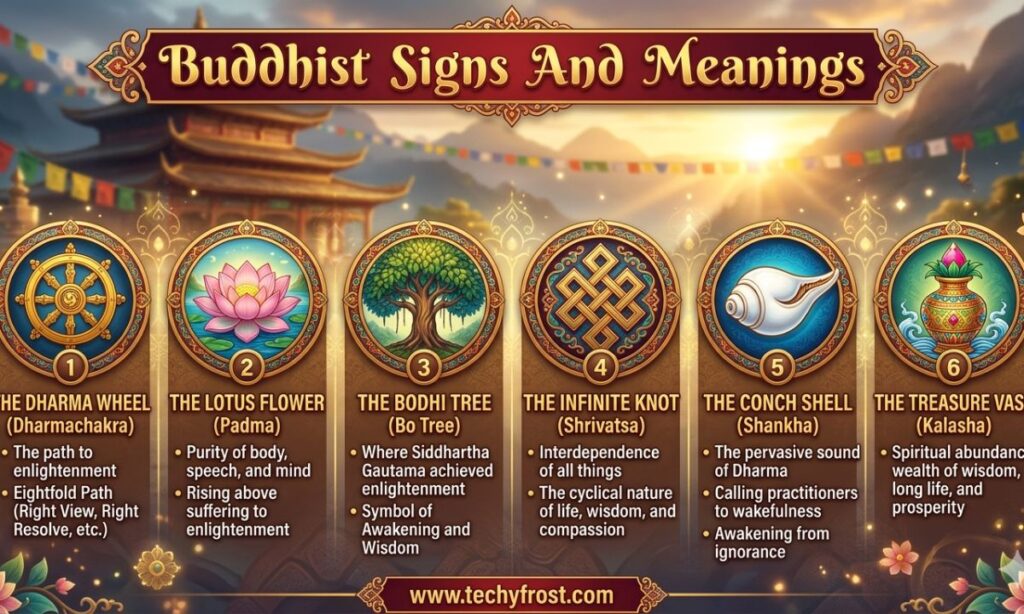
Buddhist signs communicate through shape, color, number, and context. An eight-spoked wheel means something different from a four-spoked wheel. A lotus bud means something different from a fully open flower. Learning to read this visual language opens up the meaning embedded in centuries of Buddhist art.
Buddha Protection Symbol
The Parasol specifically represents the protective power of the Dharma over practitioners. Its canopy shields against the heat of craving, the cold of indifference, and the storm of confusion — three forms of suffering the Dharma teaches us to recognize and release.
Tibetan Buddhist Symbols And Meanings
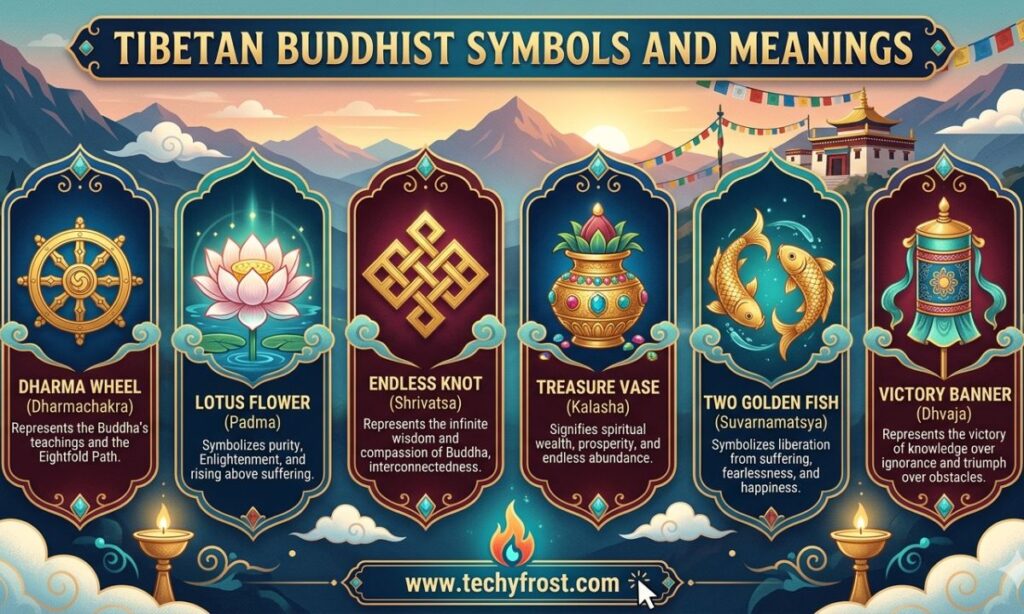
Tibetan Buddhism developed one of the richest and most complex symbolic vocabularies in the world. Beyond the Ashtamangala, Tibetan symbols include:
- The Mandala — a sacred map of the enlightened universe used in meditation and ritual
- The Thangka — a detailed painted scroll depicting deities, mandalas, and cosmological maps
- The Prayer Flag — colored cloth inscribed with mantras, sending blessings into the wind
- The Dorje (Vajra) — representing the indestructible nature of enlightenment
- The Kalachakra Mandala — one of the most complex tantric symbols, representing time, cosmos, and awakening
Strength Buddhist Symbols And Meanings
Buddhist symbols of inner strength include the Lion (courage in facing suffering), the Elephant (mental stability and steadiness), the Vajra (indestructible resolve), and the Victory Banner (triumph of the awakened mind over delusion and ego).
Enlightenment Buddhist Symbols And Meanings
| Symbol | How It Represents Enlightenment |
|---|---|
| Bodhi Tree | The physical site of the Buddha’s awakening |
| Full Lotus Flower | Complete spiritual unfoldment |
| Dharma Wheel | The motion of wisdom |
| Ensō | The wholeness of the awakened mind |
| Unalome | The full journey from confusion to clarity |
| Empty Throne | The transcendence of ego |
Zen Buddhist Symbols And Meanings
Zen emphasizes direct experience over conceptual understanding, so its symbols tend toward simplicity and paradox. The Ensō is the supreme Zen symbol: it is simultaneously perfect and imperfect, complete and incomplete, everything and nothing. Meditating on it, according to the Zen tradition, points directly to the nature of reality.
Thai Buddhist Symbols And Meanings
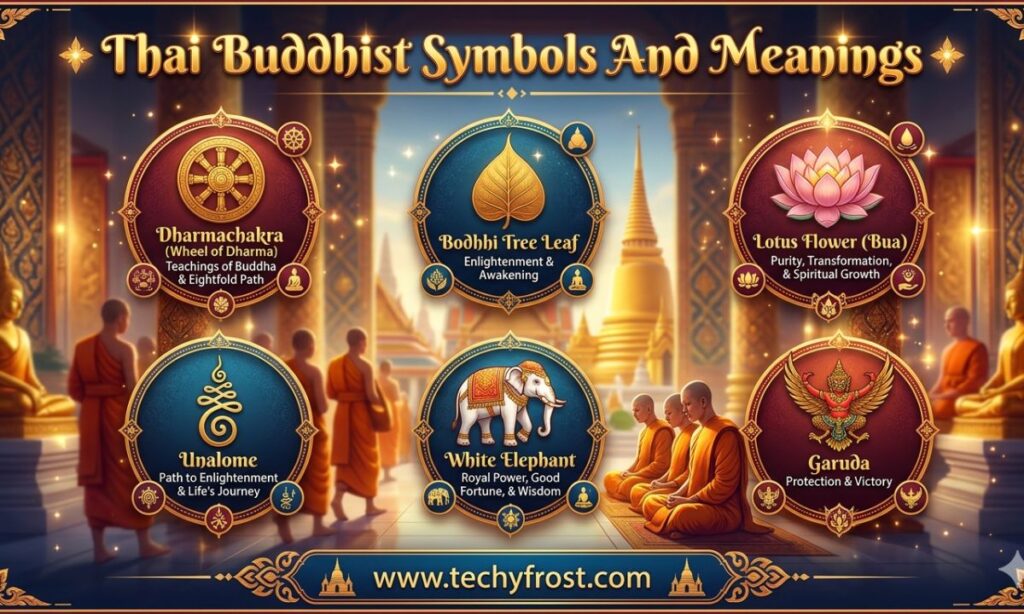
Thai Buddhism blends Theravada teachings with local spirit traditions. Symbols unique to Thai Buddhist culture include the Sak Yant — sacred geometric tattoos applied by monks, believed to offer protection and good fortune. Golden Buddha images in various mudras (hand positions) are also central to Thai Buddhist practice, with each posture carrying a specific meaning, from protection to compassion to meditation.
Tattoo Buddhist Symbols And Meanings
Buddhist tattoos are deeply personal. Some of the most meaningful choices:
- Lotus — overcoming adversity; spiritual growth
- Unalome — the imperfect path to awakening
- Dharma Wheel — commitment to ethical living
- Om — connection to universal consciousness
- Ensō — acceptance of imperfection; wholeness
- Bodhi Leaf — the potential for awakening within every person
List Of Buddhist Symbols And Meanings
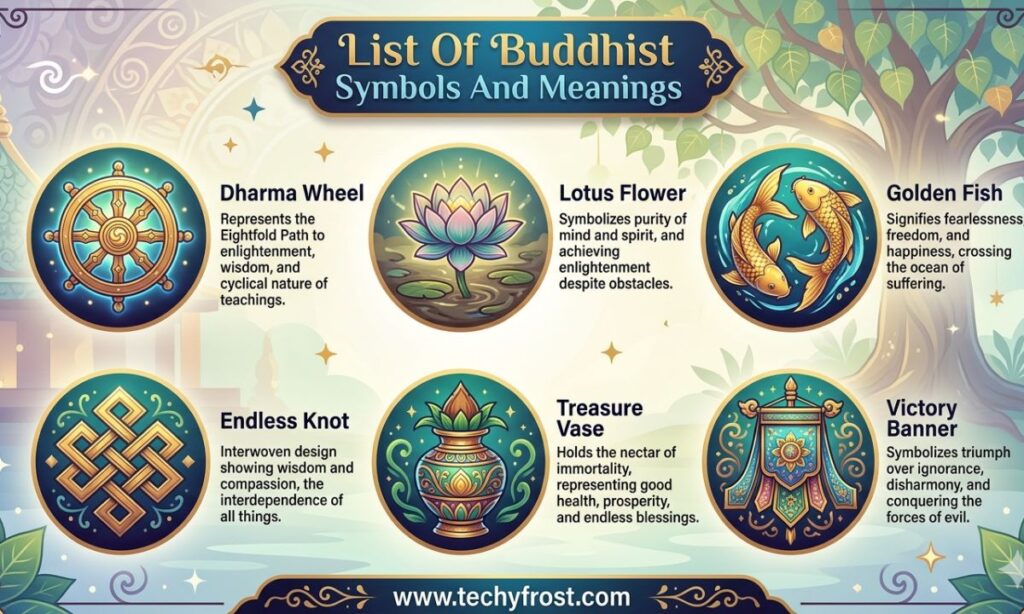
A comprehensive list of Buddhist symbols includes: Dharma Wheel, Lotus, Bodhi Tree, Stupa, Ensō, Unalome, Vajra, Bell, Conch Shell, Parasol, Golden Fish, Endless Knot, Treasure Vase, Victory Banner, Three Jewels, Mandala, Prayer Wheel, Mala, Om, Buddhist Flag, Mudras, Lion, Elephant, Deer, Swan, Naga (serpent deity), Garuda, Ankusa (elephant goad), Kalachakra, Phurba (ritual dagger), Tara (female bodhisattva), Avalokiteshvara, Medicine Buddha, Thangka, Prayer Flag, Butter Lamp, Incense, Offering Bowl, Wooden Fish Drum, Ruyi Scepter, Bodhi Seed, Kapala (skull cup), Sand Mandala, Yab-Yum (union of wisdom and compassion), Five Buddha Families, Five Colors, The 108 Beads, and the Buddhist Swastika (Manji).
Family Buddhist Symbols And Meanings
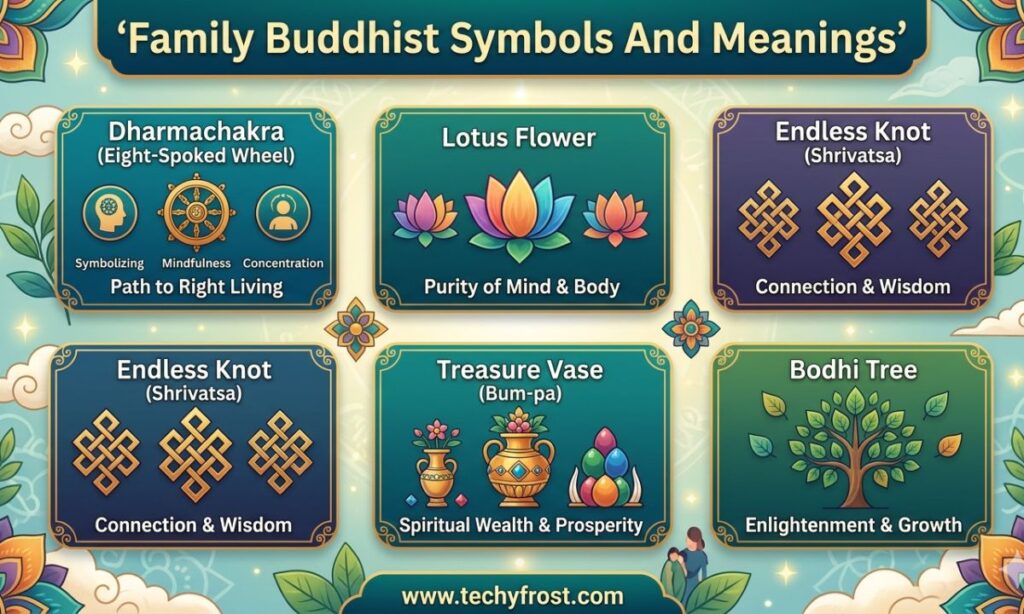
The Endless Knot represents the family most powerfully — its interlocked loops suggesting unbreakable bonds and the interconnected lives of those we love. The Lotus also carries family meaning, as each stage of the flower’s bloom mirrors different phases of a family member’s life and growth.
Inner Strength Buddhist Symbols And Meanings
Inner strength in Buddhism is not about force, but about resilience, clarity, and compassion. Symbols associated with inner strength include the Lion (courage), the Bodhi Tree (rootedness), the Vajra (indestructible commitment), and the Victory Banner (perseverance over the inner enemies of fear and doubt).
Protection Buddhist Symbols And Meanings
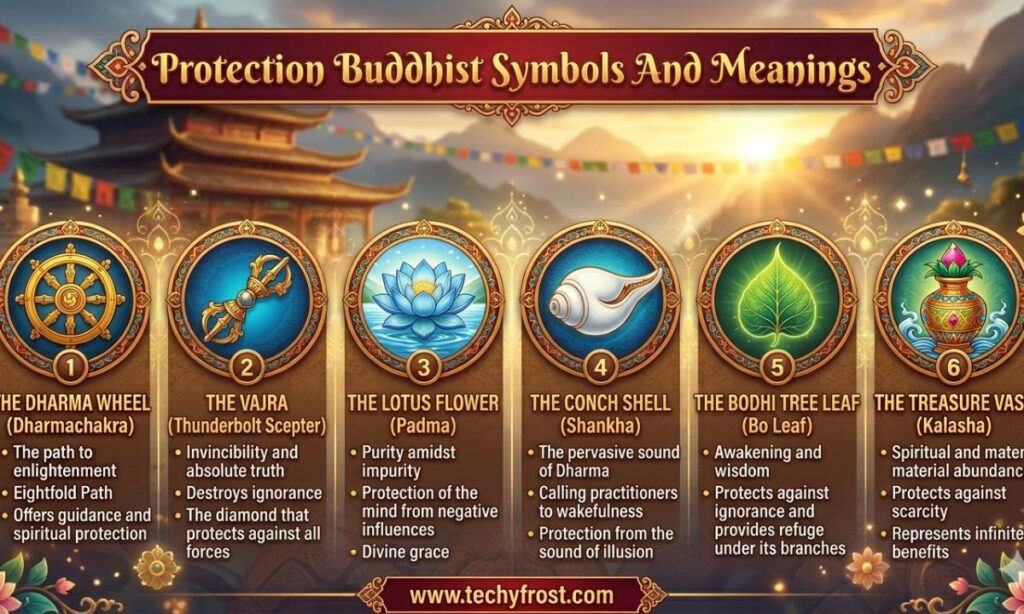
The top Buddhist protection symbols are the Parasol, the Vajra, the Endless Knot, the Buddha Eye (painted on stupas in Nepal), and the mantra Om Mani Padme Hum. These are used in amulets, home decorations, ritual objects, and clothing to create a spiritual environment of safety.
Inner Peace Buddhist Symbols And Meanings
Symbols specifically representing inner peace: the meditating Buddha, the full lotus, the Ensō, and calm-water imagery in Buddhist art all point toward the same quality — a mind that is untroubled, present, and fully at ease with what is.
Theravada Buddhist Symbols And Meanings
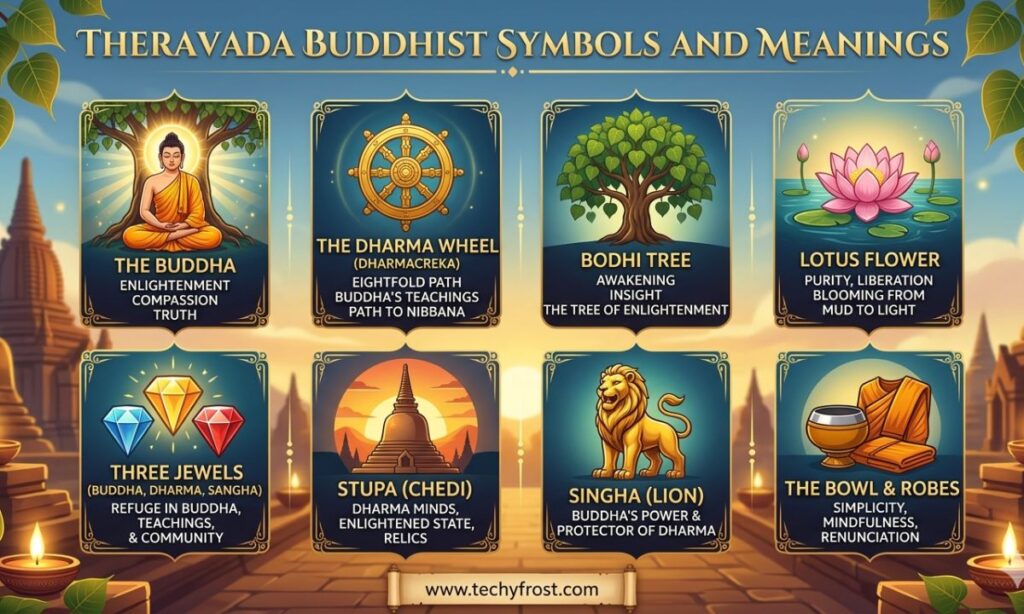
Theravada Buddhism, practiced widely in Sri Lanka, Thailand, Cambodia, and Myanmar, emphasizes the original teachings most closely. Its key symbols include the Dharma Wheel, the Bodhi Tree, the simple unadorned stupa, and the orange monastic robe. The emphasis is on the historical Buddha and his actual teachings, making the symbols relatively spare compared to Tibetan or Zen traditions.
Spiritual Buddhist Symbols And Meanings
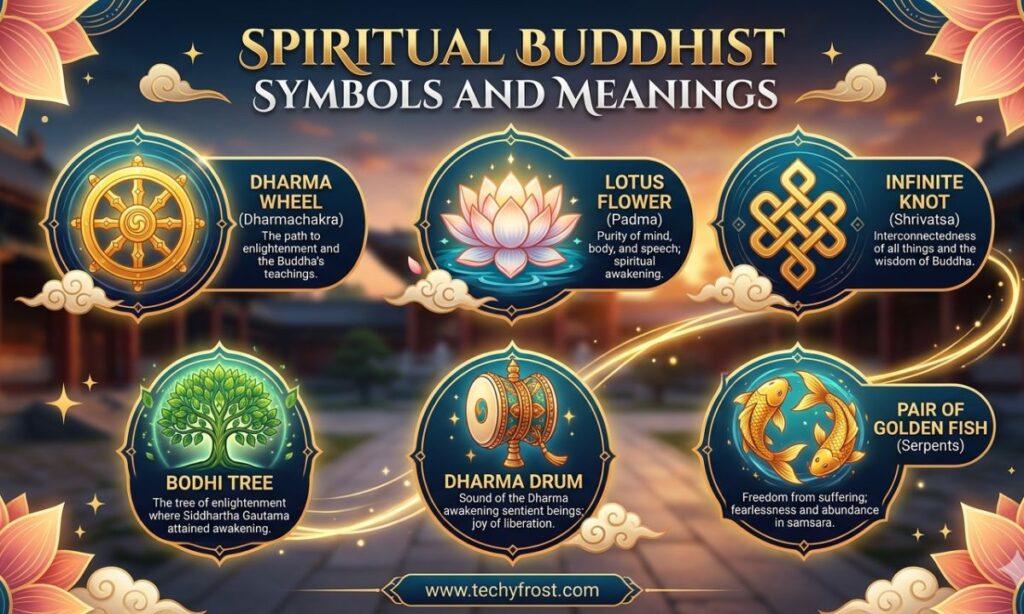
All Buddhist symbols are spiritual at their core. But symbols with the most direct spiritual resonance include the Three Jewels (representing the complete refuge available to practitioners), the Mandala (mapping the structure of enlightened reality), and the Lotus (the spiritual journey itself in visual form).
8 Buddhist Symbols And Meanings
The Ashtamangala — Buddhism’s eight auspicious symbols — are:
- Dharma Wheel — the Buddha’s teachings
- Lotus Flower — purity and awakening
- Conch Shell — the spread of the Dharma
- Endless Knot — interconnectedness and infinite wisdom
- Parasol — protection from suffering
- Golden Fish — fearlessness and liberation
- Treasure Vase — inexhaustible spiritual abundance
- Victory Banner — triumph over ego and delusion
Lotus Flower Buddhist Symbols And Meanings
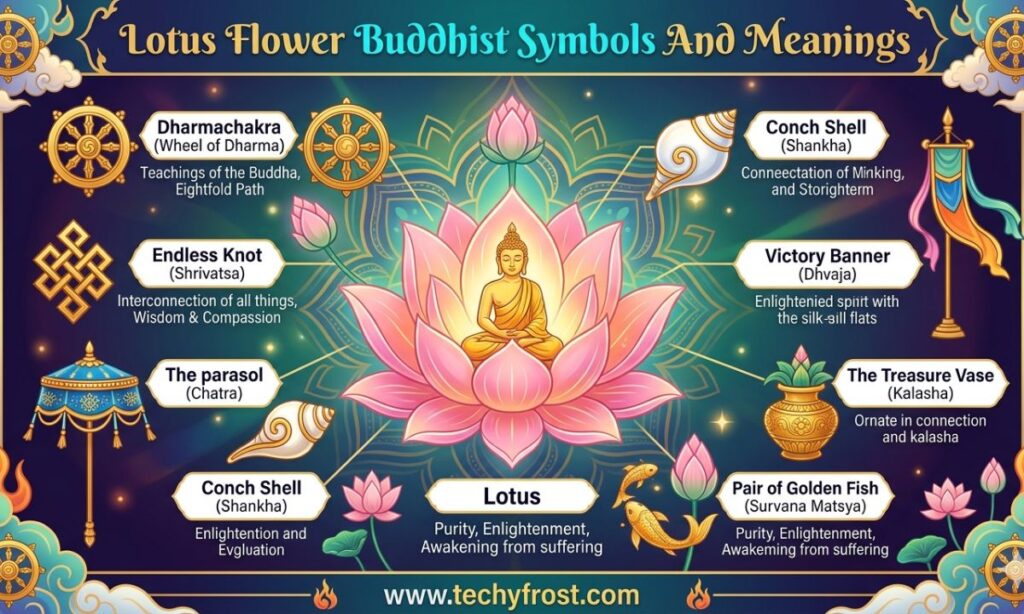
The Lotus flower deserves special focus. It grows with its roots in mud, its stem in murky water, and its blossom rising above the surface into sunlight — untouched by the dirt below. This is why the Buddha is so often depicted seated on a lotus: it represents the possibility of remaining spiritually pure even while living in the world. The stage of the lotus blossom carries meaning too: a closed bud represents the beginning of the spiritual path; a half-open flower shows progress; a fully bloomed lotus represents complete enlightenment.
Deep Symbolic Meaning of Buddhist Symbols
Spiritual Level
On a spiritual level, Buddhist symbols point toward enlightenment — the liberation from suffering and the ending of the cycle of birth and death. They represent inner awakening, balance, compassion, and the path to Nirvana. The symbols are not ends in themselves; they are guides, maps, and mirrors for the practitioner’s own journey.
Psychological Level
Psychologically, Buddhist symbols work as anchors for the mind. Gazing at a lotus or meditating on the Dharma Wheel helps calm anxiety, encourage self-awareness, and reframe personal suffering as part of a universal human experience. Many symbols reflect mental states — confusion, clarity, attachment, release — making them deeply relatable and therapeutically effective.
Cultural Level
Culturally, Buddhist symbols carry centuries of shared meaning. In countries like Thailand, Japan, Sri Lanka, and Tibet, these symbols are inseparable from national identity, artistic tradition, and communal life. Even in Western cultures, Buddhist symbols increasingly represent values like mindfulness, compassion, and intentional living — values that resonate broadly, regardless of religious affiliation.
Types and Variations of Buddhist Symbols and Meanings
1. The Dharma Wheel (Dharmachakra)
The most important symbol in Buddhism, the Dharma Wheel dates back to the 3rd century BCE. Its eight spokes represent the Noble Eightfold Path — right view, right intention, right speech, right action, right livelihood, right effort, right mindfulness, and right concentration. Three swirls at the center represent the Three Jewels: the Buddha, the Dharma, and the Sangha. The rim represents ethical restraint that holds all the teachings together. The Buddha set this wheel in motion with his first teaching in the Deer Park at Sarnath — an event so significant it is called “the first turning of the Dharma Wheel.”
2. The Lotus Flower
Growing through muddy water to bloom in pristine beauty, the lotus has been the central symbol of Buddhist art for over two thousand years. It appears in the Lotus Sutra, one of Buddhism’s most important texts, and in the imagery of virtually every Buddhist deity and bodhisattva. Colors carry additional meaning: white lotus = mental purity; pink = the historical Buddha; blue = wisdom; red = compassion.
3. The Buddha Image
Anthropomorphic images of the Buddha appeared around the 1st century CE. Each posture and hand gesture (mudra) carries specific meaning. The earth-touching gesture (Bhumisparsha) recalls the moment of enlightenment. The meditation gesture (Dhyana mudra) shows the Buddha in meditative absorption. The “no fear” gesture (Abhaya mudra) radiates protection and reassurance. The giving gesture (Varada mudra) represents compassion and generosity.
4. The Endless Knot
A closed pattern of interlocking loops with no beginning or end, the Endless Knot represents the interconnected nature of all phenomena. It symbolizes how wisdom and compassion are inseparable, and how the teachings of the Dharma flow continuously without interruption. In Tibetan Buddhism, it is seen as a symbol of Buddha’s infinite wisdom and the unity of all things.
5. The Bodhi Tree
The sacred fig tree (Ficus religiosa) beneath which Siddhartha Gautama attained enlightenment is one of Buddhism’s most revered symbols. The original Bodhi tree in Bodh Gaya, India, remains one of the most important pilgrimage sites in the Buddhist world. The heart-shaped leaf of the Bodhi tree has become a universal symbol of the potential within every human being to awaken.
6. The Stupa
A stupa is a domed structure built over sacred relics or as a monument to the Buddha’s enlightenment. Its architecture is itself symbolic: the square base represents the earth; the dome represents water; the spire represents fire; the crescent moon represents air; and the flame at the top represents ether (space). The five-part stupa embodies the five elements and points to the cosmic dimensions of the Buddha’s awakening.
Buddhist Symbols and Meanings Across Cultures
Ancient India
Buddhism was born in India, and its earliest symbols emphasized liberation, non-violence, and the middle path. The lotus and Dharma Wheel were central. Early Buddhist art deliberately avoided depicting the Buddha in human form — using instead an empty throne, footprints, or a parasol above empty space — reflecting a teaching style that invited the viewer’s own contemplation rather than passive devotion.
Tibetan Culture
Tibetan Buddhism added profound layers of mysticism and ritual complexity. Symbols like the Endless Knot and Mandala became tools for visualization practices in tantric Buddhism. The Vajra and Bell, always used together in ritual, represent the inseparable union of wisdom and compassion. Thangka paintings became encyclopedias of symbolic knowledge, with every color, gesture, and positioning carrying precise meaning.
Chinese Buddhism
When Buddhism reached China, it merged with Taoist and Confucian ideas, producing a symbolism that emphasized harmony, balance, and moral order. The Endless Knot took on additional meanings of love and marital fidelity. The Golden Fish became linked with fertility and prosperity. The Dharma Wheel was depicted as a dynamic, spinning force representing the ever-changing cosmos.
Japanese Buddhism
Japanese Buddhism, especially the Zen tradition, moved toward radical simplicity. The Ensō emerged as the supreme symbol: one brushstroke, one circle, one moment of complete presence. Japanese Buddhist art is characterized by restraint, asymmetry, and the celebration of impermanence — a philosophy captured in the term wabi-sabi.
Modern Global Culture
Today, Buddhist symbols have migrated far beyond their religious origins. They appear in wellness apps, yoga studios, hotel lobbies, fashion collections, and social media graphics. In this modern context, they generally represent inner balance, mindfulness, and intentional living. While this widespread adoption sometimes strips away the deeper spiritual context, it also introduces millions of people to ideas that can genuinely improve their wellbeing.
Buddhist Symbols in Art, Movies and Pop Culture
Buddhist imagery has long fascinated artists, filmmakers, and creators across every medium:
- Films such as Kundun, The Little Buddha, and Spring, Summer, Fall, Winter… and Spring use Buddha statues, mandalas, and lotus motifs to symbolize inner transformation and the cyclical nature of life.
- Paintings by artists from Mark Rothko to contemporary Buddhist artists use the meditative quality of Buddhist geometry and emptiness to evoke serenity and transcendence.
- Literature draws on Buddhist symbols as metaphors for awakening — the lotus as a metaphor for personal growth, the Dharma Wheel as a metaphor for karmic cycles.
- Music incorporates mantra-based chanting, with Om Mani Padme Hum appearing in everything from Tibetan ritual recordings to Western ambient and new-age music.
- Tattoo culture has adopted Buddhist symbols at scale, with the lotus and Unalome being among the most requested spiritual tattoo designs globally.
Spiritual and Dream Meaning of Buddhist Symbols
Seeing Buddhist symbols in dreams or during meditation is often interpreted as a sign of spiritual progress or invitation to deepen one’s practice:
- Dreaming of a lotus may signal inner purification, the beginning of spiritual growth, or emergence from a difficult period
- Dreaming of a Dharma Wheel may represent a calling toward truth, a turning point in life, or recognition of karmic patterns
- Dreaming of a Buddha often represents peace, inner guidance, or the activation of one’s own wisdom
- The Ensō appearing in meditation can signal a moment of complete presence — the mind momentarily free from grasping
Many practitioners report feeling calm, guided, and clarified after such inner encounters with Buddhist symbols — a testament to the depth of their psychological resonance.
Positive vs Negative Meanings of Buddhist Symbols
Positive Meanings
- Growth and transformation — the lotus rising from mud
- Wisdom and clarity — the Dharma Wheel turning
- Protection and refuge — the Parasol’s sheltering canopy
- Interconnection and love — the Endless Knot’s unbroken loops
- Inner peace and stillness — the meditating Buddha
- Abundance and spiritual wealth — the Treasure Vase
- Courage and liberation — the Golden Fish swimming freely
Negative or Shadow Meanings
Even the most positive symbols carry shadow dimensions worth understanding:
- The lotus, when used superficially, can reinforce spiritual bypassing — using ideas of “rising above” to avoid engaging with real suffering
- Buddha images placed in bathrooms, on the floor, or treated disrespectfully are considered culturally and spiritually inappropriate in most Buddhist traditions
- The Swastika (Manji in Japanese) — an ancient Buddhist symbol of eternity — has been tragically associated with Nazism in the West, causing genuine harm that makes public display complicated
- Commercialization of Buddhist symbols strips away meaning, reducing profound teachings to fashion accessories without any connection to the actual path
Why Humans Are Drawn to Buddhist Symbols
In a world of overwhelming noise, Buddhist symbols offer something rare: a moment of genuine stillness. They do not demand belief. They do not threaten. They simply invite attention, and that invitation feels healing.
Psychologically, these symbols provide what researchers call “positive affect anchors” — visual cues that reliably trigger calm, clarity, and a sense of connection to something larger than oneself. The lotus reminds us that beauty can emerge from struggle. The Dharma Wheel reminds us that truth exists and can be followed. The Ensō reminds us that wholeness is possible, even in our imperfect, unfinished lives.
Emotionally, they reassure us that suffering has meaning and an end. Spiritually, they point toward a freedom that is not theoretical but genuinely available. And in practical terms, they are beautiful — crafted over millennia by artists devoted to conveying the deepest truths of human experience in visual form.
This combination — beauty, depth, psychological effectiveness, and cultural resonance — is why Buddhist symbols are as alive in 2026 as they were when the first artists carved a lotus into stone twenty-five centuries ago.
Frequently Asked Questions
What is the main symbol of Buddhism?
The Dharma Wheel (Dharmachakra) is considered the primary symbol of Buddhism. Its eight spokes represent the Noble Eightfold Path, and it symbolizes the entirety of the Buddha’s teachings.
What does the lotus flower mean in Buddhism?
The lotus represents purity, spiritual awakening, and the capacity to rise above suffering. A closed bud signifies the beginning of the spiritual journey, while a fully bloomed flower represents complete enlightenment.
What are the 8 auspicious symbols of Buddhism?
The eight auspicious symbols, known as the Ashtamangala, are the Dharma Wheel, Lotus Flower, Conch Shell, Endless Knot, Parasol, Golden Fish Pair, Treasure Vase, and Victory Banner.
What is the Buddhist symbol for inner peace?
The meditating Buddha image and the fully bloomed lotus are the most widely recognized Buddhist symbols for inner peace. The Ensō circle in Zen Buddhism also powerfully represents a peaceful, complete state of mind.
What is the Buddhist symbol for protection?
The Parasol (umbrella) is the primary Buddhist protection symbol, representing shelter from suffering and negative forces. The Vajra and the mantra Om Mani Padme Hum are also widely used for spiritual protection.
What is the Unalome symbol?
The Unalome is a symbol representing the path to enlightenment — a spiral that gradually straightens as it ascends, showing that the spiritual journey involves setbacks and wandering before arriving at clarity and stillness.
What do Buddhist symbols mean in tattoos?
Buddhist tattoos carry the same spiritual meanings as the original symbols. A lotus tattoo often represents personal transformation; an Ensō represents acceptance of imperfection; a Dharma Wheel represents commitment to ethical living and truth.
What is the Buddhist symbol for love?
Buddhism expresses love primarily through the concept of Metta (loving-kindness). The Endless Knot and the image of Avalokiteshvara, the Bodhisattva of Compassion, are the most direct symbolic representations of universal love.
What is the Ensō in Zen Buddhism?
The Ensō is a hand-drawn circle in Zen Buddhism representing enlightenment, emptiness, wholeness, and the beauty of imperfection. It is drawn in a single or two brushstrokes and expresses the state of mind of the artist in the moment of creation.
What does the Bodhi Tree symbolize?
The Bodhi Tree symbolizes the site and moment of the Buddha’s enlightenment. It also represents the potential for awakening that exists within every human being, since the Buddha was a human who achieved enlightenment under this tree.
Are Buddhist symbols religious or cultural?
Buddhist symbols are both. Within Buddhist communities, they carry deep religious significance. In wider culture, they often represent values like mindfulness, compassion, and inner peace, making them accessible to people across religious backgrounds.
What is the number 108 in Buddhism?
The number 108 is sacred in Buddhism, representing the 108 human passions or “kleshas” that must be overcome to achieve enlightenment. This is why traditional mala (prayer bead) necklaces have 108 beads.
Conclusion
Buddhist symbols are among the richest and most enduring visual languages in human history. Each one — the spinning wheel, the rising lotus, the indestructible diamond, the unbroken circle — encodes centuries of wisdom about how to live with greater awareness, compassion, and peace.
Whether you encounter them in a temple, on a piece of jewelry, during meditation, or in a tattoo studio, these symbols have the power to stop you and remind you of something essential. Suffering is real. The path through it is real. And the peace waiting on the other side of that path is more real than anything you’ve been chasing.
That is the hidden message embedded in every Buddhist symbol and meaning — one that remains as urgently relevant in 2026 as it was on the day Siddhartha Gautama first sat beneath a fig tree and refused to get up until he understood the truth.

