
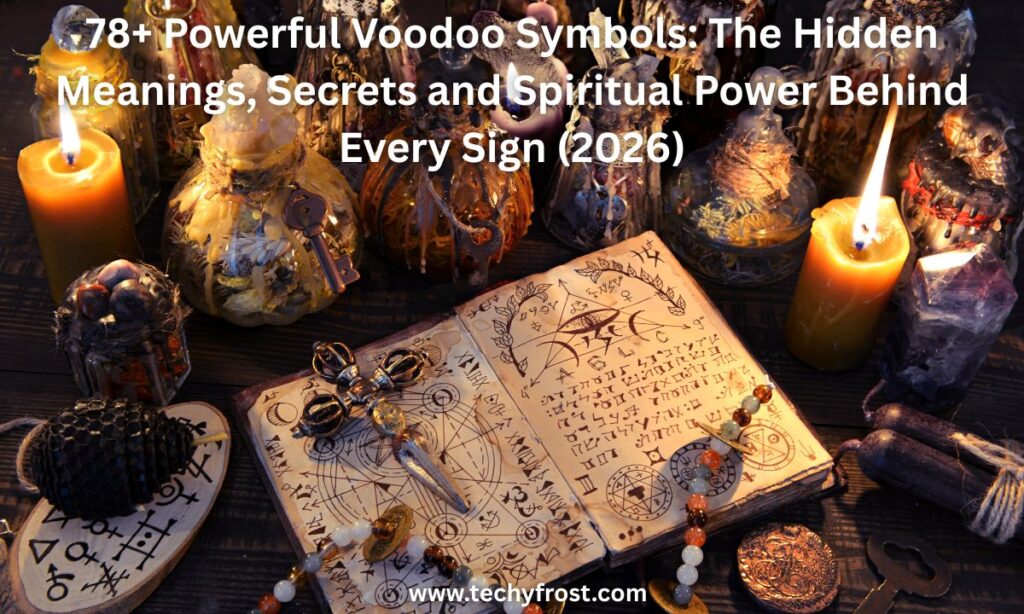
Voodoo symbols are not just mysterious drawings. They are living spiritual tools used for centuries to call upon divine forces, protect the living, honor the dead, and channel love, luck, and healing. Whether you are a curious researcher, a spiritual seeker, or someone exploring cultural history, this guide gives you the most complete, accurate, and human-centered look at voodoo symbols, their types, meanings, and power — all in one place.
What Are Voodoo Symbols?
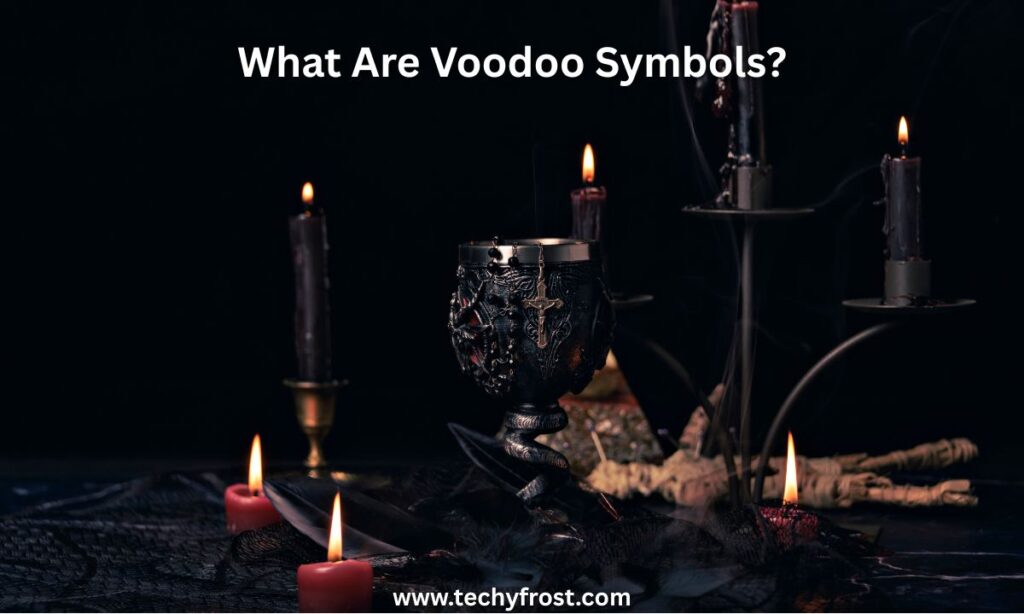
Voodoo symbols, most commonly known as veves (also spelled vèvè), are sacred geometric drawings used in Vodou ceremonies and rituals. Each symbol represents a specific Lwa (also called Loa) — a spirit or divine intermediary in the Vodou belief system.
These symbols are not decorative. When drawn with intention, prayer, and the correct materials — such as cornmeal, flour, ash, or sacred powder — they are believed to open a pathway between the human world and the spiritual realm. Think of them as a spiritual address: when you draw the correct veve, the corresponding spirit knows it is being called.
The word Voodoo itself derives from the Fon-Ewe word Vodun, meaning “spirit” or “deity.” The tradition originated among the Fon and Ewe peoples of West Africa, particularly in present-day Benin, Togo, and Ghana. It was carried to the Americas through the transatlantic slave trade and evolved into distinct regional traditions.
Voodoo Symbols | Meanings, Uses and Types
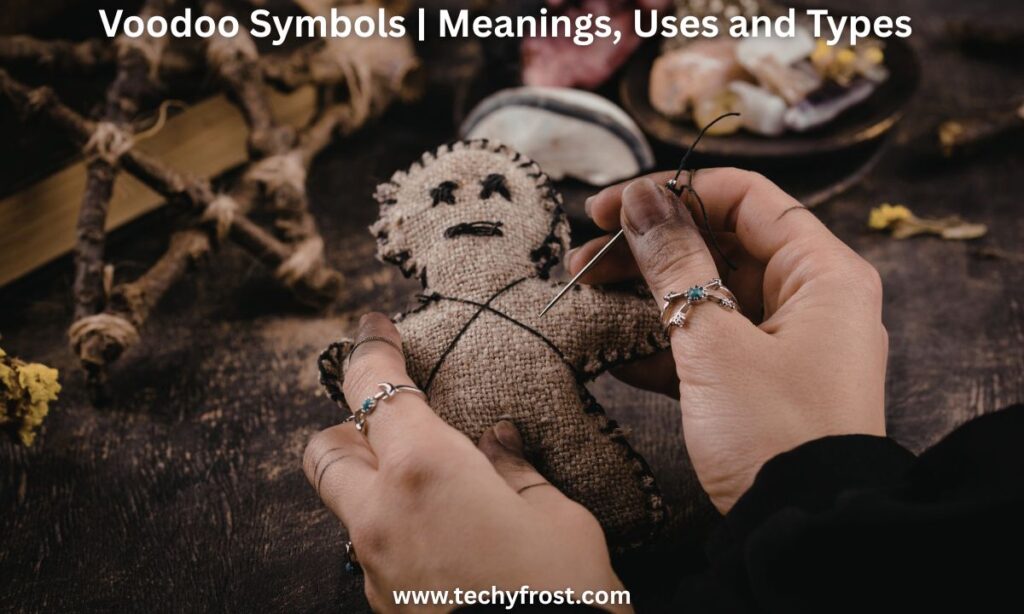
Voodoo symbols serve several core purposes in spiritual practice:
- Invocation — Drawing a veve invites the Lwa to enter the ritual space
- Protection — Certain symbols guard against evil spirits, negative energy, and harm
- Healing — Specific Lwa are called upon for physical and spiritual wellness
- Love and Relationships — Symbols tied to Erzulie are used in love rituals
- Ancestral Connection — Death symbols honor the dead and open lines of communication
- Luck and Prosperity — Symbols attract fortune, open blocked paths, and remove obstacles
Every veve is unique to its Lwa. The drawing must be created with knowledge and respect. An incorrect or careless drawing is believed to attract unwanted spiritual attention.
Understanding Voodoo Symbols and Their Meanings
To truly understand voodoo symbols, you need to understand the cosmology behind them. In Vodou belief, the universe contains:
- Gran Met (Bondye) — The supreme God, distant and unknowable
- Lwa — Divine spirits who act as intermediaries between humans and God
- Ancestors — The spirits of the deceased who remain connected to the living
Because Bondye is considered too distant for direct communication, practitioners work through the Lwa. Each Lwa governs a specific domain of life — death, love, war, water, crossroads, healing — and their veve is the key to reaching them.
Types of Voodoo Symbols Around the World
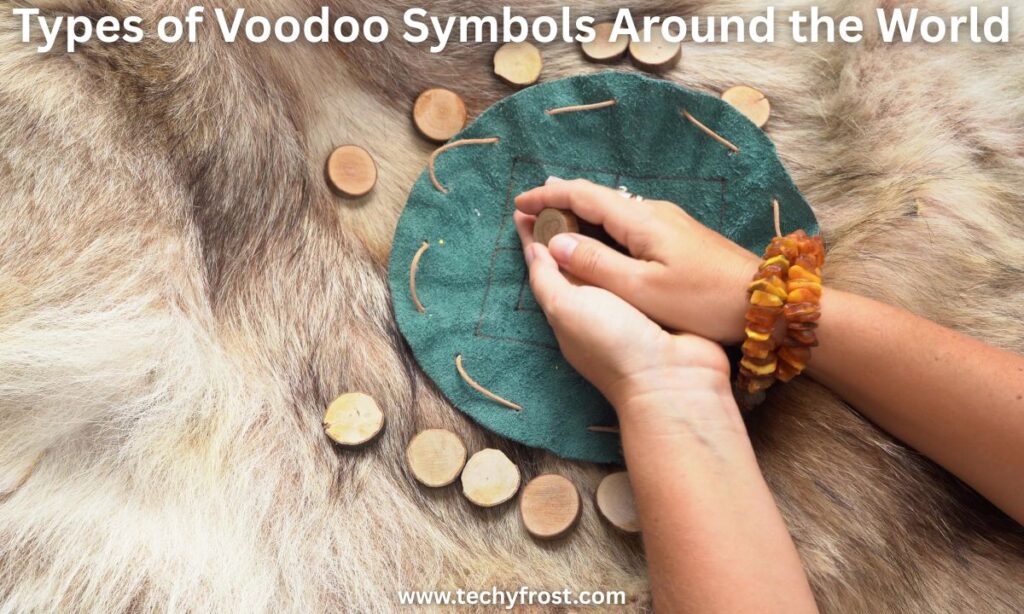
Voodoo symbols vary by region and tradition. Here is a breakdown of the major types:
| Type | Origin | Core Features |
| Haitian Vodou Veves | Haiti | Most elaborate; traced on floors in powder |
| Louisiana Voodoo Symbols | New Orleans, USA | Blended with Catholicism and Hoodoo |
| West African Vodun Symbols | Benin, Togo, Ghana | Oldest form; ancestor and nature-focused |
| Caribbean Vodou Symbols | Cuba, Puerto Rico, Brazil | Syncretic; mixed with Santería and Candomblé |
| Modern Occult Interpretations | Global | Used in art, tattoos, and digital culture |
Haitian Voodoo Symbols and Meanings
Haitian Vodou is the most widely known and formally developed branch of the Voodoo tradition. Its symbols — the veves — are among the most visually intricate sacred drawings in the world.
In Haitian Vodou, veves are drawn at the start of every ceremony. The floor becomes a canvas, and the practitioner traces each symbol with cornmeal or another sacred powder. The drawings are meticulous because precision carries spiritual weight.
Key characteristics of Haitian veves:
- Drawn from memory by trained practitioners (Houngan or Mambo)
- Often intersect with each other during ceremonies
- Destroyed or dispersed at the end of the ritual — their purpose complete
- Derived in part from the sacred drawings of the indigenous Taíno people
5 Most Powerful Voodoo Veve Symbols and Their Meanings
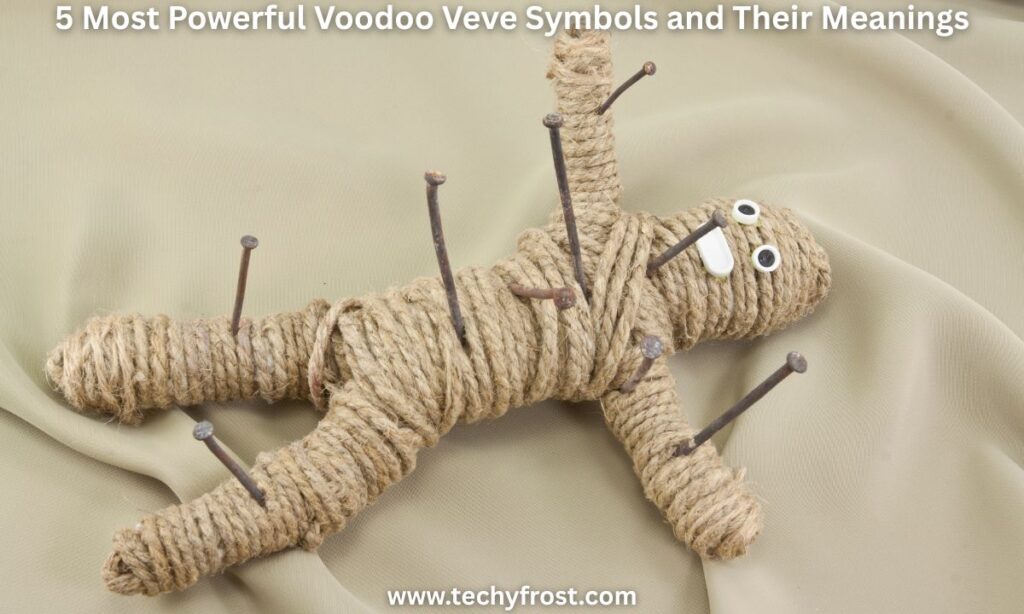
1. Papa Legba Veve — The Gatekeeper
Papa Legba is the first Lwa invoked in every Vodou ceremony. Without his permission, no other spirit can be reached. He is the guardian of the crossroads — the meeting point between the living world and the spirit world.
His veve features two perpendicular axes (a cross), representing the crossroads, along with his iconic walking cane. Some versions include keys, gates, and the sun.
- Domain: Communication, pathways, new beginnings, spiritual access
- Offerings: Tobacco, rum, small coins, keys, candy
- Colors: Red and black
- Catholic Syncretism: Associated with Saint Peter and Saint Lazarus
Papa Legba’s veve is drawn first because he alone opens the gate. Even experienced practitioners do not bypass this step.
2. Erzulie Freda Veve — The Goddess of Love
Erzulie Freda is the Lwa of love, beauty, luxury, and passion. She is the embodiment of feminine grace and the spirit most called upon in love rituals.
Her veve centers on a heart, often embellished with flowers, a crown, and decorative swirls. Unlike Erzulie Dantor’s pierced heart, Erzulie Freda’s heart is whole and radiant.
- Domain: Love, romance, beauty, prosperity, desire
- Offerings: Perfume, champagne, roses, sweets, mirrors, gold jewelry
- Colors: Pink, gold, and white
- Catholic Syncretism: Associated with Our Lady of Charity and the Mater Dolorosa
She wears three wedding bands representing her three divine husbands: Damballa, Agwe, and Ogou Feray. Her jealousy is well known — she weeps for the imperfection of the human world.
3. Baron Samedi Veve — The Lord of the Dead
Baron Samedi is arguably the most recognizable figure in Voodoo pop culture — a skeletal spirit in a top hat, sunglasses, and tails. But beyond the theatrical image lies profound spiritual meaning.
Baron Samedi is the master of death and resurrection. He decides who lives and who dies. If he refuses to dig a grave, a person cannot die. His veve typically incorporates crosses, skulls, coffins, and cemetery imagery.
- Domain: Death, resurrection, healing, protection from fatal illness
- Offerings: Rum, cigars, black coffee, hot peppers
- Colors: Black and purple
- Catholic Syncretism: Associated with Saint Expedite and Saint Martin de Porres
Interestingly, Baron Samedi is also a Lwa of medicine and healing. He can cure any disease if he chooses. His crude humor, sexuality, and love of rum make him one of the most complex spirits in the Vodou pantheon.
4. Damballa Veve — The Ancient Serpent
Damballa is one of the oldest and most powerful Lwa. He takes the form of a great white serpent and is considered the father of all Lwa. His veve is a pair of intertwined serpents, sometimes drawn as a single coiled snake.
- Domain: Creation, wisdom, purity, equilibrium, life itself
- Offerings: Eggs, milk, white foods, rice
- Colors: White and silver
- Catholic Syncretism: Associated with Saint Patrick (often depicted with serpents)
Damballa rarely speaks — he communicates in hisses and movement. Those possessed by him move on the floor like a serpent. He represents the cosmic balance that sustains all life.
5. Ogou Veve — The Warrior Spirit
Ogou (also spelled Ogún or Ogou Feray) is the Lwa of iron, war, courage, and liberation. He is deeply connected to the Haitian Revolution — the enslaved people who fought for freedom invoked his fierce energy.
His veve often features swords, machetes, fire, and lightning bolts, reflecting his warrior nature.
- Domain: Strength, justice, protection, political power, technology
- Offerings: Red wine, rum, cigars, iron implements
- Colors: Red and black
- Catholic Syncretism: Associated with Saint James the Greater and Saint George
Ogou is not simply destructive. He is a protector — one who uses force when justice demands it.
Voodoo Symbols for Protection
Protection is one of the most common reasons people seek voodoo symbols. The following are widely used in protective rituals:
- Papa Legba’s Veve — Drawn at doorways to keep negative energy from entering
- Erzulie Dantor’s Veve — Protects women, children, and the vulnerable
- Maman Brigitte’s Veve — Guardian of the dead; protects cemeteries and the living from death’s untimely reach
- Simbi’s Veve — Protective spirit of rivers and rain; guards against magical attacks
- The Crossroads Symbol — General protection drawn at thresholds and boundaries
Chicken feet, gris-gris bags, and voodoo dolls used with protective intent also carry symbolic weight in Louisiana and New Orleans Voodoo traditions.
Voodoo Symbols for Love
Love rituals are central to Vodou practice. The primary Lwa invoked for love-related matters include:
| Symbol | Lwa | Love Purpose |
| Heart (whole) | Erzulie Freda | Attracting new love, romance |
| Heart (pierced) | Erzulie Dantor | Fierce love, protection of relationships |
| Mirror symbol | Erzulie Freda | Self-love, beauty attraction |
| The Ankh | Crossroads spirits | Life force and eternal love bonds |
| Red candle symbol | Multiple Lwa | Passion and desire rituals |
Drawing Erzulie Freda’s veve while offering roses, champagne, and sweet perfume is the most traditional approach for inviting love into one’s life.
Voodoo Symbols for Good Luck
Several Lwa govern prosperity, fortune, and the removal of obstacles:
- Legba’s Veve — Opens blocked roads and creates new opportunities
- Ayizan’s Symbol — Lwa of the marketplace; brings trade luck and financial success
- Maman Brigitte — Luck in legal matters and challenges
- Marasa Veve — The Divine Twins; represent balance and the doubling of good fortune
Good luck rituals often combine multiple symbols with specific offerings and prayers, performed at crossroads or thresholds.
Voodoo Symbol for Death
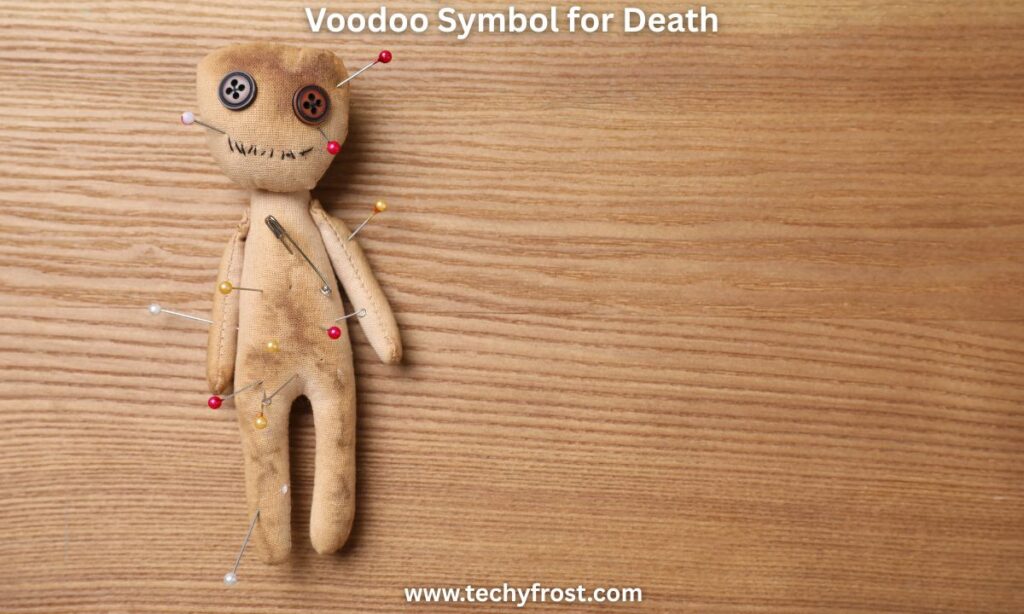
Death in Voodoo is not the enemy. It is a transition, a doorway, a completion of the cycle. The primary death symbols include:
- Baron Samedi’s Veve — The most powerful death symbol; represents the boundary between living and dead
- Grann Brigitte’s Veve — Combines crosses and hearts; governs the female aspect of death and justice
- The Cemetery Cross — Found at the entrance to cemeteries in Haitian tradition; the first grave in any cemetery is considered Baron Samedi’s home
- The Skull — Universal death symbol within Vodou; represents ancestral memory
These symbols are used in ancestral honoring ceremonies, in Gede rituals (the Vodou festival of the dead), and in healing rituals where death’s domain must be acknowledged.
African Voodoo Symbols
The oldest voodoo symbols come from West African Vodun, practiced primarily in Benin, Togo, Nigeria, and Ghana. African Vodun symbols differ from Haitian veves in form but share spiritual purpose.
Key distinctions of African Vodun symbols:
- More abstract and geometric than Haitian veves
- Deeply tied to specific ethnic groups (Fon, Ewe, Yoruba)
- Often carved into sacred objects, staffs, and shrines rather than drawn on floors
- Closely integrated with ancestor veneration and nature spirits
The Fa divination system of the Fon people uses a complex set of symbols (called du) to interpret destiny — it is one of the oldest symbolic languages in the world and was recognized by UNESCO as an Intangible Cultural Heritage.
Louisiana and New Orleans Voodoo Symbols
Louisiana Voodoo developed when West African and Haitian traditions merged with French Catholicism, Native American spirituality, and European folk magic in the 18th and 19th centuries. New Orleans became its spiritual capital.
Key features of New Orleans Voodoo symbols:
- Veves are used alongside Catholic saint images
- Gris-gris (charm bags) use symbolic objects rather than pure drawings
- Voodoo dolls are a distinct Louisiana symbol — used for both healing and, in some cases, cursing
- The Mojo hand is a symbol-carrying amulet unique to the region
- Marie Laveau, the legendary 19th-century Voodoo Queen of New Orleans, popularized many of these hybrid symbols
New Orleans practitioners often draw veves on altars rather than floors, and the symbols frequently appear alongside Hoodoo seals and Catholic iconography.
Voodoo Symbols Across Cultures
West Africa
The original home of Vodun. Symbols are carved, painted, and woven into sacred objects. Ancestor spirits and nature deities govern the tradition.
Haiti
The most developed veve tradition. Precise geometric drawings performed by initiated priests and priestesses during elaborate ceremonies that can last through the night.
Louisiana
A syncretic blend of African, Haitian, Catholic, and Native American influences. More folk-magic oriented and less ceremonially structured than Haitian Vodou.
Caribbean and Brazil
In Cuba, Santería’s Orishas parallel the Lwa. In Brazil, Candomblé and Umbanda traditions feature similar sacred drawings called pontos riscados. These share deep spiritual DNA with Haitian veves.
Modern Global Spirituality
Voodoo symbols have entered mainstream spiritual culture worldwide. People incorporate veves into tattoos, jewelry, home décor, and digital art — sometimes with deep spiritual intent, sometimes purely aesthetically.
Voodoo Symbols in Art, Movies and Pop Culture
Voodoo imagery has heavily influenced global culture, though not always accurately. Films like The Serpent and the Rainbow (1988) and Princess and the Frog (2009) brought Vodou aesthetics to wide audiences. Baron Samedi appears in James Bond’s Live and Let Die and inspired characters in video games and comic books.
The danger of pop culture portrayals is the reduction of a rich spiritual tradition to horror-movie tropes. Real voodoo symbols carry centuries of communal meaning, not theatrical menace.
In the art world, Haitian painters like Hector Hyppolite (himself a Houngan) brought veve-inspired imagery into internationally celebrated works. Today, voodoo symbols appear in tattoo culture, graphic design, fashion, and digital illustration.
Deep Symbolic Meaning of Voodoo Symbols
On a Spiritual Level
Each veve is understood as a spiritual signature — an exact representation of a divine being’s energy. When drawn correctly, it acts as a portal. The symbol does not merely represent the Lwa; in ritual context, it is the Lwa’s presence made visible.
On a Psychological Level
Voodoo symbols work as focus tools. The act of drawing a veve with precision requires concentration, intention, and reverence. This ritual focus shifts the practitioner’s mindset, making them more receptive to spiritual experience and inner guidance. Carl Jung noted the psychological parallel between sacred symbols and the archetypes of the collective unconscious.
On a Cultural Level
These symbols are acts of cultural survival. Enslaved Africans were forbidden from practicing their religions. Veves were hidden, blended with Catholic imagery, transmitted orally. Every veve drawn today carries the defiant memory of those who refused to let their heritage disappear.
Positive vs. Negative Meaning of Voodoo Symbols
Positive Meaning
- Veves are primarily tools of healing, protection, guidance, and celebration
- They honor the divine and express gratitude to spiritual forces
- Love symbols bring connection; protection symbols bring safety
- Death symbols honor the cycle of life, not destruction
Negative Interpretation
- Misused symbols, drawn without knowledge or respect, are believed to attract chaotic spiritual energy
- Some practitioners do engage in “wanga” (cursing) work — but this is a minority practice and widely considered spiritually dangerous for the practitioner as well
- Pop culture has amplified the negative associations far beyond their actual role in genuine Vodou practice
The most important truth: the vast majority of voodoo symbolism is life-affirming, community-centered, and spiritually sophisticated.
Why Humans Are Attracted to Voodoo Symbols
The appeal of voodoo symbols crosses cultural and religious lines. Several reasons explain this universal draw:
- Mystery and the unknown — The symbols gesture toward the invisible world most humans intuitively sense but cannot name
- Aesthetic beauty — Veves are genuinely stunning geometric compositions
- Functional spirituality — Unlike abstract doctrine, voodoo symbols offer something to do — a ritual, a drawing, an action
- Ancestral longing — For people of African diaspora, these symbols reconnect them with severed cultural roots
- Psychological resonance — The archetypes these symbols represent — love, death, protection, the crossroads — are universally human experiences
Conclusion
Voodoo symbols — the veves, the crossroads, the serpents, the hearts, the skulls — are far more than mysterious drawings. They are the vocabulary of a complete spiritual worldview born from Africa, shaped by centuries of diaspora, and kept alive by communities that refused erasure.
Every symbol in this tradition carries layers of meaning: spiritual, psychological, historical, and deeply human. Whether you are drawn to Papa Legba’s crossroads, the fierce love of Erzulie, the cosmic serpent of Damballa, or the defiant wisdom of Baron Samedi, these symbols speak to experiences every person knows — the need for guidance, love, protection, and a meaningful relationship with the forces greater than ourselves.
Understanding voodoo symbols is not about fear. It is about respect — for a living tradition, for ancestral wisdom, and for the invisible threads that connect us all.

