
From the moment humans first scratched spirals into cave walls, we have used symbols to speak what language could not fully express. Spiritual symbols are more than decorative art — they are doorways into the unseen, carrying wisdom, healing, and sacred meaning across thousands of years and hundreds of cultures.
Whether you are drawn to the timeless Om, intrigued by the Egyptian Ankh, or searching for the right tattoo that reflects your inner journey, this complete guide to spiritual symbols and meanings will walk you through 128+ of the most powerful signs ever known to humanity. Read on to discover where they come from, what they truly represent, and why they still matter today.
What Are Spiritual Symbols and Meanings?
A spiritual symbol is a visual image, shape, or sign that holds a deeper, often sacred meaning beyond its physical appearance. These symbols have been used throughout history to represent divine forces, universal truths, and invisible energies that shape human experience.
Unlike ordinary signs that point to concrete objects, spiritual symbols speak to the soul. They communicate concepts like:
- Life and death (the Ankh, the Ouroboros)
- Balance and duality (Yin and Yang)
- Protection and safety (the Hamsa, the Eye of Horus)
- Enlightenment and awakening (the Lotus, the Third Eye)
- Eternity and continuity (the Infinity symbol, Celtic knots)
The oldest known spiritual symbol is the spiral, found carved into prehistoric cave markings thousands of years before written language existed. This tells us something profound: humans have always needed symbols to make sense of existence.
Powerful and Ancient Spiritual Symbols
Powerful Spiritual Symbols and Their Meanings
Some symbols have lasted not because they are beautiful, but because they speak a truth people keep recognizing across generations. Here are the most universally recognized powerful spiritual symbols:
| Symbol | Origin | Core Meaning |
| Om (Aum) | Hinduism / Vedic India | The sacred vibration of the universe |
| Lotus Flower | Buddhism / Hinduism | Purity, rebirth, and spiritual awakening |
| Ankh | Ancient Egypt | Eternal life and divine protection |
| Yin and Yang | Chinese Taoism | Balance between opposing forces |
| Hamsa Hand | Middle Eastern / Jewish | Protection from the evil eye |
| Eye of Horus | Ancient Egypt | Healing, protection, and royal power |
| Mandala | Buddhism / Hinduism | The universe, wholeness, and inner peace |
| Cross | Christianity / Universal | Faith, sacrifice, and the meeting of heaven and earth |
| Tree of Life | Celtic / Universal | Connection of all living things, wisdom, growth |
| Spiral | Prehistoric / Celtic | The journey of life, growth, and cosmic energy |
7 Spiritual Symbols
If you are new to spiritual symbolism, these seven are the most widely recognized across cultures and traditions:
- Om (ॐ) — The primordial sound of creation, representing mind, body, and spirit united.
- Lotus — Rising from muddy water, symbolizing purity and the triumph over hardship.
- Yin and Yang — The dance of opposites that creates universal harmony.
- Cross — The intersection of the earthly and divine planes.
- Ankh — The Egyptian key of life, representing immortality.
- Hamsa — An open hand offering protection and blessings.
- Mandala — A sacred circle that represents the infinite cosmos.
10 Spiritual Symbols and Their Meaning
Expanding beyond the core seven, these ten symbols appear across nearly every major spiritual tradition:
- Om — Sacred sound uniting all planes of existence.
- Lotus Flower — Spiritual growth rising above earthly suffering.
- Ankh — Eternal life and divine energy.
- Eye of Horus — Spiritual protection and healing.
- Yin and Yang — Balance and the unity of opposites.
- Tree of Life — Interconnectedness of all life forms.
- Hamsa — Shield against negative energy.
- Mandala — The universe reflected in geometric form.
- Pentagram — The five elements (earth, water, fire, air, spirit) in harmony.
- Ouroboros — The serpent eating its own tail, symbolizing the endless cycle of life, death, and renewal.
Ancient Spiritual Symbols and Meanings
Ancient civilizations embedded spiritual meaning into everything — temples, jewelry, pottery, and skin. Some of the most enduring ancient symbols include:
- Scarab (Egypt) — Resurrection and the power of the rising sun.
- Caduceus (Greece) — Healing, duality, and the balance of forces.
- Triquetra (Celtic) — The threefold nature of existence: life, death, and rebirth.
- Swastika (pre-Hindu) — One of the oldest symbols on earth, representing well-being, prosperity, and the turning of the sun (predating its 20th-century misuse by thousands of years).
- Ouroboros — Found in ancient Egyptian texts and Norse mythology, it represents infinity and the self-sustaining cycle of nature.
Powerful Symbols With Deep Meanings
Some symbols carry meaning so layered that they operate on spiritual, psychological, and cultural levels simultaneously:
- The Infinity Symbol (∞) — Limitless potential and eternal love.
- The Third Eye — Inner vision, intuition, and higher consciousness.
- The Vesica Piscis — Sacred geometry representing the union of two worlds.
- The Star of David — The merge of the divine and earthly realms.
- The Feather — Connection to spiritual guidance and the wisdom of ancestors.
Spiritual Symbols for Life, Healing, and Success
Spiritual Symbols for Success
Many traditions use specific symbols to attract good fortune, strength, and achievement:
- Dragon (Chinese) — Power, wisdom, and good fortune.
- Elephant (Hindu) — Ganesha, the remover of obstacles, is depicted as elephant-headed and is the patron of new beginnings.
- Infinity Sign — Continuous growth without limit.
- Sun Symbol — Vitality, life force, and leadership energy.
- Hamsa — Attracts blessings while deflecting envy.
Unique Symbols and Meanings
Beyond the widely known, some symbols carry beautifully specific meanings:
- Vegvisir (Norse) — A runic compass used to find one’s way through storms — literal or metaphorical.
- Eye of Ra — A fiercer Egyptian counterpart to the Eye of Horus, representing the destructive and protective power of the sun.
- Nazar (Evil Eye) — A blue glass bead used across Mediterranean and Middle Eastern cultures to ward off envy.
- Bindrune — Two or more Norse runes combined to create a unique personal talisman.
- Labyrinth — A walking meditation path, symbolizing the journey inward to find one’s center.
Healing Spiritual Symbols and Meanings
Healing symbols are used in meditation, Reiki, energy work, and sacred art to promote emotional and physical restoration:
| Symbol | Healing Purpose |
| Lotus | Cleansing negative emotions, encouraging rebirth |
| Caduceus | Physical healing and balance of the body’s energies |
| Reiki Cho Ku Rei | Energy amplification and healing activation |
| Green Tara (Buddhist) | Compassion and relief from suffering |
| Ankh | Life force renewal |
| Mandala | Psychological centering and emotional balance |
| Heart Chakra (Anahata) | Emotional healing, love, and forgiveness |
Healing symbols are most effective when used with intention — through meditation, visualization, or mindful placement in living spaces.
Spiritual Symbols and Meanings List
Here is a quick-reference list of spiritual symbols covering a wide range of traditions:
Protection Symbols: Hamsa, Eye of Horus, Pentagram, Nazar, Vegvisir, Celtic Knot, Triquetra
Love and Unity Symbols: Heart, Infinity, Rose, Venus Symbol, Vesica Piscis
Wisdom and Knowledge: Third Eye, Owl, Caduceus, Thoth’s Feather, Crescent Moon
Life and Rebirth: Ankh, Lotus, Phoenix, Scarab, Ouroboros, Tree of Life
Power and Strength: Dragon, Lion, Sun, Thor’s Hammer (Mjölnir), Eagle Feather
Balance and Harmony: Yin and Yang, Scale, Sri Yantra, Mandala, Cross
Spiritual Awakening: Om, Spiral, Star Tetrahedron, Merkaba, Labyrinth
Understanding Different Spiritual Symbols and Their Meanings
Hindu Spiritual Symbols and Meanings
Hinduism has one of the richest symbolic traditions in the world. Key Hindu spiritual symbols include:
- Om (ॐ) — The fundamental vibration of all creation, present in every Hindu prayer and ritual.
- Sri Yantra — A complex geometric diagram representing the cosmos and the divine feminine.
- Swastika — In its original Vedic form, a symbol of good fortune, sun energy, and prosperity.
- Lotus (Padma) — Deities like Lakshmi and Vishnu are depicted seated on lotus flowers, symbolizing divine purity.
- Trishula (Trident) — Shiva’s weapon, representing the three aspects of time: past, present, and future.
- Chakra Symbols — Seven energy centers from root to crown, each with its own symbol and meaning.
Native American Spiritual Symbols and Meanings
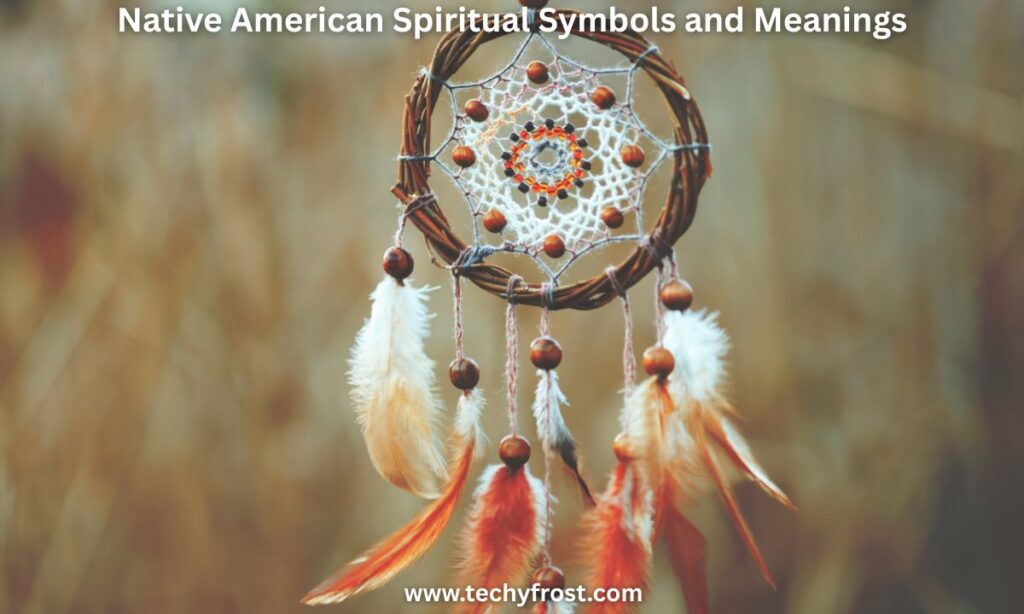
Native American tribes used symbols not just as art but as living prayers and records of wisdom. Their approach was profoundly holistic — every symbol connected the individual to nature, community, and the cosmos.
- Dreamcatcher — A woven hoop with a web that filters negative dreams and allows only good visions to pass through.
- Medicine Wheel — A circle divided into four quadrants representing the four directions, four seasons, and four aspects of the self.
- Feather — Connection to the spirit world and messages from ancestors.
- Bear Paw — Courage, strength, and the authority of a natural leader.
- Thunderbird — Divine power and the bridge between the earthly and celestial realms.
- Turtle — Long life, endurance, and the protective shell of perseverance.
- Morning Star — Renewal, courage, and purity of spirit.
Different tribes assigned different meanings to the same symbol. A broken arrow, for instance, universally signified peace and the end of conflict.
Spiritual Awakening Symbols and Meanings
Spiritual awakening is often accompanied by recurring symbols that appear in dreams, meditation, or daily life:
- Spiral — The inward-outward journey of expanding consciousness.
- Third Eye — Opening to perception beyond the five senses.
- Butterfly — Profound personal transformation and the shedding of an old identity.
- Serpent/Snake — Kundalini energy rising through the chakras, triggering spiritual awakening.
- White Light — Divine presence and the dissolution of ego boundaries.
- Merkaba (Star Tetrahedron) — An energy field believed to surround an awakened soul.
Spiritual Tattoo Symbols and Meanings
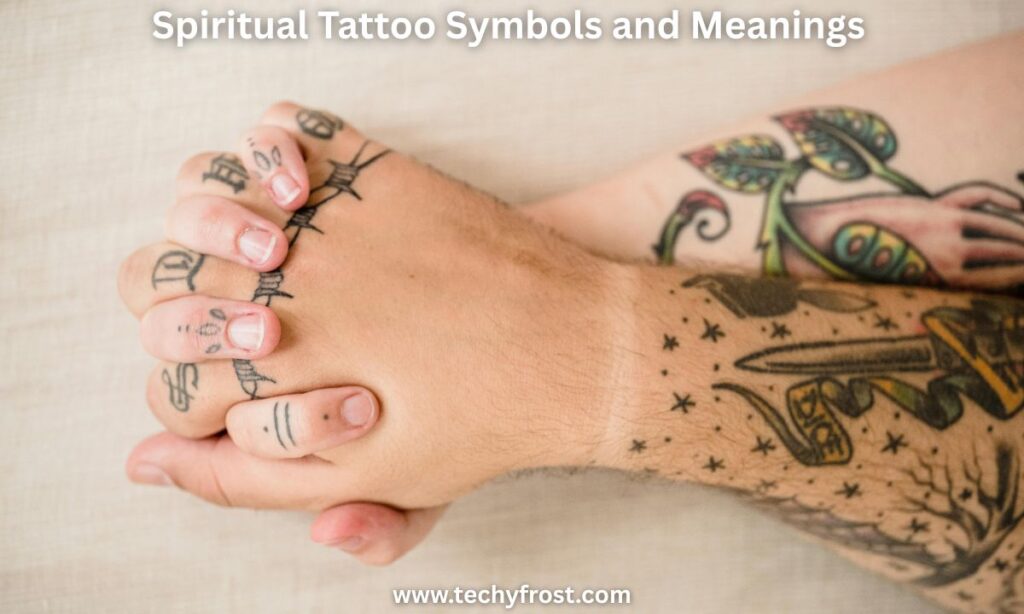
Tattoos have always been one of the most personal forms of spiritual expression. The best spiritual tattoos reflect something true about the person wearing them.
Popular Spiritual Tattoo Symbols:
- Lotus — Ideal for those who have overcome addiction, loss, or trauma. The lotus rising from mud is the perfect visual metaphor for resilience.
- Om — A declaration of spiritual commitment and the desire for inner peace.
- Mandala — Placed on the shoulder, back, or sternum, mandalas symbolize the wearer’s connection to the universe.
- Unalome — A Buddhist symbol representing the path to enlightenment — a spiral that straightens as wisdom is gained.
- Hamsa — Worn as a protective charm, especially popular in hand or wrist tattoos.
- Phoenix — Chosen by those who have experienced major transformation, loss, or rebirth.
- Feather — Representing freedom, ancestral connection, or spiritual communication.
Deep Insights Into Spiritual Signs and Symbolism
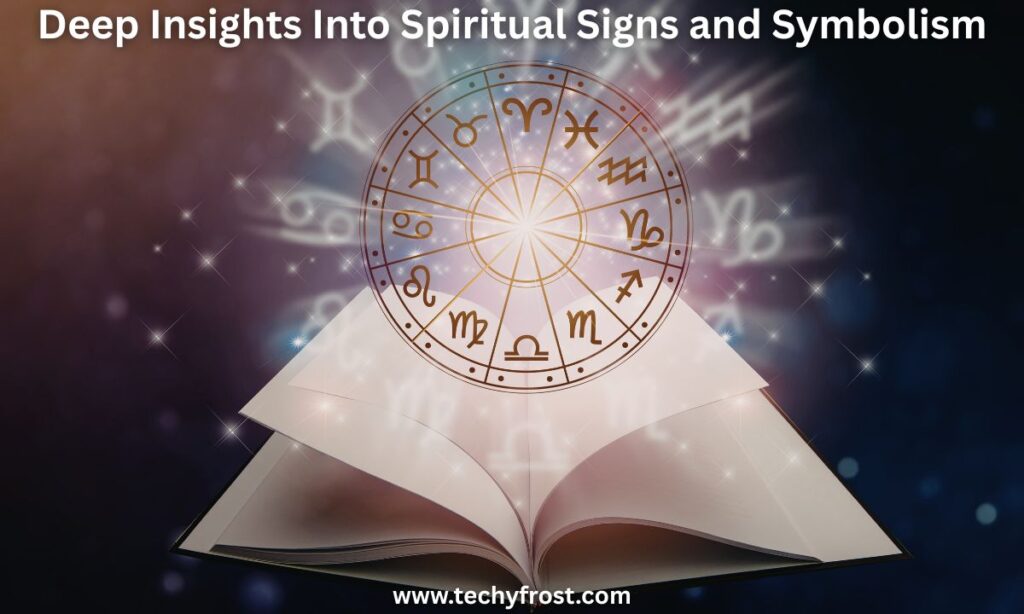
Spiritual Signs and Meanings
Spiritual signs differ from symbols in that they arrive unsolicited — as messages from the universe, your higher self, or spiritual guides. Common signs include:
- Repeating numbers (111, 333, 444) — Often called “angel numbers,” they signal alignment or a specific message depending on the sequence.
- Finding feathers — Traditionally interpreted as a sign that a loved one who has passed is nearby.
- Seeing a specific animal repeatedly — In many traditions, the repeated appearance of an animal is a message from the spirit realm.
- Hearing meaningful music unexpectedly — A song arriving at just the right moment may carry a personal spiritual message.
Symbols Meaning Truth
Several symbols across cultures are specifically associated with truth, justice, and divine order:
- The Feather of Ma’at (Egypt) — At death, a soul’s heart was weighed against this feather; a pure heart was as light as the feather.
- The All-Seeing Eye — Not only a symbol of watchfulness, but of the divine truth that sees through illusion.
- The Caduceus — Associated with Hermes/Mercury, the messenger of truth between gods and humans.
- The Scales of Justice — Universal symbol of moral balance and honest judgment.
Powerful Spiritual Symbolism and Their Importance
Spiritual Meaning of Symbols
Every spiritual symbol operates on multiple levels:
Spiritual Level — Connects the practitioner to divine energy, higher consciousness, or a specific deity or archetype.
Psychological Level — Symbols communicate with the unconscious mind. Carl Jung described them as “archetypes” — universal images that speak directly to the deeper layers of the psyche. A spiral doesn’t just mean “growth” intellectually; it evokes something in the gut.
Cultural Level — Symbols carry the memory of entire civilizations. When a crescent appears on a flag or a cross above a door, it announces a whole worldview without a single word.
Symbols of Spirituality and Metaphysical Understanding
Metaphysical Symbols
Metaphysical symbols attempt to map realities beyond the physical senses:
- Sacred Geometry — Shapes like the Flower of Life, Metatron’s Cube, and the Sri Yantra are believed to be the underlying patterns of reality itself.
- Merkaba — A three-dimensional Star of David that represents the light-spirit-body connection in sacred geometry traditions.
- Vesica Piscis — The overlapping of two circles creating a lens shape, representing the birth point between spirit and matter.
- The Fibonacci Spiral — Found in galaxies, shells, and flowers, this mathematical spiral is seen as proof of spiritual order woven into nature.
Spiritual Symbols for Tattoos and Cultural Meaning
African Spiritual Symbols and Meanings
African spiritual traditions are among the world’s oldest and most diverse. Key symbolic traditions include:
- Adinkra Symbols (Ghana/West Africa) — Over 60 distinct symbols, each encoding a proverb or philosophical principle. The Sankofa bird, for instance, represents learning from the past to build the future.
- Ankh (North Africa / Egypt) — While known globally through Egypt, the Ankh’s cross-and-loop form influenced spiritual art across the African continent.
- Scarification Patterns — In many African tribes, patterns marked on the skin represented tribal belonging, spiritual protection, and life transitions.
Types and Variations of Spiritual Symbols and Meanings
1. The Ankh
Visual Description: A cross with a looped top. Origin: Ancient Egypt. Meaning: Eternal life, divine protection, and the union of male and female energy. Pharaohs carried the Ankh as a symbol of their divine authority. Today, it is widely used as a spiritual amulet and tattoo design representing life and wisdom.
2. The Lotus Flower
Visual Description: A many-petaled flower blooming from muddy water. Origin: Buddhism, Hinduism, and ancient Egypt. Meaning: Purity, spiritual awakening, and the potential for transcendence hidden within difficulty. Color matters: white lotus represents purity, pink represents the highest divine, and gold represents spiritual mastery.
3. The Yin and Yang
Visual Description: A circle split into black and white swirling halves, each containing a dot of the other. Origin: Ancient Chinese Taoism. Meaning: The interdependence of opposites — darkness and light, rest and action, feminine and masculine. Neither can exist without the other; both are necessary for wholeness.
4. The Cross
Visual Description: A vertical line intersected by a horizontal line. Origin: Universal — predates Christianity as a spiritual symbol. Meaning: In Christianity, it represents the crucifixion and resurrection of Jesus. In older traditions, the cross represents the four directions and the intersection point between heaven and earth.
5. The Om Symbol
Visual Description: A curved glyph resembling the number 3 with a curved tail and arc above, topped by a dot. Origin: Hinduism (earliest appearance in the Vedas, approximately 1500 BCE). Meaning: The sacred vibration of the entire universe. The sound Aum consists of three parts: A (creation), U (manifestation), and M (dissolution) — the three stages of existence. Chanting Om is believed to align the mind, body, and spirit.
6. The Hamsa Hand
Visual Description: An open palm facing outward, often with an eye in its center. Origin: Found across Jewish, Islamic, Hindu, and ancient Middle Eastern traditions as early as the 6th century BCE. Meaning: Universal protection from the evil eye — the belief that envy or malice from others can cause harm. The five fingers represent the five senses, anchoring the wearer in the present moment.
Spiritual Symbols and Meanings Across Cultures
Ancient Egypt
Egyptian spiritual symbolism was among the most sophisticated the world has ever seen. Their symbols were not decorative — they were functional, used in rituals to invoke divine power and navigate the afterlife.
Key symbols: Ankh (eternal life), Eye of Horus (protection), Scarab (rebirth), Djed Pillar (stability), Feather of Ma’at (truth and divine order).
India
India’s symbolic heritage spans the Vedic, Hindu, Buddhist, and Jain traditions, producing an extraordinarily rich vocabulary of spiritual signs.
Key symbols: Om, Lotus, Swastika (prosperity), Sri Yantra, Chakra symbols, Trishula, Dharma Wheel.
China
Chinese spirituality blends Taoist, Buddhist, Confucian, and folk traditions into a rich symbolic world focused on harmony, longevity, and cosmic balance.
Key symbols: Yin and Yang, Dragon, Phoenix, Bagua (eight trigrams), Fu (fortune), Taijitu.
Ancient Greece
The Greeks used symbols to represent their gods and the philosophical principles those gods embodied.
Key symbols: Caduceus (healing and commerce), Omega (the end/completeness), Labyrinth (the inner journey), Ouroboros (infinity), Laurel Wreath (victory and achievement).
Native American Traditions
Every Native nation had its own symbolic language, rooted in the land, animals, and spirit world of its specific geography. Despite this diversity, common themes of harmony with nature, ancestral respect, and spiritual vision appear across many traditions.
Key symbols: Dreamcatcher, Medicine Wheel, Thunderbird, Bear Paw, Feather, Arrowhead (protection and alertness), Morning Star (renewal).
Spiritual Symbols and Meanings in Art, Movies, and Pop Culture
Spiritual symbols have never left mainstream culture — they have simply been repackaged. In the film The Matrix, Neo’s journey mirrors the archetype of the awakening soul, moving from illusion to truth. In The Alchemist, Paulo Coelho builds an entire novel around the idea that the universe communicates through signs and omens.
Fashion houses regularly use sacred geometry, mandalas, and ancient symbols on clothing and accessories to evoke mystery and depth. Music album covers have long used the all-seeing eye, the Ankh, and astrological symbols to communicate identity and philosophy.
In tattoo culture, spiritual symbols have become the dominant aesthetic. The mandala tattoo surged in popularity not as a trend but as a response to a genuine human desire for symbols that mean something real.
Spiritual and Dream Meaning of Spiritual Symbols
When spiritual symbols appear in dreams, their meanings often operate at a more personal level than their traditional definitions. A lotus appearing in a dream may signal that healing is underway. A snake may indicate that old beliefs are being shed. A spiral appearing repeatedly during meditation is widely interpreted across traditions as a sign of expanding consciousness and spiritual awakening.
Dream symbols are best interpreted through both their traditional meaning and the dreamer’s personal emotional response — the feeling the symbol evoked matters as much as the symbol itself.
Positive vs. Negative Meaning
Most spiritual symbols are inherently neutral — their energy is shaped by intention and context. The pentagram, for example, is a symbol of elemental harmony in Wiccan tradition but has been falsely associated with dark practice in popular media. The swastika carried millennia of positive spiritual meaning in India, Asia, and Native America before being co-opted for destructive purposes in the 20th century.
Understanding the original context of a spiritual symbol allows you to engage with its true meaning rather than a cultural misrepresentation.
Why Humans Are Attracted to Spiritual Symbols and Meanings
The human attraction to spiritual symbols is not superstition — it is deeply wired into how the mind works. Symbols communicate with the unconscious directly, bypassing the analytical mind’s tendency to argue and resist. A spiral or a lotus bypasses the part of you that says “prove it” and speaks instead to the part that already knows.
Carl Jung observed that the same symbolic archetypes appear independently in the dreams, myths, and sacred art of cultures that never had contact with one another. This suggests that spiritual symbols are not inventions — they are discoveries. They reveal something about the structure of the human mind and its deep connection to the cosmos.
Whether you wear them, study them, meditate upon them, or simply find them beautiful, spiritual symbols offer what language sometimes cannot: a direct, living encounter with meaning itself.
Frequently Asked Questions
What is the most powerful spiritual symbol? The Om is considered by many traditions to be the most universally powerful, representing the sound of creation itself.
What symbol means protection? The Hamsa Hand and the Eye of Horus are two of the most widely used protection symbols across multiple cultures.
What do spiritual symbols mean in tattoos? Spiritual tattoos carry personal declarations of belief, protection, transformation, or connection to a cultural heritage.
What is the oldest spiritual symbol? The spiral is believed to be among humanity’s oldest spiritual symbols, found in prehistoric cave markings dating back tens of thousands of years.
Can spiritual symbols work for non-religious people? Yes. Many people use spiritual symbols for psychological grounding, intention-setting, and aesthetic resonance without holding formal religious beliefs.
What symbol represents spiritual awakening? The Unalome, Lotus, Spiral, and Third Eye are all commonly associated with spiritual awakening and growth.
Are all spiritual symbols safe to use? Most symbols are safe when used with respect for their cultural origins. It is worth learning a symbol’s background before using it, particularly if it belongs to a living cultural tradition.
Conclusion
Spiritual symbols are one of humanity’s greatest inheritances. They carry the distilled wisdom of ancient Egypt, Vedic India, indigenous America, Celtic Europe, and every tradition that ever looked at the stars and asked what lies beyond the visible world.
Whether you are drawn to the protective power of the Hamsa, the transformative beauty of the Lotus, or the cosmic completeness of the Om, there is a symbol that speaks to where you are on your journey. The best way to work with any spiritual symbol is simple: learn its history, hold it with respect, and allow it to speak to you in the way that only symbols can — directly to the part of you that already knows.

