

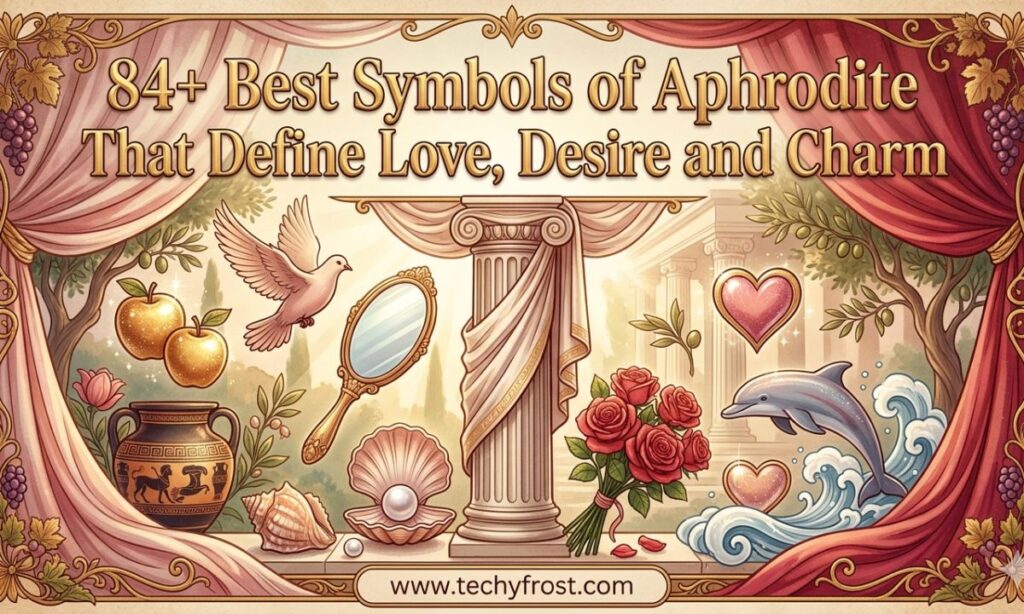
When you think of love, beauty, and desire — what images come to mind? Roses, doves, the ocean at dawn? Most of those images trace directly back to one goddess: Aphrodite. The ancient Greek goddess of love has shaped how humans express romance for thousands of years, and her symbols are still woven into modern weddings, tattoos, art, and pop culture.
This guide covers 84+ symbols of Aphrodite, exploring what each one means, where it came from, and why these symbols still hold deep emotional and spiritual power today. Whether you’re a mythology enthusiast, a spiritual seeker, or simply curious — this is the most complete resource on Aphrodite symbols you’ll find.
What Are Symbols of Aphrodite?
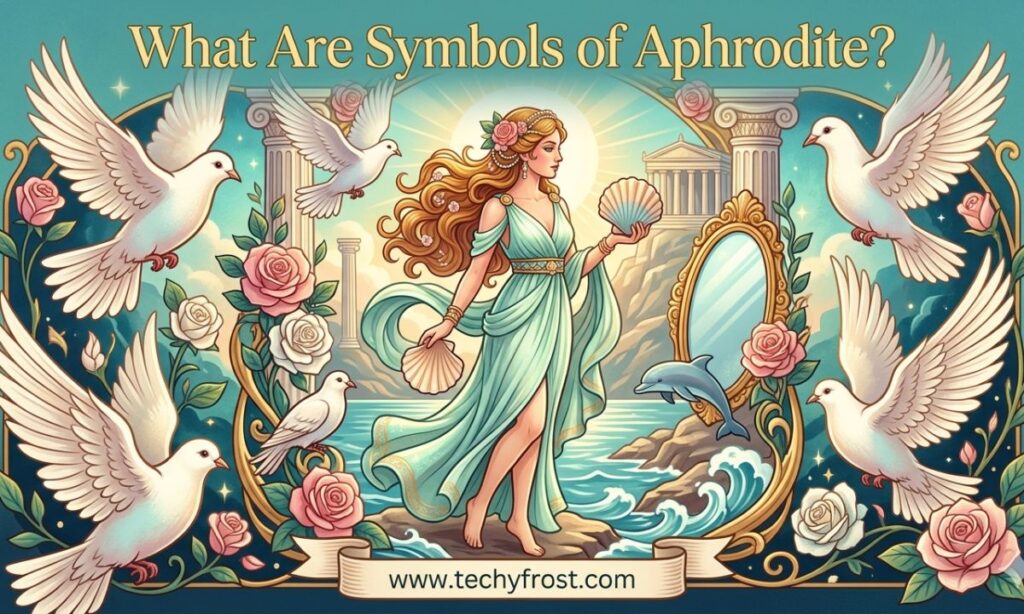
Symbols of Aphrodite are objects, animals, plants, colors, and divine attributes that ancient Greeks associated with the goddess of love and beauty. These symbols weren’t arbitrary — each one carried specific mythological meaning and was used in religious rituals, art, poetry, and everyday expressions of love.
From the white dove to the red rose, each symbol reflects a different dimension of Aphrodite’s divine personality: passion, grace, fertility, seduction, vanity, and compassion.
Aphrodite in Greek Mythology Overview
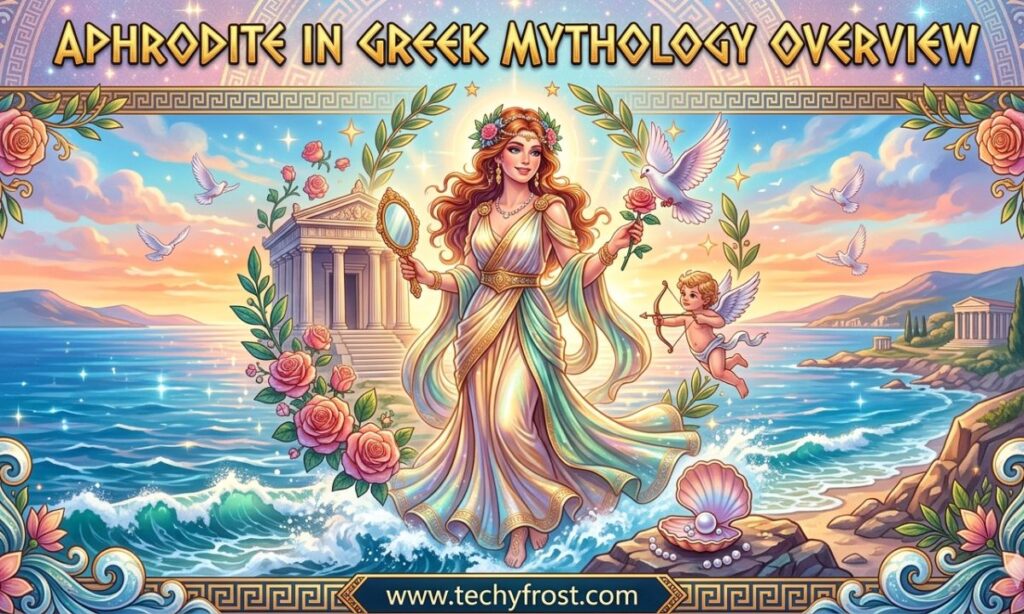
Aphrodite stands among the twelve Olympian gods as the embodiment of love, beauty, desire, and fertility. Her origin story alone sets her apart from every other deity. According to Hesiod’s Theogony, she was born from the sea foam (aphros in Greek) that formed when the Titan Cronus cast the severed remains of Uranus into the ocean. She emerged fully formed near the island of Cyprus, radiant and irresistible.
Homer offers an alternative birth story in the Iliad — that she was the daughter of Zeus and the Titaness Dione. Both versions agree on one thing: Aphrodite arrived in the world as the living definition of beauty.
She was married to Hephaestus, the god of the forge, though famously had a passionate affair with Ares, the god of war. Her children included Eros (god of desire), Harmonia, and Aeneas, who became an ancestor of Rome. Her influence triggered the Trojan War through the Judgment of Paris — a moment that would reshape the ancient world.
Ancient and Greek Symbols of Aphrodite
The ancient Greeks assigned Aphrodite a rich collection of symbols across animals, plants, objects, and celestial elements. Here is a master reference table of all major Aphrodite symbols:
| Category | Symbols |
|---|---|
| Birds | Dove, Swan, Sparrow, Goose |
| Flowers & Plants | Rose, Myrtle, Anemone, Apple, Pomegranate, Lettuce |
| Objects | Mirror, Seashell (Scallop), Girdle/Cestus, Golden Apple, Pearl |
| Colors | Red, Pink, Gold |
| Gems & Stones | Pearl, Coral, Rose Quartz |
| Sea Elements | Sea Foam, Scallop Shell, Dolphin |
| Trees | Myrtle Tree, Apple Tree, Myrrh Tree |
| Celestial | Venus (planet), Stars at dusk |
| Animals | Hare, Bee, Butterfly, Dolphin, Fish |
| Divine Objects | Cestus (magic girdle), Torch, Laurel Wreath |
Symbols of Aphrodite and Their Meanings
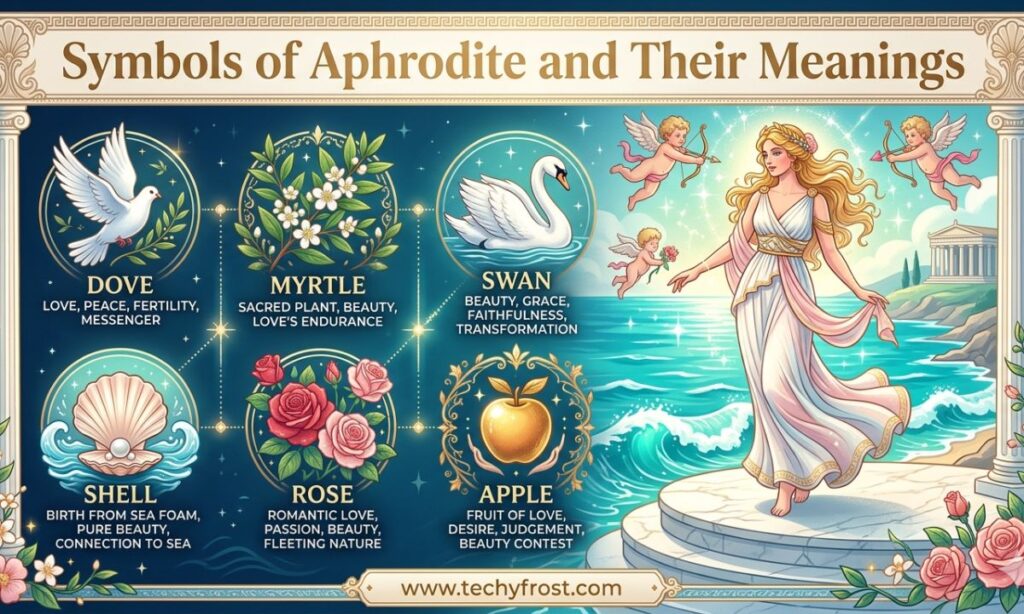
Each symbol of Aphrodite carries layered meaning that goes beyond surface appearance. Here is a breakdown of the most significant ones:
- Rose — Love, passion, and sacrifice. The red rose became sacred when Aphrodite cut her feet on its thorns while rushing to save her dying lover Adonis, staining the petals red forever.
- Dove — Peace, tenderness, and devoted love. Doves pulled her divine chariot across the heavens.
- Seashell — Birth, feminine beauty, and the divine emerging from nature. The scallop shell marks the exact moment Aphrodite touched the mortal world.
- Myrtle — Immortal love and sacred devotion. Myrtle was used in ancient Greek wedding ceremonies as an offering to Aphrodite.
- Swan — Grace, elegance, and transcendent beauty.
- Mirror — Self-awareness, vanity, and the truth of beauty. Aphrodite is often depicted gazing into a hand mirror.
- Golden Apple — Desire, temptation, and the price of beauty. The apple Paris awarded her ignited the Trojan War.
- Girdle (Cestus) — Irresistible attraction. Whoever wore it became magnetically desirable.
- Pearl — Purity and oceanic origin. Pearls were said to form where Aphrodite touched the sea.
- Anemone — The beauty that blooms after grief. This flower sprang from the blood of her beloved Adonis.
- Sparrow — Playful love and amorous energy. Sparrows were considered her earthly messengers.
- Pomegranate — Fertility, abundance, and the richness of love.
- Honey/Bee — Sweetness of affection and the sting of desire.
- Dolphin — Joyful, free love and connection to the sea of her birth.
Sacred Symbols Associated With Aphrodite
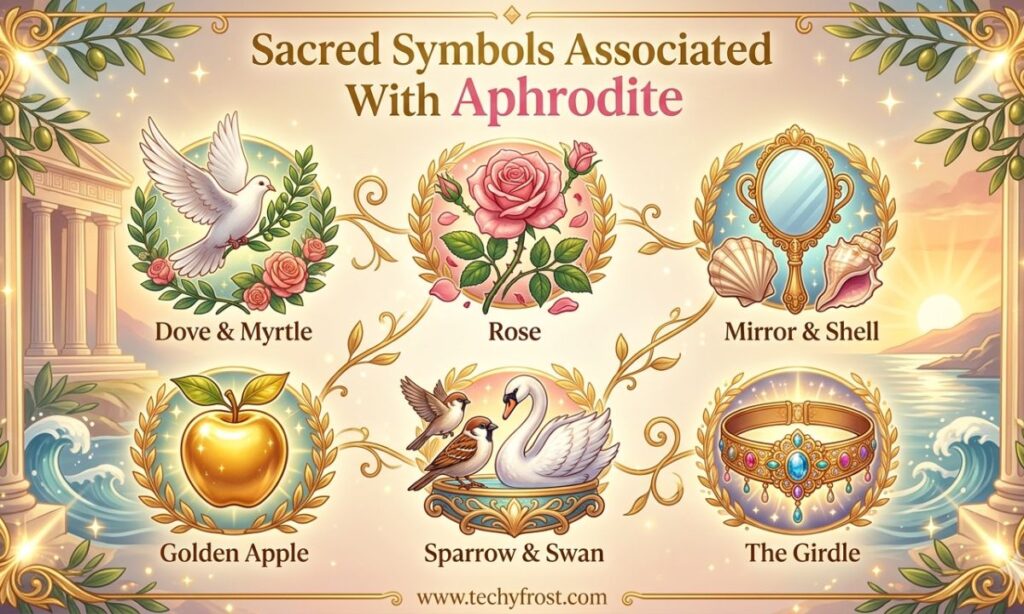
Beyond her everyday symbols, Aphrodite possessed sacred items and attributes that ancient worshippers held in the highest reverence:
- The Cestus (Magic Girdle) — A woven belt imbued with irresistible powers of love and desire. Even the goddess Hera borrowed it to win Zeus’s affection. It represents the ultimate power of seduction.
- The Scallop Shell — Not merely decorative; it was the literal vessel of her divine birth. Temples to Aphrodite often featured scallop shell motifs in their architecture.
- The Torch of Eros — Eros, her son, carried a torch symbolizing the flame of desire that Aphrodite ignited in the world.
- The Rose Wreath — A crown of roses placed on Aphrodite in ritual art and temple offerings.
- The Golden Apple of Discord — Inscribed “To the Fairest,” this apple began the chain of events leading to Troy’s fall.
Aphrodite Animal Symbols Explained
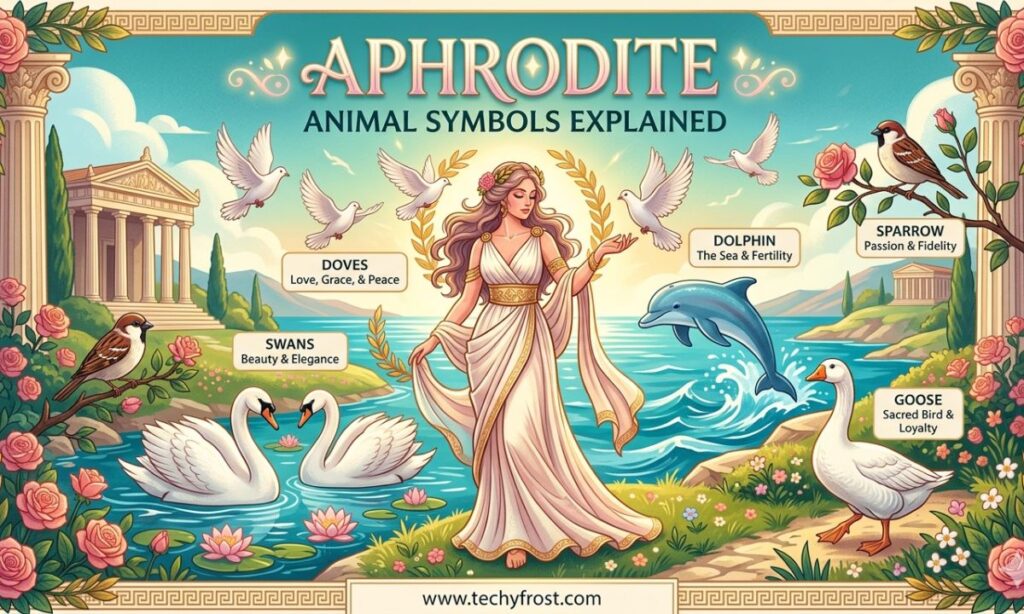
What Is Aphrodite’s Animal Symbol?
Aphrodite’s most iconic animal symbol is the white dove, representing peace, tenderness, and pure love. However, she is associated with a whole family of sacred creatures:
The Dove Doves were said to draw Aphrodite’s heavenly chariot and nest near her temples. In ancient Syria, the goddess Ashtarte (an Aphrodite equivalent) was believed to have been hatched from an egg nursed by doves — connecting these gentle birds to the very origin of divine love.
The Swan The swan embodies grace, fidelity, and beauty. In Greek art, Aphrodite occasionally appears riding on the back of a swan, floating effortlessly across divine waters.
The Sparrow The sparrow represented amorous energy and new love. Ancient poets described them pulling Aphrodite’s chariot alongside doves. Their social and affectionate nature in the wild made them perfect companions for the goddess of romance.
The Goose The white goose was another sacred bird, and ancient depictions show Aphrodite riding one side-saddle with effortless dignity.
The Hare Eros, Aphrodite’s son, was often depicted holding a hare — a symbol of unquenchable desire and fertility.
The Dolphin The dolphin connected Aphrodite to her oceanic origins. These intelligent, playful creatures represent joyful connection — qualities central to her domain.
The Bee The bee represented the sweet pleasure and industrious nature of love. Honey itself was considered sacred to Aphrodite.
The Butterfly As a symbol of transformation, the butterfly reflected how love changes us from the inside out.
Aphrodite Flower and Plant Symbols
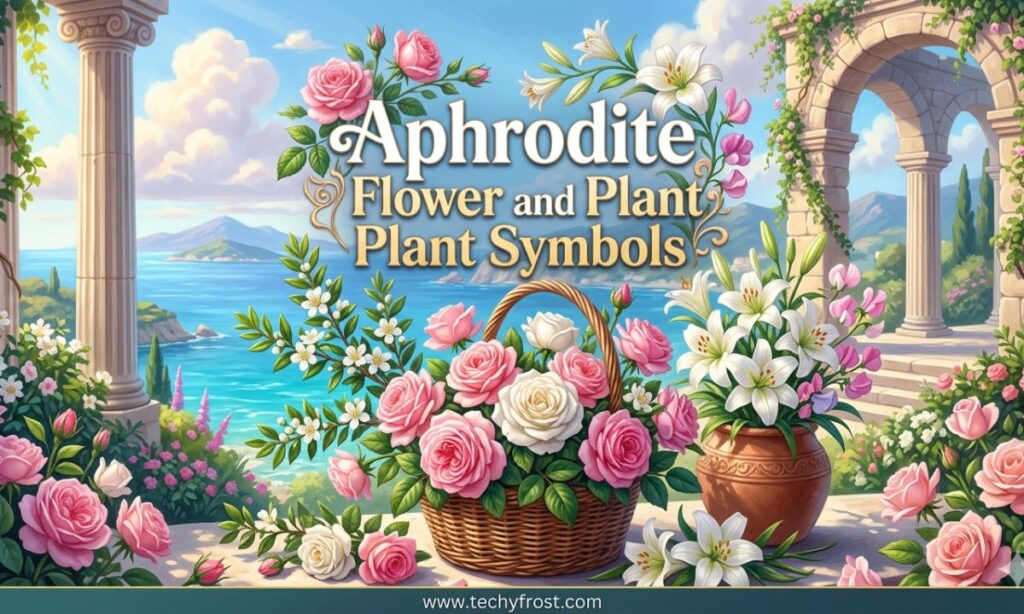
Plants held enormous significance in Aphrodite’s worship. Here are the most important botanical symbols associated with her:
The Rose
The red rose is her most recognizable plant symbol. The mythological origin: Aphrodite ran barefoot through a rose bush to reach her wounded lover Adonis, and her blood turned the white roses red. The rose thus embodies both beauty and sacrifice — love that bleeds but does not stop.
The Myrtle
Myrtle was used in ancient wedding ceremonies specifically as a tribute to Aphrodite. The plant symbolized undying love, and its evergreen leaves represented the permanence of devotion. Even today, myrtle sprigs appear in royal wedding bouquets, carrying this ancient symbolism forward.
The Anemone
The anemone flower bloomed from the blood of Adonis after Ares (jealous of Aphrodite’s love) sent a boar to kill him. The red anemone became a living memorial to lost love — beautiful, brief, and deeply emotional.
The Apple
The golden apple was both a symbol of desire and of vanity’s consequences. In the Garden of the Hesperides, golden apples represented eternal beauty and immortality.
The Pomegranate
Pomegranates, bursting with seeds, symbolized fertility and abundance — the fruits of love made real.
The Myrrh Tree
Myrrh trees were associated with Aphrodite through the story of Myrrha, who was transformed into this tree by the goddess. The fragrant resin was used in sacred offerings at her temples.
Lettuce
An unusual sacred plant, lettuce appears in Aphrodite’s mythology because she reportedly placed the body of Adonis on a bed of lettuce leaves. It later became associated with mourning and the tenderness of grief in love.
Aphrodite Powers and Divine Attributes
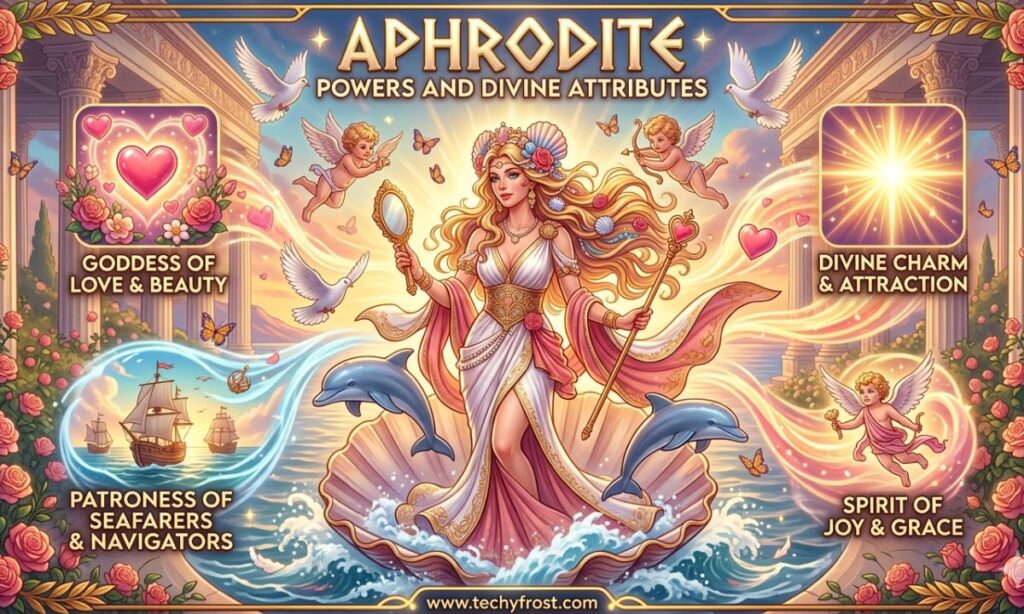
Aphrodite’s power was not limited to romantic feelings. Her divine portfolio included:
- The Gift of Seduction — She could make any god or mortal fall desperately in love with another
- Control Over Desire — She stirred eros (passionate desire) in hearts at will
- Fertility and Procreation — She blessed couples with children and ensured the continuation of life
- Beauty and Youth — She bestowed physical radiance upon those she favored
- Harmony in Relationships — She fostered affection, reconciliation, and emotional bonding
- Influence Over Nature — Flowers bloomed in her footsteps; the sea calmed at her presence
Aphrodite Goddess in Greek Mythology
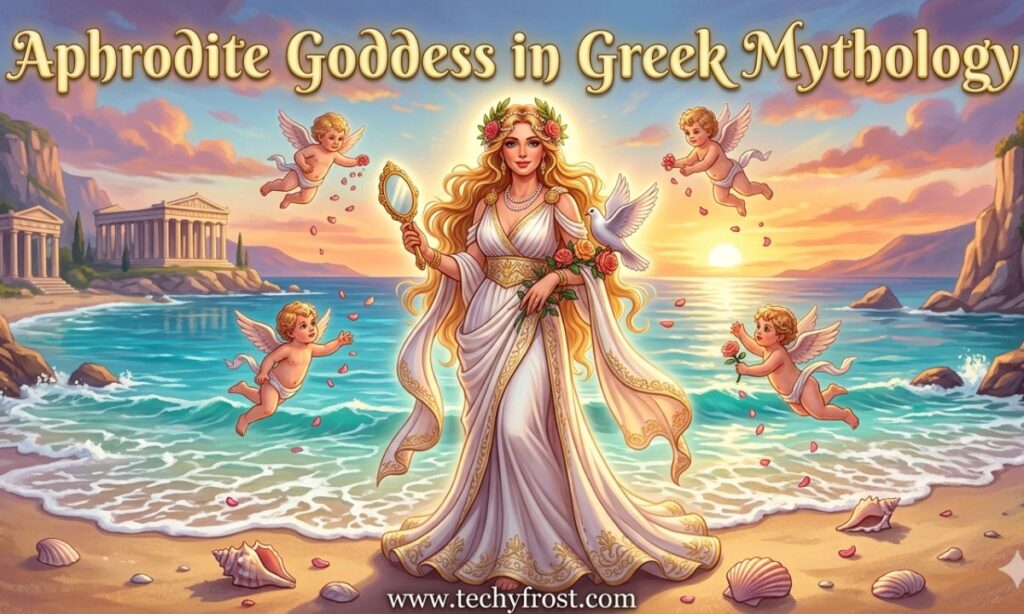
In the broader Greek mythological framework, Aphrodite was both beloved and feared. Gods pursued her despite (or because of) her being bound in marriage to Hephaestus. Ares, the war god, was her greatest passion. Their affair produced children including Eros, Harmonia, Phobos, and Deimos.
Her most famous mythological moments include:
- The Judgment of Paris — She bribed Paris with Helen of Troy, winning the golden apple and starting the Trojan War
- Pygmalion and Galatea — She brought a sculptor’s ivory statue to life as a reward for devoted love
- Cupid and Psyche — She tested the mortal Psyche through impossible tasks before allowing her union with Eros
- Adonis — She fell deeply in love with the mortal Adonis, whose death transformed both the rose and anemone
What Aphrodite Represents in Mythology
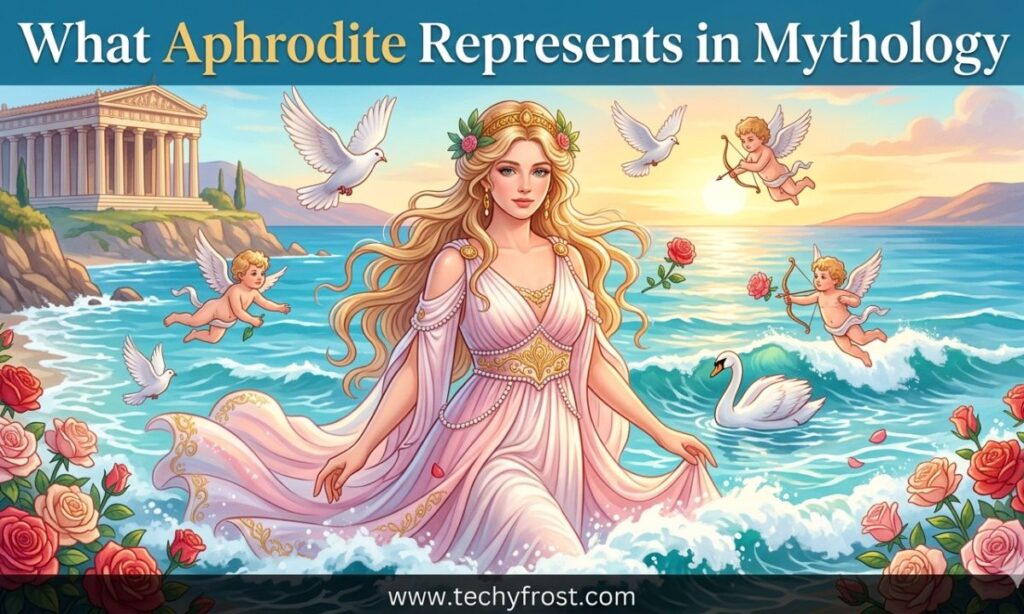
What Does Aphrodite Represent?
Aphrodite represents love in all its forms — romantic, passionate, physical, and emotional. She also represents beauty, feminine power, desire, and the creative force that drives human connection.
What Symbolizes Aphrodite?
The dove, rose, scallop shell, and myrtle are her four primary symbols recognized across ancient and modern cultures.
Things That Represent Aphrodite
Roses, seashells, mirrors, pearls, the color red, doves, swans, and the scent of myrrh all represent Aphrodite in ancient and modern contexts.
Symbols That Represent Aphrodite
Her symbols span the natural world: birds (dove, swan, sparrow), flowers (rose, anemone, myrtle), objects (mirror, shell, golden apple), and colors (red, pink, gold).
Aphrodite Symbol Meaning Explained
Each symbol reveals a different face of love — the dove shows its gentleness, the rose its passion and pain, the mirror its self-awareness, and the shell its mysterious, oceanic origin.
Aphrodite Sacred Symbols
Her most sacred symbols — the cestus, the scallop shell, and the rose — were used directly in temple worship and ritual offerings to invoke her blessings.
What Is Aphrodite’s Animal Symbol?
The white dove is her primary animal symbol, followed closely by the swan and the sparrow.
What Were Aphrodite’s Main Symbols?
Her main symbols are the rose, the dove, the seashell, the myrtle wreath, the mirror, and the golden apple.
Cultural Meaning of Aphrodite Symbols
Across cultures, these symbols evolved to represent universal emotional truths: love, beauty, longing, fertility, and the transformative power of desire.
Deep Symbolic Meaning
Spiritual Level
On a spiritual level, Aphrodite’s symbols represent the divine feminine principle — the force of creation and nurturing that underlies all of existence. The sea from which she emerged symbolizes the unconscious, the source of all emotion and desire. Her symbols invite practitioners to honor love not as weakness but as the most powerful force in the universe.
Psychological Level
Carl Jung and later psychologists saw Aphrodite as an archetype — the anima, or soul image. Her symbols trigger deep emotional responses because they connect to primal human needs: to love, to be loved, to be seen as beautiful, to belong. The mirror reflects not just vanity but the psychological need for self-recognition.
Cultural Level
Culturally, Aphrodite’s symbols have survived for 3,000+ years because they tap into universal human experiences. The rose appears at weddings and funerals. The dove appears on peace flags. The heart (derived from the shape of certain shells and leaves sacred to Aphrodite) is the universal icon of love worldwide.
Emotional Meaning of Aphrodite Symbols
Emotionally, these symbols carry warmth, longing, joy, and even heartbreak. The anemone, born from Adonis’s death, reminds us that love and loss are inseparable. The rose, stained red by Aphrodite’s sacrifice, tells us that love requires courage.
Types / Variations of Symbols of Aphrodite
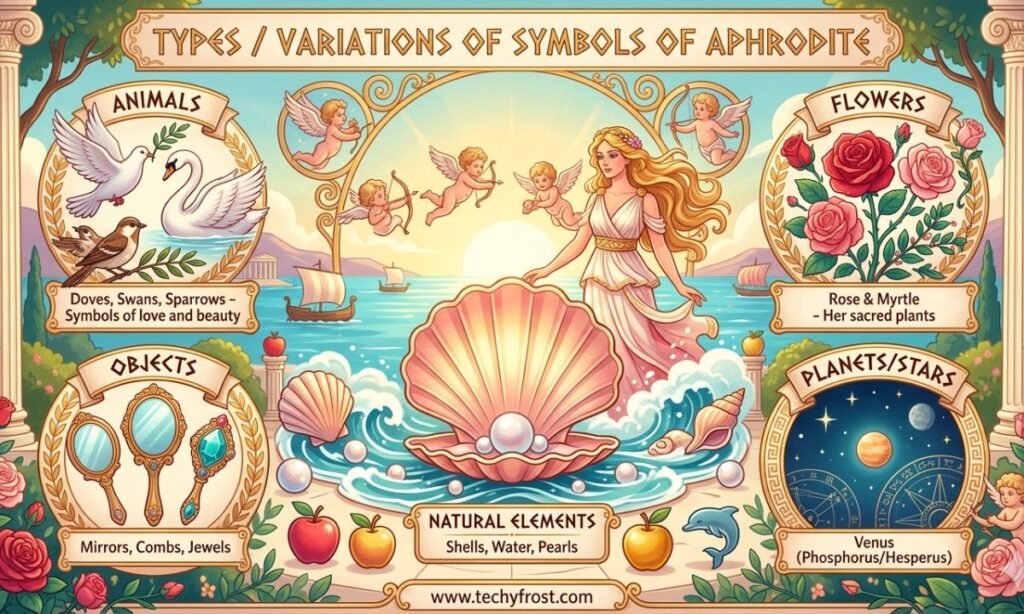
The Rose as a Symbol of Aphrodite
The red rose became Aphrodite’s emblem through sacrifice and grief. Before Adonis died, roses were white. After Aphrodite’s blood fell upon them, they turned red — and have symbolized passionate, devoted love ever since. Today, the red rose remains the single most powerful symbol of romantic love in human culture.
The Dove as a Symbol of Love
The dove’s connection to Aphrodite predates Greek mythology — similar associations appear in Mesopotamian goddess worship. In Greek culture, doves flew free in Aphrodite’s sacred gardens and were never harmed. Their cooing was considered her voice. Today, releasing white doves at weddings is a direct continuation of this ancient tradition.
The Seashell and Birth of Venus
The scallop shell is the vessel of Aphrodite’s divine birth. Sandro Botticelli immortalized this in his famous painting The Birth of Venus (1484–1486), where Venus (Aphrodite’s Roman equivalent) stands on a giant scallop shell rising from the sea. The image became one of the most recognized artworks in human history, cementing the shell’s symbolic power forever.
The Mirror and Beauty Symbolism
The mirror represents Aphrodite’s relationship with beauty — both its power and its danger. To gaze into a mirror is to practice the kind of self-awareness Aphrodite embodied. In ancient times, mirrors were polished bronze discs considered magical objects that could reveal truth.
The Swan in Mythology
The swan’s association with Aphrodite carries dual meaning: its white feathers represent purity, while its graceful, effortless movement through water mirrors Aphrodite’s own divine ease. Swans also mate for life in the wild, making them natural emblems of devoted love.
Myrtle Plant Sacred Meaning
Myrtle remains one of the most continuously used Aphrodite symbols — from ancient Greek wedding garlands to British royal wedding bouquets. Queen Victoria began the tradition of including myrtle in royal bouquets, a tradition that continues to this day. Its evergreen nature makes it a symbol of love that does not fade.
Symbols of Aphrodite Across Cultures
Ancient Greece
In ancient Greece, Aphrodite was worshipped at major sanctuaries in Corinth, Athens, and most importantly Paphos in Cyprus — believed to be her birthplace. Devotees offered roses, doves, and burning myrrh at her altars. The dove was so sacred that killing one near her temples was considered a serious offense.
Ancient Rome (Venus Connection)
The Romans adopted Aphrodite wholesale as Venus, their goddess of love and beauty. Venus held even greater political significance in Rome — Julius Caesar claimed Venus as the divine ancestor of his family line. Roman temples to Venus featured the same symbols: roses, doves, myrtle, and the scallop shell. The planet Venus, visible at dawn and dusk, was named in her honor.
Egyptian Influence
The Egyptians equated Aphrodite with Hathor, their goddess of love, beauty, and music, and sometimes with Isis. Shared symbols include the rose, the mirror, and the dove. Egyptian priests recognized the same divine feminine archetype in both goddesses, suggesting these symbols carry cross-cultural spiritual truth.
Medieval Europe Interpretations
During the medieval period, Aphrodite’s symbols were absorbed into Christian iconography — the rose became the Virgin Mary’s flower, the dove the Holy Spirit’s emblem. The underlying symbolism of love, purity, and divine grace transferred remarkably intact from pagan to Christian traditions.
Modern Culture and Pop Symbolism
Today, Aphrodite’s symbols appear everywhere: in Valentine’s Day imagery (roses, doves, hearts), perfume branding, luxury products, fashion, and social media. The ♀ female symbol is actually derived from the astrological symbol for Venus/Aphrodite. Botticelli’s Birth of Venus remains one of the most reproduced artworks in history.
Symbols of Aphrodite in Art, Movies & Pop Culture
Aphrodite’s symbols have inspired centuries of artistic masterpieces and continue to dominate modern media:
- Botticelli’s Birth of Venus (1484) — The defining visual of Aphrodite/Venus, featuring the scallop shell, rose petals, and the sea
- Ancient Greek vase paintings — Show Aphrodite accompanied by doves, swans, and Eros with his golden bow
- Clash of the Titans and Percy Jackson* — Modern films portray Aphrodite with golden light, roses, and doves as her signature attributes
- Rick Riordan’s Percy Jackson series — Aphrodite appears as a fashionably beautiful goddess surrounded by pink and gold light, roses, and hearts
- Perfume industry — Brands like Guerlain and Dior use dove, rose, and shell imagery directly tied to Aphrodite’s iconography
- Fashion — Alexander McQueen, Versace, and Valentino have all drawn on Aphrodite’s symbols in collection design
- Music — Countless songs reference Venus/Aphrodite’s rose, dove, and shell in lyrics about love
Aphrodite Symbols in Tattoos and Modern Designs
Aphrodite-inspired tattoos are among the most popular in mythology-based body art. Common designs include:
- Red rose with doves — The classic love combination, often paired with Aphrodite’s name in Greek lettering
- Scallop shell — Minimalist and elegant, popular as a feminine symbol of beauty and oceanic origin
- Venus symbol (♀) — A simple, powerful mark representing feminine love energy
- Dove in flight — Often paired with olive branches for peace and love
- Swan on water — Represents grace, beauty, and devoted partnership
- Anemone flower — A more obscure but deeply meaningful choice, symbolizing love that survives loss
- Mirror with roses — Combining Aphrodite’s beauty and self-awareness symbols
Modern jewelry designs also frequently incorporate these symbols — pearl necklaces, rose gold rings, shell pendants, and dove earrings all draw from Aphrodite’s sacred imagery.
Spiritual & Dream Meaning of Symbols of Aphrodite
In spiritual practice, Aphrodite’s symbols are used to attract love, strengthen relationships, and honor the divine feminine:
- Seeing a white dove in a dream or waking life is interpreted as a message of coming love or emotional peace
- Finding a perfect seashell is considered a sign of Aphrodite’s presence and a blessing for beauty and creativity
- A sudden abundance of roses in dreams may signal a new romantic connection or a deepening of existing love
- A mirror appearing in dreams prompts self-reflection — are you seeing yourself clearly? Are you accepting your own beauty?
- The swan in dreams represents a love relationship about to reach its highest, most graceful expression
In neo-Pagan and Wiccan practices, Aphrodite’s altar typically features rose petals, shells, a small mirror, pink or red candles, and pearl or coral stones. These objects are used in rituals for self-love, attracting a partner, or honoring feminine energy.
Positive vs Negative Meaning
Positive Aspects
Aphrodite’s symbols primarily carry uplifting energy:
- The rose represents love’s beauty and willingness to sacrifice
- The dove brings peace, harmony, and emotional healing
- The shell reminds us of our divine origin and natural beauty
- The myrtle promotes lasting devotion and fidelity
- The swan encourages graceful, committed love
- The pearl honors purity, wisdom earned through time
Negative Aspects
Aphrodite was not without shadow, and some symbols carry cautionary meaning:
- The golden apple represents vanity, competition, and the destructive consequences of unchecked desire — it started the Trojan War
- The mirror can symbolize excessive vanity or self-obsession when taken to extremes
- The cestus/girdle represents manipulative seduction — love used as a tool of power rather than genuine connection
- The anemone carries grief — the reminder that intense love often brings intense loss
Why Humans Are Attracted to These Symbols
The enduring appeal of Aphrodite’s symbols comes down to something deeply human: we are wired for love and beauty. These symbols speak to that wiring directly.
The rose triggers emotional responses tied to romance because it has done so for 3,000+ years. The dove is universally read as peaceful and loving because those associations are embedded in cultural memory across civilizations. The scallop shell evokes mystery, femininity, and the power of the sea — things humans find instinctively beautiful.
Psychologists suggest these symbols persist because they serve as emotional shortcuts — they communicate complex feelings (love, desire, grace, grief) in a single image. Aphrodite’s symbols are essentially humanity’s earliest visual language for the heart.
Frequently Asked Questions About Aphrodite Symbols
What is the most important symbol of Aphrodite?
The white dove is widely considered her most important symbol, representing love, peace, and the divine nature of emotional connection. The red rose is a close second.
What does the scallop shell represent in Aphrodite’s mythology?
The scallop shell represents Aphrodite’s miraculous birth from the sea — it is the vessel through which divine beauty entered the mortal world.
Why is the rose associated with Aphrodite?
According to myth, Aphrodite cut her feet on rose thorns while running to save the dying Adonis, and her blood stained the petals red — forever linking the red rose to passionate, sacrificial love.
What animals are sacred to Aphrodite?
Her sacred animals include the dove, swan, sparrow, goose, hare, dolphin, bee, and butterfly — all creatures associated with love, grace, and natural beauty.
What does the mirror symbolize for Aphrodite?
The mirror represents beauty, self-awareness, and vanity. It reflects both the power of Aphrodite’s beauty and the danger of excessive self-focus.
What is the Cestus (girdle) of Aphrodite?
The cestus is Aphrodite’s magical woven belt that made whoever wore it irresistibly attractive. It symbolizes the power of seduction and desire.
Is the anemone flower connected to Aphrodite?
Yes. The red anemone bloomed from the blood of Adonis, Aphrodite’s mortal lover, after his death. It symbolizes love that endures beyond loss.
What color is associated with Aphrodite?
Red and pink are Aphrodite’s sacred colors, representing passion, desire, and affectionate love respectively.
How is Venus different from Aphrodite symbolically?
Venus is the Roman name for Aphrodite, carrying nearly identical symbols. The key difference is that Venus also held political significance in Rome, where Julius Caesar claimed her as his divine ancestor.
What does myrtle represent in Aphrodite’s worship?
Myrtle symbolizes immortal love and faithful devotion. It was used in wedding ceremonies as an offering to Aphrodite and continues in royal wedding traditions today.
Final Thoughts on Aphrodite Symbols
Aphrodite’s symbols are not merely relics of an ancient religion. They are living expressions of humanity’s deepest emotional needs — to love and be loved, to experience beauty, to connect with something larger than ourselves.
From the red rose on Valentine’s Day to the dove released at a wedding, from the scallop shell hanging at a beach cottage to the pearl necklace passed between generations — we are still living inside Aphrodite’s symbolic world, whether we know it or not.
Understanding these symbols gives us a richer appreciation for love itself. They remind us that passion has always been sacred, beauty has always mattered, and the desire to connect is the most fundamentally human thing there is.
The next time you receive a rose, notice a white dove, or hold a smooth seashell in your hand — you are, for a moment, touching something ancient, powerful, and profoundly beautiful. That is the enduring gift of Aphrodite’s symbols.

