

Freedom is one of the most powerful words in every language. Throughout human history, people have used symbols to express what words sometimes cannot — the burning desire to live without chains, to breathe without fear, and to move through the world on their own terms.
From the soaring bald eagle to the quiet, fluttering butterfly, symbols of freedom cut across borders, centuries, and cultures. They unite people who have never met and inspire movements that change the world. Whether you are drawn to freedom symbols for a tattoo, a creative project, spiritual exploration, or pure curiosity, this guide covers everything you need to know.
Let’s explore 98+ of the most meaningful and timeless symbols of freedom — and what makes each one so enduring.
What Are Symbols of Freedom?
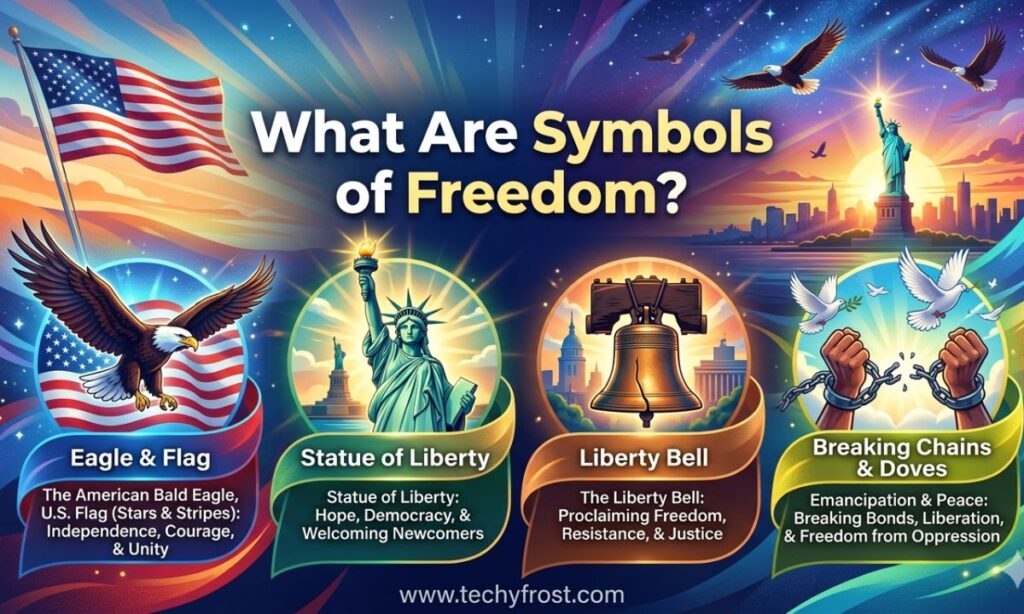
Symbols of freedom are visual, cultural, or conceptual representations that express liberation, independence, and the absence of oppression. They can be animals, objects, natural elements, mythological figures, colors, or gestures.
What makes something a true symbol of freedom is collective agreement — when people across generations share the understanding that a particular image points toward liberty, dignity, and self-determination.
Common examples include:
- Birds in flight (eagles, doves, cranes)
- Broken chains and shackles
- Open skies and vast horizons
- The Statue of Liberty and the Liberty Bell
- Fire, torches, and rising phoenixes
- Butterflies and their transformation journey
- Keys and unlocked doors
- Wild horses running free
These symbols appear in politics, religion, art, literature, tattoos, and everyday life — reminding us that the human desire for freedom is universal and timeless.
Understanding the Meaning of Freedom Symbols
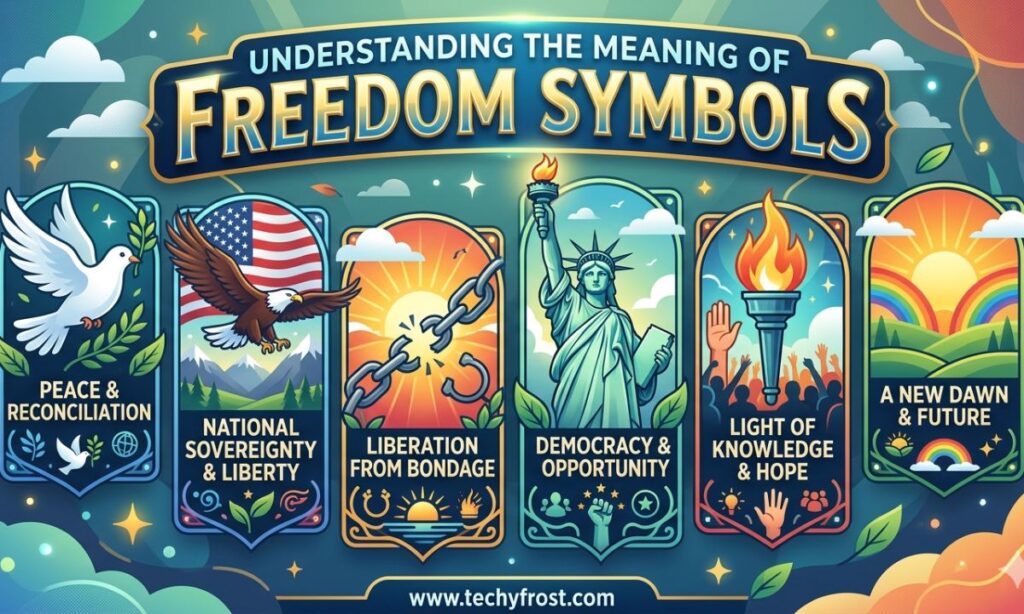
Symbolism of Freedom in Human History
Freedom symbols did not emerge in peaceful times. Most of them were born during periods of conflict, oppression, and revolution. When direct speech was dangerous, people turned to imagery. A simple gesture, a carved figure, or a raised flag became a rallying point for entire movements.
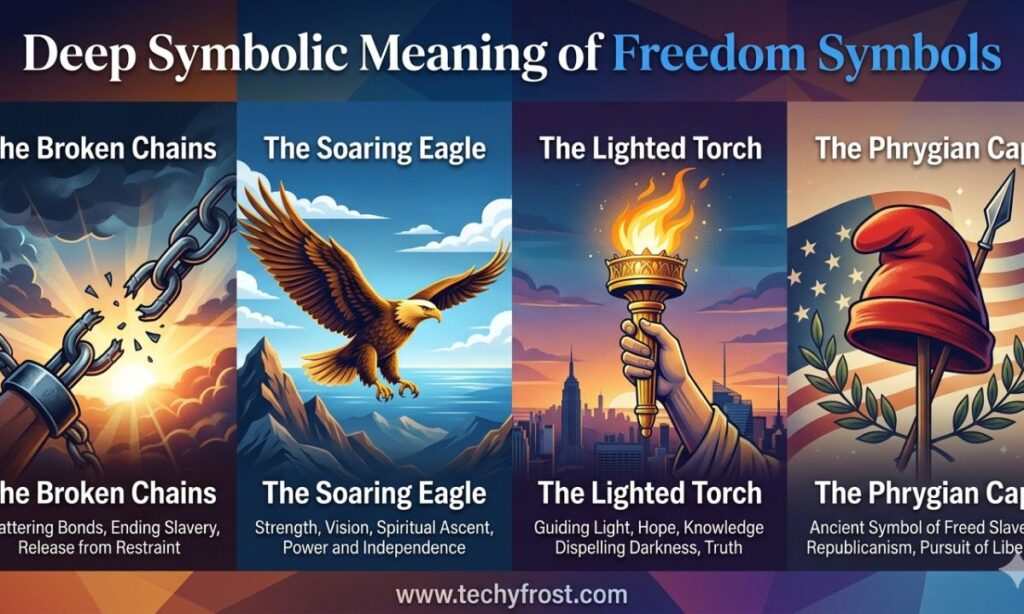
The broken chains of abolitionism, the Phrygian cap of the French Revolution, the olive branch of ancient Greece — each of these images carries layers of historical memory that give them power even today.
Why Freedom Symbols Matter Today
In the modern world, freedom symbols serve as anchors. They remind societies of hard-won rights, inspire individuals facing personal struggle, and connect current generations to the sacrifices of those who came before. From protest marches to motivational tattoos, these images continue to spark conversations and fuel courage.
Common Themes Behind Freedom Symbols
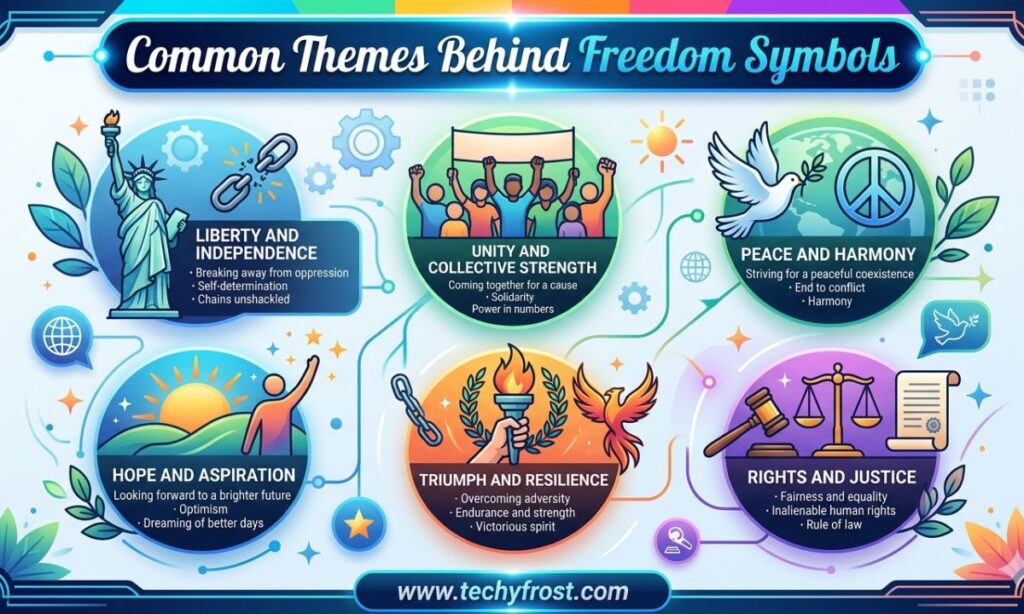
Most freedom symbols share a handful of recurring themes:
| Theme | Example Symbols |
|---|---|
| Movement and flight | Eagles, doves, butterflies, open roads |
| Breaking restraint | Chains, locked doors, cages |
| Light and knowledge | Torches, rising suns, fire |
| Wildness and nature | Horses, open skies, oceans |
| Transformation | Phoenix, butterfly, lotus |
| Protection and strength | Shields, wings, mountains |
Universal and Ancient Symbols of Freedom
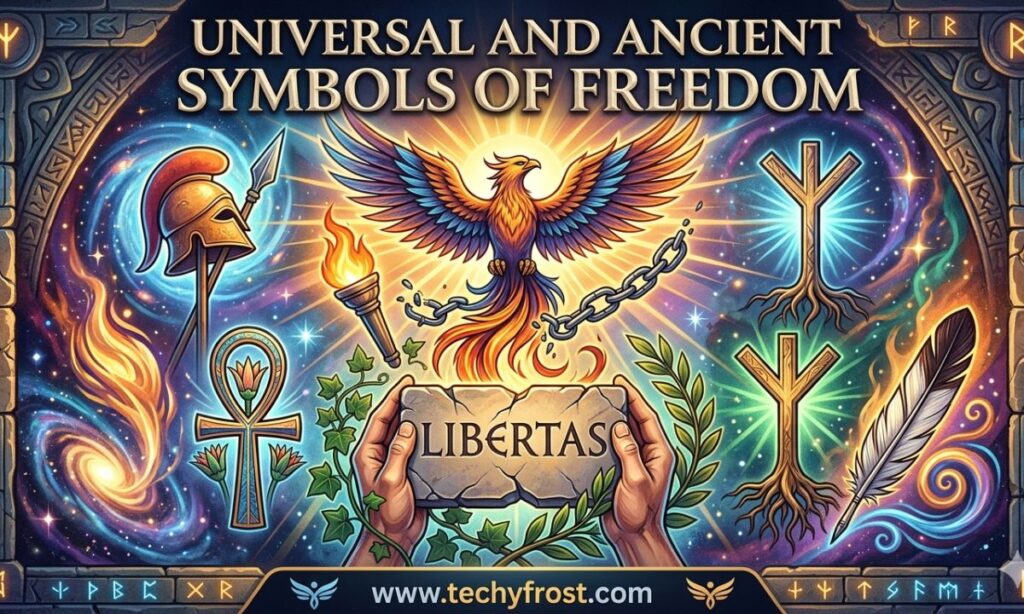
Universal Symbol of Freedom
The bird in flight is arguably the single most universal symbol of freedom across all cultures and time periods. Whether it is an eagle over the American plains, a crane in East Asia, or a dove released at a peace ceremony, the image of wings cutting through open sky speaks to something deeply human.
Other near-universal freedom symbols include:
- Open sky — boundlessness and infinite possibility
- The horizon — the place where limits disappear
- Fire — purification, courage, and uncontrollable energy
- Water flowing freely — life moving without obstruction
Ancient Symbols of Freedom
Ancient civilizations encoded freedom into their symbols long before modern nations existed:
- Winged sandals (Hermes/Mercury) — speed, movement, and freedom from earthly limits
- The Ankh (Egypt) — life, regeneration, and spiritual freedom
- The Vindicta rod (Rome) — used in ceremonies to free enslaved people; a literal tool of liberation
- The Olive Branch (Greece) — peace and the end of conflict
- The Fawohodie (West Africa/Akan culture) — an Adinkra symbol meaning independence, carrying the wisdom that freedom comes with responsibility
Symbols of Freedom in Mythology
Mythology is filled with powerful freedom imagery:
- Pegasus — the winged horse of Greek mythology represents limitless imagination and the freedom to transcend earthly boundaries
- Icarus — a cautionary tale of freedom pursued too recklessly, yet also a symbol of the unbreakable human urge to fly
- Libertas — Roman goddess of freedom, often depicted with the Phrygian cap and a staff
- Garuda — the great eagle-bird of Hindu mythology, a symbol of divine freedom and spiritual liberation
- The Phoenix — mythological bird reborn from its own ashes; freedom through total transformation
Symbols of Freedom Tattoos
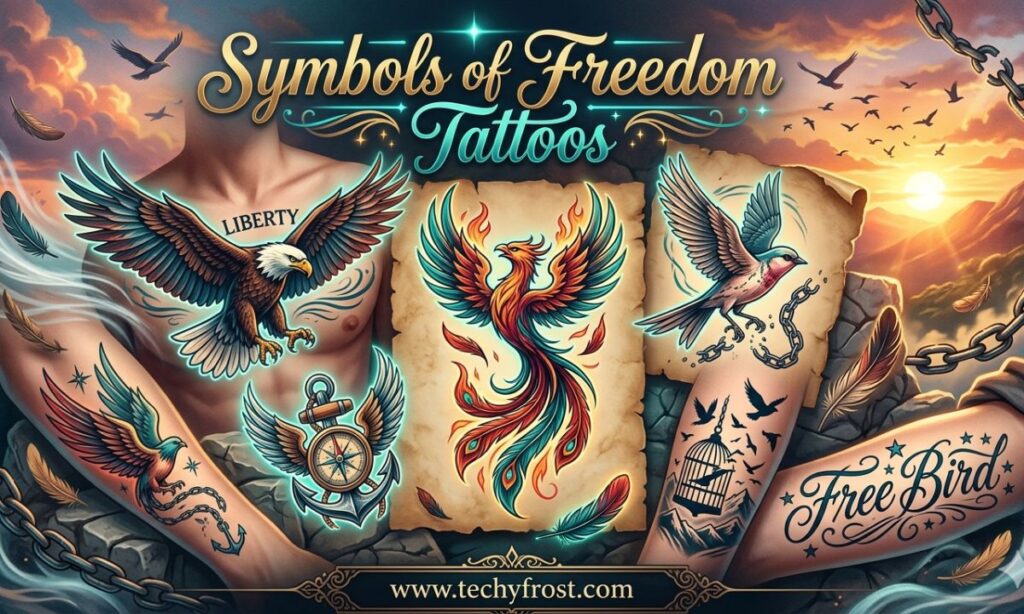
Freedom tattoos are among the most personally meaningful tattoo choices. A tattoo is a permanent declaration — a way of saying this value lives with me forever. Common freedom tattoo themes include:
- Eagle in flight with wings spread wide
- Broken chains falling from wrists
- A lone feather floating upward
- A butterfly mid-transformation
- A bird escaping an open cage
- The word freedom in a native script
Tattoos That Symbolize Freedom
The best freedom tattoos are those tied to a personal story. Someone who overcame addiction might choose a phoenix. A person who left a controlling relationship might choose broken chains. A traveler might choose an open road or compass. Each image becomes more powerful when it reflects lived experience.
Freedom Symbol Tattoo Ideas
Here are 12 powerful freedom tattoo concepts to consider:
- Soaring eagle with mountains below — American freedom and resilience
- Watercolor butterfly — transformation and inner liberation
- Broken shackles with a date — marking a specific moment of freedom
- Rising phoenix in flames — rebirth after loss
- Lotus flower — spiritual freedom rising from difficulty
- Open birdcage with a bird flying out — breaking free from confinement
- Feather turning into birds — a flock emerging from a single source of freedom
- Celtic knotwork wings — eternal freedom in Celtic tradition
- Compass and open road — freedom as a journey
- Waves and open ocean — limitless possibility
- Phrygian cap silhouette — revolutionary freedom
- Crescent moon and stars — freedom of spirit and faith
Spiritual and Creative Symbols of Freedom
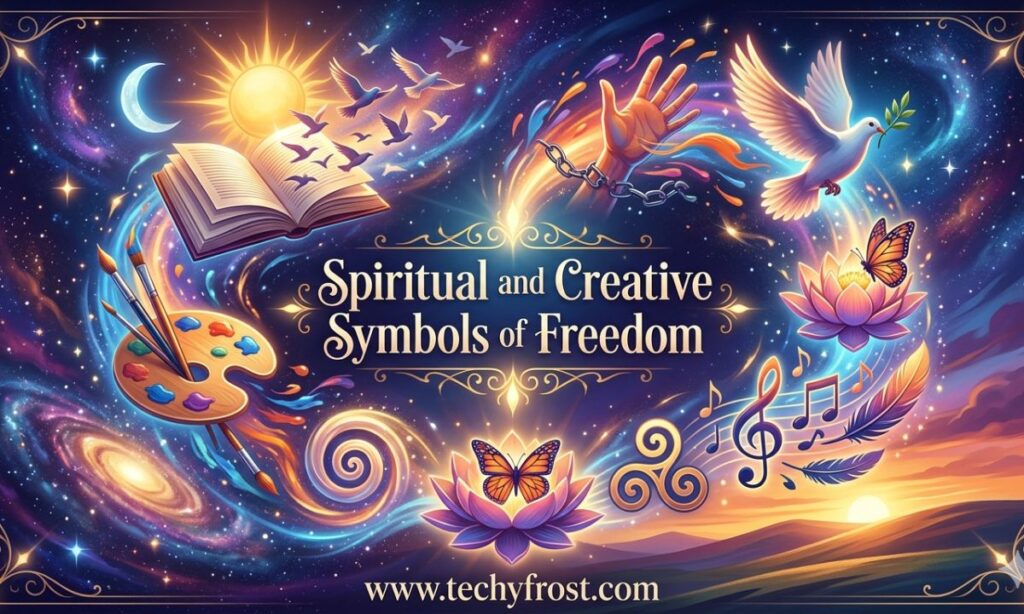
Spiritual Symbols of Freedom
Spiritual freedom means something different from political or personal freedom. It points to liberation from ego, fear, attachment, and the cycles of suffering. Key spiritual freedom symbols include:
- The Lotus Flower — grows from muddy water into beauty; a perfect image of the soul rising above suffering in Hindu and Buddhist traditions
- White dove — purity, peace, and divine presence across Christianity, Islam, and many indigenous traditions
- The open hand — surrender, acceptance, and freedom from grasping
- The flame — the eternal inner light that cannot be extinguished
- Mandala — the freedom of perfect wholeness and inner order
Symbols of Freedom in Art
Artists have long used freedom symbolism to communicate emotions that words cannot fully hold. Famous artistic freedom motifs include:
- Open doors and windows flooding rooms with light
- Flying birds against storm-dark skies
- Sunbeams breaking through clouds
- Figures with arms outstretched on mountaintops
- Chains lying discarded on the ground
Symbol of Freedom Drawing Ideas
If you want to create your own freedom artwork, consider these concepts:
- A single bird flying toward a sunrise
- A hand releasing a butterfly
- An empty birdcage with the door swinging open
- A figure standing at the edge of a cliff, facing the horizon
- A seed splitting open, roots reaching down and branches reaching up
Non-American Symbols of Freedom
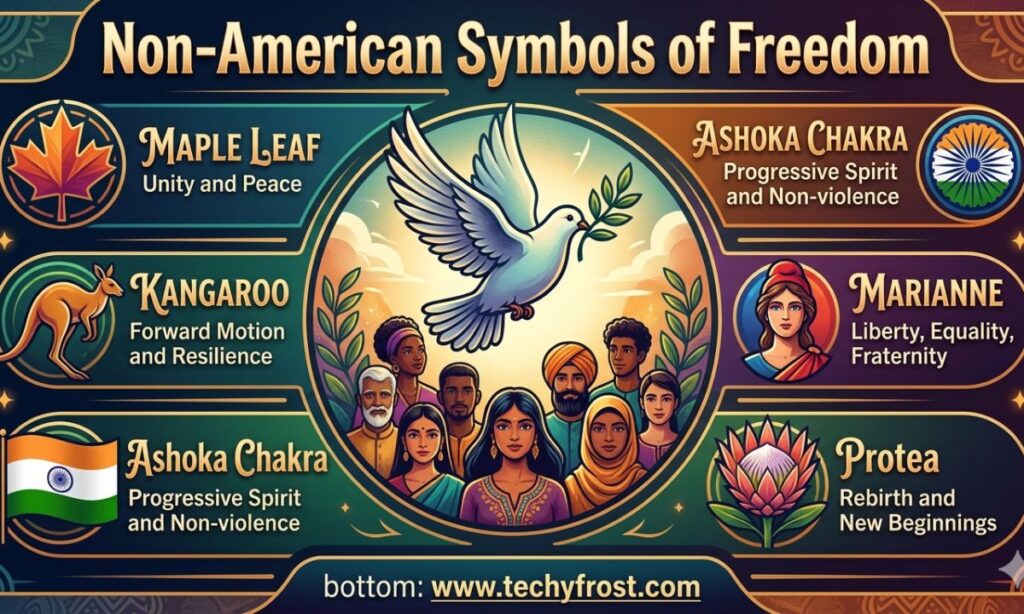
Freedom is not an American invention. Powerful freedom symbols from around the world include:
| Symbol | Culture/Region | Meaning |
|---|---|---|
| Lotus Flower | India/Southeast Asia | Spiritual liberation |
| Cherry Blossom | Japan | Fleeting, precious freedom |
| Crane | Japan/Korea | Peace and long life |
| Celtic Butterfly | Celtic/Irish | Transformation and rebirth |
| Fawohodie | West Africa (Akan) | Independence and responsibility |
| Phrygian Cap | France/Rome | Liberation from tyranny |
| Pine Tree | North America (Indigenous) | Strength and freedom |
| White Crane | China | Spiritual ascension |
Creative Representations of Freedom
Beyond traditional symbols, modern creators have invented new freedom imagery:
- An open book — freedom of thought and learning
- An empty road stretching to the horizon — personal journey without limits
- Wildflowers growing through cracked concrete — freedom persisting against control
- A window thrown open to the sky — choosing to embrace possibility
Deep Symbolic Meaning of Freedom Symbols
Spiritual Level
On a spiritual level, freedom symbols represent the soul’s liberation from fear, attachment, and ego. A bird in flight is not simply escaping the ground — it represents the spirit rising above earthly burdens. Many traditions teach that true freedom is internal: it is the moment of awakening when you realize nothing truly owns you.
Psychological Level
Psychologically, freedom symbols connect to humanity’s deepest core drives. Research in positive psychology consistently shows that autonomy — the sense of acting from one’s own will — is one of the fundamental human needs. Freedom symbols activate this need. They trigger feelings of empowerment, possibility, and self-identity. Even briefly viewing a freedom symbol can increase a person’s sense of agency and motivation.
Cultural Level
Culturally, freedom symbols serve as collective memory. They carry the stories of revolutions, abolitionist movements, civil rights marches, and independence struggles. They unite communities around shared values and remind entire nations of what previous generations sacrificed so that the present generation could live with dignity.
Types and Variations of Symbols of Freedom
The Bird (Eagle, Dove, and Other Birds)
The bird is the oldest and most widespread freedom symbol in human history. Different birds carry different nuances:
- Bald Eagle — power, resilience, and national independence (USA)
- Dove — peace, gentleness, and spiritual freedom
- Crane — long life, wisdom, and peaceful freedom
- Phoenix — rebirth through destruction
- Hummingbird — joy and freedom in small, swift moments
Broken Chains
Broken chains are among the most emotionally direct freedom symbols that exist. They require no translation. Chains represent bondage — slavery, imprisonment, oppression, abuse. When they break, liberation is immediate and visceral. Broken chains appear at the feet of the Statue of Liberty, in abolitionist imagery, and in countless tattoos marking personal turning points.
The Open Road
The open road is a distinctly modern freedom symbol, born from the automobile age but rooted in ancient ideas about journeys and horizons. It represents choice, adventure, self-determination, and the refusal to be bound by one place or one identity.
The Butterfly
The butterfly’s transformation from caterpillar to winged creature makes it one of the most beloved personal freedom symbols. It represents metamorphosis — the idea that suffering and confinement can give way to beauty and flight. In Celtic tradition, the butterfly was associated with the soul. In modern use, it often symbolizes recovery, personal growth, and inner liberation.
The Flag
Flags serve as symbols of national freedom and collective identity. From the American Stars and Stripes to the South African rainbow flag, each national banner carries the weight of struggle, sacrifice, and hard-won independence. Flags are raised at moments of victory and lowered in moments of mourning — they mark the boundaries of liberty as nations understand it.
The Key
The key is a simple yet profound freedom symbol. It represents access, opportunity, and the power to unlock what has been closed. A key can mean escaping imprisonment, accessing education, entering a new chapter of life, or finding inner peace. Keys appear in religion, fairy tales, art, and heraldry as universal symbols of potential freedom.
The Sky
The sky is possibly the oldest freedom symbol of all — boundless, unreachable from the ground, and shared by every living creature. An open sky represents limitless possibility, the absence of walls and ceilings, and the invitation to aspire. The color blue, closely associated with the sky, frequently symbolizes freedom, openness, and calm independence.
The Phoenix
The phoenix combines destruction and liberation in a single, breathtaking image. It burns completely and rises renewed — making it the perfect symbol for anyone who has faced ruin and rebuilt themselves. The phoenix appears across Greek, Egyptian, Chinese, and Arabian mythology, making it one of the most cross-cultural freedom symbols in the world.
Wings
Wings without a full bird represent freedom in its purest, most personal form. They suggest the possibility of flight — the capacity to rise, to move, to escape. Angel wings in Christian iconography represent spiritual freedom. Warrior wings in Greek myth represent divine protection and movement. In modern tattoo culture, wings are among the most popular freedom designs.
The Statue of Liberty
Standing in New York Harbor since 1886, the Statue of Liberty is arguably the most recognized freedom symbol in the modern world. Designed by French sculptor Frédéric Auguste Bartholdi, she was a gift from France representing the shared ideal of liberty. Emma Lazarus’s poem inscribed on her pedestal — welcoming “the tired, the poor, the huddled masses” — transformed her into a global symbol of refuge and hope. The broken chains at her feet represent liberation from slavery and tyranny.
The Torch
The torch represents enlightenment — the idea that freedom and knowledge travel together. Where a torch is raised, darkness retreats. The torch of the Statue of Liberty, the Olympic flame, and the torchlight of ancient temples all carry this shared meaning: freedom is illuminated, not hidden; it is carried forward, not left behind.
The Horse
The wild horse, running free across an open plain, is one of nature’s most powerful freedom images. Horses played a vital role in exploration and expansion throughout history. In many Indigenous American traditions, the arrival of horses transformed entire ways of life. Today, the image of an untamed horse represents raw, uncontrollable freedom — the spirit that refuses to be broken.
Symbols of Freedom Across Cultures
Ancient Greece
Ancient Greeks tied freedom closely to democracy and civic participation. Their freedom symbols included the olive branch (peace and reconciliation), the owl of Athena (wisdom that enables free thinking), and the laurel wreath (victory and the honor of those who fight for liberty).
Ancient Egypt
Egyptian freedom symbols centered on spiritual liberation and the afterlife. The Ankh represented eternal life and the freedom of the soul. The scarab beetle symbolized transformation and regeneration. Wings — especially those of the falcon god Horus — represented divine protection and the freedom of the sky.
Native American Cultures
Indigenous North American traditions produced rich freedom symbolism. The feather was one of the most sacred — awarded to warriors for bravery and representing the link between the individual, the Creator, and the bird from which it came. The eagle was revered as a messenger to the Creator. The pine tree became a symbol of strength and resistance during early colonial conflicts.
Celtic Traditions
Celtic freedom symbols often focused on transformation and the eternal cycle of life. The butterfly represented the soul’s freedom and rebirth. Celtic knotwork — with its unbroken, interweaving lines — symbolized the freedom of eternity, where nothing has a beginning or end. The stag represented wildness and untameable spirit.
Medieval Europe
Medieval European freedom symbols were often religious or heraldic. The white dove carried divine freedom. The open hand represented protection and peaceful intent. The tower — when broken open — symbolized escape from unjust imprisonment, a powerful image during an era of feudal control.
Eastern Philosophies
Eastern traditions approach freedom more philosophically. In Buddhism, the lotus flower growing from muddy water represents the mind’s liberation from ignorance and desire. In Taoism, the free-flowing river symbolizes freedom achieved through non-resistance. In Hinduism, the great bird Garuda represents divine freedom and the soul’s power to transcend limitation.
Modern Western Culture
Modern Western freedom symbols blend political history with personal aspiration. The raised fist became a symbol of civil rights and resistance in the 20th century. The rainbow flag became a symbol of LGBTQ+ freedom and identity. The peace sign emerged in the 1950s as a symbol of freedom from the threat of nuclear destruction.
Symbols of Freedom in Religion and Spirituality
Christian Symbolism
Christianity connects freedom closely to spiritual salvation. The white dove — descending at Jesus’s baptism — represents the Holy Spirit and divine freedom. The empty cross (without Christ’s body) symbolizes the freedom won through resurrection. The open tomb is one of Christianity’s most powerful freedom images: the ultimate liberation from death itself.
Hindu Symbolism
In Hinduism, freedom (or moksha) is the ultimate spiritual goal — liberation from the cycle of birth and death. The lotus flower growing untouched above muddy water represents this liberation. Garuda, the divine eagle ridden by Lord Vishnu, represents the freedom of the liberated soul. The peacock, associated with the goddess Saraswati, represents freedom of knowledge and self-expression.
Buddhist Symbolism
Buddhism teaches that freedom comes from releasing attachment. The unfolding lotus represents awakening — the moment the mind becomes free of suffering. The dharma wheel represents the freedom that comes from following the righteous path. Flying birds in Buddhist art often represent the mind that has let go of its burdens.
Indigenous Spiritual Traditions
Across many Indigenous traditions, freedom is expressed through relationship with nature. The eagle feather is sacred — a symbol of honor, spiritual connection, and the freedom that comes from living in right relationship with the Creator and the land. The tree of life appears across many Indigenous traditions as a symbol of interconnected freedom: every living thing free within its rightful place.
Symbols of Freedom in Art, Literature, Movies, and Pop Culture
Freedom Symbols in Famous Paintings
Some of the most celebrated artworks in history center on freedom symbolism:
- “Liberty Leading the People” by Eugène Delacroix (1830) — a bare-breasted Liberty leads revolutionaries through battle, the French tricolor raised high
- “The Slave Ship” by J.M.W. Turner (1840) — a stormy sea swallowing human bondage; a visceral meditation on freedom denied
- “American Gothic” by Grant Wood (1930) — a quieter commentary on individual freedom, hard work, and autonomy
Freedom in Literature and Poetry
Freedom is one of literature’s oldest and most persistent themes:
- Frederick Douglass’s “Narrative” — one of history’s most powerful personal accounts of the journey from slavery to freedom
- Walt Whitman’s “Song of Myself” — a celebration of individual freedom and the open road
- Maya Angelou’s “I Know Why the Caged Bird Sings” — the caged bird and the free bird as a perfect metaphor for constrained versus liberated lives
- George Orwell’s “1984” — freedom defined by its terrifying absence
Freedom Symbols in Movies
Cinema has given us some of the most emotionally resonant freedom symbols in modern culture:
- The Shawshank Redemption — Andy Dufresne’s escape through a tunnel into rain is one of film’s greatest freedom images
- Braveheart — the Scottish thistle and William Wallace’s battlefield cry of “Freedom!”
- 12 Years a Slave — broken chains as liberation and the enormous cost of freedom
- Cast Away — the raft on an open ocean representing the human will to escape and return to life
Modern Pop Culture References
Freedom symbols saturate modern pop culture:
- Music — Beyoncé’s Lemonade, Bob Dylan’s “Blowin’ in the Wind,” and countless protest songs use bird and wind imagery to express freedom
- Fashion — feather motifs, wing prints, and open-road imagery in streetwear culture
- Social media — butterfly emojis, eagle photographs, and “free” as a concept dominate personal expression online
Spiritual and Dream Meaning of Symbols of Freedom
Dreams About Flying
Flying in a dream is one of the most common dream experiences, and it almost universally points to a desire for freedom, a sense of rising above problems, or the experience of expanded possibility. Dream analysts across traditions agree: flying dreams are the mind’s most direct expression of longing for liberation.
Dreams About Birds
Dreaming of birds — especially birds in flight or birds escaping cages — typically signals a desire for change, a subconscious recognition of one’s own potential, or a message from the deeper self about freedom waiting to be claimed.
Dreams About Breaking Chains
Dreams in which you break chains or watch chains fall away are powerful transformation dreams. They often appear at turning points — when a person is psychologically ready to leave behind a relationship, habit, belief, or situation that has been holding them back.
Personal Transformation and Freedom
Many freedom symbols appear most powerfully in personal moments of transformation. The butterfly in a chrysalis does not know it will fly. The phoenix does not choose to burn. But both emerge as something new. Freedom symbols remind us that transformation, though difficult, leads somewhere worth going.
Positive vs Negative Meaning of Freedom Symbols
Positive Meaning
The vast majority of freedom symbolism is aspirational and positive:
- Hope that oppression will end
- Courage to take a new direction in life
- Celebration of independence won through struggle
- Personal empowerment and self-determination
- Spiritual awakening and inner peace
Negative Meaning
Freedom symbols can carry darker meanings in certain contexts:
- Absolute freedom without responsibility can be used to justify harm to others
- Some groups have co-opted freedom symbols to justify dangerous ideologies
- The pursuit of personal freedom at all costs can lead to isolation and disconnection
- Freedom symbolism can be weaponized as propaganda — promising liberty while delivering control
This duality does not diminish the symbols. It simply reminds us that freedom, like all powerful ideas, requires wisdom and balance to be truly meaningful.
Why Humans Are Attracted to Symbols of Freedom
The Desire for Independence
From childhood, humans instinctively seek autonomy. Infants reach for objects on their own. Children push against rules. Teenagers demand their own choices. This is not rebellion for its own sake — it is the natural development of a self-determining being. Freedom symbols tap into this deeply wired desire and validate it.
Freedom as Self-Expression
Freedom is not only about escaping constraint. It is also about expressing who you truly are. When people choose a freedom symbol for a tattoo, a piece of jewelry, or a piece of art on their wall, they are making a statement: this is what I value; this is who I am. Freedom as self-expression is one of the most intimate uses of these symbols.
Psychological Connection to Freedom Symbols
Psychologists have found that even brief exposure to symbols of freedom and autonomy can increase people’s intrinsic motivation, creativity, and sense of wellbeing. Freedom symbols work because they activate the part of the brain that processes possibility, hope, and self-efficacy — the belief that your actions can make a difference.
Frequently Asked Questions About Symbols of Freedom
What is the most powerful symbol of freedom?
The bird in flight — especially the eagle — is widely considered the most powerful symbol of freedom because it represents limitless movement, independence, and the ability to rise above earthly constraints.
What do broken chains symbolize?
Broken chains represent liberation from bondage, oppression, or any form of control. They are one of the most direct and emotionally immediate symbols of freedom from slavery, abuse, or unjust restriction.
What does the Statue of Liberty symbolize?
The Statue of Liberty represents democracy, hope, and welcome for those seeking a better life. The broken chains at her feet symbolize the abolition of slavery and liberation from tyranny.
What animal symbolizes freedom?
The eagle is the most universally recognized animal symbol of freedom, though horses, doves, butterflies, and cranes also carry powerful freedom symbolism across different cultures.
What does a butterfly symbolize in terms of freedom?
The butterfly represents personal transformation and inner liberation — the idea that going through a difficult, confining period (like a chrysalis) can lead to a beautiful and free new version of yourself.
What color represents freedom?
Blue is most commonly associated with freedom, representing open skies and limitless possibility. White also represents freedom, peace, and liberation across many cultures.
What is the universal symbol of freedom?
While no single image is universally agreed upon, the bird in flight comes closest to a universal freedom symbol — recognized across cultures, religions, and centuries as the ultimate image of liberation.
What does the phoenix symbolize in terms of freedom?
The phoenix represents freedom through total transformation. It is destroyed and reborn — a symbol for anyone who has experienced loss, failure, or oppression and risen to a completely new life.
Are freedom symbols used in tattoos meaningful?
Yes. Freedom tattoos are among the most personally meaningful tattoo choices because they often mark specific turning points — personal liberation from addiction, an abusive relationship, grief, or limiting beliefs.
What is the Fawohodie symbol?
Fawohodie is an Adinkra symbol from West Africa’s Akan culture, meaning independence and freedom. It carries the wisdom that freedom comes with responsibility — you must be willing to bear the weight of your own liberation.
Final Thoughts on Symbols of Freedom and Independence
Freedom is not a single thing. It is a thousand things — the open sky above a prairie, the quiet click of a key in a lock, the butterfly lifting off a leaf, the phoenix climbing out of its own destruction.
The symbols covered in this guide span thousands of years and every corner of the world. Yet they all point to the same truth: the human desire to be free is inextinguishable. It has survived empires, survived slavery, survived every attempt to silence it. And it always will.
Whether you connect with the soaring eagle, the broken chain, the rising lotus, or the open road, these symbols are not just images. They are mirrors. When you look at them, you are seeing your own deepest longing reflected back.
Choose your symbol. Know your freedom. Live it daily.

