

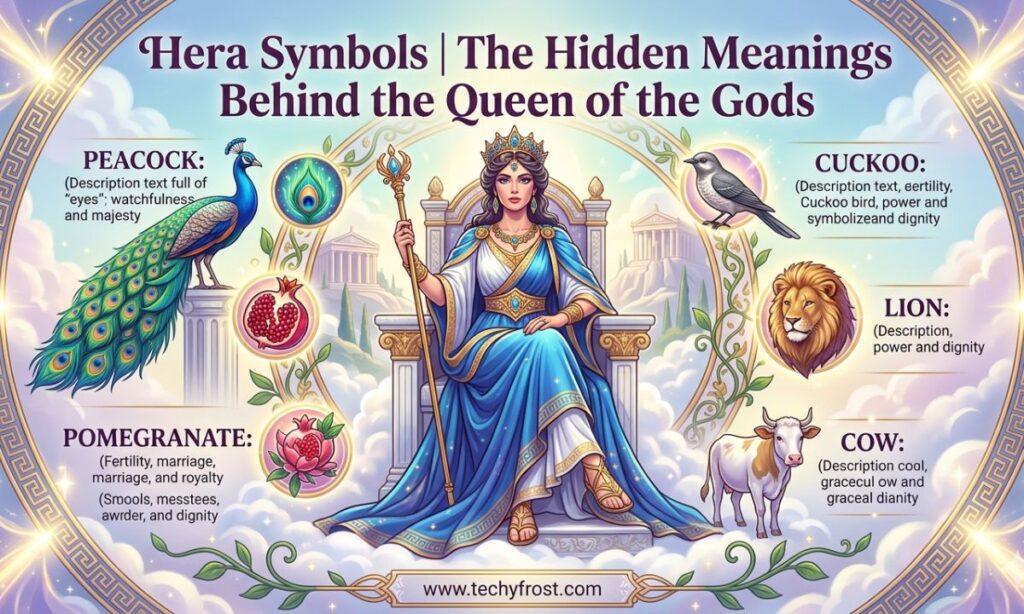
Few figures in Greek mythology carry as much quiet authority as Hera. She doesn’t need thunderbolts or a trident to command respect — her power lives in her symbols. The peacock’s watchful eye, the gleam of a golden crown, the seeds of a pomegranate: each one whispers a piece of her story.
If you’ve ever wondered why Hera is so often shown beside a peacock, or why a cow appears in her myths, you’re really asking a bigger question — what did these images mean to the people who first told her story, and what can they still mean to us?
This guide breaks down every major Hera symbol, explains where it came from, and shows how these ancient signs still show up in art, tattoos, and pop culture today.
What Are Hera Symbols?
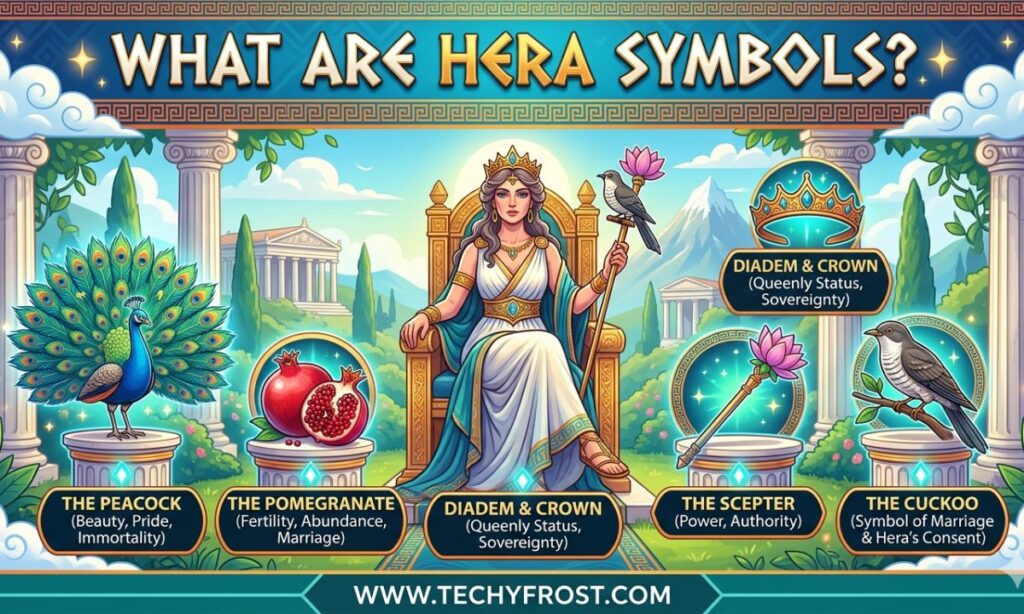
Hera symbols are the animals, objects, and visual emblems that ancient Greeks used to represent the goddess of marriage, women, and family. Long before written stories were common, symbols did the heavy lifting — a single image could tell an entire myth at a glance.
These symbols generally fall into a few categories:
- Sacred animals – the peacock, cow, lion, and cuckoo
- Royal objects – the crown (diadem), throne, and scepter
- Plants and fruits – the pomegranate and lotus
- Abstract ideas – loyalty, vigilance, motherhood, and royal authority
Each symbol points to a different side of Hera’s character. Some highlight her role as a devoted (if jealous) wife. Others reflect her position as queen of Mount Olympus. Together, they build a fuller picture of a goddess who was never meant to be simple.
Who Is Hera in Greek Mythology?
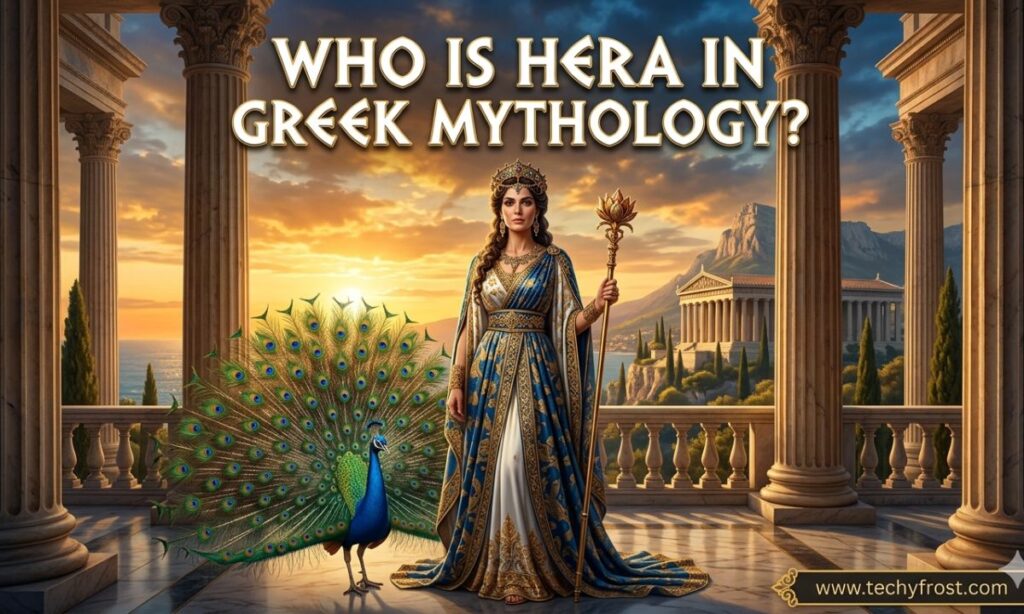
Hera is one of the twelve Olympian deities and is widely regarded as the most powerful goddess in the Greek pantheon. She is the daughter of the Titans Cronus and Rhea, which makes her the sister — and eventually the wife — of Zeus, king of the gods.
As the goddess of marriage, women, and childbirth, Hera presided over the institutions that held ancient Greek society together. She was not a soft, passive figure; she was a protector, a ruler, and at times, a force of fierce retribution against those who threatened the sanctity of marriage.
A few key facts about Hera:
- She is often called the “Queen of the Gods” and rules Olympus alongside Zeus.
- Her Roman equivalent is Juno, after whom the month of June is named.
- Despite Zeus’s constant infidelity, Hera is remembered as the eternal, faithful wife.
- She is the mother of Ares, Hebe, Eileithyia, and, in some versions, Hephaestus.
- Major sanctuaries called Heraion were built in her honor, including the famous ones at Samos and Argos.
Her dual nature — nurturing mother on one side, jealous and vengeful queen on the other — is exactly why her symbols carry such layered meaning.
Deep Symbolic Meaning of Hera Symbols
At their core, Hera’s symbols represent the balance between power and responsibility. Unlike symbols tied to war or chaos, hers are rooted in stability: marriage, household, lineage, and rightful rule.
Look closely, and a pattern emerges. Every Hera symbol carries some version of these three ideas:
- Authority – the crown and scepter show that her power is official, not borrowed.
- Vigilance – the peacock’s many “eyes” reflect a goddess who watches over her domain constantly.
- Fertility and continuity – the pomegranate and cow point to family, motherhood, and the passing of generations.
This is what separates Hera’s symbolism from that of goddesses like Aphrodite or Artemis. Her emblems aren’t about desire or the hunt — they’re about order, commitment, and the responsibilities that come with holding a throne.
Most Popular Hera Symbols and Their Meanings
Here’s a quick-reference table covering the symbols most commonly associated with Hera and what each one represents.
| Symbol | Type | Core Meaning |
|---|---|---|
| Peacock | Sacred animal | Watchfulness, beauty, royal pride |
| Crown / Diadem | Royal object | Authority, queenship, divine rule |
| Cow | Sacred animal | Motherhood, fertility, gentle strength |
| Pomegranate | Fruit | Fertility, marriage, abundance |
| Lion | Sacred animal | Protection, fierce loyalty |
| Cuckoo bird | Sacred animal | Courtship, Zeus’s pursuit of Hera |
| Scepter | Royal object | Rulership and divine power |
| Lotus flower | Plant | Purity, rebirth, divine status |
| Throne | Royal object | Stability and sovereign rule |
These nine symbols appear repeatedly across ancient pottery, temple carvings, and literary sources. The next sections take a closer look at the four most important ones.
The Peacock as Hera’s Sacred Symbol
If one image instantly brings Hera to mind, it’s the peacock. This connection traces back to the tragic story of Argus Panoptes, a giant covered in a hundred eyes who served as Hera’s loyal watchman.
When Zeus wanted to hide his affair with the priestess Io — whom he had turned into a heifer to disguise her — Hera placed Argus on guard duty, since his many eyes meant he never fully slept. Eventually, Hermes lulled Argus to sleep and killed him on Zeus’s orders. Heartbroken by the loss of her faithful guard, Hera took Argus’s hundred eyes and scattered them across the tail feathers of her favorite bird, the peacock.
This origin story gives the peacock symbol a double meaning:
- Positive side: beauty, royal elegance, immortality, and divine splendor.
- Cautionary side: betrayal, suspicion, and the need for constant vigilance.
In ancient artwork, Hera is frequently shown riding a golden chariot pulled by peacocks or standing with one perched beside her throne. The bird’s “eyes” became a lasting visual metaphor — a reminder that nothing escapes the watchful queen of Olympus.
The Crown and Throne of Hera
While the peacock represents Hera’s personality, the crown and throne represent her position. As Queen of the Gods, Hera is almost always depicted wearing a diadem — a jeweled crown that marks her as a sovereign ruler, not just Zeus’s wife.
The crown carries a few layered meanings:
- It marks her as an equal partner in ruling Olympus, not a subordinate figure.
- It reflects the Greek belief that true royalty comes paired with responsibility and wisdom.
- In sculpture, the diadem is often decorated with smaller symbolic motifs, reinforcing her divine status.
Her throne carries similar weight. Seated rather than standing, Hera is shown as composed, permanent, and unshakable — a visual contrast to the more dynamic, active poses given to gods like Zeus or Ares. Together, the crown and throne tell viewers that Hera’s authority is not symbolic flattery; it’s structural to how the Greek pantheon itself was organized.
The Cow Symbol and Its Connection to Hera
The cow might seem like an unusual symbol for a queen, but in ancient Greece, cattle represented something deeply respected: nurturing strength and fertility.
Hera was sometimes given the epithet “Boopis,” often translated as “cow-eyed” or “ox-eyed.” Far from an insult, this was considered high praise, describing large, calm, beautiful eyes — a mark of gentle dignity rather than weakness.
The cow connection also ties into one of Hera’s most famous myths: the story of Io. To protect his lover from Hera’s wrath, Zeus transformed Io into a white heifer. Hera saw through the disguise immediately and had the cow placed under careful guard, demonstrating both her perceptiveness and her fierce protectiveness over her marriage.
Symbolically, the cow reflects:
- Maternal warmth and nurturing instinct
- Agricultural abundance and prosperity
- Quiet, steady strength rather than aggression
This symbol also links Hera to older agrarian goddess traditions across the Mediterranean, including parallels with the Egyptian goddess Hathor, who was likewise associated with cattle and motherhood.
The Pomegranate in Hera Symbolism
The pomegranate is one of Hera’s most visually striking symbols, and one of her most meaningful. Ancient Greeks closely associated this fruit with marriage, fertility, and the cycle of life.
Here’s why the pomegranate fits Hera so well:
- Its hundreds of seeds represent abundance and the potential for many children.
- Its deep red color was linked to life force, passion, and vitality.
- It frequently appeared in wedding ceremonies, since Hera presided directly over marriage.
There’s also a slightly darker layer to this symbol. The pomegranate is the same fruit tied to Persephone’s binding to the underworld — once she ate its seeds, her connection to Hades became permanent. Some scholars draw a parallel between that binding and the permanent, unbreakable nature of marriage itself, which Hera was sworn to protect.
In temple art, statues of Hera often show her holding a pomegranate in one hand, balancing the fruit’s themes of abundance and permanence with her role as guardian of the marital bond.
Types and Variations of Hera Symbols
Beyond her four core symbols, Hera is linked to several secondary emblems that appear less often but still carry meaning. These variations tend to fall into a few categories:
Animal symbols:
- Lion – protection and fierce guardianship
- Cuckoo bird – tied to the myth of Zeus disguising himself to court her
- Hawk – watchfulness from above
- Snake – renewal and household protection
Plant and object symbols:
- Lotus flower – purity and divine rebirth
- Lily – associated with motherhood in later traditions
- Willow and fig trees – minor sacred plantings near her temples
- Scepter topped with a lotus or pomegranate – combined emblem of fertility and rule
Abstract or ceremonial symbols:
- The veil – worn in depictions referencing her wedding to Zeus
- The astronomical glyph used for her Roman counterpart, Juno
This variety shows that Hera’s symbolism wasn’t fixed in stone. Different regions, time periods, and artists emphasized different aspects of her character, which is why you’ll sometimes see slightly different symbol sets depending on the source.
Hera Symbols Across Cultures
Hera’s core symbolism didn’t stay confined to Greece. As Greek mythology spread and blended with neighboring belief systems, her symbols took on new forms and connections.
| Culture | Equivalent or Parallel Figure | Shared Symbolism |
|---|---|---|
| Roman | Juno | Crown, peacock, marriage protection |
| Egyptian | Hathor | Cow symbolism, motherhood, fertility |
| Etruscan | Uni | Queenship, marital authority |
| Modern Western culture | N/A | Peacock and crown as feminine power symbols |
The clearest example is Juno, Hera’s Roman equivalent, who inherited the peacock as her sacred bird and the crown as her symbol of queenship. Even today, the peacock remains a recognizable emblem of regal femininity in Western art and design — a direct echo of Hera’s ancient symbolism, even when people don’t realize the connection.
Spiritual and Dream Meaning of Hera Symbols
In modern spiritual practice, particularly within neopagan and goddess-based traditions, Hera’s symbols are often used as tools for reflection on commitment, self-respect, and personal authority.
People who work with Hera symbolism in meditation or ritual often associate her imagery with:
- Marriage and partnership guidance – calling on her energy when navigating relationship decisions
- Confidence and self-worth – the crown as a reminder of one’s own inner authority
- Boundaries and protection – the peacock and lion as symbols of guarding what matters most
When Hera symbols appear in dreams, they’re frequently interpreted along similar lines:
- Dreaming of a peacock may suggest a need for more self-respect or a warning about hidden betrayal.
- Dreaming of a crown can point to an upcoming responsibility or a desire for more control in your life.
- Dreaming of a pomegranate may reflect themes of fertility, new beginnings, or a major life commitment.
These interpretations aren’t scientifically validated, but they reflect how deeply symbolic thinking has carried Hera’s imagery far beyond ancient Greece and into modern self-reflection practices.
Positive vs Negative Meanings of Hera Symbols
Because Hera herself is such a layered figure, her symbols carry both admirable and cautionary meanings depending on context.
| Symbol | Positive Meaning | Negative Meaning |
|---|---|---|
| Peacock | Beauty, vigilance, royal grace | Vanity, jealousy, obsession with status |
| Crown | Rightful authority, wisdom | Pride, rigid control |
| Cow | Nurturing strength, abundance | Passivity, being overlooked |
| Pomegranate | Fertility, abundance, new beginnings | Binding obligation, loss of freedom |
| Lion | Loyal protection | Aggression, possessiveness |
This duality is intentional. Hera was never written as a flawless figure — she was jealous, vengeful, and at times cruel toward Zeus’s lovers and their children. Her symbols reflect that complexity rather than smoothing it over, which is part of why she remains such a compelling figure to study.
Hera Symbols in Ancient Greek Art
Ancient Greek artists used Hera’s symbols constantly, especially in temple sculpture, painted pottery, and votive offerings. Some of the clearest patterns include:
- Statues and reliefs: Hera is typically shown seated on a throne, wearing a diadem, often holding a pomegranate or scepter.
- Pottery: Painted vases frequently depict her alongside a peacock or in scenes referencing the myth of Io.
- Temple architecture: Major sanctuaries, including the Heraion of Samos and the Heraion of Olympia, contained altars and statues decorated with her sacred symbols.
- Coinage: Some city-states minted coins featuring Hera’s image alongside peacock or cow motifs to signal her protection over the region.
Museums such as the National Archaeological Museum in Athens still house extensive collections of Hera-related artifacts, giving modern visitors a direct look at how these symbols were used in daily religious life rather than just myth and legend.
Hera Symbols in Art, Movies, and Pop Culture
Hera’s symbolism didn’t fade with antiquity — it simply changed form. In contemporary media, she’s frequently portrayed using the same visual shorthand the Greeks established thousands of years ago:
- Film and television: Hera typically appears regal, crowned, and often accompanied by a peacock motif, reinforcing her queenly status even to audiences unfamiliar with the original myths.
- Comics and graphic novels: Modern retellings often lean into her complexity, showing both her protective and vengeful sides.
- Literature: Contemporary mythology retellings frequently use Hera as a symbol of feminine authority navigating a male-dominated divine hierarchy.
- Fashion and design: Peacock feather motifs, crown imagery, and pomegranate patterns are common design choices that trace directly back to her mythological symbolism.
This staying power says something about Hera herself. She represents a kind of power that doesn’t rely on physical strength or flashy magic — just unshakable authority, which translates well across centuries of storytelling.
Hera Symbols in Tattoos and Modern Designs
Hera-inspired tattoos have grown increasingly popular, especially among people drawn to themes of feminine strength, loyalty, and self-respect. The most common designs include:
- Peacock feather tattoos – representing beauty, watchfulness, and personal pride
- Crown tattoos – symbolizing self-sovereignty and earned authority
- Pomegranate tattoos – often chosen to mark fertility, motherhood, or a major life commitment
- Cow-eye or animal-eye motifs – less common, but used to represent calm strength
People choose Hera symbolism for tattoos for a few recurring reasons:
- They want a symbol of dignity that isn’t tied to aggression.
- They’re drawn to her duality — strength paired with vulnerability.
- They see her as a representation of marriage, motherhood, or personal loyalty.
Beyond tattoos, Hera’s symbols also show up frequently in jewelry design — peacock feather pendants, crown-shaped rings, and pomegranate charms remain popular pieces tied directly back to her mythology.
Why Humans Are Attracted to Hera Symbols
There’s a reason Hera’s symbols have outlasted thousands of years of cultural change. Symbols work because they compress complicated ideas into something instantly recognizable, and Hera’s symbols compress some of the most relatable human experiences:
- Authority that comes with responsibility, not just power for its own sake
- Loyalty and commitment, even when relationships get complicated
- Watchfulness and self-protection, especially for people who’ve felt betrayed
- Motherhood and nurturing strength, balanced against personal dignity
Unlike symbols tied purely to romance or chaos, Hera’s emblems speak to the steadier, more grounded parts of life — commitment, family, and earned respect. That’s a message that hasn’t lost relevance, even in a modern world far removed from Mount Olympus.
Hera Symbols Compared to Other Greek Goddess Symbols
Comparing Hera’s symbols to those of other major Greek goddesses highlights just how distinct her domain really is.
| Goddess | Domain | Key Symbols |
|---|---|---|
| Hera | Marriage, family, queenship | Peacock, crown, pomegranate, cow |
| Aphrodite | Love, beauty, desire | Dove, rose, seashell, mirror |
| Athena | Wisdom, strategy, war craft | Owl, olive branch, shield |
| Artemis | The hunt, wilderness, the moon | Bow and arrow, deer, crescent moon |
| Demeter | Harvest, agriculture | Wheat, cornucopia, torch |
Where Aphrodite’s symbols lean into beauty and desire, and Artemis’s into wildness and independence, Hera’s symbols consistently circle back to structure: marriage, rulership, and family continuity. This makes her symbolism feel more institutional and less personal — fitting for a goddess whose entire domain was about holding society’s foundational relationships together.
Interesting Facts About Hera Symbols
A few lesser-known details add extra depth to Hera’s symbolism:
- The peacock wasn’t native to Greece — it was likely introduced from regions further east, making its association with Hera a sign of luxury and exotic prestige.
- Hera’s epithet “Boopis” (cow-eyed) was considered a genuine compliment describing beauty, not an insult.
- The cuckoo bird symbol comes from a myth where Zeus disguised himself as the bird to get close to Hera before their marriage.
- Ancient Greeks believed peacock flesh didn’t decay after death, reinforcing the bird’s link to immortality.
- Hera’s Roman counterpart, Juno, lent her name to the month of June — still considered a popular month for weddings today.
- The Heraion of Samos was one of the largest temples in the ancient Greek world, reflecting just how seriously her worship was taken.
Frequently Asked Questions About Hera Symbols
What is Hera’s main symbol?
The peacock is widely considered Hera’s primary symbol, representing her beauty, royal status, and constant watchfulness.
Why is the peacock associated with Hera?
The peacock is linked to the myth of Argus Panoptes, whose hundred eyes Hera placed on the bird’s tail feathers after his death.
What does the pomegranate represent in Hera’s mythology?
The pomegranate symbolizes fertility, marriage, and abundance, reflecting Hera’s role as goddess of marriage and childbirth.
Why is the cow connected to Hera?
The cow represents nurturing strength and motherhood, and ties into the myth of Io, whom Zeus disguised as a heifer.
What is Hera’s Roman equivalent?
Hera’s Roman equivalent is Juno, who shares many of the same symbols, including the peacock and the crown.
What does the crown symbolize for Hera?
Hera’s crown, or diadem, represents her status as Queen of the Gods and her rightful authority over Mount Olympus.
Are Hera symbols still used today?
Yes, Hera’s symbols regularly appear in tattoos, jewelry, fashion, and modern retellings of Greek mythology.
Final Thoughts
Hera’s symbols do more than decorate ancient pottery and temple walls — they tell a complete story about power, loyalty, and the responsibilities that come with both. From the watchful peacock to the regal crown, each emblem reflects a different layer of a goddess who refused to be simplified.
Whether you’re drawn to her imagery for a tattoo, a piece of jewelry, or simply a deeper understanding of Greek mythology, Hera’s symbols remind us that true authority isn’t just about holding a throne — it’s about what you choose to protect once you’re sitting on it.

