

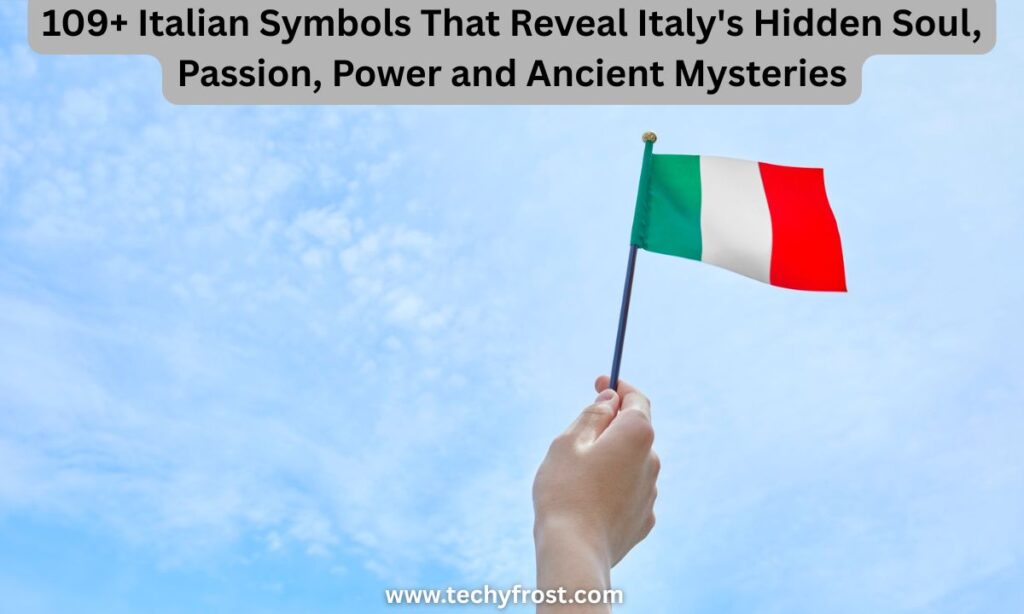
Italy is not just a country — it is a civilization carved in stone, painted on ceilings, and worn around the necks of grandmothers who still whisper prayers against the evil eye. From the shadow of the Colosseum to the narrow alleyways of Naples, symbols breathe through every corner of Italian life. They carry the weight of ancient Rome, the grace of the Renaissance, the fire of southern folklore, and the quiet devotion of centuries of Catholic faith.
This article uncovers 109+ Italian symbols that go far beyond tourist magnets and pasta shapes. These are the real markers of Italy’s soul — the ones that guarded soldiers in battle, blessed newborns at doorsteps, decorated the hands of doges, and inspired some of the greatest art humanity has ever seen. Whether you are researching Italian symbols for tattoos, jewelry, ancestry, spiritual practice, or pure curiosity, this guide gives you everything you need to understand what these symbols truly mean.
What Are Italian Symbols?
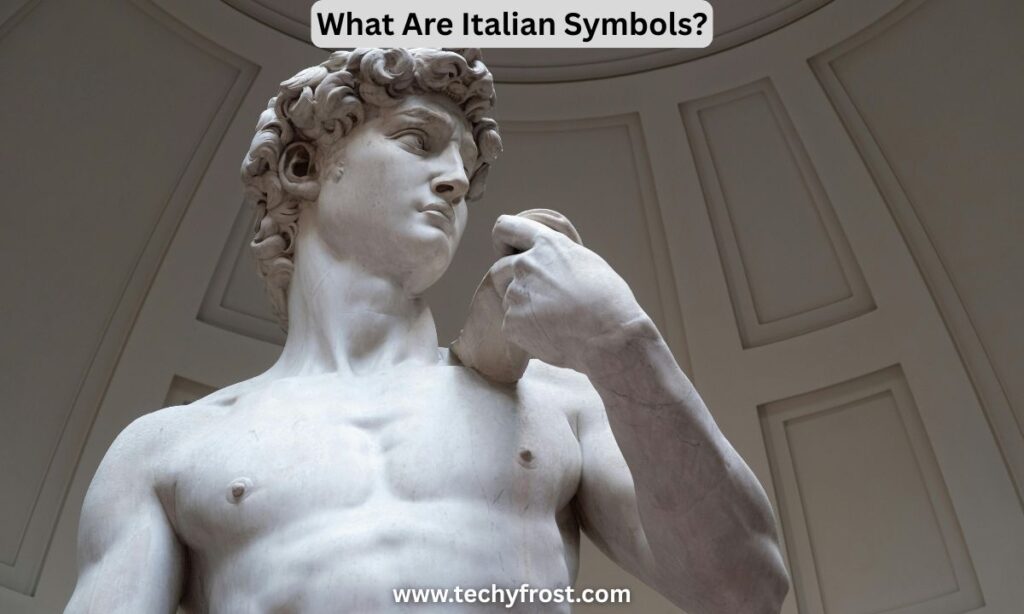
Italian symbols are visual signs, objects, gestures, patterns, or emblems that represent ideas deeply connected to Italian history, spirituality, culture, mythology, and national identity. Some originated in ancient Rome. Others grew from Christianity, Renaissance art, regional folklore, and family traditions passed down through generations.
What sets Italian symbols apart from mere decoration is emotional and historical weight. A simple curved horn charm is not just jewelry — it is a shield against jealousy rooted in pre-Roman superstition. A laurel wreath is not just a crown of leaves — it is the same symbol worn by Julius Caesar and still placed on the heads of Italian university graduates today.
Italian symbols can be grouped into several broad categories:
- National and civic symbols (the Italian flag, Stella d’Italia, Aquila eagle)
- Ancient Roman symbols (laurel wreath, SPQR, gladiator helmet)
- Protective folk symbols (Cornicello, Malocchio, Mano Cornuto)
- Religious and Christian symbols (cross, dove, sacred heart, rosary)
- Regional emblems (Lion of Venice, Fleur de Lis of Florence, Capitoline Wolf)
- Cultural and lifestyle icons (pizza, Vespa, Ferrari, Colosseum)
- Symbols of love and family (red roses, Venetian imagery, intertwined hearts)
In short, Italian symbols are where history, emotion, and national pride meet in a single image.
Famous Italian Symbols And Their Meanings
Italian Symbols And Meanings
Here is a broad overview of the most recognized Italian symbols and what they represent:
| Symbol | Category | Core Meaning |
|---|---|---|
| Italian Flag (Tricolore) | National | Hope (green), faith (white), sacrifice (red) |
| Cornicello | Protective | Ward off evil eye and jealousy |
| Laurel Wreath | Ancient Roman | Victory, honor, academic achievement |
| Stella d’Italia | National | Italy’s luminous destiny and identity |
| Roman Eagle (Aquila) | Ancient Roman | Power, military strength, imperial authority |
| Capitoline Wolf | Mythological | Founding of Rome, survival, motherhood |
| Lion of Venice | Regional | Strength, trade power, civic pride |
| Olive Branch | Peace/Nature | Peace, wisdom, Mediterranean heritage |
| Fleur de Lis | Regional (Florence) | Civic identity, noble elegance |
| Colosseum | Cultural | Architectural genius, Roman history |
| Malocchio (Evil Eye) | Superstition | Dangerous envy; protection against bad luck |
| Mano Cornuto | Folk | Defiance against evil, personal protection |
| Cross | Religious | Christian faith, sacrifice, salvation |
| Vespa Scooter | Modern | Italian innovation, post-war freedom |
| Ferrari Prancing Horse | Modern | Speed, passion, Italian excellence |
| Pizza | Culinary | Italian cuisine, cultural creativity |
| Gladiator Helmet | Ancient Roman | Courage, combat history, Roman legacy |
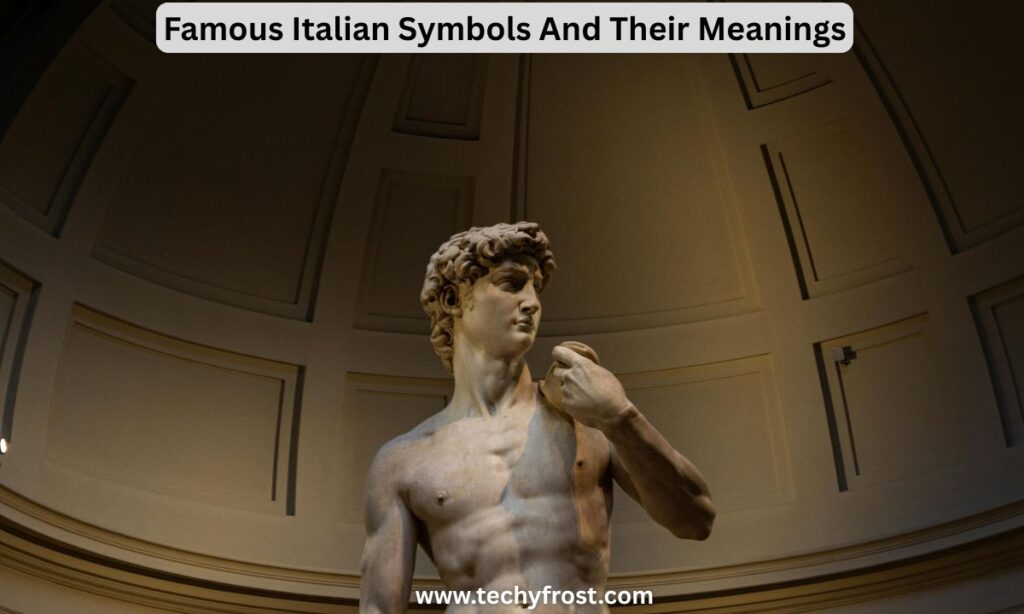
| David (Michelangelo) | Renaissance | Heroism, beauty, artistic mastery |
| White Lily | Religious | Purity, virtue, Virgin Mary |
| Cockade (Coccarda) | National | Italian unification, patriotism |
Italian Symbols Tattoos
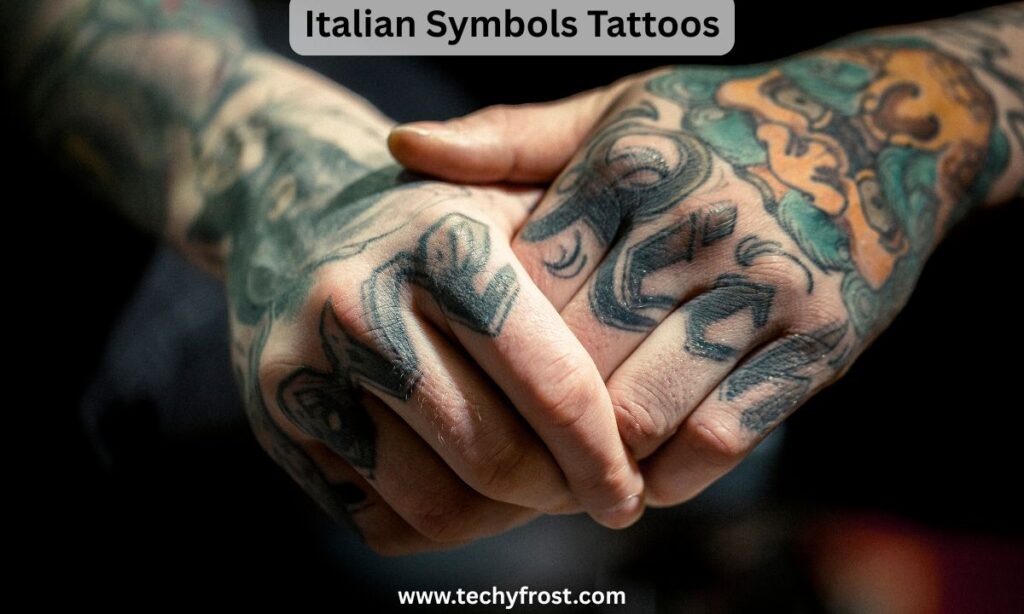
Tattoos inspired by Italian symbols have surged in popularity worldwide. People choose these designs not just for aesthetics but for the deep stories they carry on skin.
The most popular Italian tattoo symbols include:
- The Cornicello: Worn as a talisman tattoo, representing protection from the evil eye and good fortune
- Roman Eagle: Chosen for strength, leadership, and ancestral pride
- Olive Branch: A peaceful, elegant tattoo symbolizing harmony and Mediterranean roots
- SPQR: The ancient Roman initials meaning Senatus Populusque Romanus — tattooed by Roman soldiers and still popular today
- Italian Cross: A symbol of deep faith, spiritual identity, and cultural heritage
- Laurel Wreath: Popular among graduates and achievers as a permanent mark of triumph
- Colosseum: Represents resilience and the grandeur of Italian history
- Italian Phrases: Words like famiglia (family), amore (love), and forza (strength) are tattooed as personal mantras
What makes Italian tattoo symbols compelling is their dual nature — they are visually beautiful and semantically rich, making them meaningful on both a personal and cultural level.
Italian Tattoo Symbols
Beyond the classics above, lesser-known but deeply meaningful Italian tattoo symbols include:
- The Capitoline Wolf — motherly protection and the founding spirit of Rome
- Mano Figa — an ancient amulet gesture symbolizing protection and resistance
- Italia Turrita — the female personification of Italy wearing a crown of towers
- The Bocce Ball — representing traditional Italian leisure, community, and heritage
- Venetian Mask — mystery, carnival tradition, and the theatrical soul of Italian culture
- Roman Numerals — birth dates, anniversaries, and personal milestones in a classically Italian way
- The Colosseum with a Gladiator — raw courage and Italy’s powerful ancient identity
Ancient Italian Symbols
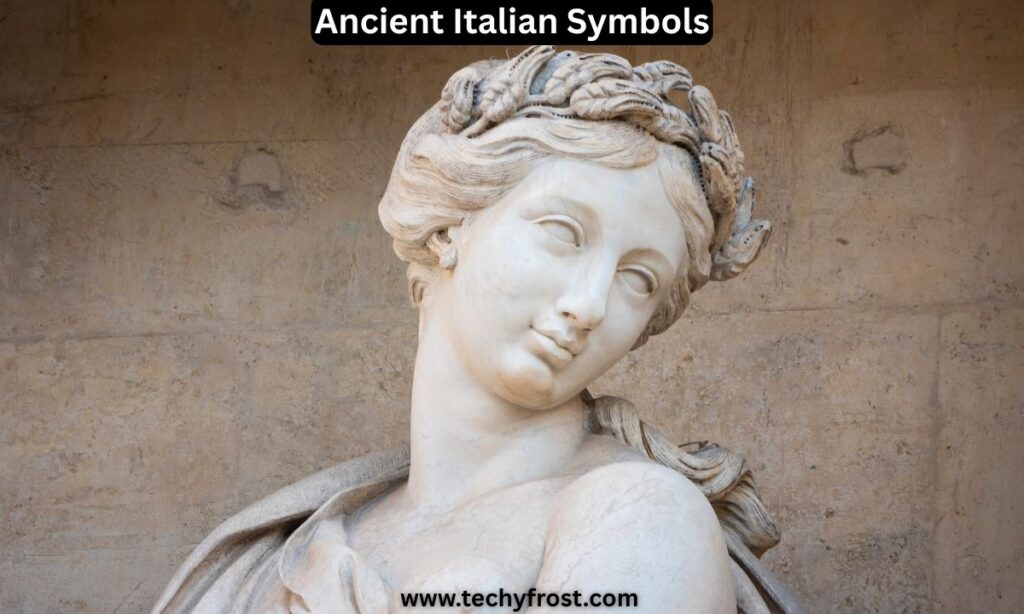
Ancient Italian symbols draw from two deep wells: pre-Roman Etruscan tradition and the vast symbolism of the Roman Empire.
Key ancient Italian symbols include:
- The Aquila (Eagle) — carried by Roman legions as the supreme military standard. Losing it in battle was considered the greatest possible disgrace.
- The Laurel Wreath — awarded at the ancient Olympics and Roman triumphs alike, representing victory and divine favor.
- The Fasces — a bundle of rods bound around an axe, symbolizing collective strength and authority.
- The She-Wolf (Lupa Capitolina) — the mythological she-wolf who nursed Romulus and Remus, the legendary founders of Rome.
- SPQR — the official emblem of the Roman Republic and Empire, representing the unity of the Senate and people.
- The Caduceus — a staff entwined with two snakes, carried by Mercury (Hermes), representing commerce and communication.
- The Trident of Neptune — symbolizing maritime power and the mastery of the seas.
- Roman Owl — associated with Minerva (Athena), goddess of wisdom and strategy.
National Symbols Of Italy
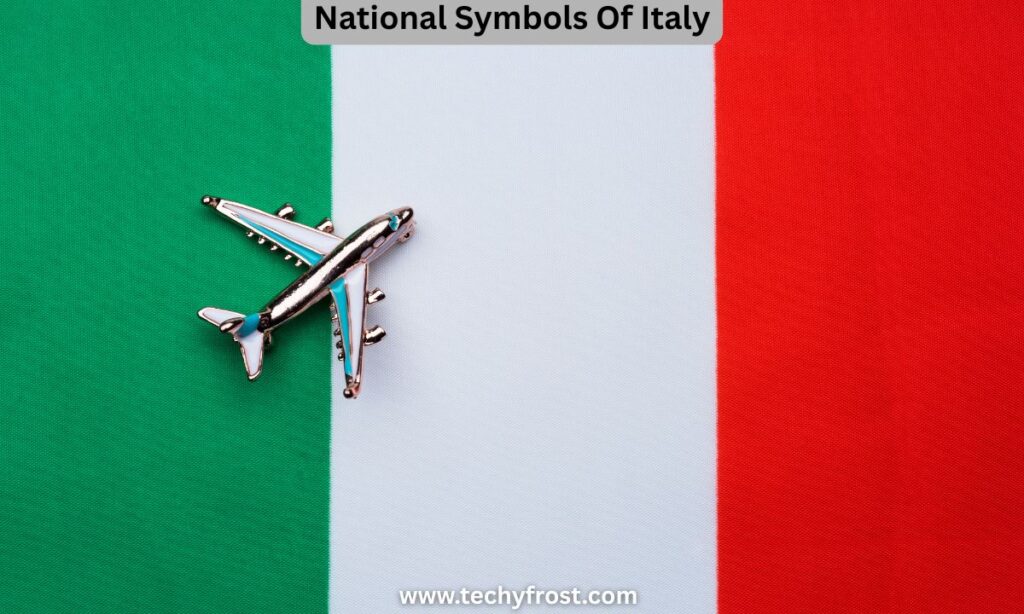
Italy’s official national symbols are defined or recognized by the Republic and carry constitutional and cultural weight:
| National Symbol | Meaning |
|---|---|
| The Italian Flag (Il Tricolore) | Green (hope), White (faith/Alps), Red (love/sacrifice) |
| Stella d’Italia | Italy’s shining destiny; present on the national emblem since 1948 |
| The National Emblem | Star + cogwheel + olive branch + oak branch — unity of people and state |
| Capitoline Wolf | The founding myth of Rome; unofficial national animal is the wolf |
| Frecce Tricolori | National aerobatic team; aerial symbol of Italian pride |
| Vittoriano Monument | The Altar of the Fatherland; Italy’s symbolic sacred center |
| Italian Sparrow | Recognized as the national bird of Italy |
| Strawberry Tree (Corbezzolo) | Its red, white, and green berries mirror the national flag |
| Italia Turrita | National personification of Italy as a crowned woman |
| Festa della Repubblica | June 2nd national day celebrating the birth of the Italian Republic |
Traditional Italian Culture And Heritage Symbols
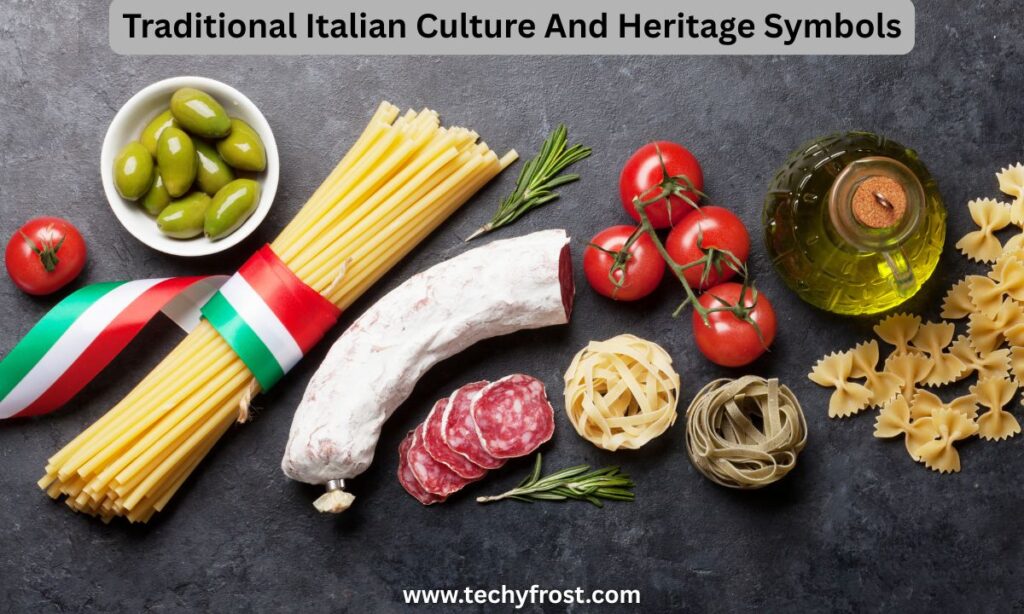
Italian Symbols Letters
Letters and alphabetic symbols carry remarkable meaning in Italian tradition:
- SPQR (Senatus Populusque Romanus) — the eternal abbreviation of Roman power, still carved into Roman manholes and public buildings today
- IHS (In Hoc Signo) — a Christian monogram used widely across Italian churches, derived from the Greek letters of Jesus’s name
- Chi-Rho (☧) — one of the earliest Christian symbols, adopted by Emperor Constantine and spread throughout Roman Italy
- Alpha and Omega (Α Ω) — representing God as the beginning and end, carved across Italian churches and catacombs
- Roman Numerals — still used on Italian monuments, clock towers, and official documents as a living linguistic heritage
Italian Symbols Of Protection
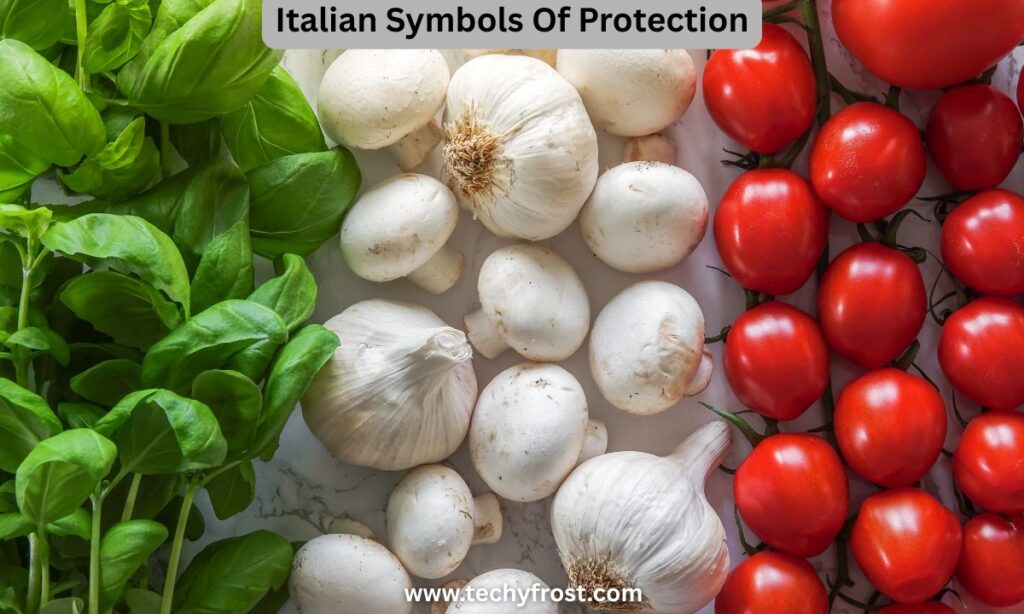
Protection has always been central to Italian spiritual and folk life. The most powerful Italian protection symbols include:
- Cornicello (Il Corno) — the twisted horn charm, rooted in Etruscan and ancient Roman tradition, believed to deflect jealousy and the evil eye. Traditionally made from red coral, gold, or silver.
- Malocchio (Evil Eye) — not just a curse but a concept that birthed dozens of protective objects and rituals across Italy
- Mano Cornuto — the horned hand gesture, used to repel evil and negative energy with a single silent sign
- Mano Figa — a fist with the thumb between middle and index fingers, one of Italy’s oldest apotropaic (evil-warding) charms
- The Rosary — beyond its prayer function, the rosary has long served as a tactile protection symbol in Italian homes and on Italian bodies
- Saint Benedict Medal — inscribed with protective Latin prayers, believed to guard against evil and illness
- Cimaruta (Rue Charm) — a silver amulet shaped like a sprig of rue, hung in Neapolitan homes to protect against witchcraft
Italian Symbols For Family
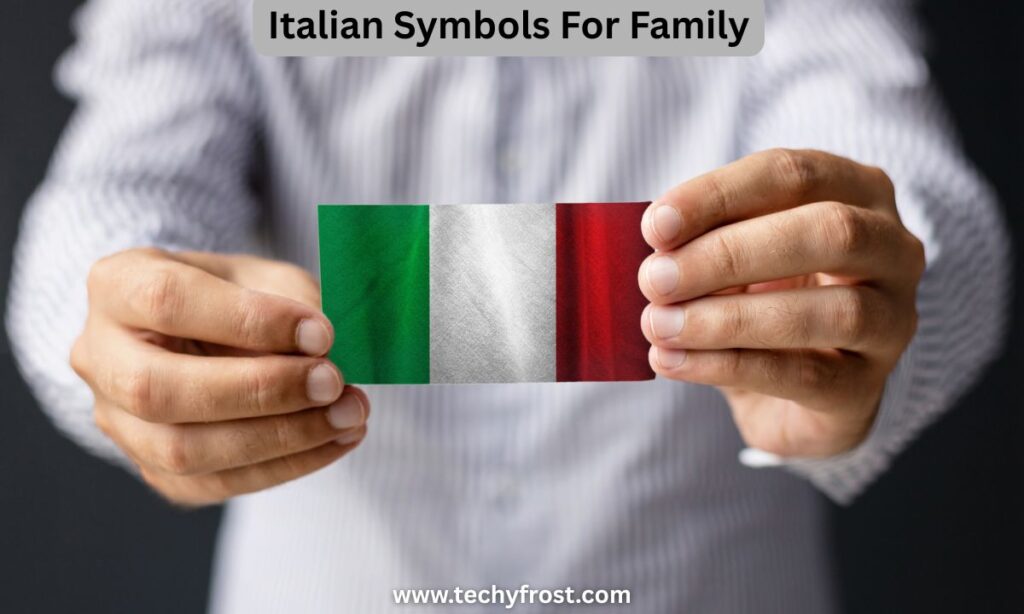
Famiglia — family — is the cornerstone of Italian identity. Symbols that represent family bonds in Italian culture include:
- The Cornicello given from parent to child as a generational protective gift
- The Coat of Arms (Stemma) — noble Italian families maintained elaborate heraldic crests representing their lineage, values, and territorial pride
- The Olive Tree — representing longevity, continuity, and the nurturing connection between generations
- Bread and Salt — ancient Italian hospitality symbols, offered to welcome family and friends into the home
- The Sacred Heart — a Catholic symbol of profound love, displayed in millions of Italian family homes
- SPQR — used as a tattoo by those connecting to their Roman ancestry and family roots
- Roman Numerals of Birthdates — a contemporary way Italians honor family milestones
Symbols Of Italy
Beyond official emblems, certain images are instantly understood worldwide as distinctly Italian:
- The Colosseum — Rome’s eternal gift to world architecture
- Pizza and pasta — culinary symbols of Italian creativity and generosity
- The Leaning Tower of Pisa — beauty, imperfection, and enduring wonder coexisting
- Michelangelo’s David — the peak of Renaissance artistic achievement
- Ferrari’s Prancing Horse — Italian passion, speed, and engineering brilliance
- The Vespa — post-war Italian ingenuity and effortless style
- Opera — Italy gave the world this art form; it remains a living national symbol
- Venetian Gondola — romance, tradition, and the magic of Venice
Italian Symbols Jewelry
Italian jewelry has carried symbolic meaning for millennia. The most significant symbolic jewelry traditions include:
- Cornicello pendants in red coral or gold — worn from southern Italy to Manhattan’s Little Italy
- Gold medallions with saints’ images — personal protection and devotion worn close to the skin
- Cameo jewelry — carved shell or stone portraits with mythological or classical themes, originating in ancient Rome
- Claddagh-inspired heart rings — love and loyalty expressed in wearable form
- Rosary bracelets — prayer and protection on the wrist
- Renaissance-inspired filigree — intricate gold or silver work reflecting Italy’s artisan mastery
- Charm bracelets with Italian icons — Colosseum charms, boot-of-Italy pendants, Venetian masks
Italian National Symbols
A quick reference to Italy’s official and recognized national symbols:
| Symbol | Type | Official Status |
|---|---|---|
| Il Tricolore | Flag | Legally defined |
| National Emblem | Coat of arms | Legally defined (1948) |
| Stella d’Italia | Star symbol | Part of national emblem |
| Capitoline Wolf | Mythological | Cultural recognition |
| Italian Sparrow | National bird | Cultural recognition |
| Strawberry Tree | National plant | Cultural recognition |
| Festa della Repubblica | National day | June 2nd, legally defined |
| Frecce Tricolori | Aerobatic team | Official representation |
Ancient And Modern Symbols That Represent Italy
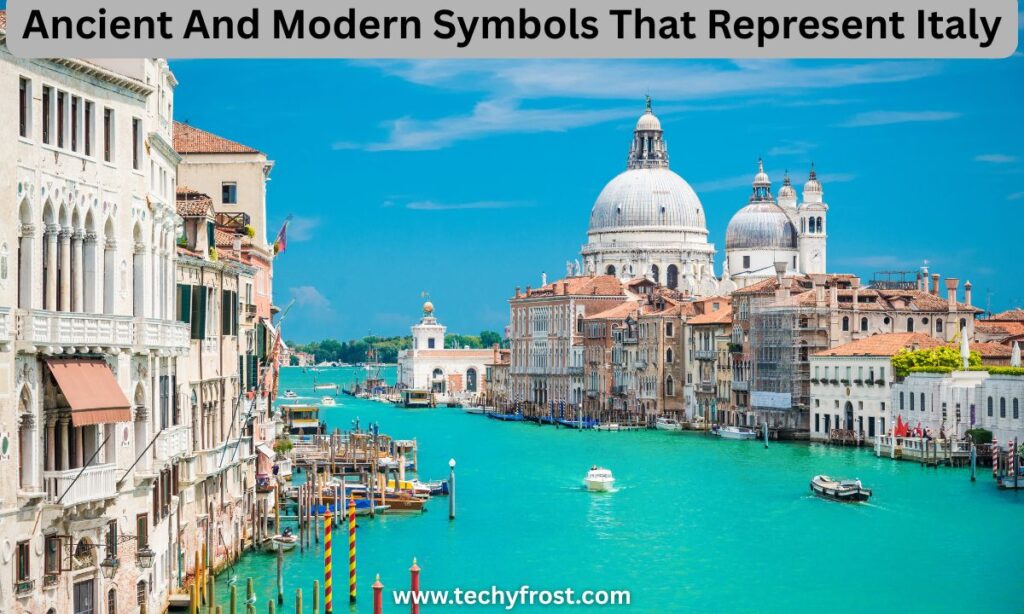
Italy Symbols
Italy occupies a unique position — it is simultaneously the heir of antiquity and the birthplace of modern style. Its symbols bridge millennia without contradiction.
The Colosseum sits 2,000 years old beside modern trams. The Ferrari Prancing Horse, born in 1923, echoes the mythological energy of ancient Roman cavalry. The Vespa, born in 1946, carries the spirit of Roman road mastery into the post-war age.
Italian Symbols Of Love
Italy’s association with love is not merely geographic or romantic cliché — it is historically and symbolically grounded:
- Red Roses — adopted from Roman goddess Venus, still the universal language of Italian romantic expression
- Venetian Imagery — the canals, gondolas, and bridges of Venice have made it the world’s capital of romantic symbolism
- The Dove — sacred to Venus and later to the Christian Holy Spirit, representing pure love and peace
- Cupid (Amore) — the Roman god of love, born of Italian mythology and still one of the most universally recognized love symbols on earth
- Intertwined Hearts — a Renaissance motif still seen in Italian jewelry, greeting cards, and church decorations
- The Pomegranate — in Italian art and mythology, symbolizing fertility, abundance, and the love between partners
Things That Represent Italy
When people worldwide think of Italy, they picture:
- The Colosseum and Roman ruins
- Pizza and espresso
- Renaissance art (da Vinci, Michelangelo, Raphael)
- Opera (Verdi, Puccini)
- Ferrari and Lamborghini
- Fashion houses (Gucci, Versace, Prada)
- The Italian language — considered one of the most melodic on earth
- The Mediterranean coastline
- The Vatican and St. Peter’s Basilica
- Family, food, and la dolce vita
Ancient Italian Symbols And Meanings
| Ancient Symbol | Origin | Meaning |
|---|---|---|
| Aquila (Eagle) | Roman Empire | Military power and imperial authority |
| Laurel Wreath | Greek-Roman | Victory, divine favor, honor |
| She-Wolf (Lupa) | Roman myth | Rome’s founding, maternal strength |
| Fasces | Roman Republic | Collective strength, authority |
| Trident | Roman mythology | Maritime dominance (Neptune) |
| Caduceus | Roman mythology | Commerce, communication (Mercury) |
| Etruscan Eye | Pre-Roman | Protection from evil gaze |
| Roman Owl | Roman mythology | Wisdom and strategy (Minerva) |
Something That Represents Italy
If forced to choose a single thing that represents Italy, most would choose the Colosseum — not just as a building but as a metaphor. It represents survival across centuries, the drama of human conflict and resolution, the pride of engineering, and the haunting beauty of ruins that refuse to disappear. But Italy is too rich for one symbol. Its soul lives in the full constellation of all these images together.
Things That Represent Italian Culture
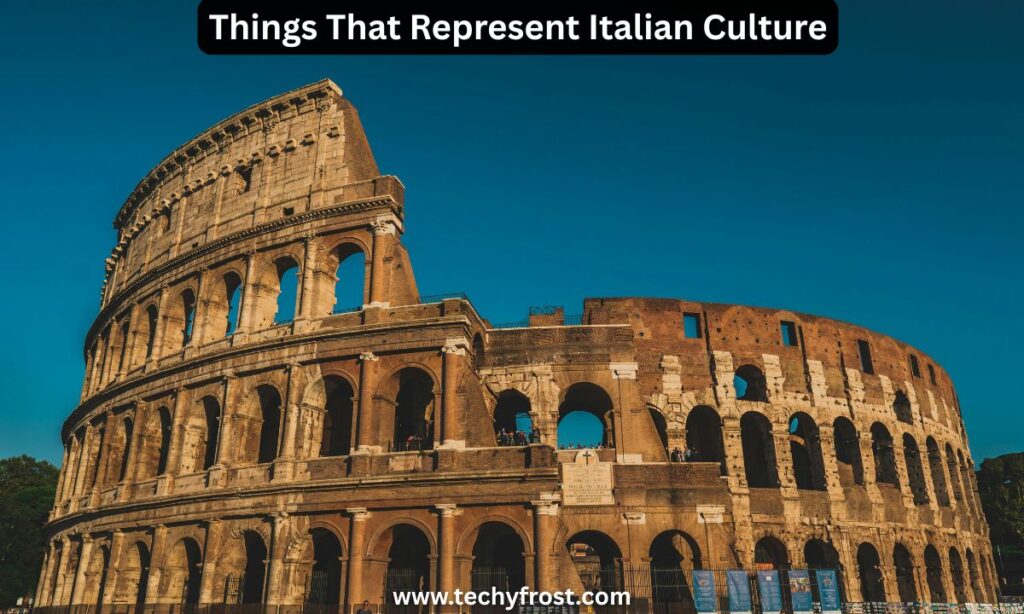
Italian culture values beauty, family, faith, food, craft, and passion. Cultural symbols that capture this include:
- Slow food movement — a modern cultural symbol born in Italy resisting fast food globalization
- Commedia dell’arte masks — the theatrical tradition of improvised character comedy
- Opera houses — La Scala in Milan is itself a cultural symbol of Italian musical supremacy
- Cathedral architecture (Duomo di Milano, Santa Maria del Fiore) — faith expressed as beauty
- Artisan workshops — leather in Florence, glass in Murano, lace in Burano
Italian Symbols Of Strength
Strength in Italian symbolism takes many forms:
- The Roman Eagle — military might and imperial dominance
- The Lion — civic courage (Venice) and kingly power (heraldic tradition)
- Hercules (Ercole) — the Roman demigod of strength appears across Italian city seals and public art
- The Gladiator Helmet — physical courage and the willingness to face danger
- The Bull — an ancient Italic symbol of raw power, seen across pre-Roman regional coinage
- The She-Wolf — ferocious maternal protection as a form of strength
The Deep Symbolic Meaning Behind Italian Symbols
Spiritual Meaning
Italy sits at the intersection of paganism and Christianity in a way no other nation quite matches. The spiritual dimension of Italian symbols is therefore layered and sometimes contradictory in the most fascinating way.
The Cornicello originated in pre-Christian Etruscan and Roman belief, connected to the moon goddess Luna and the power of horned animals to protect life. When Christianity spread through Italy, the horn charm did not disappear — it simply coexisted with the rosary and the crucifix, showing how deeply folk belief persists beneath official religion.
The olive branch carries spiritual meaning in both traditions: sacred to Athena/Minerva in antiquity and a symbol of divine peace in Christian scripture (Noah’s dove returned with one). In Italian spiritual life, symbols often serve as bridges between the human world and the unseen — whether that unseen is Roman gods, the Christian God, or the ancient forces of nature.
Dreaming of an olive branch in Italian spiritual tradition suggests inner peace or the resolution of conflict. Seeing Roman imagery in dreams may reflect ambitions, leadership potential, or a call to honor one’s roots. The Cornicello in dreams often signals a desire for protection or a warning about envy in one’s social world.
Psychological Meaning
Psychologically, Italian symbols speak to core human needs: the need for belonging (family symbols), protection (Cornicello, evil eye charms), achievement (laurel wreath), identity (national flag), and transcendence (religious imagery).
Carl Jung’s concept of archetypes maps remarkably well onto Italian symbolism. The Roman Eagle is the archetype of authority and the father. The She-Wolf is the fierce archetypal mother. The Olive Branch is the peacemaker. The Gladiator is the hero/warrior. These are not just Italian symbols — they are universal human stories written in Italian.
People without Italian ancestry report feeling emotionally drawn to Italian symbols because they tap into something older than nationality: the collective memory of Western civilization itself.
Cultural Meaning
Culturally, Italian symbols perform a crucial social function — they unite a highly diverse nation. Italy was only unified in 1861, and regional identities remain fierce. A Sicilian and a Milanese may share little in daily life, but they share the Tricolore, the Stella d’Italia, and the shadow of the Colosseum. Symbols do the work of national cohesion that geography and politics alone cannot.
At the global level, Italian cultural symbols have become aspirational — they represent a lifestyle of beauty, passion, craft, and pleasure that people worldwide want to emulate. The Ferrari, the Versace logo, the espresso cup — these are cultural symbols that communicate Italian identity instantly across all language barriers.
Types of Italian Symbols and Their Meanings
The Cornicello
Visual Description
The Cornicello is a small, twisted, horn-shaped amulet resembling an animal horn or chili pepper. It curves gently and tapers to a point. Traditionally crafted from red coral, gold, silver, or red glass, it is typically worn as a pendant or hung from keychains and rearview mirrors.
Meaning
Rooted in ancient Etruscan and Roman cultures, the Cornicello was linked to the moon goddess Luna and the protective power of horned animals. Today it serves as Italy’s most recognized protective charm — believed to deflect the malocchio (evil eye), ward off jealousy, and bring good fortune to the wearer.
Where It Appears
- Worn as necklace pendants across southern Italy and the Italian diaspora worldwide
- Hung in homes, cars, and storefronts
- Tattooed as a personal protection symbol
- Sold in gold and silver as fine jewelry
The Roman Eagle
Visual Description
A majestic eagle with wings fully spread, often depicted clutching a thunderbolt or Roman wreath in its talons. In ancient times it was mounted on a tall standard (the aquila) and carried into battle by the Roman legions.
Meaning
The Roman Eagle (Aquila) represented the supreme power of the Roman state, the divine favor of Jupiter, and the military might of the legions. Losing the eagle standard in battle was considered Rome’s greatest possible humiliation. Today it symbolizes authority, victory, and national pride across European nations that inherited Roman tradition.
Where It Appears
- Italy’s national emblem (stylized)
- Military insignia and state seals across Europe
- Tattoo art representing Roman ancestry and strength
- Architecture of the Fascist era (though now reclaimed in broader historical context)
The Olive Branch
Visual Description
A slender branch bearing small elongated leaves in silver-green tones, sometimes shown with small oval olives attached. In the Italian national emblem, an olive branch appears on the left side of the cogwheel alongside an oak branch on the right.
Meaning
The olive branch in Italian tradition represents peace, wisdom, fertility, and Mediterranean heritage. In ancient Rome it was associated with Pax (the goddess of peace) and with Minerva. In the Christian tradition it represents divine peace. In modern Italy it represents the nation’s commitment to peaceful governance, as shown by its prominent place in the national emblem.
Where It Appears
- Italy’s national emblem (official left branch)
- Diplomatic symbolism
- Religious art and church decoration
- Tattoos representing peace, reconciliation, and Mediterranean identity
The Lion of Venice
Visual Description
A winged lion, typically shown in gold on a blue or red background, either holding an open book (representing peace) or a sword (representing war readiness). The book bears the Latin inscription Pax tibi Marce, evangelista meus (Peace be with you, Mark, my evangelist).
Meaning
The Lion of Saint Mark is Venice’s most powerful symbol. According to tradition, the Evangelist Mark’s remains were brought to Venice in 828 AD, and the winged lion became the city’s divine protector. The lion represents Venice’s strength, its trading empire’s reach across the Adriatic and Mediterranean, and its fierce civic independence from both Rome and Constantinople.
Where It Appears
- Venice’s city flag and coat of arms
- St. Mark’s Basilica and the Doge’s Palace
- Venetian colonies across the former empire (Croatia, Greece, Cyprus)
- Modern Venetian civic identity and regional pride
The Fleur de Lis
Visual Description
A stylized lily flower consisting of three petals bound together at the center. In Florence’s version (the giglio), it typically appears in red on a white background (or inverted after 1251), with a distinctive Italian elegance distinguishing it from French versions.
Meaning
Florence adopted the red lily (giglio rosso) as its civic symbol, representing the city’s nobility, beauty, and cultural supremacy. After the Guelph faction took power in 1251, the colors were reversed to differentiate Florentine identity from its rivals. The fleur de lis also carries broader European meanings of royal dignity, purity, and divine favor.
Where It Appears
- Florence’s city flag and coat of arms
- Florentine football club (ACF Fiorentina) jerseys
- Renaissance-era architecture and stonework throughout Florence
- Souvenirs and regional craft products
Italian Symbols Across Different Cultures
Ancient Roman Culture
In ancient Roman culture, symbols were instruments of power and identity. The Aquila standard unified legions across three continents. The laurel wreath told citizens at a glance who had won glory. The fasces reminded everyone that collective strength surpasses individual will. Roman symbols were public, political, and deliberately awe-inspiring — designed to communicate imperial authority at a single glance to people of any language.
Christian Italian Culture
When Rome became Christian, Italy became the symbolic heart of a new spiritual civilization. Symbols shifted: the eagle gave way to the dove, military triumphs gave way to martyrs’ crowns, and the Roman caduceus was reinterpreted through a Christian lens. The cross, the sacred heart, the fish (ichthys), the lamb of God, and the Chi-Rho monogram filled the spaces where pagan symbols had stood. Uniquely, many older protective symbols — like the Cornicello — survived by existing parallel to Christian practice, showing Italy’s genius for symbolic layering.
Renaissance Italy
The Renaissance was a rebirth of ancient symbols dressed in new artistic genius. Painters like Botticelli encoded Venus, Mercury, and the Three Graces with philosophical meaning. Michelangelo’s David was simultaneously a biblical hero and a symbol of Florentine republican virtue. The laurel wreath returned to crown poets and scholars. Humanist thinkers revived Greco-Roman symbolism as a language of universal human values. Every painting became a symbolic conversation between antiquity and the present.
Medieval Italian States
Medieval Italy was a mosaic of competing city-states, each using symbols to assert sovereignty and identity. Florence had its red lily. Venice had its winged lion. Milan had the Visconti serpent (biscione) — a snake devouring a man, later inherited by Alfa Romeo. Genoa claimed the red cross on white — so powerful that English and Georgian flags still echo it. These symbols were heraldic weapons in a political landscape where visual identity meant survival.
Modern Global Culture
Today, Italian symbols circulate globally through fashion, cinema, gastronomy, and digital culture. The Ferrari prancing horse is recognized in 190 countries. Gucci’s double-G and Versace’s Medusa head are luxury symbols carrying Italian identity into global fashion. The Colosseum appears in films, video games, and brand logos worldwide. Social media has amplified Italian aesthetics — the bella vita aesthetic, Roman architecture photography, and artisan craft content all carry symbolic Italian meaning into digital spaces.
Italian Symbols in Art, Movies, Literature, Tattoos and Fashion
Italian symbols have permeated creative expression for centuries in ways both deliberate and deeply subconscious.
In Art: Renaissance masters embedded symbolic objects — olive branches, doves, roses, laurel wreaths — into paintings that operated simultaneously as religious narratives, political statements, and philosophical allegories. A lily in a Madonna painting was not just a flower; it was a coded declaration of purity. Caravaggio used light and shadow as moral symbols, with darkness representing sin and illumination representing grace.
In Movies: Italian cinema, from Fellini’s La Dolce Vita to Coppola’s The Godfather (deeply rooted in Italian-American symbolism), uses Italian symbols as shorthand for entire value systems. The Cornicello, the family dinner table, the Catholic church interior — these function as instant cultural signifiers telling audiences everything about a character’s world.
In Literature: Italian literature from Dante’s Divine Comedy onward is saturated with symbolic language. Dante used the she-wolf to represent avarice, the lion for pride, and Virgil (himself a Roman symbol) as the guide through human moral experience.
In Tattoos: Roman numerals, eagles, olive branches, the Cornicello, amore, famiglia, and the Colosseum are among the most tattooed Italian symbols worldwide — chosen both by Italians honoring heritage and by global enthusiasts drawn to Italian aesthetic depth.
In Fashion: Versace’s Medusa head represents dangerous beauty and mythological power. Gucci’s double-G has become a modern heraldic symbol of luxury. Valentino’s red roses and Dolce & Gabbana’s Sicilian iconography — majolica tiles, Baroque details, religious imagery — carry Italian symbolism directly into global haute couture.
Spiritual And Dream Meaning of Italian Symbols
Italian symbols appear in dreams and meditative states with remarkable frequency among people of Italian heritage and those with deep emotional connections to Italian culture.
Dreaming of an Olive Branch suggests approaching peace after conflict, a reconciliation on the horizon, or an internal resolution of long-held tension.
Dreaming of the Roman Eagle often signals ambition awakening, leadership emerging, or a call to take authority in a challenging situation.
Dreaming of the Cornicello may reflect the dreamer’s awareness of envy in their surroundings, a subconscious desire for protection, or a message to guard what is precious.
Dreaming of the She-Wolf speaks to fierce protective instincts, particularly maternal energy — a symbol of willingness to defend loved ones at any cost.
Dreaming of the Colosseum can represent confronting personal challenges with courage, facing public scrutiny, or working through the weight of history and legacy.
Some spiritual practitioners believe that ancient symbols like the Aquila or the olive branch function as archetypal bridges — connecting the conscious mind to collective historical memory and ancestral wisdom stored in the deeper layers of human consciousness.
Positive And Negative Meanings of Italian Symbols
Not all Italian symbols carry purely positive meaning. Understanding both sides provides a complete picture:
| Symbol | Positive Meaning | Negative or Complex Meaning |
|---|---|---|
| Roman Eagle | Power, victory, strength | Associated with empire, conquest, and later with Fascist imagery |
| Fasces | Collective strength, unity | Adopted by Mussolini’s Fascist party; carries dark historical association |
| Malocchio (Evil Eye) | Awareness of envy, protective culture | Represents fear, superstition, and social suspicion |
| Gladiator Helmet | Courage, resilience | Represents slavery, forced combat, and brutal spectacle |
| Medusa (Versace) | Power, dangerous beauty | In mythology: a monster, a symbol of petrifying fear |
| Carnival Mask | Joy, freedom, anonymity | Concealment, deception, moral ambiguity |
| Cornicello | Protection, luck | Associated with superstition and folk belief sometimes dismissed as backward |
Understanding these complexities makes Italian symbolism richer, not poorer. The most powerful symbols in any culture carry the full spectrum of human experience.
Why Humans Feel Deeply Attracted to Italian Symbols
The global attraction to Italian symbols is not accidental. It rests on several psychological and cultural foundations:
Historical gravity: Italy’s symbols carry the weight of the Roman Empire, the Renaissance, and the Catholic Church — three of the most influential forces in human history. When you wear a Roman eagle, you connect to 2,000 years of recorded human ambition.
Aesthetic beauty: Italian symbols are almost universally beautiful. The cornicello is elegant. The laurel wreath is graceful. The Venetian lion is majestic. Italian culture has always believed that beauty itself is a form of truth.
Emotional resonance: Symbols like famiglia, the olive branch, and the Cornicello speak directly to universal human needs — love, protection, belonging, and peace.
Cultural aspiration: Globally, “Italian” represents a certain quality of life — la dolce vita — that many aspire to. Its symbols carry this aspirational quality with them wherever they travel.
Archetypal depth: As noted above, many Italian symbols are not just Italian — they are Western civilization’s original symbolic vocabulary, making them feel instinctively familiar across cultures.
Italian Symbols And Their Role In Daily Italian Life
Italian symbols are not museum pieces. They live in the present tense of daily Italian life in concrete, observable ways:
- Graduates across Italy still wear laurel wreaths after university ceremonies, directly connecting their achievement to ancient Roman tradition.
- Drivers in Naples and across southern Italy hang the Cornicello from their rearview mirrors for daily protection.
- Families display the Sacred Heart or Saint Benedict Medal at home entrances.
- Football fans rally behind the Azzurri (Italy’s national team), whose color is itself a symbol — the blue of the House of Savoy.
- Artisans in Florence, Venice, and Murano continue producing symbolic objects — leather goods with lily motifs, glass blown in traditional Venetian forms — keeping symbolic craft alive.
- Religious festivals (Epiphany, All Saints’ Day, patron saint days) fill the streets with symbolic processions, costumes, and iconography.
- Children receive Cornicello charms as gifts at birth, maintaining the generational chain of protective symbolism.
The extraordinary thing about Italian symbols is precisely this: they have survived millennia not as relics but as living practice. In a world of accelerating change, they offer Italians — and the world — a thread connecting the present to something ancient, beautiful, and enduring.
Frequently Asked Questions
What is the most famous Italian symbol?
The Cornicello (Italian horn) and the Roman Eagle are among the most recognized Italian symbols worldwide, though the Italian flag remains the definitive national symbol.
What does the Italian horn symbolize?
The Italian horn (Cornicello) symbolizes protection from the evil eye (malocchio), good luck, and positive energy. Its roots trace back to ancient Etruscan and Roman traditions.
What are ancient Italian symbols of protection?
The most important ancient Italian protection symbols are the Cornicello, Mano Cornuto, Mano Figa, the Cimaruta (rue charm), and the Etruscan eye. Each was believed to deflect negative spiritual energy.
What Italian symbol represents family?
The olive tree, the family coat of arms (stemma), and the word famiglia itself (often tattooed) are the most common Italian symbols of family. The Cornicello is also frequently passed from parent to child as a family protection symbol.
What does the Fleur de Lis mean in Italy?
In Italy, particularly Florence, the Fleur de Lis (Giglio Rosso) is a civic symbol of the city’s nobility and identity. It represents Florentine cultural pride and was historically used to distinguish Guelph political allegiance.
What is SPQR and why is it important?
SPQR (Senatus Populusque Romanus) means “The Senate and People of Rome.” It was the official abbreviation of the Roman Republic and Empire, symbolizing the unity of state authority and the people. It is still engraved on public infrastructure in Rome today.
What do Italian symbols mean in tattoos?
Italian tattoo symbols typically represent heritage, protection, strength, love, or personal identity. Common choices include the Cornicello (protection), Roman Eagle (strength), olive branch (peace), and Italian phrases like amore (love) or famiglia (family).
What is the Stella d’Italia?
The Stella d’Italia is a five-pointed white star that has represented Italy since the Graeco-Roman period. It appears on Italy’s national emblem and symbolizes the bright, luminous destiny of the Italian peninsula.
Are Italian symbols still used today?
Yes. Italian symbols remain deeply embedded in daily Italian life through jewelry, tattoos, religious practice, graduation ceremonies, football culture, fashion design, and regional festivals.
What symbol represents Italian strength?
The Roman Eagle, the Lion of Venice, Hercules (Ercole), the gladiator helmet, and the bull are the primary Italian symbols of strength, all rooted in ancient Roman and regional Italian tradition.
Conclusion
Italian symbols are not decoration. They are a living archive — a collection of images, objects, and gestures that have carried Italy’s soul through war, renaissance, revolution, and renewal across more than two thousand years of history.
From the curved horn that guards a Neapolitan grandmother’s kitchen to the Roman eagle that once led legions across three continents, from the laurel wreath on a university graduate’s head to the prancing horse on a Ferrari door, these symbols speak a language older than any written text. They speak of power, faith, beauty, protection, love, family, and the enduring Italian conviction that life — la vita — is something worth adorning.
Whether you are drawn to Italian symbols through ancestry, spiritual practice, tattoo design, jewelry, or simple curiosity, what you find in them is always the same: a civilization that believed deeply in the power of images to carry meaning across time. And in that belief, Italy gave the world not just symbols but a way of seeing — passionate, beautiful, and ancient beyond measure.
This article was written for educational and informational purposes. All cultural and historical information has been carefully researched from authoritative sources on Italian history, art, and symbolism.

