


Few figures in ancient mythology carry as much raw, unfiltered energy as Ares — the Greek god of war. His symbols have outlasted empires, inspired tattoo artists, and shaped the way entire cultures think about conflict, courage, and chaos. Yet most people only scratch the surface when it comes to understanding what these symbols truly represent.
Whether you are a mythology enthusiast, a tattoo seeker, or someone trying to decode the spiritual weight behind war imagery, this guide breaks down every major Ares symbol, its hidden meanings, and why these ancient icons still resonate so powerfully in 2026.
What is Ares and His Symbols?
Ares is the ancient Greek god of war — specifically the violent, chaotic, and brutal side of battle. Born to Zeus, king of the gods, and Hera, queen of Olympus, he occupies a unique position among the Twelve Olympians. While his half-sister Athena represents military strategy, discipline, and wisdom in warfare, Ares embodies raw aggression, bloodlust, and the physical destruction of conflict.
His symbols are the tools and companions of a battlefield warrior: the spear, the helmet, the shield, the vulture, and the war dog. These are not just decorative icons. Each one carries a layered meaning tied to Greek philosophy, human psychology, and the cultural experience of ancient warfare.
Unlike gods such as Apollo or Poseidon, who had rich and complex iconographies, Ares had surprisingly few distinct symbols. This was not accidental. The Greek people held Ares in deep ambivalence — even his own father Zeus once called him “the most hateful of all gods.” His simple, soldier-like imagery reflected exactly how the Greeks felt about him: necessary, dangerous, and not to be celebrated.
Ares Symbols And Meanings
Ares Symbols Tattoos
Ares tattoos have surged in popularity as body art that communicates inner strength, resilience, and warrior energy. The most common Ares tattoo elements include the spear and shield (representing courage and protection in adversity), the war helmet (symbolizing readiness and mental toughness), the vulture (honoring those lost in battles literal or personal), and the planet Mars (a nod to his Roman counterpart).
People also get Ares tattoos to honor military service members or deceased loved ones who fought personal battles. Some pair the imagery with Latin phrases like Si vis pacem, para bellum (“If you want peace, prepare for war”) for extra power. A “Greek Ares” style tattoo tends to feel primal and untamed, while a “Roman Mars” design carries a more disciplined, structured military undertone.
Ares Personality
Ares was volatile, passionate, and driven entirely by instinct rather than reason. He was impulsive, quick to anger, and responded to even minor slights with ferocious outrage. Despite being a god of war, Greek mythology frequently portrayed him as a coward — he fled the battlefield crying after being wounded by the mortal Diomedes.
He was also deeply passionate. His love affair with Aphrodite (goddess of love and beauty) was one of the most famous in all of mythology, symbolizing the union of passion and violence. His children with Aphrodite — Phobos (Fear) and Deimos (Terror) — accompanied him into every battle.
Ares God Of War
As the god of war, Ares did not represent the glory of battle. He represented its horror. Homer described him as “manslaughtering, blood-stained, stormer of strong walls.” While other cultures celebrated war gods for their heroism, the Greeks used Ares to embody everything frightening and reprehensible about armed conflict: hatred, rage, slaughter, and destruction.
He was, however, revered in warrior cultures. Sparta and Thrace — both known for their warlike peoples — honored Ares more devotedly than most Greek city-states. In Scythia, he was even worshipped in the form of a sword, with animal (and sometimes human) sacrifices made in his honor.
Ares Characteristics
| Characteristic | Description |
|---|---|
| Domain | War, violence, bloodshed, chaos |
| Personality | Impulsive, aggressive, passionate, emotional |
| Family | Son of Zeus and Hera |
| Allies | Eris (Discord), Phobos, Deimos |
| Rivals | Athena, Hephaestus |
| Sacred City | Sparta, Thrace |
| Weakness | Cunning; often outsmarted in battle |
Ares Roman Name
In Roman mythology, Ares became Mars — but with a significant upgrade in status. While Greeks feared and somewhat despised Ares, Romans revered Mars as the father of Romulus and Remus, the legendary founders of Rome. He became the second most important deity in the Roman pantheon after Jupiter. The month of March is named after him. This shift reflects how Roman culture viewed military strength as honorable and foundational to civilization, rather than chaotic and dangerous.
Ares Animal
Ares had two primary sacred animals: the vulture and the dog. The vulture circled battlefields after combat, feeding on the fallen — a sobering symbol of death, decay, and the aftermath of war. The dog represented loyalty, ferocity, and the bond between soldiers. A third animal, the boar, is also linked to Ares in some traditions, representing untamed aggression and brute strength. All three reflect different facets of Ares’s domain: the reality of death, the loyalty demanded in battle, and the raw, wild power of combat.
Ares Facts
- Ares was one of the few Olympians who sided with the Trojans in the Trojan War, betraying a promise to Hera in the process.
- He was imprisoned in a bronze jar for thirteen months by the twin giants Otus and Ephialtes.
- His throne on Olympus was said to be made of human skin, symbolizing his cruelty.
- Ares fathered numerous children, including the Amazons, through various relationships.
- The planet Mars is named after his Roman counterpart, and the word “martial” (as in martial arts) traces directly to his name.
Ares Symbols Greek Mythology
In Greek mythology, Ares symbols consistently represented the darker, more visceral truth of war. Unlike the laurel wreath of victory or the olive branch of peace, Ares symbols did not comfort. The spear drove home the personal, violent nature of combat. The helmet was not a symbol of wisdom but of endurance under assault. These symbols reminded ancient Greeks that war was not a game of strategy — it was blood, pain, and grief.
Symbols Of Ares And Their Power
Ares Symbols And Animals
The vulture and dog stand as Ares’s most recognized animal symbols. The vulture’s connection to death and carrion made it a fitting companion for a god who left battlefields littered with the fallen. The dog, loyal and fierce, echoed the dual nature of soldiers — devoted to their comrades, savage to their enemies.
Ares Symbols And Meanings
Every Ares symbol carries a dual meaning: destruction and necessity. The spear destroys but also defends. The shield protects but also enables aggression. This duality runs through all his iconography and speaks to the fundamental human truth that conflict, while terrible, is sometimes unavoidable.
Ares Symbols And Powers
Ares’s symbols directly reflect his divine powers: the ability to inspire battlefield frenzy (the spear), grant warriors physical invulnerability in the heat of combat (the helmet and shield), and connect mortality to the divine through the presence of sacred animals. He also held power over the raw human emotions of hatred, anger, and the “fight” response.
Ares Symbols And Attributes
His core attributes — war, violence, courage, and passion — map directly onto his symbols. The spear represents decisive action and aggression. The helmet represents readiness and mental resilience. The shield represents protective instinct. The vulture represents unflinching acknowledgment of death’s reality. Together, they form a complete portrait of what it means to be a warrior in the fullest, most brutal sense.
Symbols Of Ares
The five core symbols of Ares are:
- Spear — his primary weapon and most recognizable attribute
- Helmet — his most iconic visual identifier in Greek art
- Shield — protection in battle, also associated with the Spartans
- Vulture — death, aftermath, transformation
- Dog — loyalty, ferocity, brotherhood in arms
God Ares Symbol / Ares God Symbol
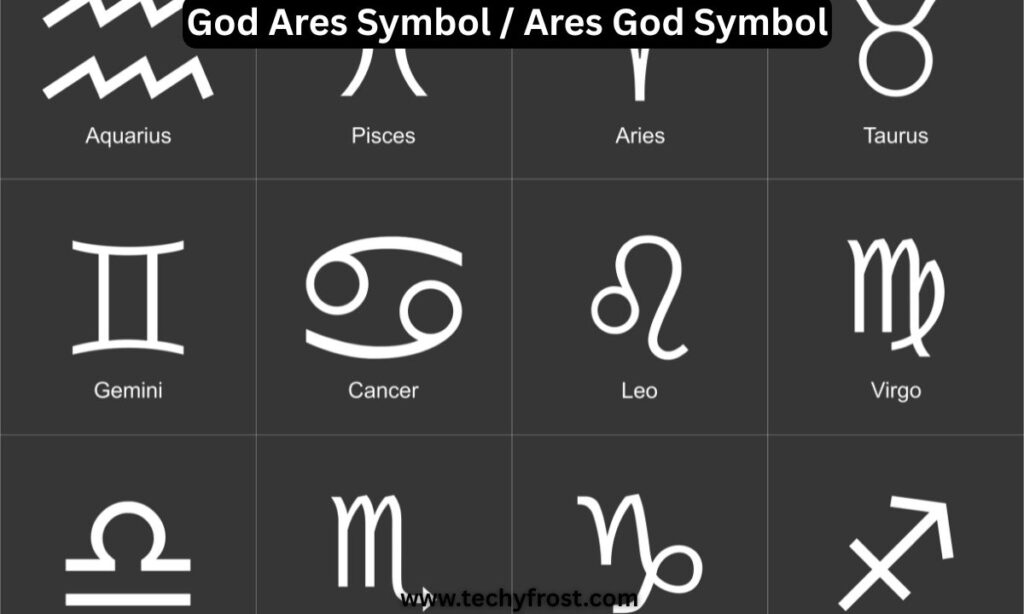
The single most recognized Ares symbol across ancient art and modern iconography is the warrior’s helmet — specifically the peaked Corinthian-style helmet. Whether he is shown wearing it, carrying it, or holding it beside him, the helmet appears in virtually every artistic depiction of Ares. It distinguishes him from mortal warriors and marks him as the presiding divine force over every armed conflict.
Ares Special Symbols
Beyond the standard weapons and armor, Ares had more unusual symbolic associations: the burning torch (representing the fire of battle, rage ignited), the chariot (representing speed, power, and the momentum of war), and the chain (in Spartan tradition, statues of Ares were kept in chains, symbolizing the idea that military victory should never leave the city).
Ares Helmet Symbol
The helmet is Ares’s most personal and persistent symbol. It represents not just protection but transformation — the moment a person puts on a warrior’s helmet, they step out of civilian identity and into something more primal and dangerous. For Ares, the helmet symbolizes his permanent readiness for war. He is never shown relaxing in robes like other gods; he is always armed and armored.
Ares Powers And Symbols
| Symbol | Associated Power |
|---|---|
| Spear | Aggression, decisive force, courage |
| Helmet | Endurance, identity, readiness |
| Shield | Protection, defensive strength |
| Vulture | Command over death, aftermath |
| Dog | Loyalty, ferocity, war brotherhood |
| Chariot | Speed, power, unstoppable momentum |
What Is Ares Symbol Of Power?
Ares’s ultimate symbol of power is the spear. It is his weapon of choice in nearly every mythological encounter, and it represents the most direct expression of his divine domain: the will to fight, the capacity to destroy, and the courage to face an enemy head-on. The spear also symbolizes decisive action — no hesitation, no strategy, just raw, forward-moving force.
Deep Symbolic Meaning of Ares Symbols

Spiritual Meaning
Spiritually, Ares symbols represent the inner warrior that lives within every human being. They surface in moments of confrontation, crisis, or survival — when we must set aside hesitation and act from a place of raw energy and instinct. In spiritual traditions, the warrior archetype is not celebrated for its violence but for its courage to face darkness head-on. An Ares symbol in a spiritual context can represent the act of confronting your deepest fears, standing your ground when everything around you demands retreat, or channeling anger into transformation rather than destruction.
Psychological Meaning
From a psychological standpoint, Ares symbols connect to the fight response — the primal human reaction to threat, injustice, or danger. Carl Jung would recognize Ares as a shadow archetype: the part of our psyche that holds raw aggression, unfiltered emotion, and the will to dominate. Engaging consciously with this energy (rather than suppressing it) is, in modern therapeutic terms, an act of integration. Ares symbols in this context become reminders that anger and aggression are not inherently destructive — they are also protective, motivating, and necessary for survival.
Cultural Meaning
Culturally, Ares symbols have meant very different things to different societies. In ancient Athens, they were cautionary — a reminder of what war cost. In Sparta, they were aspirational — a model for the disciplined soldier. In Rome, they became symbols of national pride and imperial destiny. Today, in global pop culture, they represent rebellion, inner strength, and the refusal to be a victim. The cultural meaning of Ares symbols shifts depending on who is holding them and why.
Types / Variations of Ares Symbols
Spear
The spear is Ares’s primary weapon and his most universally recognized attribute. In mythology, he is consistently depicted either carrying or leaning against it. The spear represents direct, uncompromising force — no tricks, no strategy, just decisive action. It also symbolizes masculine energy, aggression, and the willingness to enter into direct conflict rather than avoiding it.
Helmet
The peaked warrior’s helmet — most often depicted in the Corinthian style — is the visual icon most associated with Ares across Greek vase paintings, sculptures, and coins. It represents the warrior’s identity, protection in the heat of battle, and the psychological transformation that occurs when a person prepares to fight. It also symbolizes the idea that war is both an external and internal experience.
Shield
The shield carries protective symbolism alongside its martial identity. In Ares’s hands, it represents the defensive necessity of war — the understanding that fighting is sometimes the only way to protect what matters. In Spartan tradition, the shield was the most sacred piece of a warrior’s armor; coming home without your shield was considered a disgrace, while dying in battle with it was considered honorable.
Vulture
The vulture is a deeply underappreciated Ares symbol. It circled ancient battlefields, connecting the world of the living with the world of the dead. As an Ares symbol, the vulture reminds us that destruction always leads to transformation. Death is not an ending but a transition — and those who wage war must acknowledge, not ignore, the mortality that surrounds them.
Dog
The war dog symbolizes loyalty, ferocity, and the pack mentality of soldiers. Dogs were used in actual ancient warfare and were celebrated for their courage. As an Ares symbol, the dog represents the bonds formed between warriors under fire — fierce to the enemy, devoted to the friend beside you. It is one of the more human and emotionally resonant of his symbols.
Ares Symbols Across Cultures
Ancient Greece
In ancient Greece, Ares symbols reflected the ambivalence Greeks felt toward war itself. They acknowledged its necessity while deeply distrusting its chaos. His symbols — the plain soldier’s weapons with no ornate additions — mirrored this attitude: war is real, ugly, and stripped of glamour.
Roman Interpretation
In Rome, the same symbols attached to Mars took on a grander, more honorable tone. The spear became a symbol of Roman military destiny. The helmet became imperial. The dog became the loyal legionary. Rome’s Mars was a civilizing force, not a destructive one, and his symbols shifted meaning accordingly.
Norse Influence
While Norse mythology developed independently, their war symbolism shares deep thematic overlap with Ares. Odin and Tyr — the Norse war gods — carried their own versions of the warrior’s weapons and sacred animals. The raven (Odin’s bird) parallels the vulture: both circle battlefields and connect the living to the dead. Both mythologies agree that war carries a spiritual dimension, not just a physical one.
Egyptian Culture
Egyptian war imagery, particularly surrounding gods like Horus and Montu, balanced destruction with divine order. Unlike Ares — who was chaos itself — Egyptian war gods were protectors of cosmic balance. However, both traditions used predatory animals (falcons, vultures, dogs/jackals) as symbols linking warfare with the divine, and both acknowledged that death in battle carried sacred meaning.
Modern Culture
Today, Ares symbols appear everywhere: in tattoo studios, video game art, superhero mythology (Ares is a major DC villain/anti-hero in Wonder Woman), gym culture, military branding, and fashion. In modern culture, these symbols have largely shed their “god of war” specificity and taken on broader meanings: strength, resilience, primal power, and the refusal to be dominated. They are, in short, symbols of the fighter’s spirit — which is why they continue to endure.
Ares Symbols in Art, Movies & Pop Culture
Ares has experienced a major cultural resurgence in the 21st century. In DC Comics and the 2017 Wonder Woman film, Ares appeared as the god manipulating World War I from behind the scenes — a portrayal that stayed faithful to his mythological role as a chaos-inducing, conflict-amplifying force. In the God of War video game franchise, Ares served as the primary antagonist, depicted as a towering armored giant whose ambition ultimately led to his downfall.
In art, Ares continues to inspire works exploring the tension between violence and beauty — particularly in pieces that pair his armor and weapons with softer imagery of Aphrodite, symbolizing the eternal interplay between love and war. In tattoo art, helmet and spear designs remain among the most requested Greek mythology themes globally.
Spiritual & Dream Meaning of Ares Symbols
Dreaming of Ares symbols carries significant interpretive weight. A spear appearing in dreams often signals a need for decisive action — something in your waking life may require you to stop hesitating and move forward with force. Dreaming of a war helmet may indicate a need to protect your mental or emotional space. A vulture in a dream typically signals transformation through loss: something must end before something new can begin.
Spiritually, encountering Ares symbolism during meditation or ritual work can indicate that warrior energy is needed in your life — not necessarily aggression, but courage, boundaries, and the willingness to face conflict rather than flee from it. Many practitioners of Hellenic polytheism invoke Ares when seeking strength before significant challenges.
Positive vs Negative Meaning of Ares Symbols
Positive Meaning
- Courage — the willingness to face danger and act despite fear
- Protection — defending those who cannot defend themselves
- Resilience — enduring hardship and emerging stronger
- Passion — pursuing what matters with fierce, undivided energy
- Transformation — allowing old versions of yourself to fall away so new strength can emerge
- Brotherhood — the bonds forged between people who face difficulty together
Negative Meaning
- Uncontrolled aggression — violence that destroys rather than protects
- Emotional instability — acting from rage rather than reason
- Chaos — disruption of order and peace without purpose
- Cowardice disguised as bravado — fighting not from strength but from insecurity
- Destruction without rebuilding — tearing down without ever creating
Understanding both sides is essential. Ares symbols are not inherently good or evil — they reflect the full complexity of human conflict: the best and worst of what we become when we are pushed to our limits.
Why Humans Are Attracted to Ares Symbols
The attraction to Ares symbols is deeply human and entirely understandable. We live in a world that constantly presents us with challenges, injustices, and moments that demand we choose between fight and flight. Ares symbols speak directly to that part of us that refuses to back down — the part that says I will survive this. I will not be broken.
There is also an honesty to Ares symbols that other, more polished mythology cannot match. They do not dress up conflict in glory or make war look noble. They acknowledge that battle is ugly, costly, and real — and they honor the people who walk into it anyway.
In tattoos, in gyms, on the walls of military barracks, and in the imagery of competitive sports, Ares symbols persist because they give language to a fundamental human experience: the experience of being tested, pushed beyond comfort, and having to summon something fierce from within just to keep going.
Ares is not the god of heroes. He is the god of every ordinary person who picks themselves up and fights — not because it is glorious, but because they must. That is why his symbols endure, and why they will continue to matter long into the future.
Frequently Asked Questions
What is the main symbol of Ares? The spear and the warrior’s helmet are his two most recognized symbols, representing combat and warrior identity.
What animal represents Ares? The vulture (associated with death and the battlefield) and the dog (loyalty and ferocity) are his primary sacred animals.
What is Ares’s Roman name? Ares is known as Mars in Roman mythology, where he held considerably higher status as a protector of Rome.
What do Ares tattoos symbolize? They represent inner strength, resilience, warrior spirit, protection, and the courage to face adversity head-on.
Why did the Greeks dislike Ares? Greeks respected strategic warfare (Athena’s domain) but feared and distrusted the blind violence and chaos that Ares represented.
What does the Ares helmet symbol mean? It represents the warrior’s identity, protection, readiness for battle, and the transformation from civilian to fighter.
Is Ares a positive or negative god? Both — he embodies the destructive side of war but also the raw courage, passion, and protective instinct that war sometimes demands.
Understanding Ares symbols means understanding something true about human nature itself: that chaos and courage are two sides of the same coin, and that the most powerful symbols are the ones that refuse to lie about what it costs to survive.

