

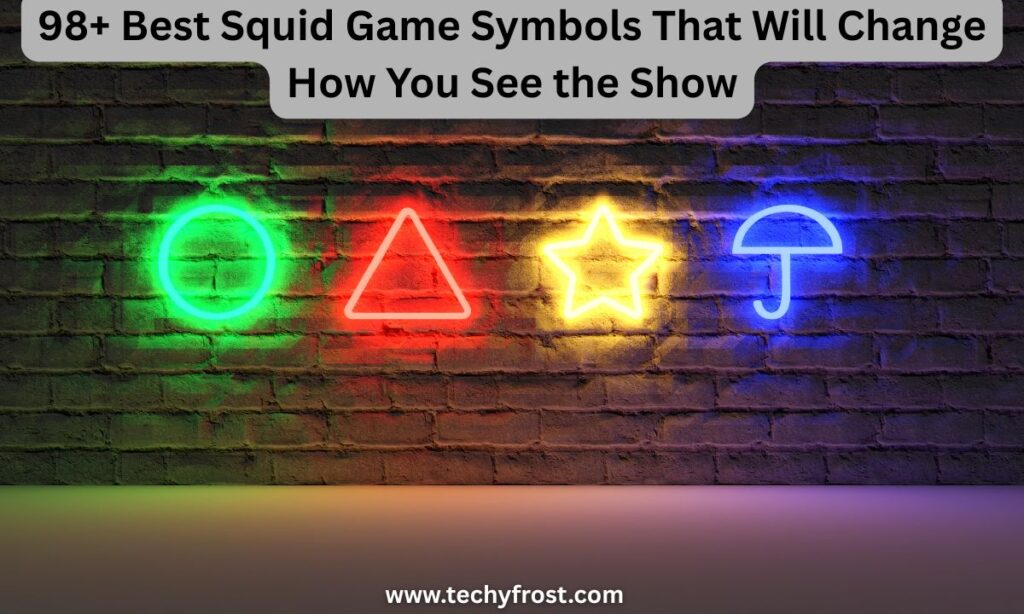
If you think the circle, triangle, and square on those red-suited guards are just design choices, think again. Squid Game’s symbols are one of the most layered visual systems ever built into a TV show. Creator Hwang Dong-hyuk didn’t pick those shapes randomly — they carry meaning at every level: cultural, psychological, spiritual, and societal. Once you truly understand them, you cannot watch a single scene the same way again.
This guide breaks down every major Squid Game symbol, explores what each shape really represents, and reveals why these simple geometric forms became global icons practically overnight.
What Are Squid Game Symbols?
Squid Game symbols are the geometric shapes — primarily the circle, triangle, and square — used throughout Netflix’s hit Korean survival drama to communicate rank, identity, power, and deeper philosophical meaning.
You first notice them on the black masks worn by the show’s masked workers. But look closer, and these shapes appear on invitation cards, the game’s playing field, and even in the structural design of scenes themselves. They function as a visual language — one that audiences instinctively decode without needing a single line of dialogue.
According to Hwang Dong-hyuk at a Netflix press conference, the symbols were among the very first concepts he developed for the show. He drew them from childhood — literal shapes he scratched into playgrounds as a kid. In the show, however, they carry far more weight.
Interestingly, the shapes also serve a literal linguistic function: the circle, triangle, and square represent the Korean letters O, J, and M, the initials of Ojingeo Geim — which translates directly to “Squid Game.” Every worker wearing a mask is, quite literally, branded with the show’s name.
Deep Symbolic Meaning
The genius of Squid Game’s visual design is that its symbols operate simultaneously on multiple levels. Here’s how each layer works.
Spiritual Level
On a spiritual level, these three shapes echo ancient philosophical ideas about existence itself. The circle represents the infinite — the endless cycle of desire, suffering, and rebirth. In many spiritual traditions, it is the symbol of completeness and the universe with no beginning or end.
The triangle, with its sharp angles pointing upward, spiritually represents energy, tension, and the force that drives transformation. Many spiritual systems associate it with the dynamic interplay between opposing forces — body, mind, and spirit.
The square grounds everything. Spiritually, it represents the physical world, earthly limitation, and the structures that govern human life. In the context of Squid Game, the square-masked managers are the enforcers of a system that literally controls whether people live or die.
Together, the three shapes mirror what Japanese Zen monk Sengai Gibon (1750–1837) depicted in his famous painting “Maru-Sankaku-Shikaku” (Circle-Triangle-Square), subtitled “The Universe” — a meditation on infinity, form, and structure as the building blocks of all existence.
Psychological Level
From a psychological standpoint, the symbols are brilliantly engineered to create instant emotional responses. Human brains are pattern-recognition machines. Simple geometric shapes trigger subconscious associations that have been wired in since childhood.
The featureless masks amplify this effect. By stripping guards of human faces and replacing them with abstract shapes, the show psychologically detaches viewers (and characters) from seeing these enforcers as people. This is precisely what enables both the guards and the audience to accept the violence. Anonymity, wrapped in geometry, becomes the architecture of complicity.
The hierarchy itself is communicated without a word: circles at the bottom doing menial labor, triangles in the middle enforcing rules with weapons, squares at the top managing operations. The brain reads this power structure immediately because it mirrors real-world organizational charts humans encounter throughout life.
Cultural Level
Culturally, the circle, triangle, and square are embedded in Korean identity. The shapes appear in Hangul, the Korean alphabet, where letter forms are constructed from these same basic geometric units. This wasn’t accidental — it ties the game’s system of control directly to language, identity, and the culture in which the players exist.
These shapes also connect to the Korean philosophical concept of cheon-ji-in (天地人), which translates to heaven, humanity, and earth. The circle represents heaven, the triangle represents humanity, and the square represents earth — a cosmic framework that maps perfectly onto the show’s three-tier guard hierarchy.
Types / Variations of Squid Game Symbols
| Symbol | Mask Wearers | Rank | Core Meaning |
|---|---|---|---|
| Circle | Workers / Laborers | Lowest | Compliance, cycles, endless labor |
| Triangle | Soldiers / Enforcers | Middle | Force, conflict, action |
| Square | Managers | Highest | Control, structure, authority |
Circle
The circle is the most fundamental shape in Squid Game’s symbol system. Workers who wear the circle mask are responsible for the most basic tasks: moving bodies, cleaning floors, maintaining facilities. They follow orders without question and hold no authority of their own.
Symbolically, the circle is deeply ambivalent. On one hand, it represents unity, wholeness, and the infinite. On the other, in this context, it represents entrapment — an endless loop with no exit. The circle workers are trapped in the lowest rung of an inescapable system, much like the players themselves are trapped in cycles of debt.
Triangle
The triangle represents the armed soldiers — the enforcers. They wield weapons, oversee games, and eliminate rule-breakers. They hold real power over life and death, yet they still answer to those above them.
The triangle’s pointed form is no coincidence. It naturally conveys aggression, directionality, and instability. It is the shape of a weapon. In art and architecture worldwide, triangles signal strength combined with tension — exactly what the soldier guards embody.
Square
The square-masked managers sit at the top of the guards’ hierarchy. They oversee operations, maintain order among the workers and soldiers, and are the closest link between the playing field and the show’s shadowy VIP leadership.
The square is the shape of buildings, institutions, and systems. It represents rigidity and control — the framework that contains everything else. In Squid Game’s critique of capitalism, the square is perhaps the most pointed symbol of all: a structure that boxes people in and defines the limits of acceptable existence.
Combined Symbol System
When all three shapes function together, they create a complete organizational system — a microcosm of real-world corporate and institutional hierarchy. The combination also mirrors the actual playing field of the squid game itself, which is drawn using a circle, triangle, and square connected by lines. You start at the square, move through the triangle, and win by reaching the circle — a detail that inverts the guard hierarchy in a quietly subversive way.
Squid Game Symbols Across Cultures
One reason these symbols resonated globally is that they carry meaning in nearly every major cultural tradition.
Korean Culture
In Korea, these shapes are woven into language (Hangul letter construction), philosophy (cheon-ji-in), and childhood play. The show’s creator grew up drawing them on playgrounds. They are simultaneously innocent and loaded — the perfect vehicle for a story about how familiar systems become sites of violence.
Ancient Greek Influence
Ancient Greek philosophy used geometric forms to represent the elements and the cosmos. The triangle was associated with fire and dynamic energy (Plato’s Timaeus). The square represented stability and the earth. The circle — perfect, infinite — represented the heavens. These associations have persisted in Western thought for over two millennia, which is partly why global audiences felt an immediate, if intuitive, pull toward the show’s visual language.
Eastern Philosophy
Beyond Korea, Eastern philosophical systems — particularly Zen Buddhism and Taoism — have long used the circle-triangle-square triad to represent the totality of existence. Sengai Gibon’s painting “The Universe” is the most famous example. Aikido founder Morihei Ueshiba also used this triad in his teachings: the circle for serenity, the triangle for energy generation, and the square for applied control. The parallel to Squid Game’s guard hierarchy is striking.
Modern Global Culture
For Western audiences, the shapes carried an additional layer of recognition: they are the PlayStation controller buttons. Sony’s iconic control pad uses circle, triangle, square (and cross) — instantly associating the show’s workers with video game characters who exist to serve a player’s entertainment. This connection reinforces Squid Game’s central critique: the players (and even the guards) are NPCs in a game designed by and for the ultra-wealthy.
Digital Age Symbolism
In the digital era, these symbols have taken on new life. They have become shorthand for Squid Game itself — recognizable without any text. As memes, emojis, and social media visuals, they communicate hierarchy, survival, and systemic critique in a single glance. The shapes became one of the most recognizable visual brands of the 2020s almost entirely organically.
Squid Game Symbols in Art, Movies & Pop Culture
The cultural impact of these three shapes spread far beyond Netflix. Within weeks of Season 1’s release in September 2021, the circle-triangle-square combination was appearing in:
- Fashion and streetwear — hoodies, sneakers, and jackets featuring the guard symbols sold out globally
- Halloween costumes — the masked guard became one of the most popular costumes of 2021 and 2022
- Tattoos — people chose these symbols to represent resilience, survival, rebellion against systems, or simply love of the show
- Visual art — artists worldwide began using the Squid Game symbol system to explore themes of identity, class, and institutional power
- Memes and social media — the shapes became universal shorthand for hierarchical absurdity in everyday life
The symbols also entered academic discussion, appearing in essays on media literacy, visual semiotics, and capitalist critique. For a set of shapes that a director once drew on a playground, they have traveled remarkably far.
Spiritual & Dream Meaning of Squid Game Symbols
Many viewers and symbolism researchers have explored what it means when these shapes appear in dreams or meditative visualization. While this is interpretive rather than clinical, the associations are consistent enough to be worth noting.
- Dreaming of a circle often reflects feeling trapped in routine, a longing for peace, or awareness of life’s cyclical nature
- Dreaming of a triangle may signal inner conflict, ambition, or a confrontation that is coming or being avoided
- Dreaming of a square frequently relates to a desire for control, frustration with rigid structures, or a sense of being institutionally constrained
In broader spiritual interpretation, seeing all three shapes together — as in the Squid Game logo or playing field — can represent awareness of the full spectrum of human experience: freedom, struggle, and structure existing simultaneously.
Positive vs Negative Meaning
Like most powerful symbols, the circle, triangle, and square carry both affirming and troubling meanings depending on context.
Positive Meaning
| Symbol | Positive Association |
|---|---|
| Circle | Wholeness, unity, infinity, peace, protection |
| Triangle | Strength, ambition, dynamic energy, growth |
| Square | Stability, reliability, fairness, solid foundation |
In their most affirming interpretations, these shapes represent the full cycle of human experience — growth (triangle), completion (circle), and grounded stability (square). They are the building blocks of both art and architecture because they carry an innate visual harmony.
Negative Meaning
| Symbol | Negative Association |
|---|---|
| Circle | Entrapment, endless cycles, lack of escape |
| Triangle | Aggression, hierarchy imbalance, conflict |
| Square | Rigidity, institutional control, imprisonment |
Squid Game deliberately leans into these darker readings. The show takes shapes that children learn as neutral building blocks and weaponizes them as symbols of a system that consumes people without remorse.
Why Humans Are Attracted to These Symbols
The global obsession with Squid Game’s symbol system reveals something fundamental about human psychology: we are meaning-making creatures, and we are drawn to systems that give hierarchy a visual form.
Several forces drive this attraction:
1. Simplicity with depth. The shapes are so basic that any child recognizes them instantly, yet they carry layers of philosophical, cultural, and narrative meaning. This combination — accessible surface, deep interior — is exactly what makes a symbol iconic.
2. The hierarchy makes discomfort legible. Real-world power structures are often invisible or deliberately obscured. Squid Game makes hierarchy visible, literal, and color-coded. Audiences find this both horrifying and oddly satisfying — the clarity of a system is perversely appealing even when the system is monstrous.
3. Universal cultural resonance. Because these shapes appear in Korean philosophy, Greek thought, Zen Buddhism, PlayStation culture, and playground games simultaneously, they function as a genuinely cross-cultural visual language. Almost every viewer arrives with some pre-existing association.
4. The PlayStation connection. For the billions of people who grew up gaming, the circle-triangle-square combination activates deep nostalgia. The show hijacks that familiarity and corrupts it — turning controller buttons into symbols of oppression. That cognitive dissonance is memorable and difficult to shake.
5. They encode the show’s core argument. Squid Game is ultimately about how economic systems reduce human beings to functions. The symbols do exactly that — they strip away names, faces, and individuality, leaving only a shape that tells you what a person is for. Audiences recognize this logic because they live inside versions of it every day.
Conclusion
Squid Game’s symbols are not decoration. They are the show’s argument, compressed into three geometric forms. The circle traps. The triangle enforces. The square controls. Together, they build a visual architecture of power that audiences worldwide recognized instantly — not because the show invented these meanings, but because it crystallized meanings that have existed across cultures, philosophies, and centuries.
Understanding these symbols changes how you watch the show. Scenes that seemed like stylized art direction become pointed social commentary. Guards who seemed interchangeable become legible as a functioning hierarchy. And the whole system — masks, jumpsuits, games, VIPs — reveals itself as a single, coherent argument about what modern society does to people who fall through its cracks.
Frequently Asked Questions
What do the three symbols in Squid Game mean? The circle represents lower-rank workers, the triangle represents armed soldiers, and the square represents managers — together forming the guard hierarchy.
Why did Hwang Dong-hyuk choose these shapes? He drew from childhood playground games and wanted symbols simple enough to be universal yet layered enough to carry deeper philosophical meaning.
Do the symbols spell something in Korean? Yes — circle, triangle, and square represent the Korean letters O, J, and M, the initials of Ojingeo Geim (Squid Game).
What is the spiritual meaning of the circle in Squid Game? The circle spiritually represents infinity, completeness, and the endless cycle of desire and suffering — an unbroken loop with no escape.
Why does the triangle represent soldiers? The triangle’s pointed form naturally conveys aggression, directed force, and tension — qualities that mirror the armed enforcers’ role.
Are these symbols connected to PlayStation? Yes — circle, triangle, and square are three of the four PlayStation controller buttons, reinforcing the idea that players are treated like video game characters.
What does the square symbolize in Squid Game? The square represents institutional control, structural authority, and the rigid systems that govern and confine human behavior.
Do the Squid Game symbols have a dream meaning? Informally, seeing the circle in dreams may suggest feeling trapped; the triangle suggests conflict or ambition; the square suggests a desire for control or frustration with authority.
Are the symbols based on Korean philosophy? Yes — they connect to the Korean concept of cheon-ji-in, representing heaven (circle), humanity (triangle), and earth (square).
Why did these symbols become global pop culture icons? Their simplicity, layered meaning, cross-cultural resonance, and connection to gaming nostalgia made them instantly recognizable and deeply memorable worldwide.

